What Instagram's inactive account policy actually says
Instagram publishes no rule that deletes an account for going quiet. That is the honest answer to "does IG delete inactive accounts" as of October 2026. Its inactive username policy says only this: "To keep your account active, make sure that you log in and share photos, as well as like and comment on photos." No month count, no warning email, no release date for the username. Older versions were harsher and warned that accounts "may be permanently removed due to prolonged inactivity," a sentence that was gone by late October 2018 (AllThings.how, October 2018). Nothing replaced it. A companion article on usernames that merely look inactive suggests picking a variant with periods or numbers, and offers no form to request the original. Read together, the two pages describe a habit Instagram encourages, not a deadline it enforces.
So does Instagram delete inactive accounts today? Not for inactivity alone. Will Instagram delete inactive accounts in the future? It could rewrite the page, and its Terms already let it disable anyone who breaks "these Terms of Use or our policies," yet the current instagram inactive account policy ties nothing to time. When does Instagram delete inactive accounts, then? When an account breaks a rule, looks fake, gets taken over, or its owner asks for deletion.
Other apps draw the line elsewhere. Telegram runs a real timer: you can delete a Telegram account by hand or let it self-destruct after an idle period you pick in Privacy and Security. Facebook, like Instagram, has no public form to claim an inactive Facebook username from someone who went quiet.
Your Reputation Solution is an account recovery and online reputation firm that handles Instagram lockouts, impersonation and username disputes for people and brands. On a profile that seems to have vanished, its first step is reading the account's status, because a paused account and a disabled one need different fixes.
Does Instagram deactivate inactive accounts, or did something else happen?
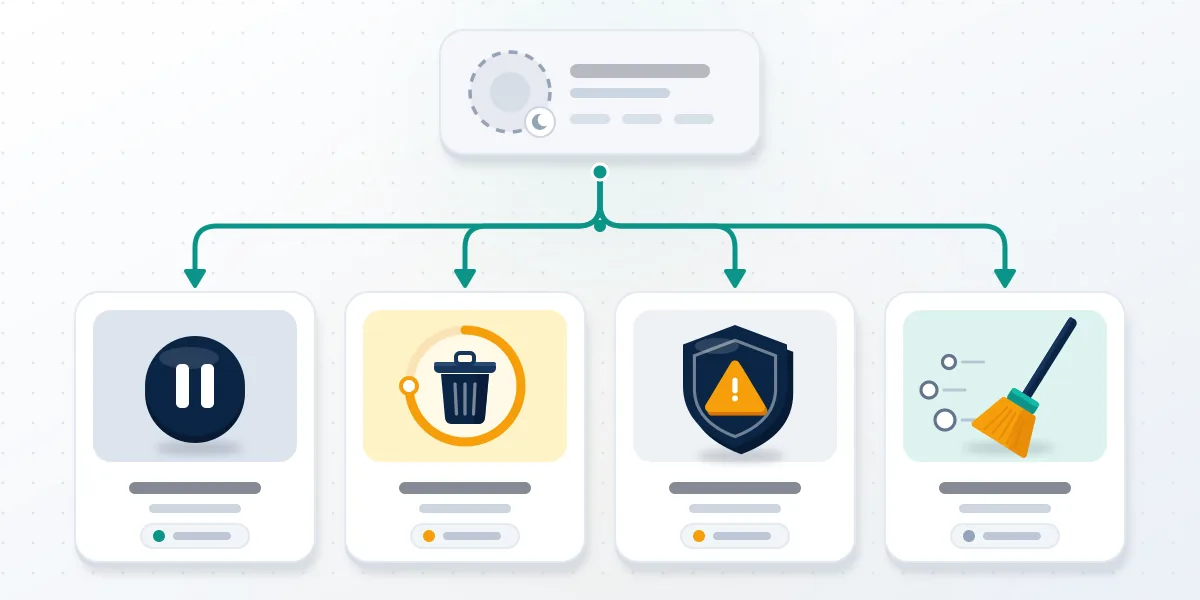
Deactivation is a switch only the owner can flip, so Instagram does not deactivate inactive accounts. A logged-out visit to a missing profile shows one notice, "Profile isn't available," and that screen hides five different states.
| State | Who set it | Username | Way back |
|---|---|---|---|
| Temporarily deactivated | The owner | Stays with the account | Log back in |
| Deletion requested | The owner | Stays during the 30 days | Log in before day 30 |
| Deleted | The owner | Free once deletion ends, unless someone takes it | None; sign up again |
| Disabled or suspended | Instagram, for a breach | Held while the decision stands | Appeal from the notice |
| Memorialized | Instagram, after a family request | Frozen | Removal request by family |
Match the row to what you remember doing. If you paused the profile yourself, the guide on how to disable Instagram covers the switch, which Instagram allows "once a week" (Instagram Help Center, October 2026). The walkthrough on how to delete my old Instagram account handles the reverse problem, where you want it gone and can't log in. That deletion clock is the likeliest source of the "deleted after 90 days of inactivity" claim. Instagram's Terms of Use say deletion begins "no more than 30 days after your request" and "may take up to 90 days" to finish, which is the timeline for an account its owner chose to close. Instagram inactive account deletion, as a rule of its own, appears in no help page we have read, and the Terms never mention idle time at all.
When a client says an account was "deleted for inactivity," Your Reputation Solution checks the owner's own records before the public URL: the login email, any security notice from Instagram, and Settings > Account Status if the owner can still sign in. Read in that order, those records tell a pause from a ban without anyone sharing a password.
Disabled accounts trace to a breach the owner may not have noticed. Repeat intellectual-property complaints are one documented cause, so check whether you can get copyrighted on Instagram before blaming neglect. Memorialized profiles go quiet for a sadder reason, and the steps for how to report someone's death on Facebook follow the same Meta process.
Why old accounts disappear anyway: purges, hijacks and rumours
Old accounts disappear because idleness makes them easy to fake or steal, not because a clock runs out. Spam and fake profiles get removed in waves, and a dormant account with a reused password is exactly what account thieves look for.
Did Instagram delete inactive accounts in bulk before? It deleted spam ones. In December 2014 Instagram said it was "deleting these accounts forever, so they will no longer be included in follower accounts," and Justin Bieber lost 3.5 million followers while Kim Kardashian lost 1.3 million (The Drum, December 2014). So does Instagram purge inactive accounts? It purges accounts it judges fake, and a profile with no photo, no posts and no login for years can look fake to an automated system. Does Instagram remove inactive accounts that belong to a real, rule-following person? Not under any rule it has published. The May 2026 follower drop fits the same pattern: regional outlets reported celebrity accounts losing millions of followers after an automated cleanup and quoted a Meta spokesperson saying "active followers remain unaffected" (The Peninsula, May 8, 2026). Anyone typing "instagram delete inactive accounts" that week was watching a follower count shrink, not an account being deleted.
Once Your Reputation Solution opens a dormant account that "vanished," the first question is whether someone else touched it. A new email on file, a renamed handle or posts the owner never made point to a takeover, and Instagram's hacked-account route applies instead of any inactivity theory.
Year-stamped searches need the same care. Checking "does instagram delete inactive accounts 2025" turns up no new rule; the help page we read on October 7, 2026 still names no deadline. Forum queries such as "does instagram delete inactive accounts reddit" look for personal stories, and one vanished account can't prove a rule the help center never wrote.
Hijacks are the bigger risk. An old login with a leaked password can be renamed, emptied and used to message your former followers, a pattern also seen in Facebook sextortion attempts. Ban sellers push the opposite myth, that enough reports remove any account, yet no platform publishes how many reports to get banned on TikTok, Instagram included.
Can Instagram take your username while you're away?
Yes, in narrow cases, and inactivity isn't one of them. Instagram's Terms of Use say it may change a username "if we believe that it is appropriate or necessary (for example, if it infringes someone's intellectual property or impersonates another user)." That clause is the instagram username policy on removal: trademarks and impersonation, not idleness.
Nothing in the instagram inactive username policy adds a third reason. Usernames are first-come, first-served and "may not be reserved," a trademark inside someone's handle isn't automatically infringement, and the Terms ban buying, selling or transferring any part of an account, username included. So can Instagram take your username? After a valid complaint, usually a trademark report sent through the forms that return an Instagram report number by email. Where someone poses as you under a lookalike handle, the impersonation route can delete a fake Instagram account and leave yours alone. For a genuine trademark or impersonation case, Your Reputation Solution prepares the report with the evidence Instagram asks for; Instagram alone decides whether a username moves. Sellers of "inactive username claims" are the trap in this corner. Nobody outside Meta can release a handle, and a service that wants your password, or a fee to "pull" a name off a quiet account, is selling something Instagram's Terms prohibit.
Wanting someone else's dormant name is a separate job; the guide asking can you claim an Instagram username has those steps. Waiting for an idle holder to be deleted isn't a plan when no deletion date exists.
Keeping an old account alive, or closing it on your own terms
Logging in now and then is all the inactive policy asks for. Does Instagram delete old inactive accounts faster than new ones? Its help center sets no age rule, so a 2012 account and a 2024 account sit under the same terms. Alive isn't the same as safe, though. Confirm that the email and phone under Accounts Center > Personal details > Contact info still reach you, then turn on two-factor authentication under Password and security. Open Account Status in Settings for removed posts or restrictions you never saw, and end any session you don't recognize under "Where you're logged in." Those four checks fit in one sitting, and they are the details Instagram's recovery flow leans on if the account is ever taken. Old school and work addresses lapse without notice, which is why the email check comes first.
Locked out of an old Instagram account you want closed, or watching a dormant one used against you? Your Reputation Solution reviews the case for free and names the route Instagram will actually accept. Talk to the team; nobody there will ask for your password.
If you're finished with the account, closing it yourself beats leaving it for a thief. Each app has its own steps: you can delete an old Twitter account even without the login, and delete a Snapchat account only from its web page.
On Meta's and Google's side, deleting an account on Facebook runs through the same Accounts Center, while you can delete a YouTube account and keep the Google account behind it.
Short-video profiles age the same way, and how to delete a TikTok account covers TikTok's own 30-day hold. Once any profile is gone, the steps to remove a page from Google search results clear a cached copy that still ranks.
When the dormant account isn't yours
Report a dormant account for what it is doing right now, not for being idle, because idleness alone breaks no rule. That matters when an old profile impersonates you, reposts your photos or wakes up to harass you, and each problem has its own route. Impersonation reports need proof of identity, usually a photo of a government ID, or business documents for a brand. Copied photos and logos go through Instagram's intellectual-property forms, which only the rights holder or an authorized agent can file. Harassment needs a pattern, so screenshot the messages or posts with their dates before you report anything. What Your Reputation Solution won't do is mass-report a quiet account, buy or "release" a username, or promise that Instagram deletes anything; platform decisions stay with the platform, and the service limits spell out the rest.
Start with the profile itself. Report an Instagram account for impersonation from its three-dot menu, then flag individual posts, since a reported Instagram post is reviewed on its own.
If you accidentally reported a post on Instagram, only IP reports can be withdrawn. And if you report someone on Instagram, will they know? Instagram's answer: "your report is anonymous, except if you're reporting an intellectual property infringement."
An impostor may copy you on more than one app. Reporting a post on Facebook is anonymous for the same non-IP report types, and you can report someone on TikTok from the profile's share arrow.
Snapchat clones follow their own process, so read how to get a Snapchat account taken down before you file.
An old YouTube channel posting about you falls under the YouTube harassment policy, and you can block someone on YouTube while that report is reviewed.