What does it mean to take down a Snapchat account?
Taking down a Snapchat account means asking Snapchat to remove, lock, or permanently terminate an account — or a single Snap, Story, or Spotlight post on it — because it breaks the Snapchat Community Guidelines, the Terms of Service, or the law. As of July 2026, only Snapchat can carry out a takedown. No user can delete another person's account directly; you submit a report or a legal complaint, and a human reviewer or an automated system decides. One rule shapes everything that follows: Snapchat acts on a confirmed violation of its rules, not on how many people tap "Report." The phrase "how to take down a Snapchat account" actually covers several separate actions — reporting a harassing account, reporting one abusive Snap or Story, filing an impersonation claim, recovering a hacked account, and escalating illegal material such as threats or non-consensual images. Each has its own route, its own evidence bar, and its own realistic outcome.
One quick fork before you start. If you searched how to take down a Snapchat account because you want to remove your own account, that is a different task — use Snapchat's official account deletion page instead; this guide is about getting someone else's abusive account or content removed. The team behind YRS has handled hundreds of platform-enforcement and content-removal cases since January 2024 (our internal records as of July 2026), and roughly one in three people who ask how to take down a Snapchat account actually need to recover their own hijacked account instead. So get the category right first — the same evidence-first method drives our guide to how to take down a social account the right way on X, and the wrong category is the most common reason a genuine report stalls.
How to get a Snapchat account taken down: the official report routes
There are two official ways to get a Snapchat account taken down, and matching the route to the violation is what makes a report actionable. The fastest is in the app itself. Menu labels shift slightly between app versions, but the flow as of July 2026 is:
- Open the profile of the account you want to report, or press and hold their name in your chat list.
- Tap the three-dot menu (More) in the top-right, then Report.
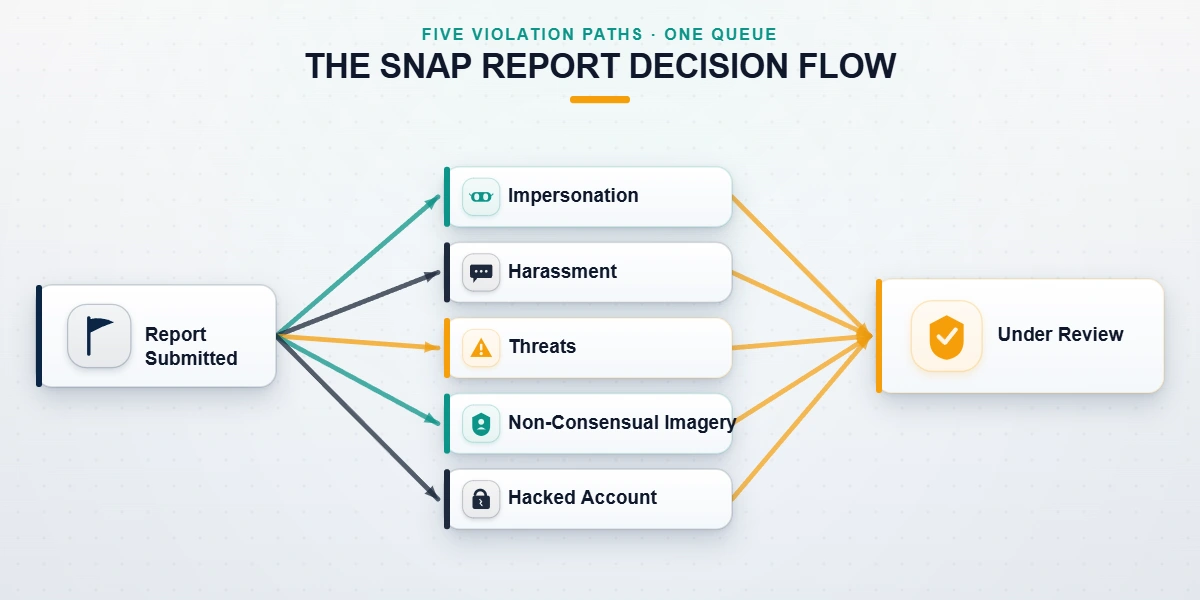
- Choose the reason that fits — impersonation, harassment or bullying, threats or violence, nudity or sexual content, a scam, or "they're pretending to be someone."
- Add any detail Snapchat asks for and submit. Reports route to Snapchat's Trust & Safety reviewers, not to the person you reported.
When you can't see the account — because it blocked you, or is impersonating you to people you don't follow — use the web instead. Snapchat's Support site has dedicated forms for impersonation, safety concerns, and illegal content that don't require you to be friends with the account, or even to have the app open. This is the same reporting logic behind getting an Instagram account taken down: a specific, evidenced violation filed under the correct category, not a pile of complaints. Report volume is not the lever; a provable breach is.
How to take down a Snapchat story or a single Snap
You don't always need to remove a whole account — sometimes the problem is one Story or one Snap. To take down a Snapchat story that targets, harasses, or exposes you, press and hold the Story or the individual Snap, tap the flag / Report icon, and choose the reason; the same press-and-hold gesture reports a Spotlight post or a Snap inside a group. Reporting one Story is not the same as taking down the account behind it: a single flagged Story might be removed while the account stays live, and only a pattern of violations — or one severe one — leads to a full account takedown. If you're unsure how to take down a Snapchat story versus the whole profile, start narrow, report the specific Snap, and escalate to an account report only if the abuse continues.
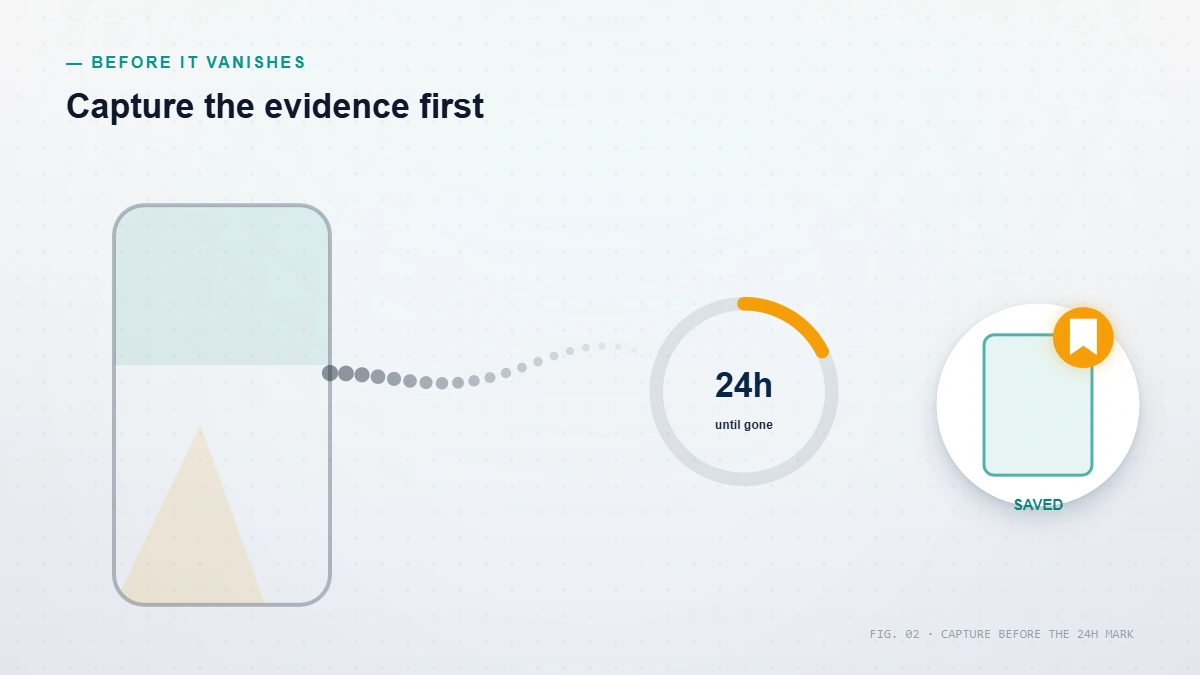
There's a catch unique to Snapchat: content is ephemeral. A Story disappears after 24 hours and a Snap can vanish in seconds, so the evidence you need for a credible report can be gone before you file it. Before you report, capture it — screenshot the Snap or Story, photograph the screen with a second device if a screenshot would alert the sender, and note the username, the date, and the time. Preserving proof of a disappearing post is the single most important step in learning how to take down a story on Snapchat, because reviewers act on what you can show them, not on what you describe. For fast-moving abuse, our guide to getting content taken down immediately on TikTok uses the same capture-first discipline.
Which Snapchat violations can be taken down — and which can't
A successful takedown starts with knowing what Snapchat will actually act on. Snapchat removes content and accounts that break its rules on abuse and illegal content, including:
- Impersonation of you, your brand, or a public figure.
- Harassment, bullying, and threats aimed at a person.
- Non-consensual intimate imagery (NCII), and any sexual content involving a minor.
- Fraud, scams, and phishing — fake giveaways, sextortion, investment cons.
- Hate speech and incitement to violence.
- Hacked-account abuse, where someone took over an account and is using it against its owner.
What generally stays up is just as important, because misjudging it is how people waste weeks on reports that go nowhere. Lawful opinion, criticism, satire, parody, unflattering-but-true statements, and ordinary commentary about a public figure are not policy violations, and no legitimate service can force their removal. Snapchat is also strict about who may file certain reports: an impersonation claim is generally accepted only from the person being impersonated, or their parent or guardian — not from an unrelated third party — so you usually cannot get an account taken down on someone else's behalf. Being honest about that boundary is part of what we will and won't take on; a service that promises to delete lawful speech, or to brigade an account you simply dislike, is describing a scam rather than a capability.
How to report a hacked or impersonating Snapchat account
Two of the most common reasons people search for how to get a Snapchat account taken down are a hijacked account and an impersonator — and Snapchat treats them very differently. If your own account was taken over, don't try to remove it; recover it. Use Snapchat's "My account is compromised" flow to reset access, then lock it down with two-factor authentication. The recover-and-harden sequence is nearly identical across platforms — our account-recovery process for a hacked TikTok and our Instagram hacked-account recovery guide walk through the same steps of proving ownership, resetting credentials, and closing the door behind you so the intruder can't walk back in.
If instead someone is impersonating you — a fake profile using your name, photos, or brand — file an impersonation report through the app or Snapchat's web form, and be ready to prove who you are. Because Snapchat generally accepts impersonation reports only from the real person or their guardian, the strongest submissions arrive with identity verification built in: a photo of your ID, a link to your authentic profile, and a plain, factual description of the fake account and the harm it is doing. Our Trust & Safety specialists — several of them former platform reviewers — assemble exactly that evidence pack before filing, because a complete, verifiable report is reviewed far faster than a vague one. For a business, that same pack is what turns a brand-impersonation complaint into an actioned removal.
What happens after you report — timing, outcomes, and the "report volume" myth
After you report, Snapchat reviews the case confidentially — the account you reported is not told who filed it. In our experience, clear-cut cases are often reviewed within about 24 hours, though Snapchat publishes no guaranteed timeline and complex or borderline cases take longer. The possible outcomes fall on a ladder: a warning or strike for a first or minor violation, a temporary lock that forces the user to verify or acknowledge the rules, and a permanent termination for severe or repeated abuse. Reporting a single Snap does not automatically jump to the top of that ladder — the outcome tracks the severity of the violation and the strength of the evidence, which is exactly why the capture step above matters so much.
Here is the myth worth killing, because scammers profit from it: the number of reports does not decide the outcome. Snapchat acts when a violation is confirmed, not when some threshold of complaints is crossed. A hundred coordinated reports against an account that breaks no rule remove nothing; one well-documented report of a genuine violation can end an account on its own. That is how enforcement works on every major platform — the same evidence-over-volume principle governs getting someone's WhatsApp account banned, too. And if a legitimate report is denied, the fix is escalation, not repetition: refile through Snapchat's Support site with tighter evidence and the exact usernames and timestamps, and for anything criminal, use the routes below. Filing the same report ten times does not move the queue and can look like abuse.
Non-consensual images and urgent harm: StopNCII, Take It Down, and the police
Some abuse is too serious to leave to an in-app report alone, and Snapchat is not the only lever you have. If someone is sharing — or threatening to share — intimate images of you, two free services get ahead of the spread. For adults, StopNCII.org creates a digital fingerprint (a "hash") of your images on your own device and shares only that hash with participating platforms, including Snapchat, so copies can be detected and blocked without you ever uploading the photo itself. For anyone under 18, the Take It Down service run by the U.S. National Center for Missing & Exploited Children does the same. Both work alongside a direct Snapchat report, not instead of it, and neither asks for money.
For threats, extortion, stalking, or any sexual content involving a minor, treat it as a crime, not merely a policy breach. Report it to Snapchat under the relevant category, preserve every piece of evidence, and contact law enforcement — a police report can carry weight a user report cannot, and Snapchat responds to valid legal process. Snapchat's own Safety & Reporting resources and its in-app "Report a Safety Concern" flow route these cases to specialized reviewers. This is where preserving that ephemeral evidence pays off twice over: timestamps, usernames, and saved copies turn a "he-said" complaint into an actionable one, for both Snapchat and the police. If a scam or sextortion attempt is involved, you can also file a complaint with the FTC at reportfraud.ftc.gov.
What a legitimate Snapchat takedown service will and won't do
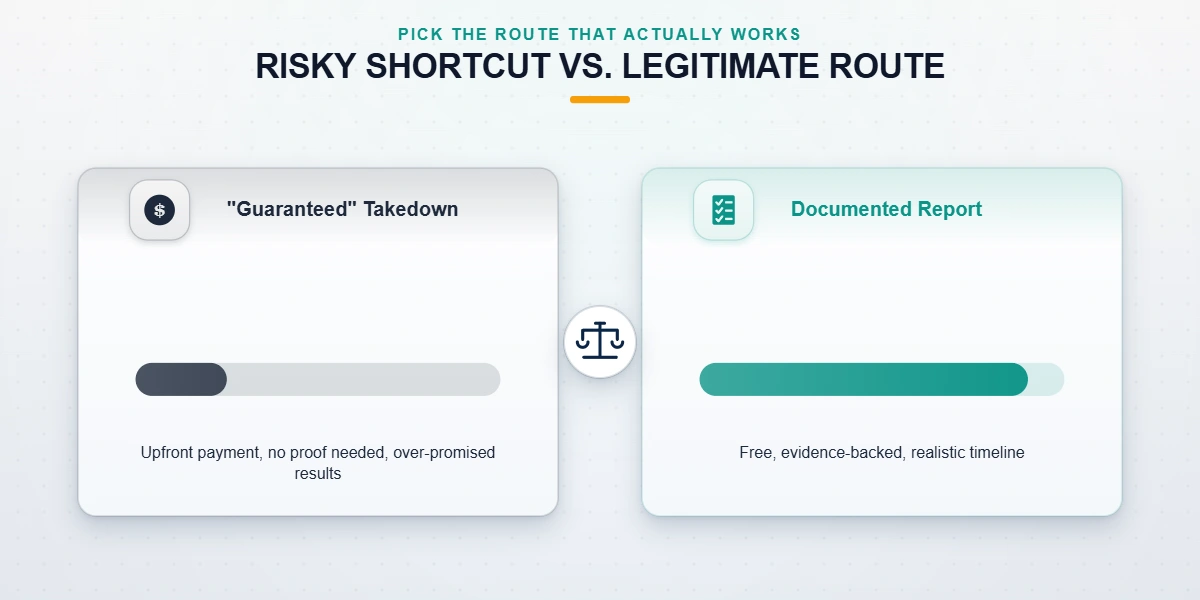
This niche is crawling with scams, so here is exactly where the line sits. A legitimate Snapchat takedown service will never ask for your password or a login code — reporting and removal never require them, and anyone who asks is phishing your account. It will not sell "pay-to-remove" guarantees: no amount of money makes Snapchat delete content that breaks no rule, and anyone charging for a "guaranteed instant ban" is either reselling the free report form or simply taking your money. It will not mass-report or file false claims against an account you dislike, because coordinated false reporting is itself abuse of Snapchat's tools and can get the reporting accounts actioned instead. And it will never file a fraudulent impersonation or copyright claim — a false report made under penalty is deception, not a service.
Not sure whether your case is actually removable — or which route fits? Talk to our team for a free 60-minute case review. We'll tell you plainly what Snapchat will act on, what it won't, and exactly what evidence to gather — before you spend a cent.
What a real service actually does is unglamorous: it identifies the correct violation category, builds the evidence pack reviewers need, files through the official channels above, and — for abuse that spans several apps — coordinates removal and monitoring together. That work is led by our account-recovery and takedown specialists, several of them former Meta and TikTok Trust & Safety reviewers, and it starts with an honest assessment. We don't guarantee removal, because nobody legitimately can — we guarantee a sober, evidence-based read on whether your case is removable at all.
Is Snapchat being taken down? Clearing up the rumors
If you arrived here after searching is Snapchat being taken down, you may be asking something different from the rest of this guide: whether the Snapchat app itself is shutting down. It isn't. As of July 2026, Snapchat is a public company with more than 400 million daily active users (Snap Inc. investor reporting, 2025) and no announced shutdown, so Snapchat being taken down as a platform is not on the table. The recurring "is Snapchat getting taken down" panic almost always traces back to a viral hoax — usually a fake "your account will be suspended" broadcast that spreads screenshot to screenshot, which is also the source of every "snapchat getting taken down" wave that resurfaces each year. Whatever the phrasing — is Snapchat going to be taken down, or simply snapchat taken down — the answer today is the same: the app is operating normally, and these rumors are not a reason to worry about your own account.
One more unrelated search worth untangling: can you take a snapchat video without holding it down? Yes — but that is a recording question, not a reporting one. Snapchat's hands-free capture lets you lock the shutter so you don't have to keep the button pressed, and it has nothing to do with removing anyone's account. We only mention "can you take a snapchat video without holding it down" because it shares the "take" and "down" wording with the takedown searches above; if that camera tip is what brought you here, the report routes won't help you. For the genuine article — removing a harmful account or Story — the official routes higher up this page are the place to start, and you can compare how the process differs on other apps in our platform takedown guides.