
What a twitter account removal service actually does
A twitter account removal service is a paid specialist that classifies a violation, assembles the supporting evidence, and files the takedown through X's own reporting and legal channels on your behalf. The service deletes nothing. X does. What you are paying for is accuracy at the filing stage: choosing the correct form, proving the specific facts that form asks for, and escalating properly when the first review comes back "no violation found."
That distinction decides most outcomes in this market. Every legitimate provider files through the same public forms you can reach yourself, which means nobody is selling access. They are selling classification judgement and persistence. A report filed under the wrong policy is not a weak report; it is a report the reviewer is required to close, because the thing you described is not the thing that policy governs. Impersonation filed as harassment gets closed. Harassment filed as spam gets closed. A copyright claim filed through the in-app report button instead of the formal notice route gets closed. None of those closures mean the content was acceptable. They mean the question was asked in a form the answer could not fit.
This is also why "we already reported it and nothing happened" is such a weak signal about whether a case is winnable. Across the twitter content removal cases that reached us in the first half of 2026, a clear majority arrived with at least one prior report already filed and declined (our internal case records, January–July 2026). In most of them the underlying violation was real and the original filing had simply gone to the wrong queue with the wrong evidence attached. A prior decline tells you how the last report was written. It does not tell you whether the content breaches X's rules, and treating the two as the same thing is how people give up on cases that would have succeeded on the second, better-built attempt.
Marcus Okafor, who directs our reputation practice, puts the job in one line: a reviewer gives your case seconds, not minutes, and decides on what is visible inside those seconds. Everything you want them to conclude has to be sitting in the report itself. They will not go looking.
Worth naming what sits outside this service, because the gap between the two is where the money gets wasted. There is no back channel at X, no contact who owes anyone a favour, no panel that deletes posts on request. Anyone describing their capability in those terms is describing something that does not exist. Our team covers the honest limits of this work in more depth in our breakdown of what a Twitter ban service really does.
Five routes X will act on, and one that runs outside X
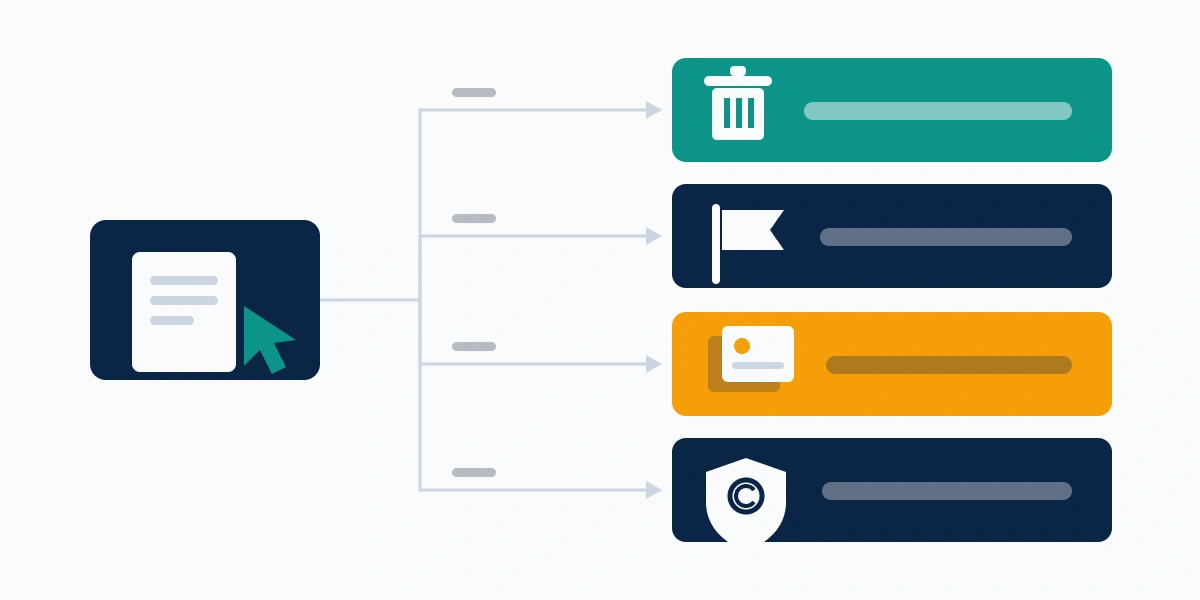
Six situations share the word "removal," and picking the wrong one costs days. Find your row before you pay anyone.
| What you want gone | Route | Who decides | Realistic timeline |
|---|---|---|---|
| Your own post or account | Delete or deactivate it in-app | You | Instant |
| An account pretending to be you or your brand | Authenticity / impersonation report | X | 2 days to 3 weeks |
| Your copyrighted image, video, or text reposted | Formal DMCA notice | X | 1 to 10 days |
| Your registered mark used to pass off as you | Trademark complaint (separate form) | X | 1 to 4 weeks |
| Your private information, address, or intimate imagery | Private information report | X | Hours to several days |
| A false factual claim that a court has ruled on | Court order served on X | A judge, then X | Months |
Row one is free and takes seconds, and it is where a surprising share of this traffic belongs. Anyone searching for twitter post removal or a tweet removal service while wanting their own post gone is one long-press away from finishing the job. Rows two through five are the ones a specialist genuinely changes, because each has its own evidence standard and its own form. Row six is a legal process with a legal budget attached.
One disambiguation saves people real money here. Searches for fake twitter account removal and delete fake twitter account return two completely unrelated product categories, and the overlap in wording hides how different they are. Most of the top results sell bot-and-follower cleanup — tools that scrub inauthentic followers from your account, usually by the thousand, usually on a subscription. That is not the same job as removing an impersonator who is pretending to be you, and the tools that do the first cannot touch the second. They operate on your follower list, which you control. An impersonator sits on their own account, which you do not.
The practical test takes a second. If the thing bothering you has a face, a handle, and a posting history, you need a report filed against it, not a cleanup tool pointed at yourself. People arriving from a delete fake twitter account search almost always mean the former and end up buying the latter, then wonder why nothing changed. Fake twitter account removal in the sense that matters here, an impersonator gone, runs through the authenticity route below, and no subscription product reaches it.
How to take down a fake twitter account pretending to be me
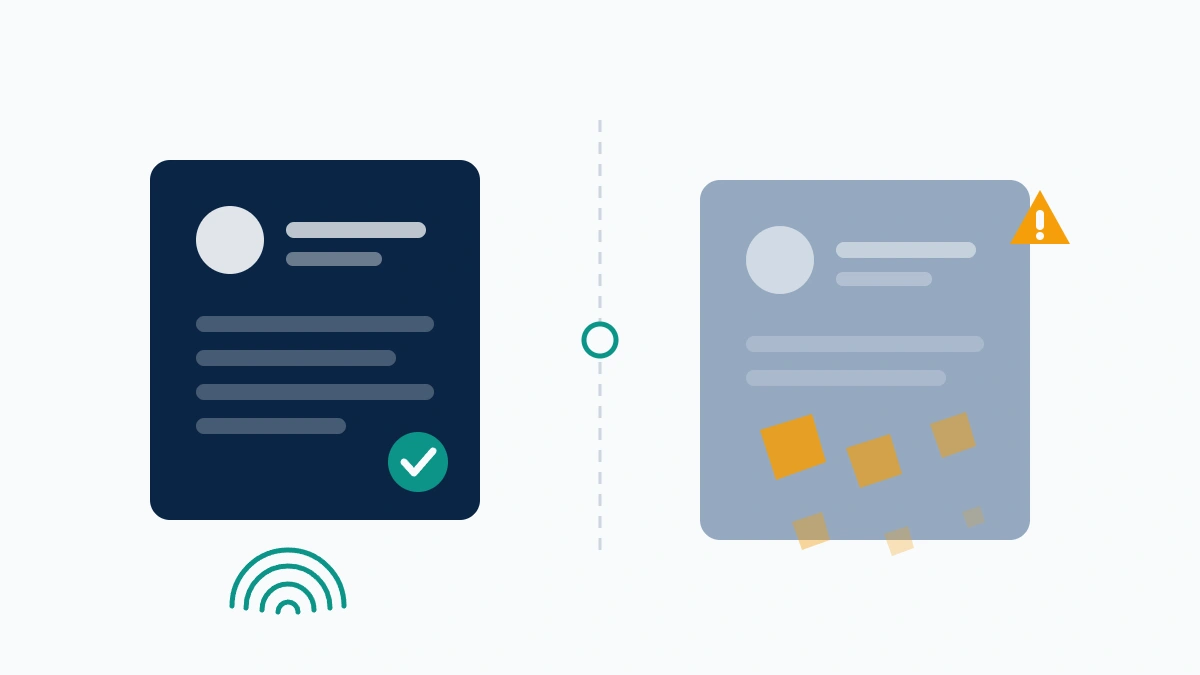
Impersonation is the highest-success category in this entire cluster, and the reason is structural: it turns on identity, and identity is provable. You either are the person depicted or you are not, and a government ID settles it in one attachment. Compare that with a harassment case, where the reviewer has to weigh context, or a defamation case, where somebody eventually has to decide what is true. Twitter impersonation removal asks a question with a clean answer.
X governs this under its authenticity policy, and the filing route is the dedicated impersonation form rather than the in-app report button. Use the form. The in-app path routes into a general queue; the form routes into the team that handles identity.
The PCF rule that decides more cases than people expect
Since 10 April 2025, X requires every Parody, Commentary, and Fan account to carry a qualifying word — "parody," "fake," "fan," or "commentary" — at the beginning of the display name, and forbids using an avatar identical to the entity being depicted (Social Media Today, April 2025; X profile labels).
That rule is the single most useful lever available to anyone trying to remove impersonator on twitter accounts that hide behind a satire defence. The keyword has to lead the name, because names truncate in feeds — "Jane Doe (parody)" fails the rule, "Parody Jane Doe" passes it. So when an account claims parody but buries the word at the end, or runs your exact profile photo, it is out of compliance on a mechanical, checkable basis. You are no longer arguing about whether the joke is funny. You are pointing at a formatting requirement it does not meet, and that is a far easier thing for a reviewer to confirm in seconds.
What an authenticity report actually needs
Four things, and reports missing any of them stall:
- The exact profile URL of the impersonating account, not a screenshot of it.
- A government-issued photo ID matching the identity being impersonated.
- A link to your own authentic account or website, establishing which one is real.
- A short factual statement of the harm — messages sent in your name, money solicited, clients confused.
Point four carries more weight than most people give it. "This account is fake" is a claim. "This account direct-messaged four of my clients asking for payment, and here are the timestamps" is evidence of harm, which is what moves a borderline case.
Two habits separate reports that succeed from reports that stall, and neither costs anything. Capture your evidence before you file, because impersonators delete posts once they notice a report has landed, and a case built on links to material that no longer exists is a case the reviewer closes. Screenshot the profile, the bio, the follower count, and every harmful post, with the URL and timestamp visible in frame. Then file once and wait. The instinct to report fake x account profiles repeatedly, or to ask friends to pile on, works against you: duplicate reports on one target get consolidated rather than weighted, and coordinated volume is itself something X enforces against. One well-evidenced report beats fifty thin ones, every time, and the fifty carry a risk the one does not.
Brand cases run on a different track, and conflating them costs weeks. A twitter account removal service for brand impersonation should be filing on trademark grounds where a registered mark exists, using X's separate trademark policy form, because a company cannot supply a passport. Personal identity and corporate identity are proven with different documents, and the forms are not interchangeable. If the impersonator has also grabbed a handle close to yours, our guide to reclaiming a dormant X handle covers what happens to the username afterwards.
Twitter copyright removal: the notice that survives a counter-notice
Twitter copyright removal is the fastest route on this page when it genuinely applies, and the most abused when it does not. X processes formal notices under its copyright policy through the dedicated DMCA form, and content coming down within a day or two is common — far quicker than any behavioural report.
The catch is the counter-notice. Whoever you filed against can dispute it, and if they do, the material can be restored while the two of you argue. A notice built properly survives that step; a notice built on a shaky ownership claim collapses.
What a valid notice has to contain
You are signing a statement under penalty of perjury, so the accuracy bar is real. The notice needs identification of the copyrighted work, the direct URL of each infringing post, your contact details including a physical address, a good-faith statement that the use is unauthorised, and your signature as owner or authorised agent (US Copyright Office).
Two failure modes account for most rejected notices we see. The first is filing over material you do not own. A photographer's shot of you belongs to the photographer, not to you, and a screenshot of someone else's tweet belongs to them. The second is using copyright as a lever against criticism. Filing a knowingly false notice exposes you to liability for damages and attorney's fees, and it is the one route on this page where getting it wrong can cost you money rather than just time. We decline these requests, and any provider that does not is exposing you to the risk while collecting the fee. The same mechanics apply across platforms, which is why our YouTube takedown guide spends most of its length on ownership rather than on filing.
Remove defamatory tweet requests: where the line actually falls
This is where honest providers and scam providers part company, and where the largest share of inbound requests arrives misclassified.
The law does not protect you from being criticised. It protects you from provably false statements of fact presented as fact. That distinction, opinion versus a verifiable false assertion, is the hinge the entire category turns on (Cornell Legal Information Institute). "This company is badly run and I regret hiring them" is opinion, however much it stings. "This company lost its licence in March" is a factual claim, and if the licence was never lost, it is actionable.
What this means for delete negative tweets requests
Most of them cannot be actioned, and no amount of money changes that.
A negative review is not defamation. An unflattering opinion is not defamation. A screenshot of something you genuinely said is not defamation. When someone asks for a service to delete defamatory tweets about my business, the first job is separating the handful of posts that assert checkable falsehoods from the majority that are simply unwelcome. In our own casework, roughly 30% of inbound defamation enquiries contain at least one post we can act on; the rest are protected speech, criticism, or accurate reporting the client wishes were not public (our internal case records, January–July 2026).
Telling clients that is the job. A provider who agrees to remove all of it either intends to file dishonest reports in your name, or intends to take the money and report back that X declined.
Not sure which category yours falls into? Send us the URLs and our team will tell you which posts are actionable and which are not, before any money changes hands. Request a free case review — if there is nothing here worth filing, we will say so.
What we will not file
We do not file impersonation reports against accounts that are clearly labelled parody. We do not file copyright notices over material the client does not own. We do not file harassment reports against journalists or reviewers for publishing accurate criticism. And we do not coordinate mass reporting, because volume does not persuade X's reviewers and it exposes the person paying for it to enforcement of their own — a mechanism our team documented in detail in what a mass report campaign does to the buyer. Our full scope limits sit in the service disclaimer.
Why a guaranteed twitter takedown is the clearest scam signal in this market
No third party can guarantee a twitter takedown, because no third party makes the decision. X does, under policies X writes and applies. A vendor promising a guaranteed outcome is promising something they do not control.
So the promise itself is diagnostic. When you see it, you are looking at one of three things: a provider who plans to file dishonest reports in your name, a provider who will take payment and blame X, or a refund policy dressed up as a capability. None of the three is worth buying. The tell is easy to check before any money moves — ask which specific X form the provider intends to file through, and what evidence they need from you. A real specialist answers immediately and in detail, because the answer is their actual method. A scam gets vague, because there is no method behind it.
Two other red lines are worth stating plainly. Nobody legitimate ever asks for your X password or a two-factor code; there is no filing route that requires either, and a request for them is an account takeover in progress. And nobody legitimate charges only on a pay-to-remove basis with no case review first, because the review is what determines whether the case exists at all.
Four checks settle most of it before you send money, and all four can be done on the page you already have open. Does the provider name the specific form they will file through, or only "our channels"? Do they tell you what they cannot do, unprompted? Do they publish scope limits anywhere you can read without asking? And do they price the assessment separately from the outcome? A provider who answers those four cleanly may still fail to get your content removed, because X may simply disagree — but they will have filed a real case, and you will know what happened to it. That is the actual product. Everything else in this market is packaging.
What hiring a twitter removal expert actually buys
Not access. Not speed at X's end. What you buy is the elimination of the failure modes above, and the persistence to work an escalation that most people abandon after the first automated decline.
| Case type | Typical first response | Realistic resolution | Success rate |
|---|---|---|---|
| Impersonation with ID proof | 24–72 hours | 2 days to 3 weeks | High |
| Copyright (valid ownership) | 24–48 hours | 1 to 10 days | High |
| Private information / doxxing | Hours to 2 days | 1 to 7 days | High |
| Trademark / brand impersonation | 3–7 days | 1 to 4 weeks | Moderate |
| Harassment without prior reports | 3–10 days | 2 to 6 weeks | Moderate |
| Defamation without a court order | n/a | Rarely actionable at X | Low |
| Search suppression after removal fails | n/a | 90 to 180 days | Varies |
Anyone advertising same-day results across every row is describing X's copyright queue and quietly implying it applies everywhere. It does not.
People searching hire twitter removal expert are usually standing at one of two very different points, and the honest advice diverges sharply between them. If your case is row one, two, or three above and you have the evidence, file it yourself. The forms are public, the process is documented, and our step-by-step walkthrough of how to take down a Twitter account covers each route in order. Pay someone when the first filing has already been declined, when the account is part of a coordinated pattern across several platforms, when a business is losing money weekly, or when you simply cannot face doing it. Those are the situations where an agency to take down malicious tweets quickly earns its fee — usually by escalating correctly rather than by filing faster. Anyone looking to hire expert to delete fake x profile cases specifically should ask how many they filed last quarter and what the decline rate was. The credentials behind our own desk are listed on our team page, and the wider catalogue sits under services.

When the post stays up: the layer nobody explains
Sometimes a twitter removal request is declined and stays declined. The post is lawful, X has reviewed it twice, and no further filing will change that. This is the point at which most guides stop, and it is the point at which the actual problem — people finding it — usually remains completely unsolved.
Removal and visibility are separate problems with separate tools. A tweet that survives every report can still fall out of the first page of search results for your name, because ranking is governed by Google, not by X. Suppression works by building and strengthening legitimate properties you control until they outrank the post: your own site, professional profiles, interviews, credible coverage. It is slow and it is not deletion. In our experience the meaningful movement lands somewhere between 90 and 180 days, and it does not work at all on high-authority news domains, where the honest answer is that the article stays where it is.
There is a sequencing trap worth naming here, because it costs people months. The instinct after a declined report is to file again, harder: a second report, then a third, then a different friend's account filing the same thing. Marcus's read after twelve years of this: repeat filings on settled cases do not just fail, they actively consume the window in which suppression would have been working. X has already answered. The second and third reports change nothing about the post, while the search result quietly accumulates the age and link signals that make it harder to outrank later. The decision that matters is not how hard to push on the takedown. It is how quickly you accept a genuine "no" and switch to the other tool.
Being clear about this is part of the service rather than a footnote to it. A client who understands that a lawful post cannot be removed, but that its position in search results can often be changed, makes a better decision than one who spends six months paying for takedowns that were never going to be filed successfully. Twitter harassment takedown work and search suppression solve different halves of the same worry, and the two are worth running in the right order — takedown first, because it is faster and cheaper when it applies, and suppression only for what genuinely survives it. If a fake account has already been removed but the damage spread to other platforms, our guides to Instagram takedowns and Facebook account removals cover the same routing logic for those networks, and our removal service breakdown for Instagram posts and reels maps the equivalent forms.