Can you delete a Telegram account, and what disappears when you do?
Yes. It is free, it needs no support ticket, and nobody asks you why.
The shape of the deletion is what catches people out. Telegram's FAQ states the consequence without softening it: "Termination of a Telegram account is irreversible. If you sign up again, you will appear as a new user and will not get your history, contacts or groups back." No thirty-day grace window sits behind that button. No archive. No support agent holding a restore key.
Pause there, because the platform most readers are silently comparing against behaves in the opposite way. TikTok parks a deleted account for thirty days and cancels the whole process if you log in once during them. Telegram gives you a confirmation dialog, then nothing.
| What deletion destroys | What it leaves standing |
|---|---|
| Your messages and media in the Telegram cloud | The copies of those messages on your contacts' devices |
| Your contact list | Groups and channels you created, now without a creator |
| Your username, released back to the pool | The admin rights of everyone you promoted |
| Your account's link to the phone number | App Store or Google Play billing for Telegram Premium |
Your Reputation Solution is a recovery and reputation practice rather than a deletion desk, which shapes what follows: both routes below are yours to run for free, and the only part where anyone needs outside help is the diagnosis further down this page.
That right-hand column holds most of the confusion, and it deserves plain language. Deleting your account does not reach into other people's phones. Every message you sent is a copy they hold, and it survives your exit; the sender label changes to Deleted Account and the words stay where they are. Groups and channels work the same way. Telegram's FAQ describes what you built as "orphaned and left without a creator but admins retain their rights", so a channel with a second admin keeps running under that person, and a channel with no other admin keeps running under nobody at all. Nobody can close, rename or reclaim it afterwards, because the account with authority to do any of that has stopped existing. Anyone planning to delete and take their community with them has the order backwards.
Your username returns to circulation, which carries a consequence worth weighing. A handle people associate with you becomes available to whoever registers it next, and Telegram runs no waiting period on released usernames the way some platforms do. If your name carries weight in a niche, releasing it is not a neutral act, and the remedy afterwards is the slow one: reporting the impersonation once it appears, on whichever platform the copy shows up. Businesses feel this hardest, since a support handle customers have saved for years turns into an unclaimed address the moment the account closes. Prevention costs a minute here. The cure costs weeks.
One group should stop before going further. People arriving at can i delete a telegram account, telegram account removal or how to shut down telegram account after being locked out are describing a different problem, because deletion needs access you no longer have. Your Reputation Solution sorts those cases apart before any other question, and the next two sections explain why the difference is mechanical rather than a matter of preference.
The Telegram account deletion page, step by step
Telegram runs deletion on the web, not in the app. The address telegram.org/deactivate redirects to my.telegram.org/delete, and when we checked it on 8 September 2026 the page carried the heading Delete Account or Manage Apps above a single field for a number in international format.
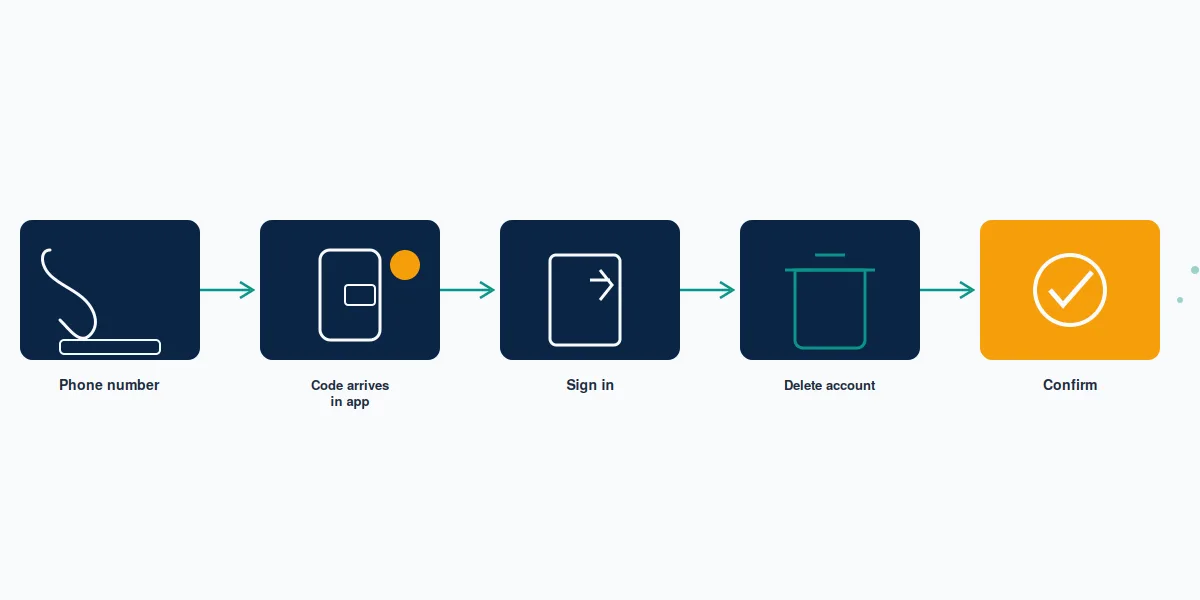
Roughly a minute of work, in five steps:
- Open the deactivation page in any browser, on any device.
- Enter your phone number with the country code, and press Next.
- Read the code that arrives, then type it into the confirmation field.
- Sign in, choose Delete Account, and give a reason if you want to. That reason box changes nothing.
- Confirm. The account ends at that moment, not at the close of a countdown.
Phrases like delete telegram account permanently instantly and telegram account delete permanently describe what this page already does rather than some faster tier you have to hunt for. Speed is the default on Telegram, and it is the part people misjudge. Elsewhere an account exits through a holding pen: deactivate, wait, reconsider, and a log-in during the window quietly cancels the whole thing. Telegram compresses all of that into a single confirmation click and keeps no reversal state afterwards, which is why the checklist further down this page matters more here than on any other major platform. Everything you might want to keep has to be collected while the account still exists, because a minute later there is no account left to collect it from, and no queue to appeal to. Your Reputation Solution treats that asymmetry as the defining feature of Telegram deletion: on most platforms a rushed decision is recoverable for a month, and on this one it is recoverable for zero seconds.
The confirmation code arrives in the app, never by SMS
One line on that page decides whether this route works for you, and it is easy to skim: "Enter your number and we will send you a confirmation code via Telegram (not SMS)."
Read it twice if you are here because you cannot get into Telegram. The code lands as a message inside the app, on a device already signed in. Lose access to every signed-in device and the deletion page cannot help, because the thing it needs to verify you is the thing you have lost. No email fallback exists, no identity-document route, no support queue for this. Telegram built a closed loop on purpose.
Priya Raman spends most of her week on account hardening, and raises the same point with every client who asks about closing an account: nobody should ever be asked to hand over that code. It authorises a login. We will never request it, no legitimate service will, and a stranger offering to run the telegram account delete process on your behalf is asking for the keys rather than for permission.
There is no password step, and no second gate
A number and a code make up the entire authorisation. No two-step verification cloud password appears at this stage, which surprises people who set one up years ago and assumed it guarded the exit as well as the entrance.
Treat that as a security fact about your own account rather than a convenience. Anyone holding a signed-in session of yours can close the account permanently in under two minutes. Where a device has gone missing, revoking its session outranks every other task on the list, and Your Reputation Solution puts that step ahead of the deletion itself whenever a lost handset is part of the story. Settings, then Devices, shows every session and ends any of them.
The asymmetry runs the other way too, and it is worth understanding before you rely on either control. A cloud password blocks somebody trying to sign in on a new device, which is the attack it was built for. It does nothing about a session already open on a device that walked out of a café with somebody else, and that session can reach the deletion page exactly as you would. An unrevoked session is the live risk in a lost-device case, sitting well ahead of a password nobody was going to bypass.
How to delete a Telegram account on the app
The in-app route exists too, and most people find it first. Its exact path has drifted between versions, so hunt for the word Privacy rather than matching a screenshot from an old guide.

Wording splits along a line that does not exist inside Telegram. Some people type how do i delete a telegram account, others how do you delete a telegram account, and a third group reaches for telegram account remove, telegram delete account or the blunt telegram account delete. Every one of those lands on the same two routes described here, because Telegram built a single deletion mechanism and put a signpost to it in the app. Treat the phrasing differences as noise. What actually changes the answer is whether you can still receive a code, whether a second admin exists on anything you built, and whether a subscription is attached to the account, and none of those three questions is visible from the search box you started in. Your Reputation Solution asks those three before discussing routes at all, since two of them close permanently the moment the account does.
Android and iPhone
On Android, open the three-line menu, then Settings, then Privacy and Security, and scroll to Delete My Account at the bottom. On iPhone, tap Settings in the bottom-right corner and follow the same two steps. Both land on a screen holding two controls that people routinely confuse: If Away For, which sets a timer, and Delete Account Now, which waits for nothing.
Choosing Delete Account Now hands you off to the same web page described above. The app is a signpost rather than a mechanism, and that single fact explains why guides promising an in-app-only method quietly end at a browser.
Telegram Desktop and the web clients
Desktop behaves the same way, and its Settings menu carries the same Privacy and Security section. No separate desktop deletion engine exists. Whichever client you start from, you finish at my.telegram.org, which is the honest answer to how to remove telegram account questions that assume each platform ships its own button.
Two practical notes follow from that. Deleting the app from a phone deletes nothing on Telegram's side, since the account lives in the cloud rather than on the handset, and reinstalling months later finds everything intact. Signing out of a client is likewise not deletion; it ends one session and leaves the account running. People conflate all three constantly, which is why an account someone believed they closed years ago often turns out to be sitting there, still reachable, still counting down its own timer.
What the app can do that the web page cannot
Before you leave, the app is the only place to take your history with you. Settings, then Advanced, then Export Telegram Data produces a local copy of chats and media, and it has to happen while the account still exists. Nobody can request that export afterwards, because nothing remains to export.
Channels follow the same logic. Promote a trusted second person to admin with full rights before you delete, or the community you built becomes the orphan described earlier. Your Reputation Solution meets the aftermath of that sequence often enough to raise it early: the request that arrives is usually to restore ownership of a channel, and no mechanism exists to grant it. The X trademark route that can pry a brand handle back from a squatter has no Telegram equivalent, so sequence matters more than speed.
Why a Telegram account gets deleted automatically
Because Telegram closes accounts nobody has used, on a timer that runs whether or not you know it is there.

Section 10.4 of the Telegram privacy policy, read on 8 September 2026, sets the default: "By default, if you stop using Telegram and do not come online for at least 18 months, your account will be deleted along with all messages, media, contacts and every other piece of data you store in the Telegram cloud. You can go to Settings to change the exact period after which your inactive account will self-destruct." Telegram's FAQ repeats the figure word for word.
That number needs a flag, because as of September 2026 almost every competing guide still prints six months. The If Away For menu inside the app has long offered a shorter set of periods, commonly one, three, six and twelve months, and an account carrying an old six-month selection self-destructs at six months regardless of what the policy default says. Both figures can be true at once. One is the value applied when nobody has ever touched the setting; the other is whatever you, or a much older version of the app, selected. Open that menu and read your own screen, because the number sitting there is the only one governing your account, and it is the single fact this entire section turns on. Your Reputation Solution asks every dormant-account client to photograph that screen before anything else, and the answer decides whether a case exists or the account has already closed itself.
Setting the timer, or stopping it
The same screen that deletes an account immediately is where the timer lives, and moving the setting takes one tap. Shorten it if you want an abandoned account to close itself. Lengthen it if you keep a number for occasional use and want the account waiting when you come back.
Signing in resets the clock. One session, from any device, and the countdown restarts at zero.
That reset is the cheapest insurance available for an account you want to keep but rarely use. Opening the app twice a year moves the deadline a full period into the future. A second number kept only for verification codes deserves a calendar reminder rather than good intentions, because nothing warns you first.
The other three reasons an account vanishes
Inactivity is only the first explanation, and a telegram account deleted automatically is not always the platform's doing. Four causes account for nearly everything we receive under that description, and they separate cleanly once you know what to look at.
The timer fired, in which case the account is genuinely gone. Or the phone number was recycled: carriers reissue disconnected numbers, and whoever received yours can register it, severing your account from a number you no longer control. Or Telegram removed the account for a policy breach, which is enforcement rather than deletion and follows a different path back. Or nothing was deleted at all and the app simply logged out, which looks identical from the outside and ranks as the least alarming of the four by a wide margin. Most reports of a telegram account deleted itself overnight, and nearly every telegram account deleted automatically android report Your Reputation Solution sees, resolve to that fourth cause once someone checks whether the number still receives a login code.
Classification decides everything downstream. A YouTube privacy complaint shares that quality: the wrong label at the start sends a request down a queue that cannot produce the outcome you wanted, however carefully the form gets filled in.
Deleted, frozen, banned, or a number someone else now owns?
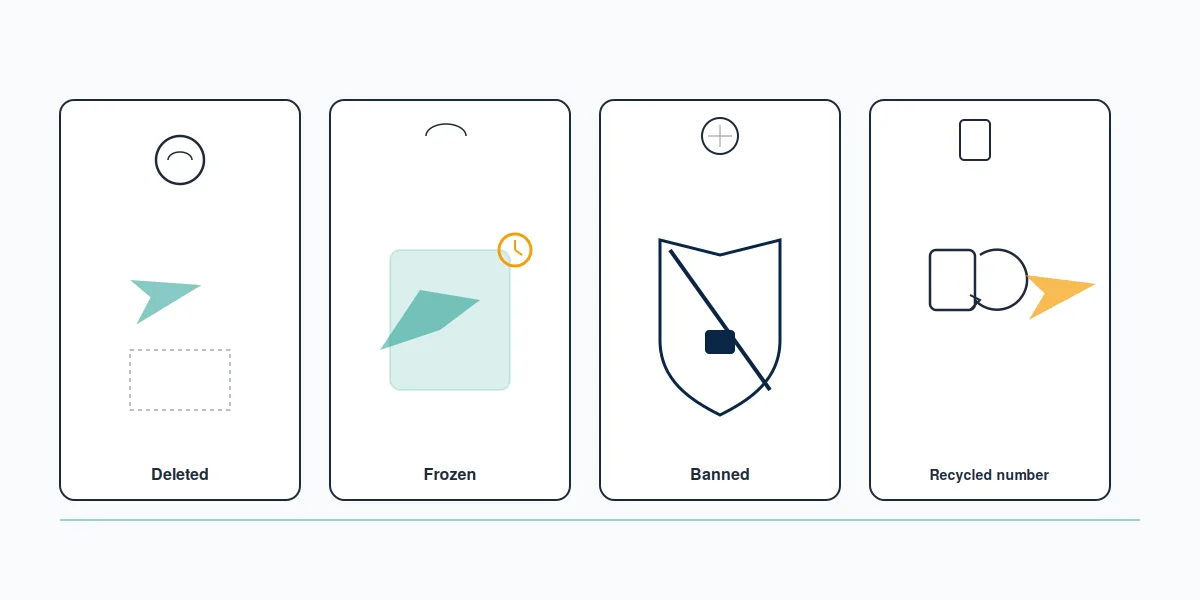
Four states wear the same word in everyday speech and lead to four different places. A telegram account deleted permanently by you or by the timer is finished, and nothing on this page changes that. A frozen Telegram account still exists, still holds everything you wrote, and simply cannot speak until an appeal clears it. A banned account is enforcement, so it follows the appeal route rather than the recovery route. A recycled number is the odd one out: your account may be perfectly intact while the number that unlocks it belongs to somebody else.
We sort incoming Telegram cases by that distinction before anything else, because the diagnosis decides whether any work exists to do. When the answer is a completed deletion, the honest response is that no service, ours included, can undo it, and the conversation ends there rather than at an invoice. The same principle governs what re-registering a deleted WhatsApp number actually returns: a clean account on a familiar number, carrying none of the history that made the old one worth having.
Reporting sits in a different category again, and the two get mixed up constantly. Filing a report asks a platform to review something. A Snapchat report is a request for review rather than a delete button, and the same holds for reporting a Telegram group you would rather leave than close. Deletion is the one action on this page that belongs to you alone, which is also why it cannot be delegated, bought or performed on your behalf.
Not sure which of the four you are looking at? Describe what you see when you open the app and our team will tell you which state it is, including when the answer is that nothing can be done. Your Reputation Solution runs that assessment before any fee is discussed.
Deleted and re-created too many times
Delete and re-register the same number repeatedly and Telegram stops you at the door. People hitting that wall report a message along the lines of: sorry, you have deleted and re-created your account too many times recently, please wait for a few days before signing up again.
Telegram's support account gave the reason on X in April 2023: "After repeatedly deleting and recreating an account, users have to wait several days before they can create the account again. This is to prevent any potential misuse of the ability to delete and recreate accounts. I suggest checking back every few days." That statement remains the only first-party guidance on the subject, and it names no fixed number of days. Anyone quoting an exact figure of seven or fourteen is repeating a guess. A telegram account deleted too many times is a cooling-off period applied to new signups, not a punishment attached to the old account, and it lifts on its own. Readers who plan to remove telegram account permanently and then reconsider a week later are the ones who meet it; a single clean deletion never triggers it at all.
Your Reputation Solution turns these enquiries away, and the reason is worth stating plainly: there is no case here. Nobody can shorten the wait, no contact inside Telegram accelerates it, and any service claiming otherwise is charging for the passage of time. Check back every few days until the signup screen accepts the number again.
What to settle before you delete, and the deletion services selling you nothing
Deletion cannot be undone, so the checklist runs before the button rather than after it. Export your data. Promote a second admin on anything you built. Revoke old sessions, since any of them can close the account. Then handle the bill, because this is the trap almost nobody mentions.
Telegram Premium bought through an app store is a subscription with that store, not with Telegram, and closing your account does not touch it. Google's Play billing documentation is unambiguous: "When you uninstall the app, your subscription won't cancel." Cancel it first from your phone's subscription settings, or keep paying for an account that stopped existing. Telegram's FAQ says nothing about Premium billing in its deletion answer, which is the gap this warning fills; a subscription bought inside Telegram through its own payments bot behaves differently from one bought through Apple or Google, so check where the charge originates rather than assuming.
Nobody needs to sell you a deletion
A telegram account deletion service is a product built around a free button. Deleting an account you control costs nothing, takes a minute, and needs no intermediary at all. Anyone charging for it is charging for your credentials, and anyone promising to delete an account belonging to somebody else is describing something no platform permits, which is exactly why no one can delete another person's Snapchat account either.
Two adjacent markets deserve naming here. Paid ban panels claim to remove accounts they dislike, and the WhatsApp version of that pitch fails for one reason every time: enforcement follows evidence, not payment. Recovery firms are the mirror image, with red flags identical across platforms, as the TikTok recovery market shows with unusual clarity. Fees demanded before any assessment. Requests for passwords or login codes. Promised outcomes that no platform has agreed to.
Our own limits get stated the same way. Your Reputation Solution works on Telegram accounts inside the self-destruct window and on hacked, frozen or number-loss cases, prepares and escalates the appeal, and leaves the decision where it sits, with Telegram. We never ask for a password or a login code, we do not sell deletions, and we decline completed deletions rather than taking the case. The full statement of what we will and will not do sits with our service limits.
Being told no costs nothing here, and it saves the fee that a less careful firm would have taken for work with no possible outcome.
One last piece of context for anyone deleting to escape a person rather than a platform. Closing your account removes you, not them: their posts, their messages to others and their account all outlive your exit. Where harassment is the reason, the tools that reach it are aimed at their content, whether that means reporting harassment on Facebook object by object, blocking someone on YouTube and deleting their comments, or reporting a Marketplace seller after money has moved. Deleting your own account is a clean way to leave. It is a poor way to win an argument and an expensive way to hide from one, since scam adverts and the accounts behind them carry on undisturbed once you are gone. Nor does an abandoned account close itself everywhere: X will not delete an old account for you the way Telegram eventually will.
Weigh the timer against the button before deciding. Setting If Away For to one month closes a dormant account on its own, keeps the door open until then, and asks nothing of you today. Pressing Delete Account Now settles it in a minute and forecloses the reconsideration entirely. Your Reputation Solution has no preference between them, because neither is a service anybody sells; the only recommendation worth making is that you finish the checklist above before whichever one you choose takes effect.