
What a TikTok content removal service actually does
A TikTok content removal service is a paid specialist that builds and files evidence-backed removal requests on your behalf, through TikTok's in-app reporting queue, its legal and intellectual property forms, or a formal legal notice where the facts support one. The service never deletes anything itself. TikTok does. What you are paying for is the part most people get wrong alone: classifying the violation correctly, capturing evidence a reviewer will accept, filing through the channel that reaches a human, and escalating when the first pass returns "no violation found."
Scale is why that precision matters here more than on smaller platforms. TikTok removed 184,012,576 videos in Q1 2026, and 99.3% of them came down through automated detection before a single person reported them (TikTok Community Guidelines Enforcement Report, Q1 2026). The reporting queue you are filing into handles what the classifiers missed, which is almost always the context-dependent material: impersonation, targeted harassment, a stolen clip reposted with the watermark cropped out. Those cases turn entirely on evidence, because nothing about them is obvious from the pixels alone. A machine cannot tell that the account in the video is pretending to be you, or that the person filming outside a house is filming yours. A human reviewer can reach both conclusions in seconds, but only from what you put in front of them. That is the whole job, and it is why two reports about the same video routinely produce opposite outcomes.
Diego Fernández spent three years on TikTok's Trust & Safety team in Dublin before joining the people behind YRS, and his summary of the job is short. A reviewer has seconds per item and no memory of your situation. Everything you want them to conclude has to be visible inside those seconds.
Worth naming what sits outside the service, too. There is no backdoor, no contact who owes anyone a favour, no panel that deletes videos on request. Every legitimate provider files through the public channels you can reach yourself, so what you buy is speed, classification accuracy, and escalation judgement — never access.
Which removal are you actually trying to do?
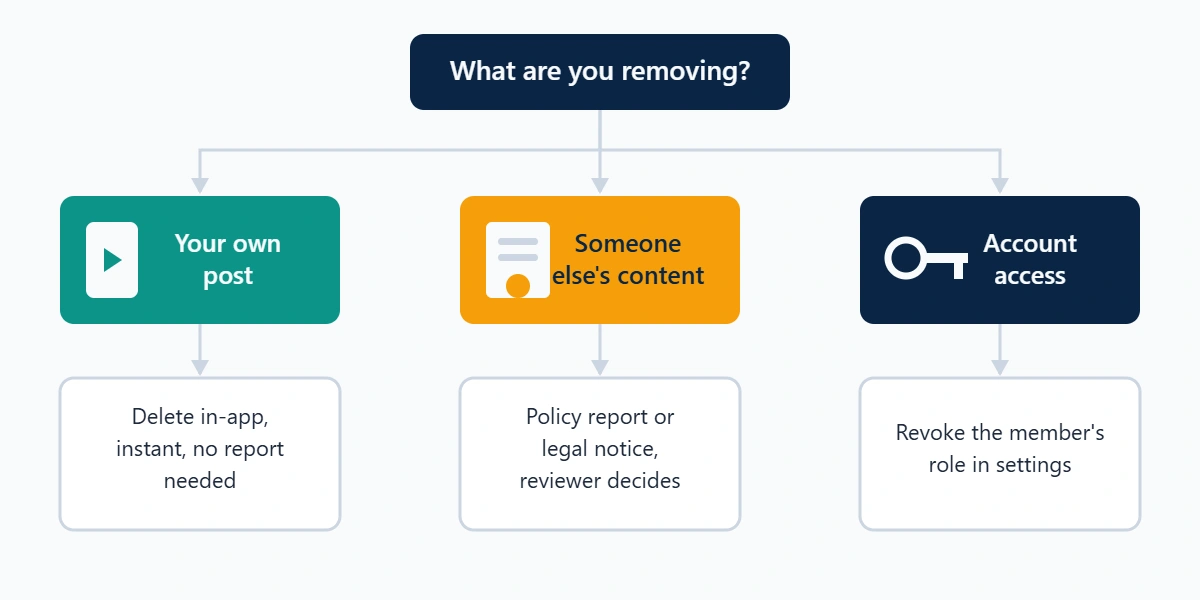
Three different jobs share the word "remove," and picking the wrong one wastes days. Work out which row describes your situation before you pay anyone.
| What you want gone | Who controls it | Route | Realistic timeline |
|---|---|---|---|
| Your own video or comment | You | Delete it in-app | Instant |
| Your own account | You | Settings and privacy → Account → Deactivate or delete account | 30-day window, then permanent |
| A follower, a logged-in device, or a Business Center member | You | Revoke access in settings | Instant |
| Someone else's video that targets you | TikTok | Policy report, IP form, or legal notice | 24 hours to several weeks |
| Someone else's entire account | TikTok | Evidence-backed account report, often multi-round | Days to weeks |
Rows one through three cost nothing and need no service, because you already hold the controls. Skip to the relevant section below, do the thing yourself in under a minute, and close the tab. Rows four and five are the only situations where a paid specialist changes the odds, and even there the platform holds the final decision rather than the vendor. Most of the money wasted in this market is spent by people who were sitting in row one or row two and did not realise it, usually because a search for how to get a TikTok account removed returned pages selling a service instead of pages explaining the settings menu. Sorting yourself into the right row is the highest-value minute on this page. Our companion guide on getting a single TikTok video taken down walks the urgent version of row four step by step.
How to remove a post from TikTok when it's yours
Deleting your own content takes four taps and nobody's permission. The question reaches us worded a dozen ways — how do I remove a post on TikTok, how to remove a TikTok post, how to remove a post from TikTok — and the answer is identical for all of them:
- Open your profile and tap the video you want gone.
- Tap the three dots, or the share arrow on older app versions, to open the action sheet.
- Scroll the bottom row of icons and tap Delete.
- Confirm.
Save a copy to your device first, because deletion here is not reversible. Comments work the same way: long-press yours, then tap the delete icon. Drafts live only on your phone.
One caveat catches almost everyone out. Deleting the original does not delete the copies. Where somebody duetted, stitched, or simply downloaded your video before you removed it, those derivative posts survive on their accounts untouched, and clearing them becomes a row-four problem rather than a row-three one. Check for duets and stitches before you delete, because once the original is gone you lose the easiest way to find them: the original video page lists the posts built from it, and that list disappears along with the post. Screenshot it first when the content is sensitive, and save the URLs of anything you may later need to report. Two minutes there saves a week later. The same asymmetry applies across every platform, which is why our guide on removing a video from YouTube spends most of its length on other people's uploads rather than your own.
How to remove a TikTok account you own
Anyone asking how to remove a TikTok account or how to remove account on TikTok wants the same menu path: Settings and privacy → Account → Deactivate or delete account. TikTok then splits the choice in two, and the difference is worth understanding before you tap.
Deactivate hides your profile, videos, likes, and comments while preserving all of it. Log back in and everything returns intact. Use this when you want distance from the app rather than an ending.
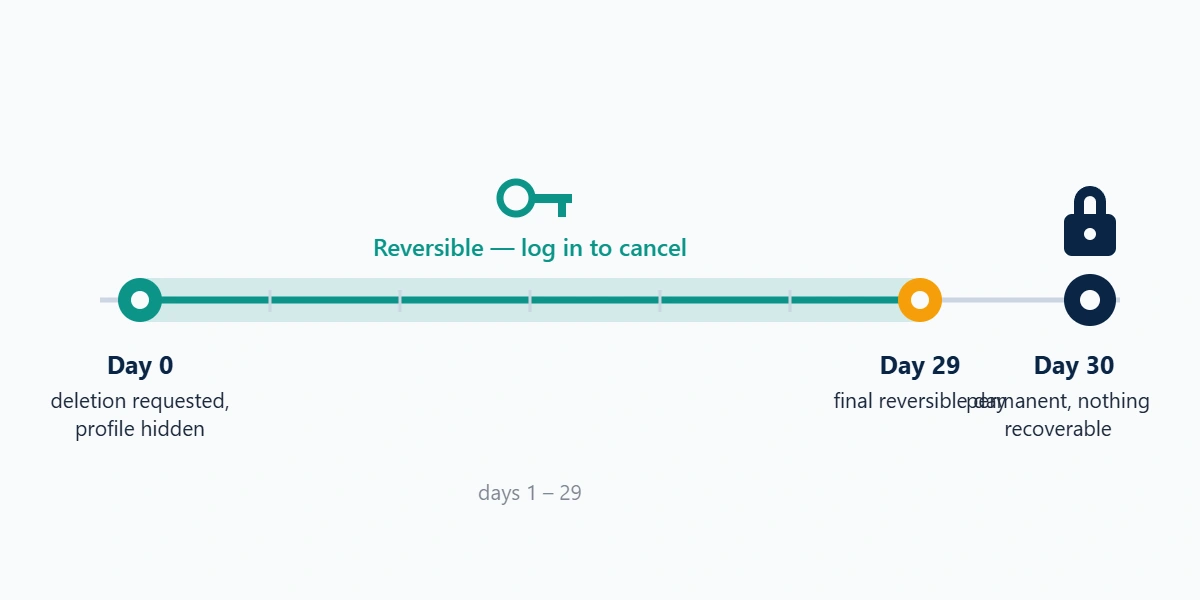
Delete starts a 30-day countdown. Your account is hidden immediately, and logging in during that window cancels the deletion. After 30 days the account and its content are gone permanently, and cannot be restored by TikTok or anyone else (TikTok Help Center).
That 30-day window is the single most useful fact on this page for anyone acting in distress. We regularly hear from someone who deleted an account during a bad week and wants it back on day nine, and in that scenario the fix is free and takes one tap: log in. Nobody needs to be paid for it. Past day 30 there is nothing left to recover, no internal backup a vendor can reach, and any service claiming otherwise is selling a fiction dressed up as a technical capability. Being locked out is a different problem entirely, with different odds and a different process, and the honest routes for that are covered in our TikTok account recovery service breakdown. Deleting on purpose and losing access to something you still want are opposite situations, and conflating them is how people end up buying the wrong thing.
How to remove business account on TikTok without losing the profile
Searches for how to remove business account on TikTok usually mean one of three things, and they resolve very differently.
Wanting the personal experience back is not deletion at all. Go to Settings and privacy → Account → Switch to Personal Account. Videos, followers, and username stay put; you lose business-only analytics and the commercial sound library, and you regain the full music catalogue.
Detaching a profile from an agency or an employer's ad setup happens inside TikTok Business Center rather than in the app. An admin opens Business Center, finds the profile under the assets list, and removes it, severing the ad and analytics permissions while leaving the TikTok account untouched (TikTok Business Center help).
Deleting the business account outright uses the same Deactivate or delete account path described above, but do the housekeeping first or you will lose things you cannot get back. Detach the profile from Business Center, settle or transfer any TikTok Shop obligations, download your analytics export, and reassign any running ad campaigns, because none of that survives the 30-day window and none of it can be reconstructed afterwards. Sequence matters here in a way it does not for a personal profile: a business account that disappears mid-campaign leaves billing and fulfilment tails behind it. Sellers who lost access before they could do any of this should read our notes on restoring a locked TikTok Business profile, since the order of operations changes completely once you are on the outside of the account looking in.
How to remove someone from your TikTok account
This phrase covers two problems that feel similar and are not. One is social. The other is a security incident.
The social version is a follower you would rather not have. Open your profile, tap Followers, find the person, tap the three dots beside their name, and choose Remove this follower (TikTok Support). No notification is sent, though they can follow you again unless you block them outright. Blocking is the durable version.
The security version involves somebody who holds access to the account itself: an ex-partner who knows the password, a former social media manager who was never offboarded, an attacker who landed a phishing hit. Removing them as a follower achieves nothing at all, since their access does not run through the follow graph. Open Settings and privacy → Security & permissions → Manage devices, review every logged-in session, and remove any you do not recognise. Change the password next. Turn on two-step verification last, so a stale password stops being sufficient on its own. Order matters more than people expect: changing the password while a hostile session is still authorised can leave that session live, which is why the device sweep comes first rather than second. Where a phone number or email on the account has also been altered, treat it as a full compromise and work through recovery rather than settings.
On a shared business profile the equivalent control is Business Center member management: an admin removes the person's role, revoking access without touching content or followers.
How to get a TikTok account removed when you don't control it
Everything above was housekeeping. This is the part people actually hire for, and the honest framing is that you are not removing an account, you are persuading TikTok to remove it. That verb change decides where your effort should go.
TikTok acts on accounts that break a specific line in its Community Guidelines or that infringe rights it is legally obliged to protect. Everything else stays up, however unfair that feels.
What TikTok will act on
Successful cases cluster into a short list. Impersonation, where an account presents itself as you or your business and a reasonable viewer would be misled. Targeted harassment aimed at a specific identifiable person rather than general nastiness. Non-consensual intimate imagery, which TikTok treats as an emergency and moves on fastest. Intellectual property infringement, where you hold the underlying copyright or trademark and can evidence it. Doxxing, meaning publication of an address, workplace, or phone number. Each maps to a named policy, and naming that policy in your report is what separates a file that gets actioned from one that gets closed.
What TikTok will not act on
Lawful criticism stays. So does an unflattering opinion, a negative review, accurate reporting you would rather were not public, and a video that is merely embarrassing. A vendor promising to remove any of that is either lying or planning to file a false claim in your name.
Build the evidence file before you file anything. Capture the profile URL and every offending video URL, screenshot each one with the date visible, record your own account or trademark details for the impersonation comparison, and note any off-platform context that establishes intent. Only then choose a channel, because the channel follows the evidence rather than the other way round. In-app reporting handles guideline violations and is where most cases should start. The copyright and IP report forms handle stolen content and trademark misuse under the notice-and-takedown framework the US Copyright Office administers, and they carry legal weight the in-app flow does not. European users with a privacy claim can also invoke the right to erasure under GDPR Article 17, which runs on a separate legal track with its own statutory deadlines and its own appeal route. Filing the same case through all three at once is a common mistake and tends to slow everything down.
Firms marketing TikTok account removal services are, at their most useful, doing exactly this assembly work at speed and knowing which of those four channels fits the facts. Our detailed walkthrough of reporting another person's TikTok account covers the evidence standard for each category, and the companion piece on what a TikTok ban service can and cannot deliver sets the expectations most vendors leave deliberately vague.

Not sure which row you're in? Send the profile or video link with a one-line description. We will tell you free of charge whether TikTok is likely to act, which channel fits, and whether you need us at all — start a case review.
What separates the best TikTok content removal service from a scam?
Anyone shopping for the best TikTok content removal service is shopping in a market built for confusion. Every vendor's landing page makes the same promises in the same order, the pricing is rarely published, and the two categories that matter — firms doing real filing work and operations selling access they do not have — are visually indistinguishable from the outside. Judge them on behaviour rather than copy, and specifically on what they are willing to say no to. The six signals below are the ones that have actually predicted outcomes across the cases clients bring us after a previous vendor failed, and most bad providers fail at least three of them within the first email exchange. None of these requires you to understand TikTok's policies. All of them can be checked before you pay anything.
They tell you no. A provider who accepts every case is not assessing any of them. Roughly a third of the TikTok enquiries we decline are declined because the content is lawful and no channel exists for it, and saying so costs us the sale.
Nobody asks for your password. No legitimate removal workflow requires your login. Credential requests are the clearest scam signal in this category, and handing them over usually precedes the account being sold on.
Pricing describes a process, not an outcome. "Guaranteed removal in 24 hours" is not a service level, it is a claim about a decision the vendor does not make. Honest pricing describes the work, the channels, and the escalation path.
Fabricated claims are refused outright. Filing a copyright notice over content you do not own is perjury under the DMCA framework, not a clever shortcut, and it exposes you rather than the target.
They do not sell report volume. Report-bombing tools dominate this market's advertising and do not work, because TikTok weighs reports against policy rather than counting them; we took that apart in detail in our analysis of TikTok mass report bots. Coordinated false reporting is itself a guidelines violation, so the flood can boomerang onto the senders.
They put the limits in writing before payment. Ask for the refusal list and the failure scenario in the same document as the price. Vendors who will not commit to what happens when TikTok says no are describing a lottery ticket, not a service, and that single question filters out most of the market in one email.
Our full refusal list is published on the service limitations page, and the same standards apply across every platform we handle, from Instagram account takedowns to TikTok. Cost expectations for adjacent unban work are broken down in our TikTok unban service pricing guide.
How long does removal take, and what if the first report fails?
Clear-cut cases move fast. TikTok removed 94.4% of the violating videos it actioned in Q1 2026 within 24 hours of posting, so where content plainly breaches a guideline the system is genuinely quick (TikTok Community Guidelines Enforcement Report, Q1 2026). Contested cases are slower by an order of magnitude, because a human has to weigh context that the classifier could not. Across our TikTok impersonation and harassment casework since January 2026, the median evidence-complete file closed in 6 days, while the slowest quarter of cases ran past three weeks (our internal case records as of 6 August 2026). Anyone quoting you a fixed 24-hour turnaround on a contested case is quoting the easy-case number and hoping you do not know the difference. Ask instead what happens on day seven, and whether the escalation is included in the price or billed again.
First-pass rejections are normal rather than fatal. Around 40% of our TikTok reports return "no violation found" on first review, and most succeed on the second attempt once the evidence is reframed to point at a specific named guideline instead of describing the harm in general terms.
Reversals run in the other direction too, which is worth knowing before you assume a takedown is permanent. TikTok restored 8,838,710 videos after further review in Q1 2026, roughly one for every twenty it removed. A removal is a decision, and decisions get revisited.
What removal doesn't fix
Getting the video down closes one problem and leaves two open. Search results outlive the post: a clip that went viral before removal keeps surfacing in Google, on aggregator sites, and in reposts for months afterwards, and pushing those down is separate work on a 90 to 180 day horizon. Copies are the second gap, since whoever downloaded or mirrored the content still holds it.
Plan for both from the start rather than meeting them as a surprise at the end. And treat any guarantee sceptically, ours included, because the only party who can remove content from TikTok is TikTok.