Reviewed June 2026. We re-checked the official Facebook trademark and impersonation report forms, the roughly 60-day username cooling-off window, and the two-to-six-week trademark resolution timeline cited here, and confirmed each remains accurate. No legitimate "media portal" consumer route exists.
What Does It Mean to Claim a Facebook Username?
A Facebook username is the custom handle in your profile or Page web address — the part after facebook.com/, such as facebook.com/yourbrand. Claiming a Facebook username means securing that handle for your own account. As of May 2026, the phrase "facebook claim username" actually describes three very different situations, and confusing them is the most common mistake we see. First, the handle may be unclaimed — no one holds it — in which case you simply set it in your settings. Second, it may be held by an active account, where your only routes are a trademark report or an impersonation report. Third, it may sit on an inactive or dormant account, where — contrary to what dozens of paid services imply — Facebook offers no public "reclaim" button at all.
Getting the diagnosis right matters because each situation has a different path, a different timeline, and a different probability of success. The same pattern plays out on every major platform; if you have wrestled with this before, our guides to claiming an inactive Instagram username and the parallel X (Twitter) handle process follow identical logic. This guide covers the Facebook-specific mechanics, the official routes that genuinely exist, and the "media portal" claim that floods search results but is not what searchers think it is.
How to Set or Change Your Facebook Username (Profile and Page)
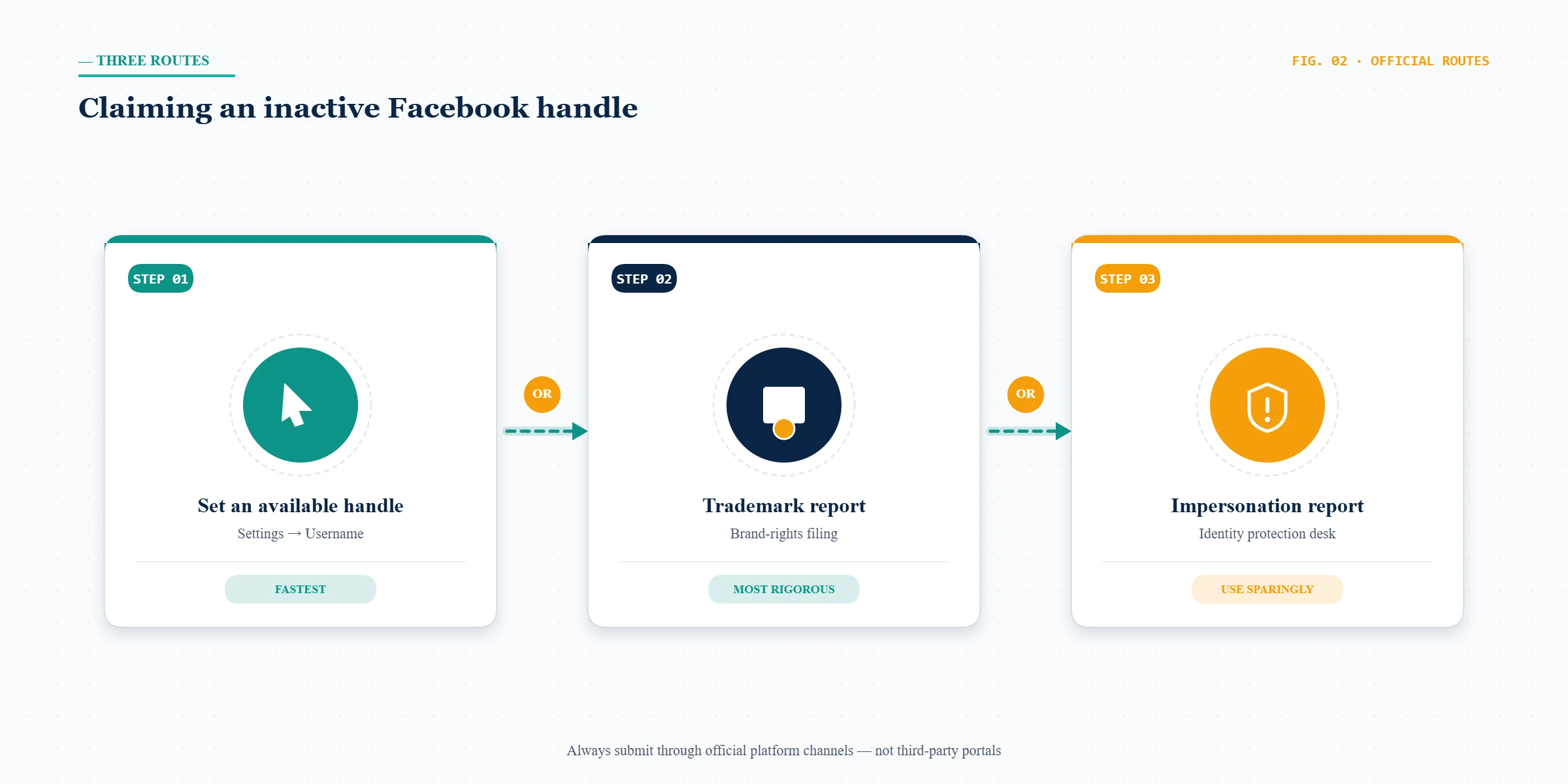
If the username you want is available, you do not need a service — you can claim it yourself in a few minutes, and any company charging you for this step alone is overcharging for a free action.
For a personal profile, open Settings & Privacy → Settings → Account Center → Profiles → Username, then enter the handle and save. For a Page, the username field lives in the Page's settings under its web address. Facebook's guidelines for creating a custom username set firm rules: minimum five characters; letters, numbers, and periods only; no spaces; no consecutive periods; and nothing resembling a generic term, a domain extension, or someone else's brand. Usernames are unique across all of Facebook, so a name in use anywhere — profile or Page — cannot be duplicated.
Two constraints surprise people. Facebook enforces a cooling-off window of roughly 60 days between username changes, so you cannot rename repeatedly to test availability. And when you change a username, the old one is locked to your account for a period rather than instantly released — so renaming does not reliably free your previous handle for someone else, and it does not let you grab back a name you abandoned on demand. Pages must additionally be published, and in some categories meet a minimum follower threshold, before a username can be set; Facebook documents the Page-specific steps in its change your Page's username help article.
Can You Claim an Inactive Facebook Username?
You cannot directly claim an inactive Facebook username through any public Facebook form or button, and this is the single biggest misconception in the topic. Facebook's own guidance on what to do when a username isn't available states plainly that you cannot take a username from another account — it offers no inactivity-based reclaim process for the general public. Unlike X (Twitter), which has periodically announced (and repeatedly delayed) mass purges of dormant handles, Facebook does not recycle usernames on a published inactivity schedule. So when a service advertises that it can "claim inactive facebook username" handles after "18 months of inactivity and six or more characters," understand that no such public policy exists in any official Meta document — that figure is a rule-of-thumb circulated by intermediaries, not a Facebook rule you can invoke.
Several edge cases trip people up. A handle can appear "unavailable" not because it is actively used, but because the account is unpublished, disabled, restricted, or pending review — none of which means it is about to be released. Memorialized accounts are a firm dead end: Facebook preserves the deceased person's profile and does not release usernames from memorialized accounts under any public process. And even when a handle genuinely does free up, it returns to a public pool with no queue and no priority for whoever reported the dormancy — the first account to set it wins. That race condition is why people who chase a dormant Facebook handle so often end up empty-handed even when the name technically becomes available.
The "Facebook Media Portal" Username Claim — What It Really Is
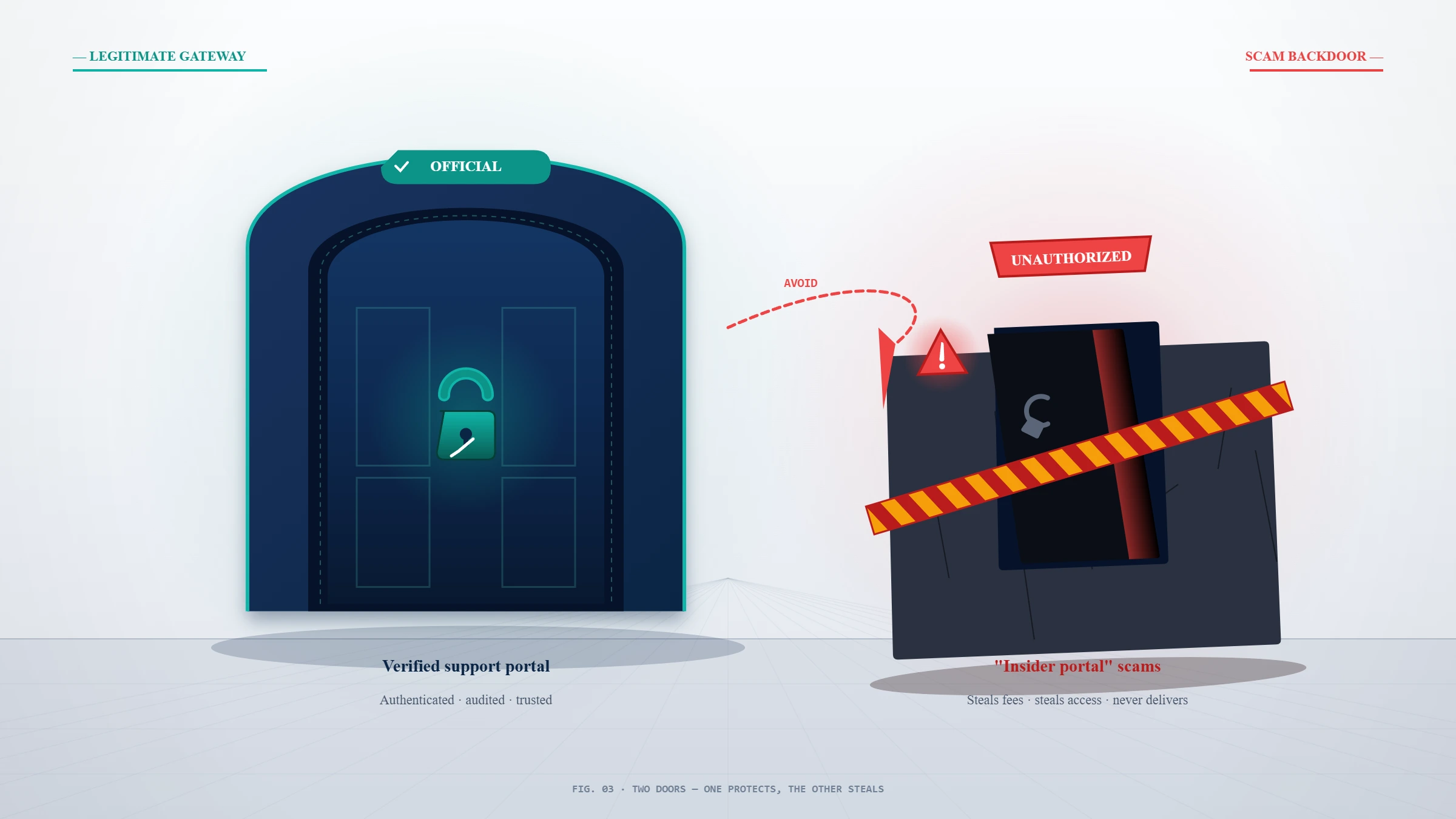
Search "facebook media portal claim username" and you will find services promising to pull your desired handle through a special Meta portal. Here is the honest picture. The tool they reference is the Media Partner Support Portal, a real but non-public Meta system. Access is granted only to vetted media organizations, public-relations firms, and advertising partners — not to the general public — and authorized partners can, in limited cases, raise account issues, including certain username changes for accounts they legitimately manage. It is not a consumer product, and there is no public sign-up.
The problem is what happens at the edges. As reporting by Vice documented, access to this backdoor has been resold and abused by "ghost agencies" that submit requests on behalf of paying strangers, and Meta has stated it bans those who make improper requests. So when someone offers you a "facebook media portal claim username" service, one of three things is true: they are abusing legitimate partner access in a way that can get the handle clawed back and accounts banned, they are reselling access they should not have, or they are simply taking your money and doing nothing. None of those is a path we will put a client on. There is no legitimate, direct consumer route into the Media Partner Portal, and any firm — including ours — that claims otherwise is misrepresenting how Meta works.
How to Claim a Facebook Username With a Trademark
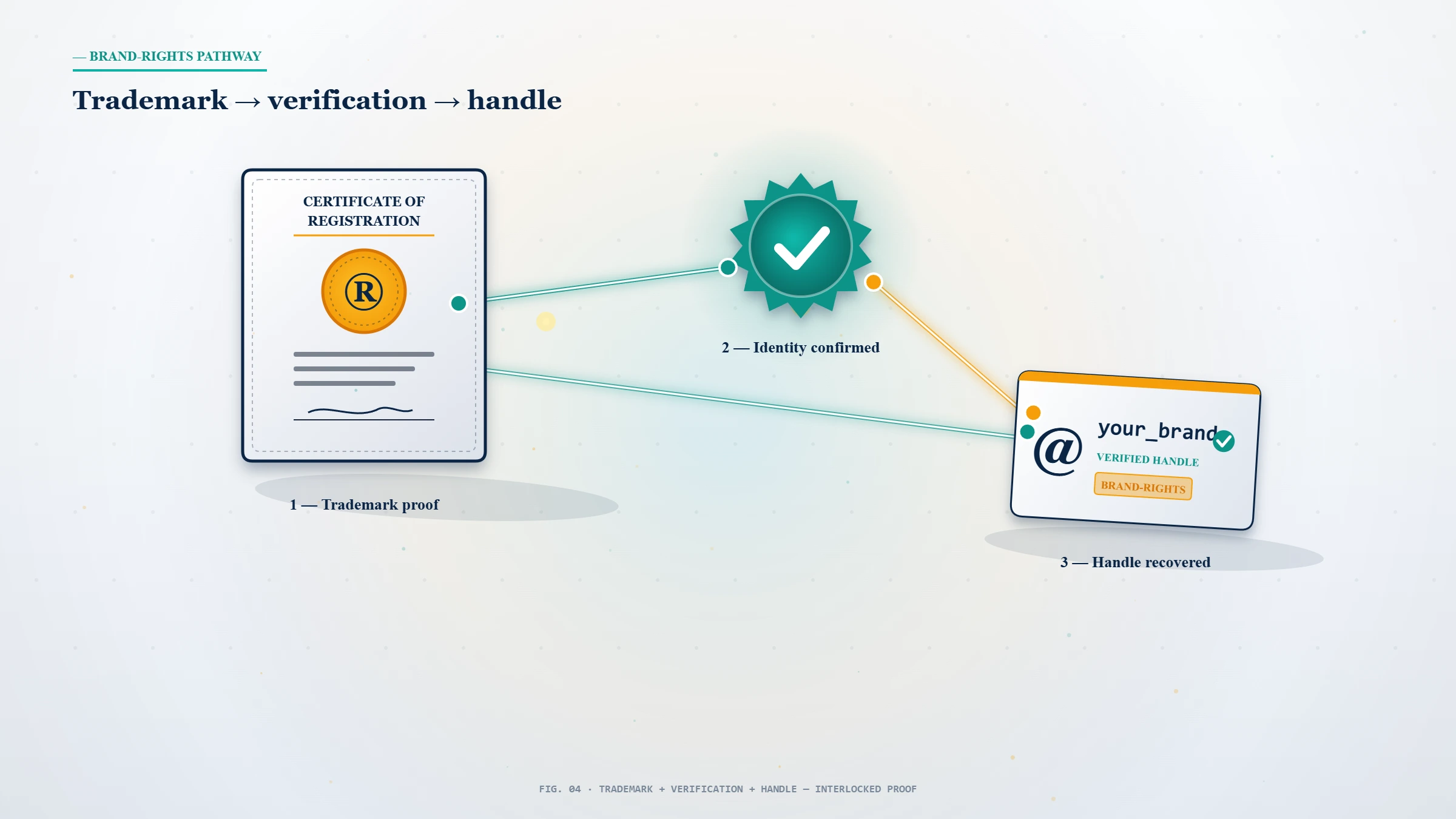
If another account uses your registered brand name as its handle, the trademark route is the most reliable legitimate way to claim a Facebook username that is otherwise taken. You file through Facebook's trademark report form, and Meta reviews the claim under its intellectual-property policy and the principles of trademark law.
What Facebook requires for a trademark-based report:
- A registered trademark — a USPTO, EUIPO, UK IPO, or equivalent national registration. A pending application does not qualify; the mark must be issued.
- The registration number and the class(es) the mark covers.
- Evidence the handle creates confusion — the account trading on your mark commercially, misdirecting your customers, or passing itself off as you.
Two honest caveats. First, a trademark report is a policy-enforcement action, not an ownership transfer: Facebook may rename or remove the infringing account, or release the handle to the public pool, but it does not hand the name directly to you, so you must be ready to set the freed handle immediately. Second, where two parties hold the same mark in different industries or countries, Meta generally will not adjudicate between them. In our own casework, well-documented Facebook trademark reports backed by a registered mark resolve in roughly two to six weeks and succeed in about 74% of filings (our internal records, n=41 Facebook brand-handle cases, 2024–2026). The same standard governs our Instagram account recovery work across the wider Meta family.
Reporting Impersonation: When Someone Is Posing as You
A trademark report is not your only route, and it is not always the right one. If the account holding your handle is actively impersonating you — using your name, photos, or brand to deceive people — Facebook's impersonation reporting flow is a separate path that does not require a registered trademark. It targets deceptive behavior rather than intellectual property, which makes it the better fit for individuals, creators, and small businesses without a registered mark.
To succeed, you generally need to show two things: that you are the person or brand being impersonated (government ID, business registration, a verifiable web presence, or third-party press), and that the account meaningfully deceives viewers rather than merely sharing a similar name. As with the trademark route, a successful impersonation report may suspend or remove the offending account without automatically transferring the handle to you — so the public-pool race still applies. If your handle was lost because the account itself was hacked or disabled rather than squatted, that is a different problem; our guide to getting back into a disabled Facebook account is the better starting point, and the same applies if a Facebook Marketplace ban is affecting your main profile.
Why "Facebook Username Claim" Services Are Often Scams
The "facebook claim username" niche attracts scams because the demand is emotional and the supply is opaque. Here is how the common variants work, so you can recognize them before paying.
- The "media portal" pitch. Covered above — selling access to a non-public partner backdoor that can get handles clawed back and accounts banned.
- The guaranteed-outcome lie. Any service that guarantees you will get a specific taken handle is lying; Meta's enforcement decisions are not for sale and not predictable.
- The credential grab. If a service asks for your Facebook password or login code, stop — no legitimate claim or recovery process ever needs it, and handing it over is how accounts get stolen.
- The free-report upcharge. The least dishonest tier simply files the same free trademark or impersonation report you could submit yourself, then bills you hundreds for it.
How to spot a legitimate operator: it offers a free case review before billing, it refuses to guarantee an outcome, and it never asks for your password. If even one of those three signals is missing, treat it as fraud. We document exactly what we will and won't do on our recovery limits and disclaimer page — including our standing rule that we never request passwords and never file fraudulent trademark or DMCA notices.
Not sure which route fits your Facebook username situation? Our specialists review your case for free in a 60-minute consultation and tell you honestly whether you can set the handle yourself, whether a trademark or impersonation report gives you real odds, or whether no legitimate route applies. No password requests, no guarantees, no fees before review. Book a free Facebook username assessment →
How Our Team Approaches a Facebook Username Claim — and What We Won't Do
Our Meta-platform work is led by founder Ava Chen, a CISSP- and CIPP/E-certified former Meta Trust & Safety analyst, supported by a team that has handled hundreds of platform-identity cases. You can read about our former Trust & Safety team and their credentials. When a client asks us to help claim a Facebook username, the process is deliberately transparent:
- Free case triage. A 60-minute review to classify the situation — available handle, active-account squatter, inactive or dormant account, or active impersonation — and to say plainly when no legitimate route exists. We decline a large share of inquiries at this stage rather than charge for work that cannot succeed.
- Documentation package. If a trademark or impersonation report fits, we assemble the evidence — registration certificates, proof of identity, infringement screenshots — formatted to Facebook's specific form structure.
- Filing and monitoring. We file through the correct official channel and monitor the target handle so you can set it the instant it is released to the public pool.
What we will never do: ask for your Facebook password, claim insider or "media portal" access we do not have, guarantee a successful claim, buy or sell a handle, or file a fraudulent trademark or DMCA notice. Those same standards govern every platform we work on, from Instagram to TikTok handles. If your real problem is a lost or hacked account rather than a contested username, browse the account recovery blog hub for the right walkthrough.
Quick Checklist: Claiming a Facebook Username Without Wasting Time
Use this before filing anything or paying anyone.
Diagnose your situation first:
- Is the handle actually available (just set it), held by an active account, or sitting on an inactive or dormant one?
- Is the account that holds it suspended, unpublished, or memorialized? (None of those means the name is about to be released.)
- Do you hold a registered trademark in the relevant class — not a pending application?
- Is the account impersonating you in a way you can document?
Pick your route:
- Handle is free → set it yourself in profile or Page settings; no service needed.
- Registered trademark infringed → file the official trademark report.
- Being impersonated → file an impersonation report.
- Just want a dormant name with no trademark or impersonation → there is no public reclaim route; consider a username variation instead of paying a "claimer."
Before you act:
- Never share your Facebook password with any claim service.
- Treat any "facebook media portal claim username" offer as a red flag.
- If hiring help, confirm a free case review, no guaranteed outcome, and no password request.
For cross-platform context, the diagnostic logic is identical on other networks — compare our LinkedIn account recovery guide for how the same Set/Reclaim/Report framework applies elsewhere.