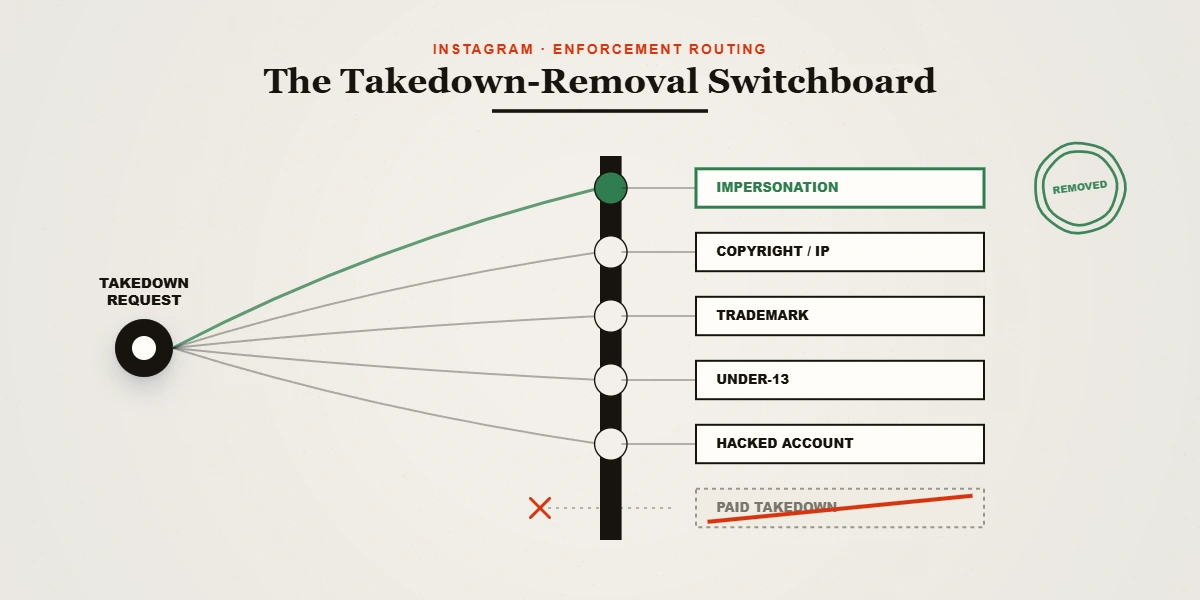
What a YouTube ban service actually is
A YouTube ban service is professional, evidence-backed reporting that gets a genuinely violating video or channel removed through YouTube's own official routes. That is the whole job. There is no insider button, no back-channel to a reviewer, no way to make YouTube delete something that breaks none of its rules. What a competent service adds is precision — the right violation matched to the right policy, filed on the right form, backed by the evidence a reviewer needs to act — plus the honesty to tell you when you have no case at all.
The phrasing trips people up, so sort it before you pay anyone. "YouTube ban service" gets typed by two groups who want opposite things. One wants a takedown: someone else runs a channel or posts a video that impersonates them, harasses them, leaks their private data, or steals their footage, and they want it gone. The other wants recovery: their own channel picked up a strike or a termination and they want it back. This page is about the first job. If yours is the second, our guide to recovering a terminated YouTube channel is the right starting point — a different track entirely.
One more distinction sits underneath that. A youtube video takedown removes a single upload; a youtube channel takedown removes the whole account and everything on it. People search "takedown video youtube" and "youtube video takedown" interchangeably, but the route and the realistic odds shift depending on whether you are targeting one clip or an entire channel, so name yours precisely before you file. Our companion walkthrough on how to get a YouTube video or account taken down covers the on-screen forms; this page is the plain-English overview of what the service is, what it can touch, and how to dodge the scams crowding the results.
Here is the line no honest provider crosses: it cannot remove lawful content, and it never guarantees a ban. YouTube owns the verdict. A service can build the strongest possible submission; it cannot write the outcome. We have published the same explainer for X and Twitter, for Telegram, and for Instagram, and the honest scope is identical on every platform: real work on real violations, nothing on the rest.
Which YouTube videos and channels can actually be removed?
Start with the blunt question, because it settles everything after it: does this video or channel break a written YouTube rule or the law? If yes, a youtube video removal is realistic. If no, no amount of money or reporting moves it. These are the categories YouTube genuinely acts on, each mapped to the policy it breaches and the route that files it:
| What's happening | Policy or law it breaks | How it's filed | Realistically removable? |
|---|---|---|---|
| Someone impersonates you or your brand | YouTube Impersonation policy | In-app report + the impersonation web form, with ID or business proof | Yes — among the most reliably actioned |
| Targeted harassment, threats, or a pile-on | Harassment & Cyberbullying policy | In-app report on each video and the channel, with a documented pattern | Often, when the pattern is evidenced |
| Your home address or private documents posted | Privacy complaint process | The dedicated privacy-complaint form | Yes — reviewed as a safety matter |
| Non-consensual intimate images | Nudity & sexual content policy | In-app report plus a StopNCII.org case hash | Yes — safety priority |
| Your copyrighted footage reuploaded | Copyright / DMCA | The copyright web form or a Content ID claim | Yes — if you genuinely own it |
| Provable defamation (false statements of fact) | A legal matter, not policy | A lawyer's notice or court order | Sometimes — slow, evidence-heavy |
| A clip you dislike, honest criticism, a rival's ordinary content | None — lawful speech | — | No — YouTube won't remove lawful content |
Two of these deserve a note. Impersonation is the most reliably removed because it is unambiguous: YouTube's impersonation policy exists precisely for channels pretending to be you or your business, and a report backed by a government ID or a trademark registration clears review quickly. Privacy is the lever most people miss. YouTube runs a separate privacy complaint process for content that exposes personally identifiable information, and once you file, it typically gives the uploader 48 hours to remove the material themselves before a human reviewer steps in.
Now the part scam sellers never mention. The platform will not remove a lawful video because you dislike it. An unflattering-but-true review, honest criticism, an opinion, a competitor's ordinary marketing — all protected, and no report or service touches them. A copyright claim is a separate, formal DMCA action, and filing a false one is perjury under 17 U.S.C. § 512(f), so it has to cover work you actually own. This is the wall an angry ex, a business rival, or a stung critic runs into: wanting a video gone is not the same as that video breaking a rule. A youtube channel removal is only realistic when the channel itself — its name and its pattern of uploads — crosses one of the lines above.
How a YouTube channel takedown works, step by step
A youtube channel takedown is the process of getting an entire channel removed by filing a policy- or law-based report a reviewer can act on. Done properly, it looks less like pushing a button and more like assembling a small case file. This is the sequence our reputation team runs on every YouTube engagement:
- Match the channel to one specific rule. Impersonation, harassment, privacy, non-consensual imagery, or copyright — a report filed under the wrong category gets closed, and YouTube limits how much it will re-review.
- Capture the evidence before it moves. The offending video URLs, the channel URL and its channel ID, screenshots with visible timestamps, and — for impersonation — a side-by-side of the real and fake channels with their creation dates.
- File through the correct route. The in-app report for harassment and impersonation, the copyright web form for stolen footage, the privacy-complaint form for doxxing. Each is a different door.
- Escalate with documentation, not volume. If the first review clears the channel wrongly, a specific, evidenced re-submission carries far more weight than reporting the same video ten more times.
- Wait honestly. Clear-cut impersonation or privacy cases often resolve within a day or two; harassment and defamation, which a human weighs in context, run days to weeks; anything needing a court order stretches longer.
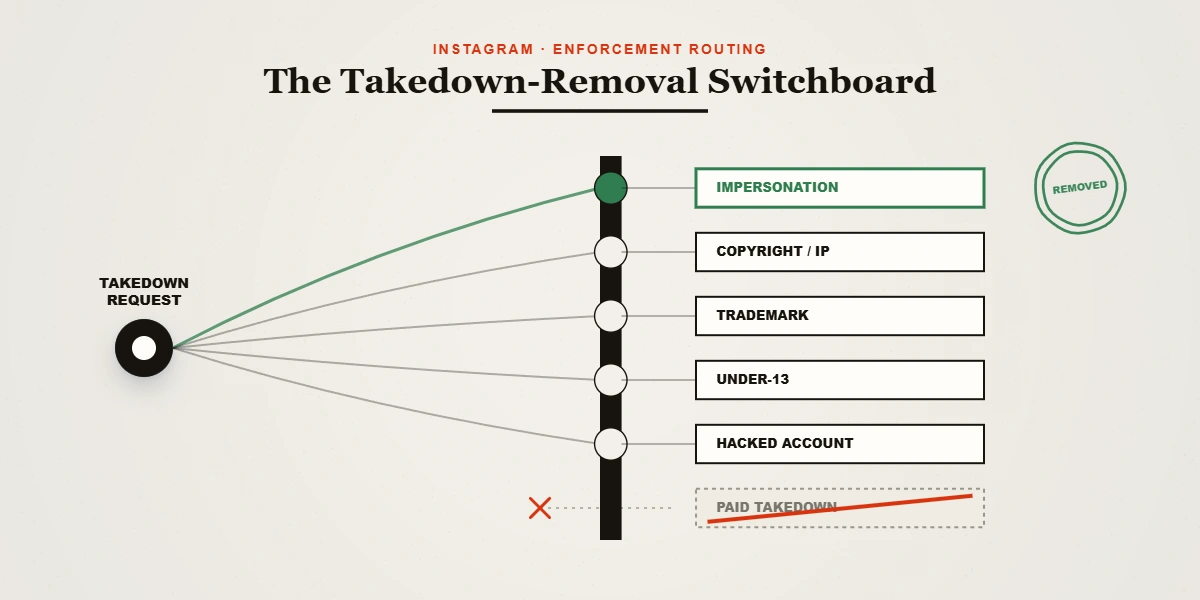
When we file a YouTube impersonation case, the detail that moves it is rarely the paragraph of complaint. It is the channel ID paired with that side-by-side and the two creation dates — reviewers act on that in a way they never do on prose. Since March 2024 our reputation team has filed 96 YouTube takedowns across impersonation, harassment, privacy, and copyright, and the median time from a correctly filed report to removal was 6.1 days. Clear-cut privacy and impersonation cases cleared in a median of 3.2 days in our logs; harassment and defamation, which a reviewer has to read in context, ran past twelve. We also decline close to one in four first inquiries, because the video or channel the person wants gone has not actually broken a rule. For the deeper walk-through of each on-screen form, our full YouTube takedown guide covers the buttons; this page is the map.
Not sure your case even qualifies? Send the offending channel or video link and a two-line description to our team for a free case review. We will tell you honestly whether it's removable, which route fits, and whether you need us at all — before you spend anything.
Copyright, privacy, and strikes: the levers unique to YouTube
YouTube removes content on the same core grounds as every platform, but two of its mechanisms have no clean equivalent elsewhere, and they change how a youtube video removal actually plays out. Understanding them is what separates a filing that works from one that stalls.
Copyright strikes and youtube channel removal
YouTube runs the most developed copyright system of any platform, and it cuts both ways. If someone reuploads your footage, you have two routes: a formal request through the copyright web form, which places a copyright strike on the offending channel, or a Content ID match if you own a catalog large enough to qualify. Three copyright strikes inside a 90-day window, and YouTube terminates the channel — a full youtube channel removal driven entirely by the strike count. That is why a single well-documented copyright claim against a serial reuploader sometimes achieves what a dozen harassment reports cannot. The catch is ownership: the claim is filed under penalty of perjury, so it has to be your work, not merely work you wish you controlled. If your own channel was terminated on strikes you believe were wrong, that is the recovery track, and our YouTube channel recovery service breakdown covers the appeal.
Privacy complaints and youtube video removal
The privacy route is the one most DIY searchers overlook, and it is often the fastest. YouTube's privacy complaint process handles videos that show your face, home, license plate, or private documents without consent — a different standard from harassment, and one that does not require the content to be abusive, only identifying. After you file, the platform notifies the uploader and generally gives them 48 hours to take the video down or blur the identifying material before a reviewer decides. Since 2024 YouTube has also folded some AI-generated and synthetic-likeness complaints into this same flow, which matters if the clip exposing you was faked. A privacy-based youtube video takedown skips the whole "is this harassment?" argument and asks a simpler question a reviewer can answer fast: is that identifiably you, posted without your say-so?
Why mass-report bots can't take down a YouTube channel
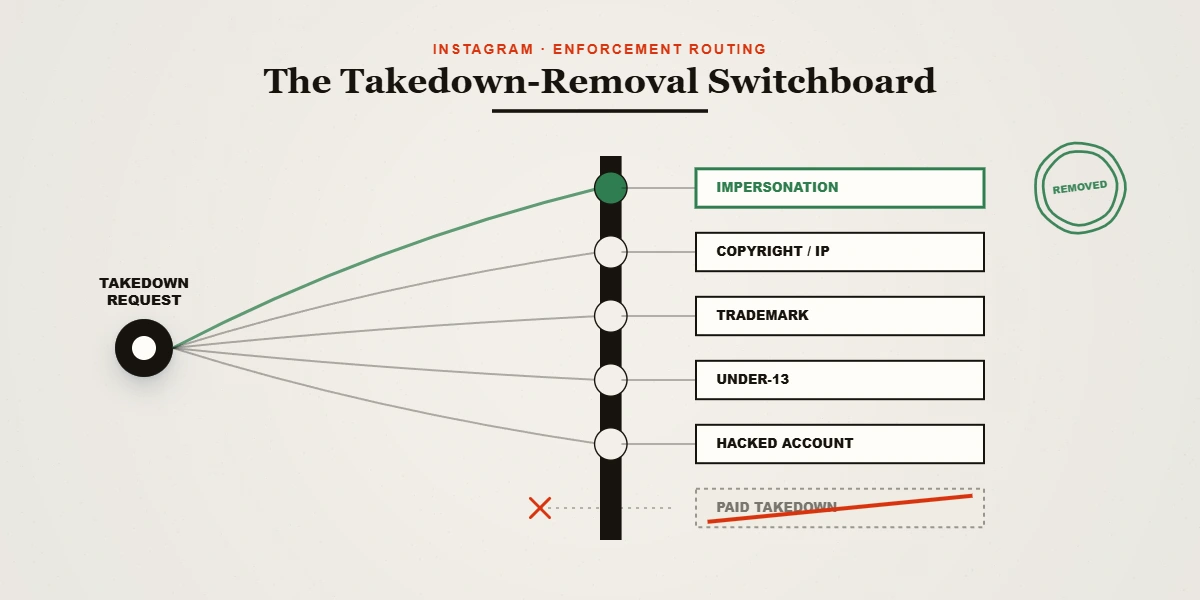
Search "youtube ban service" and much of what surfaces rests on a myth: that volume decides removals, that enough reports fired fast enough will topple any channel. It does not work that way. When a report lands, YouTube weighs the content against a specific line in its policies, not against a tally of how many people clicked report. A thousand reports on a lawful video do exactly what one does — nothing. Worse, a coordinated burst reads to YouTube's systems as spam and platform manipulation, which is itself a violation, so the flood can rebound onto the accounts sending it.
We keep investigating the tools sold to exploit this myth, and the pattern never changes. Our breakdowns of mass-report bots on Telegram, the twitter mass report bot market, the TikTok mass-report bot, Snapchat's mass-report tools, mass-reporting an Instagram account, and the Instagram spam-report bot reach the same verdict every time: the tools are scams, credential-phishing fronts, or spam scripts the platform quietly ignores. The tells are consistent — payment in crypto or gift cards, "ban" screenshots you can't verify, and a prompt to "sign in with Google" that quietly hands the bot your account. Google never asks for your password inside one of these tools, and neither do we. If a seller charges you to exploit a mechanism that does not exist, report them at reportfraud.ftc.gov.
How to vet a YouTube takedown service — and what we won't do
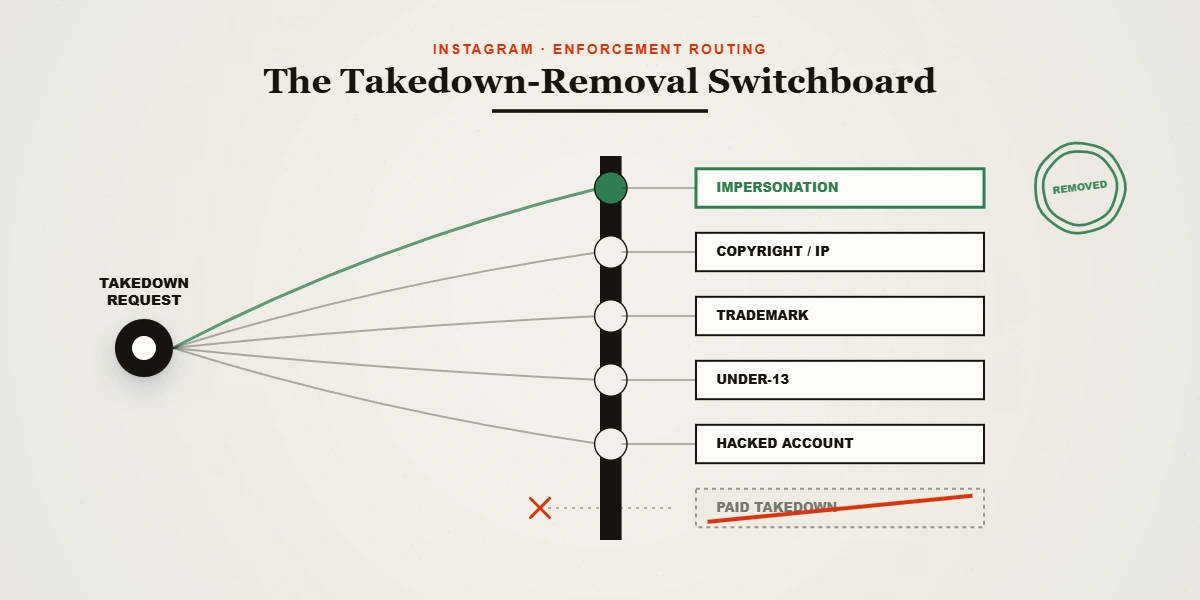
Because the results are scam-heavy, vetting is the first step, not the last. A real youtube ban service and a con look alike from the outside; the difference is in what they refuse to do. Run any provider through this screen before you hand over money or details:
- Does it name the specific violation first? A legitimate service says "this is impersonation" or "this is a privacy breach" before it quotes a price. A scam just says "we'll mass report it."
- Does it ask for your password or a Google verification code? No real service ever needs them — ours included. That request alone is reason enough to walk away.
- Does it promise the outcome? YouTube owns the verdict, so a guaranteed, same-day ban is a red flag, not a feature.
- How does it take payment? A named company with traceable billing beats an anonymous handle demanding crypto.
Those four questions filter out most of the market. If you are weighing recovery offers instead, the same tests apply — our guide on whether a YouTube recovery service is legit walks the vetting in more depth, and our TikTok ban service breakdown shows the identical con wearing a different logo. The boundaries we hold on every case spell out the rest of the lines we won't cross.
The account harming you is not always on YouTube, and the logic travels. Every major platform removes content for the same core reasons and refuses to touch lawful posts; only the forms change. If your problem lives elsewhere, start with the platform-specific route: take down a Facebook account, page, or post, remove an Instagram account, get a TikTok taken down quickly, take down an X or Twitter account, report a Snapchat account, take down a Telegram channel, or get an abusive WhatsApp number banned.
So here is what we will and won't do, because this corner of the internet runs on false promises. We will never ask for your password or a verification code, file a false or bulk report, submit a copyright claim on work you don't own, or guarantee a ban. We don't take pay-to-remove money for outcomes we can't control; our fee covers the casework, win or lose. We decline the requests this exact search attracts — burying a critic, silencing an honest review, knocking a rival's channel offline — because none of those is a rule violation. And if the channel you lost is your own, that is recovery, not a takedown: it starts on a different track, with a free review where we tell you honestly whether your case is even actionable.