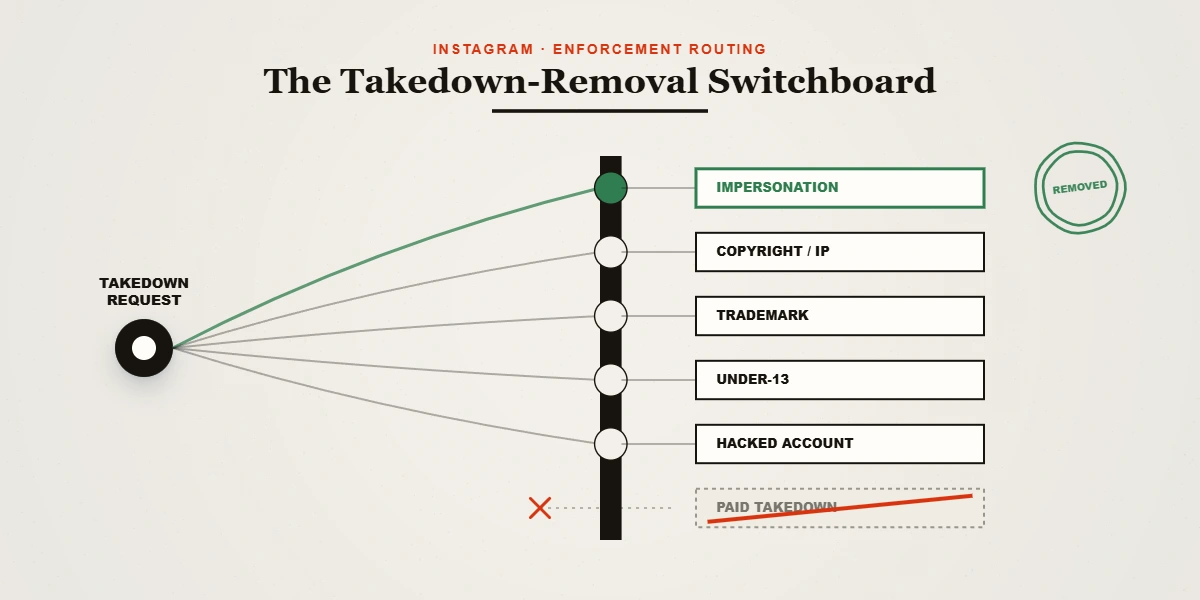
What a TikTok account ban service actually is — and what it can't be
A TikTok account ban service is a professional reporting and takedown service that helps you get a genuinely violating TikTok account removed: it files the right evidence, through the right official channel, so a human reviewer acts on it. It is not a button that bans anyone you dislike. Diego Fernández spent three years on TikTok's Trust & Safety team in Dublin before joining the team behind YRS, and he states the rule plainly: TikTok removes an account for breaking a policy, never for losing an argument. That one fact sets the honest scope of the work. A real service can move fast on impersonation, harassment, non-consensual images, defamation, and stolen content — and it can do nothing about a lawful post you happen to hate. The gap between what people expect and what the platform will actually do is where nearly every scam in this market lives.
There is also a naming problem worth clearing up before you spend a cent. People who search for a "ban TikTok account service", or a plain "tiktok ban service", usually mean one of three very different things:
- The national ban. The on-again, off-again US law that could force TikTok to divest or shut down. That is politics and the courts, not something any service touches.
- A single video or comment. One piece of content you want gone. That is a content takedown, and our companion guide on getting a single TikTok video taken down walks the in-app route step by step.
- A whole account. An impersonator, a harassment account, a fake shop trading on your name. That is an account-level takedown, and it is what this page is about.
Get that distinction right first, because the evidence, the form, and the realistic timeline are different for each one.
When TikTok will actually ban or take down an account
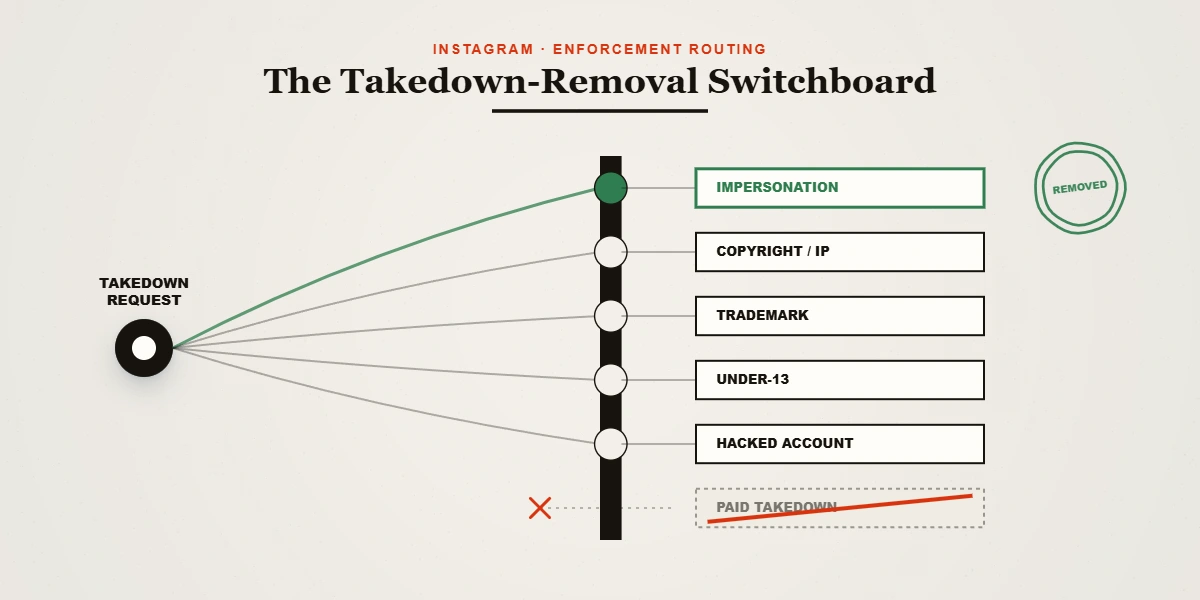
Start with the yes-or-no question, because it saves everyone time: can this specific account be removed? The answer is yes only when the account, or what it posts, breaks a written TikTok rule or the law. These are the categories that genuinely qualify — the ones our caseload actually moves:
- Impersonation. An account cloning your name, face, or brand is the most reliably removed of all, because it is unambiguous. Report it through the profile's "Report account" flow, or file directly through TikTok's impersonation report form with a photo ID or trademark proof.
- Harassment, bullying, and doxxing. Sustained targeting, threats, or the posting of your private address or documents.
- Non-consensual intimate images. Treated as a safety priority. Beyond reporting it in-app, create a case hash at StopNCII.org so participating platforms, TikTok included, can block re-uploads before they spread.
- Defamation. Provably false statements of fact that damage you — usually the route that needs a lawyer's letter behind it.
- Copyright and stolen content. If an account is built on your videos, music, or art, that is an intellectual-property claim. Under US law a copyright notice is a formal DMCA action, and filing a false one carries real liability under 17 U.S.C. § 512(f), so it has to be work you genuinely own.
Now the part the scam sellers never say out loud. TikTok will not ban an account for posting lawful criticism of you, an unflattering-but-true video, an opinion you disagree with, or ordinary content from a competitor. An angry ex, a business rival, a critic — if they are inside the rules, no report and no service will remove them. This is why a "ban TikTok account service" that promises to take down any account on request is either naive or lying: the platform does not have the button they are selling.
How a legitimate TikTok account takedown works, step by step
A TikTok account takedown is the process of getting an entire profile removed by submitting a policy- or law-based report that a reviewer can act on. Done properly it is unglamorous and methodical, closer to building a small case file than pushing a big red button. This is the sequence our team follows on every engagement:
- Diagnose the violation. Match the account to one specific rule — impersonation, harassment, NCII, IP — because a report filed under the wrong category gets closed, and TikTok limits how many attempts you get.
- Gather evidence. Screenshots with visible usernames and dates, the offending URLs, proof of who you are, and, for impersonation, a side-by-side of the real and fake profiles.
- File through the correct channel. In-app for most categories, the dedicated IP or impersonation forms for those, and a formal legal notice where the situation needs weight.
- Escalate and document. If the first review clears the account wrongly, a documented, specific re-submission or legal follow-up carries more force than a second identical tap of "Report."
- Wait for the review — honestly. Clear-cut cases such as obvious impersonation or nudity often resolve within a few hours to 48 hours. Context-heavy cases like harassment or defamation run two days to two weeks. Anything needing a lawyer or a court order stretches to weeks or months.
When we file an impersonation case, the single thing that moves it fastest is that side-by-side of the real and fake profiles with the account creation dates — reviewers act on that in a way they never do on a paragraph of complaint. Across the 180-plus TikTok impersonation, harassment, and takedown cases our team has handled since January 2024, the median time from a correctly filed report to removal was 3.1 days. Fast, but never the "instant" a scam promises. We also turn away roughly 22% of the people who contact us on the first call, because the account they want gone hasn't actually broken a rule — telling them that up front is cheaper for everyone than selling false hope.
Not sure whether your case even qualifies? Send the offending profile link and a two-line description to our team for a free case review. We will tell you honestly whether the account is removable, which channel fits, and whether you need us at all — before you spend anything.
"Tiktok ban service" scams: mass-report bots and guaranteed-ban sellers
Search "tiktok ban service" and most of what you find is a market built on a myth. The myth is that volume bans accounts — that enough reports, fired fast enough, will tip any profile over. It does not work that way, and it never has. When a report lands, TikTok drops it into a queue and judges the content against a specific line in its Community Guidelines, not against a vote count. Ten thousand reports against a lawful account produce exactly what one does: nothing. Worse, a sudden burst of coordinated reports reads to TikTok's systems as brigading, which is itself a violation, so the flood can boomerang onto the people sending it.
We tested this so you don't have to. If you want the long version, our breakdown of whether a TikTok mass report bot actually works documents what we found when we investigated the tools being sold. The short version: every one was a scam, a credential-phishing front, or a spam script TikTok simply ignores. TikTok's own Community Guidelines Enforcement Report shows the large majority of violating videos are removed proactively by automated systems before a single user reports them — so for real violations the report count barely matters, and for non-violations no amount of reporting changes the verdict.
The sellers cluster on Fiverr, Telegram, and Discord, and they share the same tells: payment in crypto or gift cards, screenshots of "bans" they can't verify, and a request that you "log in with TikTok" so the bot can report on your behalf, which is just an account-takeover kit pointed at the buyer. It is the same con on every platform, which is why we have written the same warning about mass reporting an Instagram account, mass report bots and panels sold for X, Telegram mass report bots, Snapchat mass-report tools, and the truth about Instagram spam report bots. If a seller is charging you to exploit a mechanism that doesn't exist, report them at reportfraud.ftc.gov; the FTC logged over 2,300 fake social-media support complaints in 2024 alone.
How to vet a TikTok ban service before you pay
The scam-heavy search results are exactly why vetting should be your first step, not an afterthought. A trustworthy service and a con look similar from the outside; the difference is in what they refuse to do. Run any provider through this screen before you hand over money or details:
| Signal | Legitimate takedown service | "Guaranteed ban" scam |
|---|---|---|
| Names the specific violation first | Yes — impersonation, IP, harassment | No — "we'll just mass report it" |
| Asks for your password or login code | Never | Often ("log in with TikTok") |
| Promises the outcome | No — TikTok decides | Yes — "banned in 24 hours, guaranteed" |
| Payment | Traceable, named company | Crypto or gift cards, anonymous handle |
| What it actually files | Accurate, evidence-backed reports | Bulk junk reports or a fraudulent DMCA |
Two rules cover the rest. First: if a provider asks for your credentials, walk away — no legitimate service, ours included, ever needs them. Second: a guarantee is a red flag, not a feature, because nobody outside TikTok controls the review. If you want a fuller field guide to telling a real operation from a con, our write-up on spotting a legitimate TikTok unban and takedown service from a scam goes deeper, and the boundaries we hold on every case spell out the lines we won't cross for anyone.
Getting harmful accounts removed on other platforms
The account causing you grief is not always on TikTok, and the good news is that the logic travels. Every major platform removes content and accounts for the same core reasons — impersonation, harassment, non-consensual images, and IP theft — and refuses to remove lawful posts, exactly like TikTok. What changes is the specific form and the wording that gets a reviewer to act. If your problem lives somewhere else, start with the platform-specific route:
- Instagram — how to get an Instagram account taken down
- Facebook — how to take down a Facebook account
- Twitter / X — how to take down a Twitter or X account
- Snapchat — how to take down a Snapchat account
- Telegram — how to take down a Telegram channel
- YouTube — how to get a YouTube video taken down
- WhatsApp — how to get someone's WhatsApp banned when the account is genuinely abusing you
Read whichever one fits, and the same honest baseline applies across all of them: a documented, accurate report beats a hundred angry ones, and no service can remove something the platform's rules protect.
What we will and won't do
Because this corner of the internet runs on false promises, our boundaries are worth stating plainly — they are also how you can tell us apart from the sellers above. On any case, for any client, we will never ask for your password or a verification code, file a false or mass report, submit a copyright claim on work you don't own, or guarantee a ban. We don't take pay-to-remove money for outcomes we can't control; our fee covers the casework, win or lose. And we decline the requests this whole keyword attracts — silencing an ex, burying a critic, knocking a competitor offline — because wanting an account gone is not the same as that account breaking a rule.
One more distinction people mix up. This is a service for removing someone else's violating account. If the account you have lost is your own — hacked, locked, or suspended — that is recovery, not a takedown, and it runs on a different track. Our TikTok recovery and takedown service page covers that side and starts every engagement with a free 60-minute review, where a former TikTok Trust & Safety operations specialist tells you honestly whether your case is even actionable. The honest baseline never changes: we can document, escalate, and file with precision, but no one can remove lawful content on demand, and anyone who says otherwise is selling you something that doesn't exist.