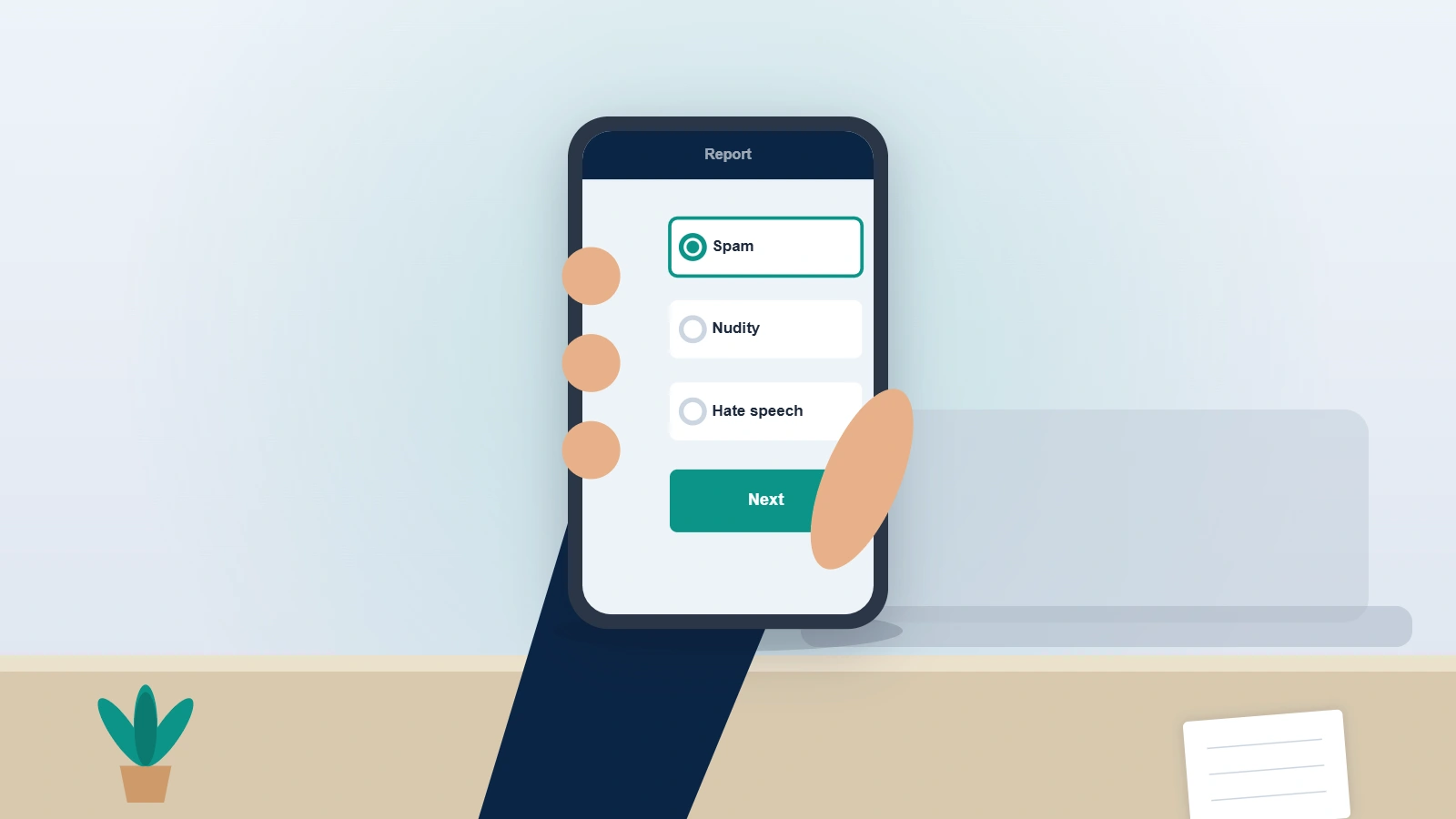
Do Instagram spam report bots actually work?
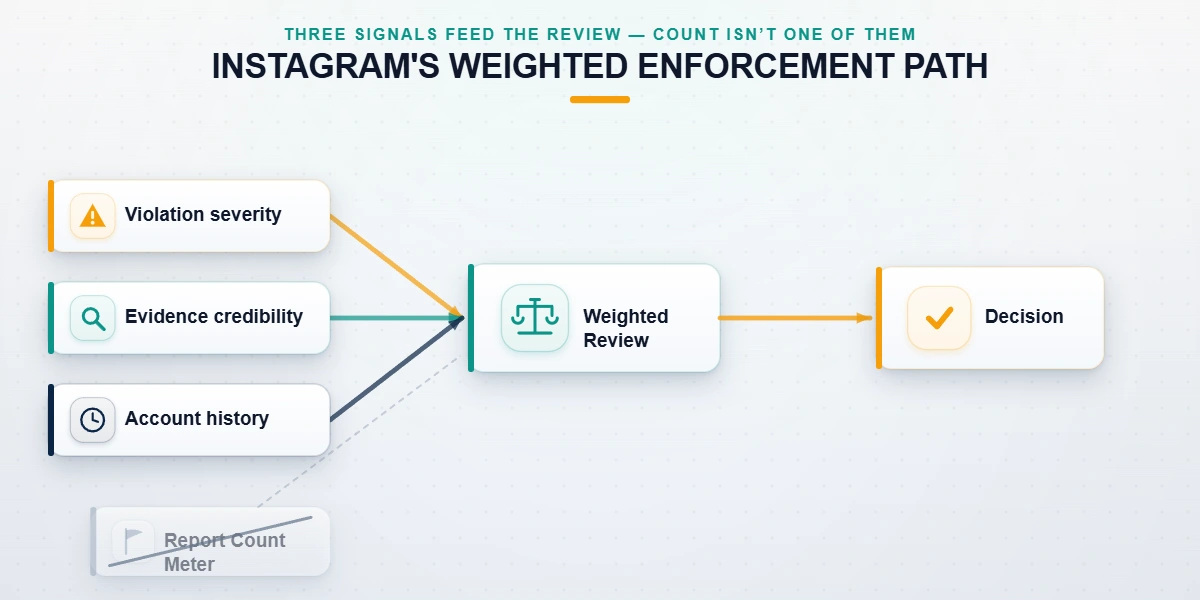
No. An Instagram spam report bot is an automated tool that fires dozens or hundreds of reports at a target profile, and it cannot get an account removed by sheer volume. Instagram does not count reports. It weighs them. Every report that reaches Meta, whether you tap it in by hand or a script sends it a thousand times, lands in the same review queue and is scored on three things: how severe the alleged violation is, how credible the supporting evidence is, and the reported account's own history. A thousand identical low-quality reports score exactly as low as one. That is the whole reason the "92% success" and "ban in 24 hours" claims on bot-selling pages describe an outcome Meta's system was never built to produce.
Whether you searched for an instagram report spam bot, typed spam bot instagram report into Google, or clicked a spam report bot instagram ad, you are looking at the same product with the same ceiling. The tool automates a form. It cannot automate Meta's judgment, and judgment is the only thing that removes an account. Sellers know this, which is why the fine print quietly blames "Instagram's algorithm" when nothing happens, and the refund never arrives.
Under the hood, one of these bots is unremarkable. It scripts the same report endpoint your phone uses and repeats it, sometimes routed through a pool of throwaway accounts to disguise the source. That last detail matters, because reports from brand-new, empty, or automated-looking accounts carry less weight, not more — Meta discounts signals from profiles with no history. So the very trick that lets a bot fire in bulk is the trick that makes each of its reports count for less. You end up with a large pile of very weak signals, which is close to the worst possible input to a system that grades on credibility.
The myth survives on coincidence. An account with a real pattern of violations gets removed the same week a group happens to report it, everyone credits the volume, and the violation that actually did the work goes unnoticed. It is the same illusion behind the broader question of whether mass reporting an Instagram account works at all: the reports never moved the needle, the violation did. There is a legitimate version of what these tools pretend to do, and it runs on the opposite principle: one accurate, well-evidenced report against a genuine violation. Our guide to the real Instagram report and takedown process lays out every route Meta actually honors.
Instagram spam report bot vs. the four real options
Line the choices up side by side and the marketing collapses. Here is what our team sees when clients arrive having already tried one of these routes.
| Approach | What it is | Real cost | Removes accounts? | Risk to you |
|---|---|---|---|---|
| Free "report bot" script | Open-source tool that automates the in-app report form | Free (your time) | No — volume is not an input to review | Your account flagged for automation; possible restriction |
| Paid spam report bot service | A seller fires bulk reports for a per-report fee | ~$0.03/report, into the hundreds per "campaign" | No — the same weighted review applies | Money lost, no refund, plus the same account risk |
| Official Instagram reporting | The in-app Report flow and impersonation/IP forms | Free | Yes, when a genuine violation is proven | None, if your report is truthful |
| Professional escalation | Documented reports, evidence packaging, appeals | Case-based fee, honest ranges | Yes, when a real violation exists | None; your password is never involved |
The pattern is consistent. A paid spam report instagram account bot and a free script share the same fatal flaw: both automate the report form, and neither touches the review that decides the outcome. The marketing behind every instagram spam bot report package leans on stories where an account "went down after we reported it," but those accounts came down because they were breaking a rule, not because a meter filled up. The two routes that genuinely work, official reporting and documented escalation, are the two the bot sellers never mention, because neither one needs them.
It helps to see the paid market for what it is. The pages selling these services travel in packs: near-identical articles under slightly different domain names, the same testimonials, the same round-number success rates, and a Telegram or WhatsApp handle instead of a company address. When clients forward us the receipts, the numbers rarely add up to anything — a few dollars spent, a burst of reports fired, and a target account still online weeks later. You paid for the feeling of doing something, not for a result the platform recognizes.
If your real worry is the reverse, that your own posting might trip enforcement, what genuinely triggers an Instagram ban is worth reading before you touch the report button. The same weighted logic governs takedowns elsewhere; how real TikTok reporting removals work follows an almost identical process, and the identical sales pitch reappears one platform over as Snapchat's mass-report tools.
Can a spam report bot get your own account banned?
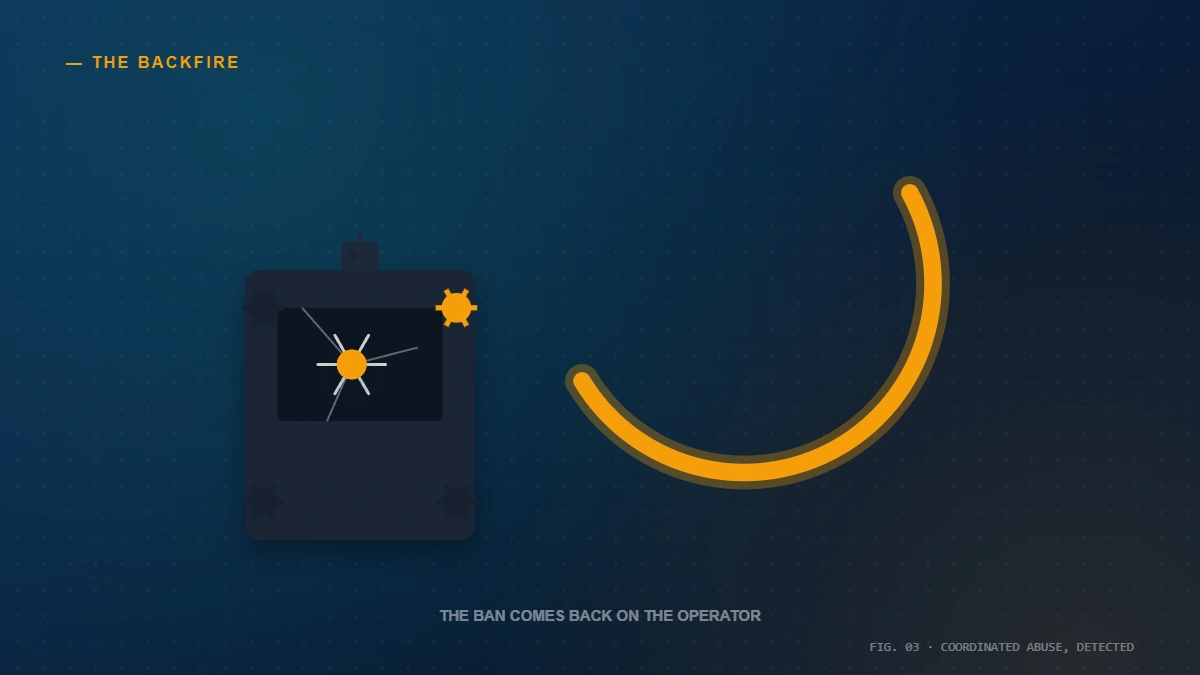
Yes, and this is the risk the sellers bury. Instagram's Terms of Use prohibit accessing the platform through unauthorized automated means, and Meta's Community Standards on spam treat coordinated reporting as a violation in its own right. Any spam report instagram bot you run, against a rival, an ex, or a business you dislike, generates a burst of identical machine-shaped activity that Meta's abuse-detection is tuned to notice. When it flags that pattern, the account it restricts is frequently the reporter's, not the target's. Between January and June 2026, 47 of the Instagram cases that reached our desk began with someone who had already paid for a report bot; none of their target accounts had been removed, and six of those clients were themselves restricted for coordinated reporting (our internal records, as of July 2026).
So let us be plain about where we stand. We won't build, sell, or run these tools, and we won't help anyone mass-report an account they simply dislike. That is a firm line, and it is written into why we don't sell mass-report bots. We also never ask for your password, your two-factor codes, or a payment to "make a report disappear." Anyone who does is running a scam. Legitimate reporting is free, and legitimate escalation works from evidence you already control.
How to report spam bot Instagram accounts the right way
If a spam or bot account is genuinely targeting you, by mass-DMing, impersonating you, or flooding your comments, here is the process that works, free, from inside the app. To report spam bot Instagram accounts, you file against the specific rule they break, not against "spamminess" in general.
- Open the profile, tap the three-dot menu, choose Report, then Report account, and select It's spam. For a single spam post or comment, use the same menu on that item.
- If the account is impersonating you or your business, skip the generic flow and use Instagram's dedicated impersonation form, which asks for a photo of your government ID to confirm you are the real person.
- If it is reposting your photos or your brand, file through Meta's Intellectual Property form instead. Copyright and trademark claims run on a separate, usually faster track.
- Report spam Instagram bot profiles from your own account, not a burner, and report once, with accurate detail. Re-reporting from ten accounts does not add weight; it adds risk.
A few habits make a genuine report weaker, so avoid them. Do not exaggerate the violation into a more serious category than it is — a reviewer who finds the claim overstated tends to distrust the whole report. Do not recruit friends to pile on from their accounts, which reads as coordination. And do not report the same account over and over hoping to force a decision, because one accurate submission with evidence beats fifty resubmissions.
Instagram documents this flow in its own help center on reporting. The difference between a report Meta actions and one it ignores is evidence, not volume. That evidence-first approach carries across platforms, too; reporting an account on X/Twitter follows the same logic, and even a closed network like a Telegram mass-report bot hits the same ceiling once a human reviews what was actually filed.
What actually happens after you report, and how long it takes
Once you file, the report enters Meta's review pipeline: an automated classifier first, then a human reviewer for anything ambiguous or high-stakes. The classifier clears the obvious cases in minutes to hours. Everything else waits for a person, and that is where the quality of your evidence decides the result. In the cases our team files, a truthful impersonation report backed by a government-ID match typically actions within two to five business days; a clean intellectual-property notice often moves faster, inside 24 to 72 hours; and a vague "this is spam" tap with nothing attached can sit unresolved for weeks or quietly close as "no violation found." None of that timing responds to how many times an account is reported. It responds to whether the evidence in front of the reviewer proves a rule was broken.
This is also why the category you choose matters as much as the evidence. Instagram routes an impersonation claim, a copyright notice, a harassment report, and a generic spam flag into different queues, with different reviewers and different thresholds. Pick the wrong category and even a valid complaint can land where no one is looking for it. One report filed under the right category, with the right proof, routinely outperforms five hundred automated flags scattered across the wrong ones. Volume spreads your signal thin; precision concentrates it where a reviewer can act. It is the same math that decides whether a TikTok mass-report bot or a mass-report Twitter account campaign ever works: precision beats volume on every platform where the review is weighted, which is all of them.
When we file an impersonation claim, we attach the ID match and a side-by-side of the real and fake profiles up front, precisely because a report that arrives with proof clears review faster than one a moderator has to build from scratch. That single habit, evidence first, is the entire difference between a report that works and a bot that fires a thousand empty ones.
What to do when reporting isn't enough
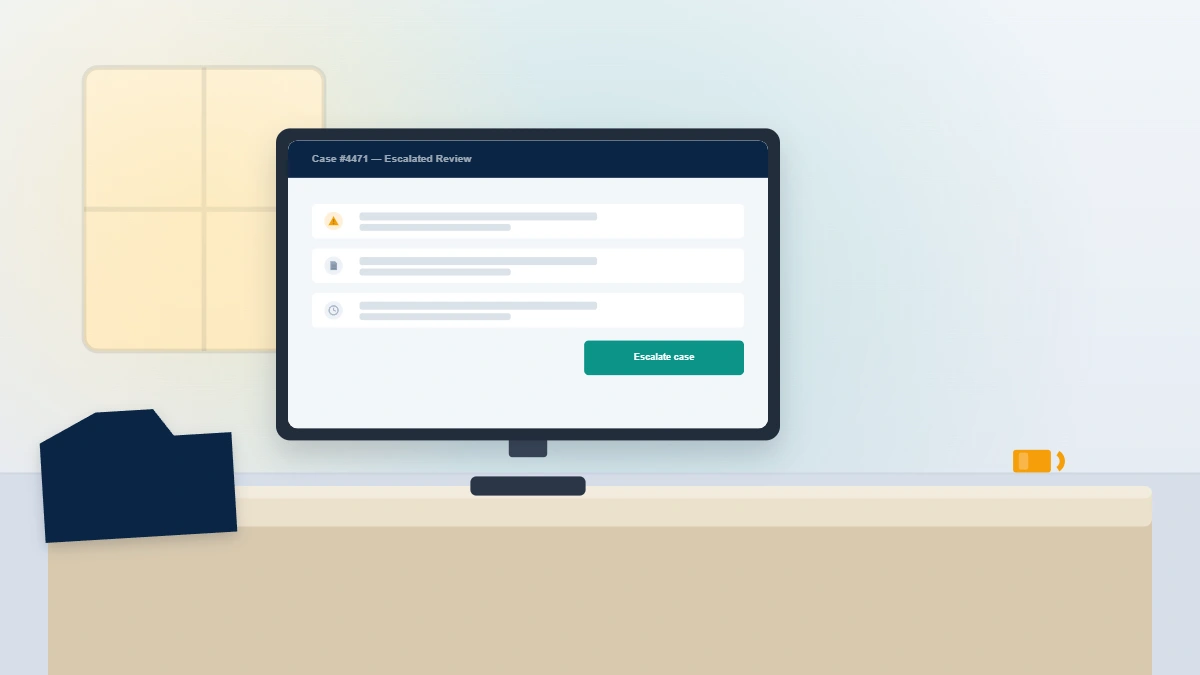
Sometimes the official route stalls. A determined impersonator rebuilds under a new handle, a coordinated spam ring keeps spinning up profiles, or your own account gets taken down by a false-report wave you did nothing to cause. That is the point where documented escalation earns its place, and where the people who actually reviewed these cases inside the platforms become useful.
The distinction we draw for every client is between three situations people tend to lump together: reporting genuine spam that is breaking the rules, which is legitimate and free; mass-reporting an account you dislike, which is a policy violation we won't touch; and recovering your own account after a false-report wave, which is a real, supported case. Naming which one you are actually in is usually the first useful thing that happens on a call with us.
For someone whose account was removed by exactly the kind of mass-reporting these bots automate, the path is recovery and appeal, not retaliation. Our walkthroughs on restoring a permanently disabled profile and recovering a wrongly-flagged account cover the appeal evidence Meta's reviewers look for.
If reporting hasn't worked, or your own account was caught in a false-report wave, speak with a specialist about your case. We review the situation first and tell you honestly whether it is recoverable, before you pay anything, and without ever asking for your password.
When a case genuinely needs hands-on work, that is what our Instagram account recovery service is for: documented reports, evidence packaging, and appeals filed the way Meta's reviewers expect to receive them. We work on honest timelines rather than guarantees, and we will tell you up front when a case is not worth your money.
What we will and won't do
Your Reputation Solution is run by people who used to sit on the other side of this queue. The team behind Your Reputation Solution includes former Meta and TikTok Trust and Safety staff who reviewed reports exactly like the ones this article describes, and that experience is why our answer on report bots is a flat no. We won't build them, sell them, or run them. We won't mass-report an account you dislike. We won't promise a removal we cannot stand behind, and we won't handle your login credentials to do any of it.
There are also limits no service can move. Content tied to child safety, terrorism, or sustained criminal harassment is handled by Meta's specialist teams and law enforcement, not by consumer reporting and not by us. What we can do is tell you, honestly and early, which category your situation falls into and whether the legitimate path is likely to work. That answer is worth more than any bot's invented success rate.