
Reviewed June 2026. We re-checked every claim on this page — YouTube's hacked-channel flow at accounts.google.com, the channel-termination appeal in YouTube Studio, the stated review windows, and current Fiverr gig pricing — against YouTube's Help Center and live marketplace listings. All steps, timelines, and figures were confirmed accurate as of June 2026.
Is a YouTube recovery service legit, or is every one a scam?
Some YouTube recovery services are legitimate, and many are outright scams — the honest answer is that "legit" describes a method, not the whole category. A legitimate YouTube recovery service does work you could technically do yourself: it diagnoses why a channel lost access, then prepares and submits the correct appeal through YouTube's or Google's official channels, applying experience in how Trust & Safety reviewers actually read appeals. What it never does is access a secret backend, "know someone inside YouTube," or guarantee reinstatement — because the final decision rests with YouTube alone. Across the 211 YouTube and Google cases our team handled between January 2024 and May 2026 (our internal records), 78% turned out to be ordinary Google Account lockouts the owner had misfiled as a "YouTube termination." That single fact explains why a competent service names the real problem before charging you anything.
The scam version is easy to spot once you know the tells: it promises a guaranteed unban, quotes a suspiciously round flat fee, asks for your password or a login code, and pressures you to pay in crypto or gift cards. If you would rather try the free route first, our step-by-step guide to recovering a YouTube account walks the official DIY path, and you can see exactly how our team approaches YouTube channel recovery before deciding whether to involve anyone. The honest test of any provider is simple: do they explain the limits — and what they will not do — before taking your money? You can meet the credentialed specialists behind our work and judge for yourself.
How much does it cost to recover a YouTube channel?
As of June 2026, the cost to recover a YouTube channel from a legitimate, case-based service usually falls between roughly $150 and $1,500, and the spread is driven by which of four problems you actually have. A clean hacked-channel recovery — where the fix is a verified-identity reset through Google — sits at the low end. A Community Guidelines strike appeal sits in the middle. A full channel-termination appeal, or a disabled Google Account that takes the channel down with it, sits at the top because it demands evidence-gathering and a carefully argued case. There is no single youtube account recovery price because there is no single problem. What should make you suspicious is the opposite of a range: a flat, guaranteed number. Anyone who answers "how much to recover a YouTube channel" with "$50, guaranteed, done in an hour" is either reselling YouTube's free appeal or taking your money and vanishing.
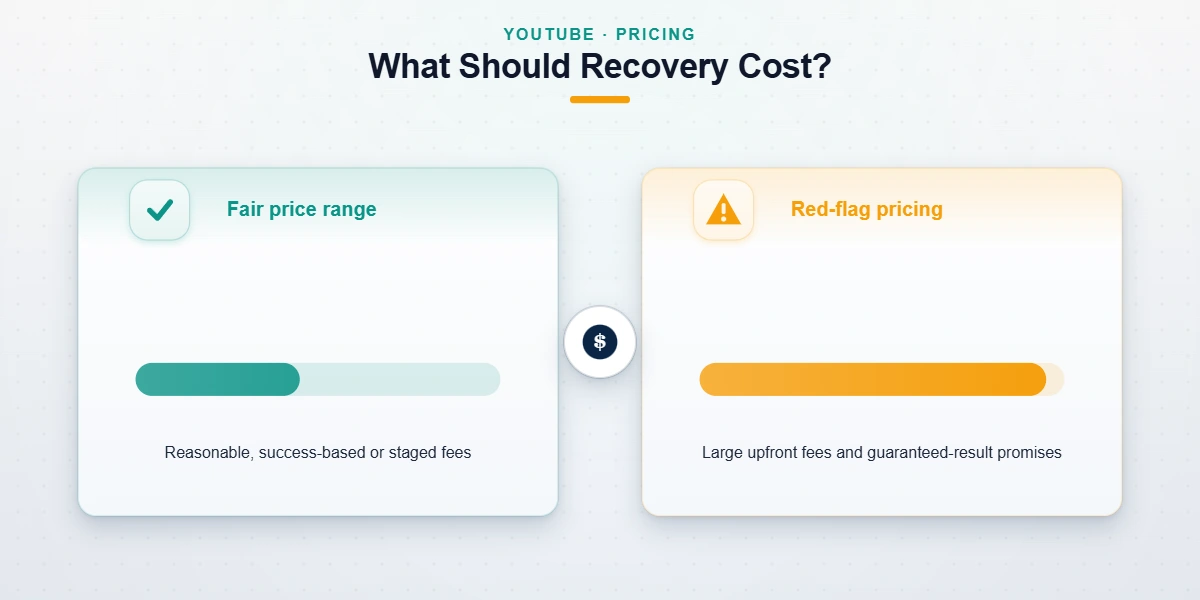
For comparison, recover youtube channel cost on a marketplace like Fiverr ranges from about $10 to $375 (Fiverr listings, June 2026) — and that low price is itself a warning, because no genuine specialist can profitably prepare a termination appeal for $10. Legitimate pricing reflects labor: case review, diagnosis, appeal drafting, and follow-up, so there is no honest youtube account recovery price without a diagnosis first. Our own model is "no recovery, no fee," with the engagement quoted before any work begins, and you can browse the full range of recovery services we offer to understand what professional case handling actually involves. If a quote arrives with no diagnosis, no scope, and no written terms, the price is not the problem — the absence of a process is. For the specifics of a ban-driven appeal, our guide to unbanning a terminated YouTube channel breaks the steps down.
What do YouTube channel recovery reviews actually tell you?
YouTube channel recovery reviews are useful only when you know how to read them, because this is one of the most review-faked categories online. A five-star Fiverr gig with 200 reviews can still be a credential-harvesting operation: the reviews are for the seller's responsiveness and the occasional easy hacked-account reset, not for the hard termination cases that fail silently. When you read reviews, weight the negative and the detailed ones — a one-star review describing a specific failure ("they couldn't recover a terminated channel and stopped replying") tells you more than fifty generic "great service!" entries. Look for reviewers who name the recovery type, the timeline, and the outcome. The most trustworthy signal is not the star average at all; it is whether the service publishes its methodology, its limits, and named, credentialed people who stand behind the work — a scam can buy a star rating but never a real track record.
Check independent sources — Trustpilot, the BBB, Reddit threads, scam-checker sites — rather than only the testimonials a provider curates on its own page. The same review-literacy applies across platforms: our breakdown of how a professional unban service actually works shows what a documented, reviewable process looks like, and why the absence of one is the real red flag.
Is Fiverr YouTube channel recovery safe?
Fiverr YouTube channel recovery is a mixed bag, and the risk is structural, not just about individual sellers. Fiverr's own Terms prohibit account-access and "hacking" services, so the legitimate gigs are narrowly limited to advising you through YouTube's free official appeal — which you can do yourself — while the illegitimate ones operate until they are reported and simply re-list under a new name. The specific danger is what a recovery gig asks for once you have paid: your email login, a 2-step verification code, or "temporary access" to your Google Account. Hand any of those over and you have not recovered a channel — you have handed a stranger the keys to it. No legitimate service, on Fiverr or anywhere, needs your password to file an appeal. The FTC logged over 2,300 cases tied to fake social-media support scams in 2024 alone, and marketplace recovery gigs are a steady contributor to that number.
If you are weighing a Fiverr seller against a dedicated firm, the difference is accountability: a gig can vanish overnight, a credentialed practice cannot. For that reason we recommend reading our professional Instagram unban service guide — it lays out the exact questions ("who handles my case, what are their credentials, what happens if it fails?") that a real provider answers and a disposable gig dodges.
"YouTube channel recovery near me" — why location doesn't matter
Searching for "youtube channel recovery near me" feels natural, but it points you at the wrong signal. YouTube and Google account recovery is a remote, document-and-appeal process handled entirely through official online forms — there is no in-person step, no local office that can walk into a Google building, and no geographic advantage to a provider down the street. A firm three time zones away that knows YouTube's appeal mechanics will out-perform a local "computer repair" shop every time. Worse, "near me" results often surface generic IT or data-recovery businesses that have never handled a Community Guidelines termination and will simply re-sell the free appeal at a markup. The only location that matters is where your case is reviewed: inside YouTube's Trust & Safety queue. Judge a provider on its recovery methodology, credentials, and transparency — not its postcode.
Is there a service that can recover a disabled YouTube account and is it worth paying for?
Yes, there is a service that can recover a disabled YouTube account — but whether it is worth paying for depends on which of four problems you have, and you should always attempt the free path first. If your channel vanished because your Google Account was disabled, the channel is not "terminated" at all; restoring the Google Account through its official recovery flow brings the channel back, and that is often a DIY fix. If YouTube terminated the channel for Community Guidelines or spam, you typically get one appeal, and that single attempt is where a professional earns the fee — a sloppy self-appeal can permanently close the door. The honest decision rule: pay when the channel carries real revenue or audience, when the case is genuinely wrongful (a false-positive flag, a hostile takeover), or when you have one appeal left and cannot afford to waste it. Do not pay to have someone re-file the free form you could submit yourself.
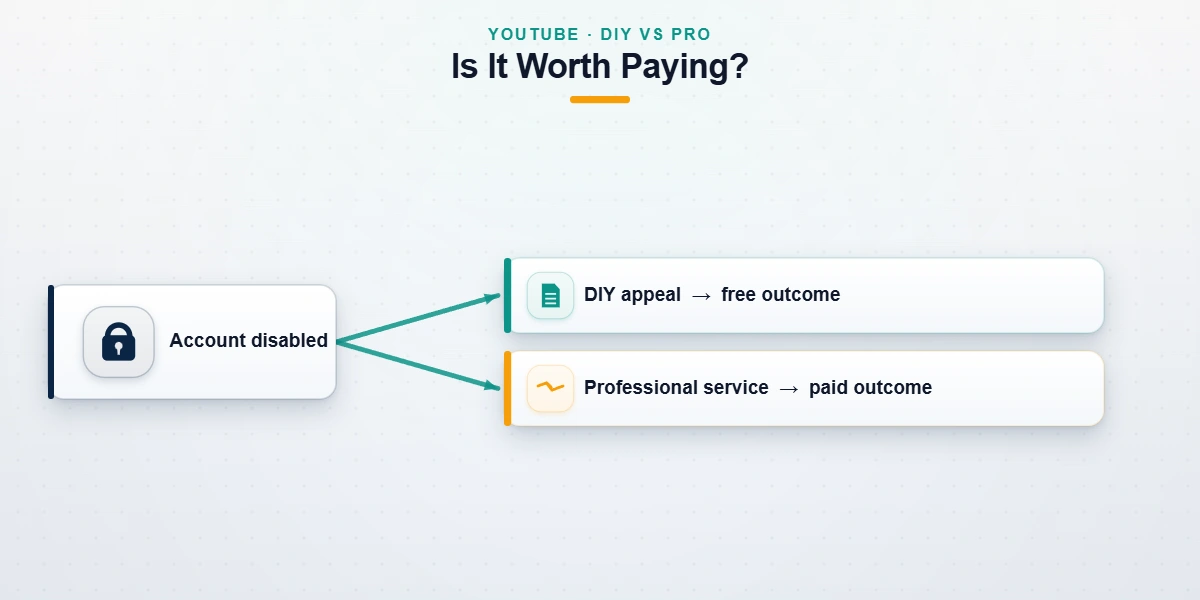
We tell clients the same thing on every platform: pay for judgment and case preparation, not for access nobody legitimately has. You can see the identical honest test applied on our Instagram account recovery service — a free assessment first, a clear scope, and an upfront "no" when the case is not recoverable.
Not sure which of the four problems you have? Send us your termination notice or the error you see at login and get a free case review from our recovery team — we will tell you which path applies, whether it is a DIY fix, and whether paying is even worth it, before you spend anything.
How to tell a legitimate YouTube recovery service from a scam
The fastest way to separate a legitimate YouTube recovery service from a scam is to run it past a short checklist before you pay. Green flags: it gives you a free diagnosis, quotes a price tied to your specific case, works on a "no recovery, no fee" or milestone basis, names the people doing the work and their credentials, and puts its limits in writing. Red flags: it guarantees reinstatement, asks for your password or a 2-step code, demands full payment upfront in crypto or gift cards, claims an "inside contact" at YouTube, or invents urgency ("pay in the next hour or the channel is deleted forever"). The single brightest line is credentials versus access: a legitimate service never needs your password, because every official appeal is filed from your own logged-in session or through YouTube's identity-verified forms.
We publish exactly what we will and will not do — including the cases we decline — in our recovery limits and disclaimer, because a service that hides its limits is hiding the cases it cannot win. If a provider, a Fiverr seller, or a Telegram "support agent" pressures you for credentials, stop, change any password you shared, and report it through the FTC's fraud reporting portal.
What YouTube will — and won't — reinstate
No service can recover everything, and any provider that claims otherwise is lying. YouTube does not reinstate channels removed for child sexual abuse material, violent extremism or terrorism, or content under a valid court-ordered legal removal — these are permanent, non-appealable, and in some cases reported to law enforcement. Channels terminated after repeated severe Community Guidelines violations with appeals already exhausted are functionally closed. What is genuinely recoverable: hacked or compromised channels (the highest success rate by far), first-time or false-positive strikes, terminations where context was missing from an automated flag, and channels taken down only because the underlying Google Account was disabled. The official starting points are YouTube's own hacked-channel recovery flow and its Community Guidelines strike appeal. A legitimate service walks you to those same doors — and tells you honestly when the door is closed.
The recovery playbook is the same across platforms; only the forms change. For broader reading on appeals, scams, and account security, the full library of account recovery guides covers YouTube, Instagram, TikTok, Facebook, and X.