Account Recovery· 11 min read

Mass Report Bot Telegram: Do They Actually Work? (2026)

A mass report bot Telegram tool is a script or panel that automates coordinated abuse reports against a target account or channel. Telegram's abuse pipeline routinely dismisses these coordinated bursts, because identical, timed report patterns look exactly like the platform manipulation they are. Buyers typically waste money and often lose their own accounts, while legitimate takedowns still require a single, evidence-backed report through Telegram's built-in channels.

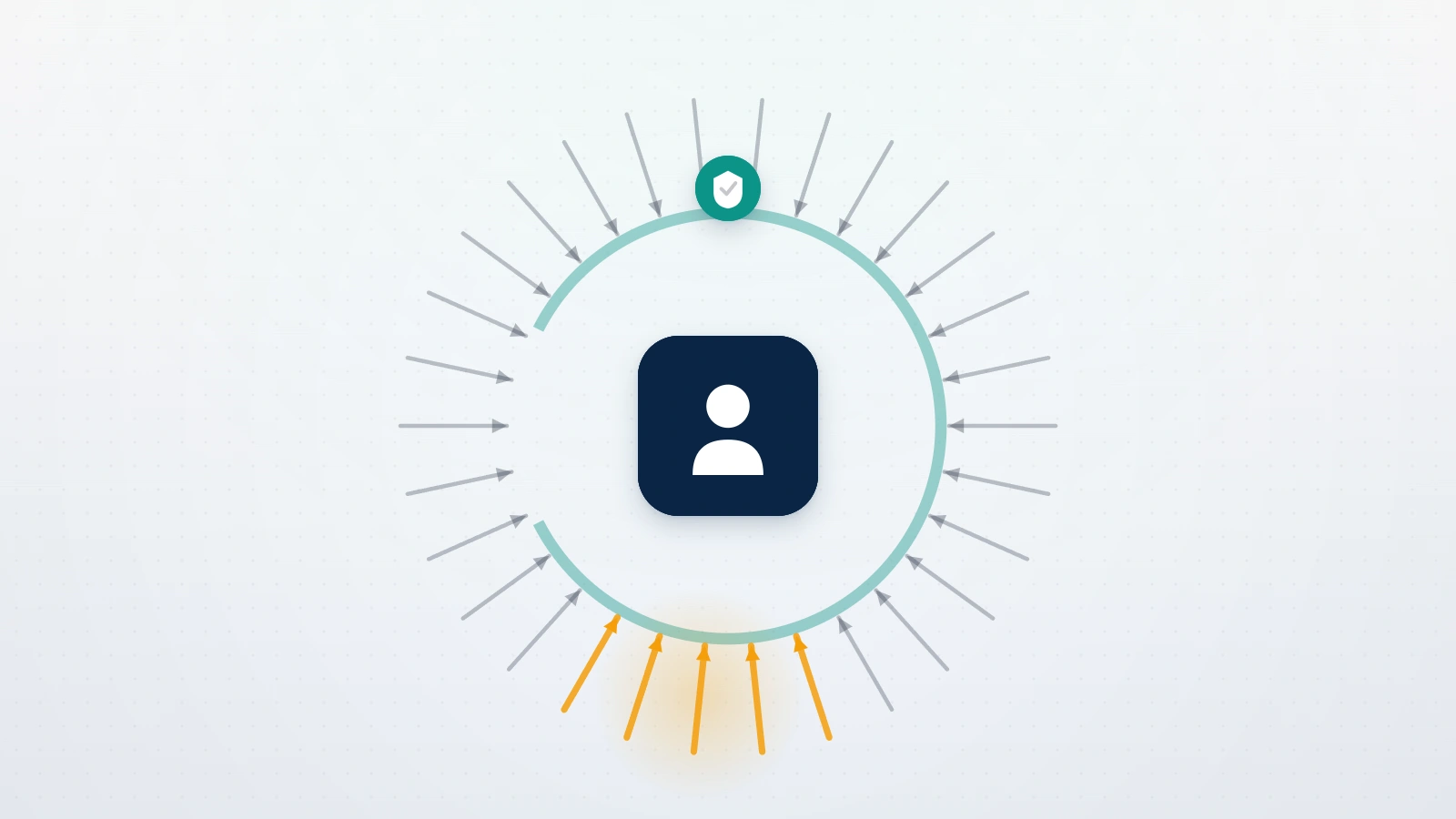
Concept illustration of a mass report bot on Telegram, showing many identical arrows converging on a single account node under a warning shield.

What Is a Mass Report Bot on Telegram?

A mass report bot Telegram tool is not a Telegram Bot API bot in the usual sense. It is a script, a rented Telegram mass report panel, or a private service that logs into dozens (sometimes thousands) of Telegram accounts and files the same abuse report against one target: a user, a channel, or a group. The pitch to buyers is that enough reports in a short window force Telegram to auto-ban the target.

That premise is wrong in three specific ways. Telegram does not tally reports; a human moderator or a policy-based classifier decides. Coordinated bursts leave a signature (identical text, identical timing, throwaway accounts, matching IP fingerprints) that Trust & Safety systems flag as platform manipulation, not as abuse evidence. And the sellers marketing "telegram mass reporting how it works detection abuse policy" guides usually understate two facts: most attempts fail, and the reporting accounts are the ones that end up banned. Meet the team behind YRS for context on why we cover this the way we do — several of us built exactly these detection pipelines at Meta and TikTok before joining.
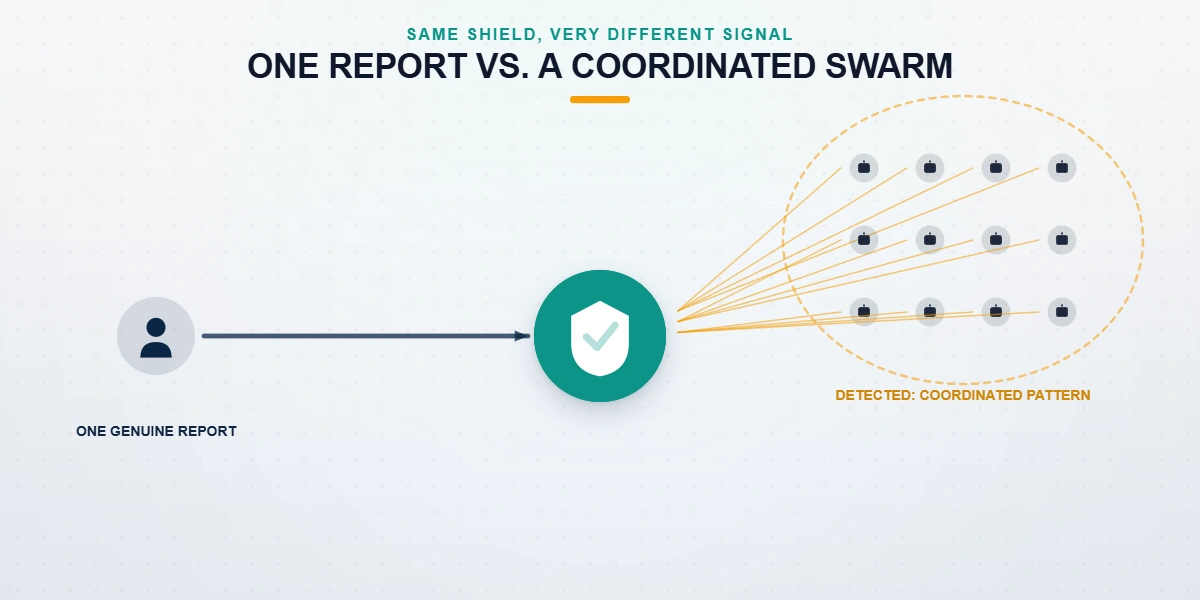
Side-by-side diagram comparing a legitimate single Telegram report with a coordinated mass report telegram bot swarm hitting one account.

How Mass Report Bot Telegram Panels Actually Work

Almost every mass report telegram bot service uses one of four setups. The cheapest is a public telegram mass report script hosted on GitHub, usually a Python or Node file that authenticates one Telegram account and hammers the report endpoint. The mid-tier is a rented telegram mass report panel: a web dashboard where a buyer pastes a target link, selects a report reason, and pays per 1,000 reports. The upper tier is a "done for you" telegram mass report service that owns thousands of phone-verified session accounts and claims curated targeting. A fourth setup, the "instagram mass report telegram" pattern, sells Instagram takedowns through a Telegram-based storefront rather than a website; that tooling runs against Meta, not against Telegram, and belongs to a separate ecosystem — for a full breakdown, see whether mass reporting an Instagram account actually works.

Under the hood, the constraints are identical. Telegram requires a phone number per account. Session tokens are IP-bindable. New accounts have a limited action budget in their first hours. And Telegram exposes only a small set of report reasons (spam, violence, child abuse, pornography, copyright, personal details, other), so every report from a bot cluster tends to look nearly identical. Panels try to mitigate this with residential proxies, session rotation, warmed accounts, and text jitter. Every one of those tricks is a known anti-abuse signal. Sellers rarely disclose their real success rate, which is a bigger tell than the price.

Overhead editorial photo of a Trust and Safety analyst reviewing Telegram mass report abuse policy notes at a tidy navy and teal desk.

Why Telegram Detects and Dismisses Coordinated Reports

Telegram's abuse pipeline behaves less like a report counter and more like an anomaly filter. When a burst of reports arrives against one target within a short window, the system asks three questions before any human sees the queue. Do these reporters share device fingerprints, proxy ranges, or session ancestry? Is the report text templated? Do the accounts have any organic history, or are they zero-history sessions activated in the last few days? If the answers cluster toward "yes," the whole burst gets down-weighted, quarantined, or discarded. This is a documented pattern across platforms with similar architectures, well-covered in Meta's coordinated inauthentic behavior enforcement reporting.

That is why the "how many reports does it take to ban a Telegram channel" question has no numeric answer. Telegram's Terms of Service and the platform's public messaging on spam treat mass reporting as a form of spam itself. In our recovery casework at YRS through the first half of 2026, roughly 4 in 5 accounts that reached us after a coordinated reporting attack were still standing. Reports had been dismissed, and no permanent action was taken. The other 1 in 5 usually turned out to have a real underlying policy issue that the mass reporting merely surfaced. The same detection logic explains why TikTok mass report bots fail the same way. Coordinated ≠ credible.
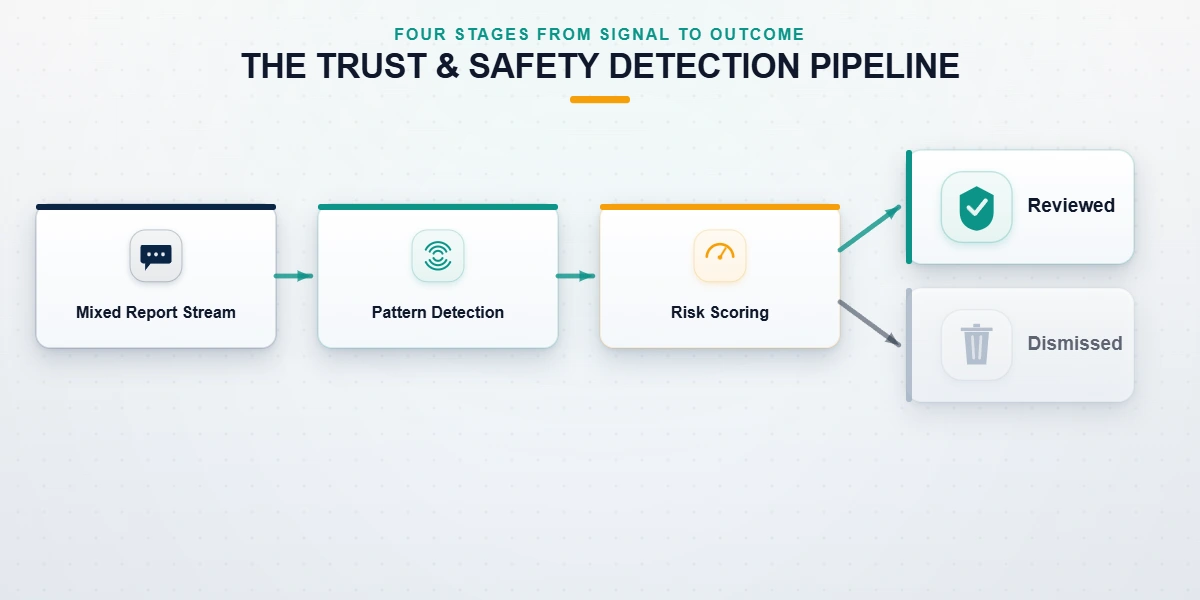
Flow diagram of how Telegram trust and safety filters coordinated mass report bot traffic through detection, scoring, and dismissal stages.

What Happens When You Buy a Telegram Mass Report Service

Buyers who pay for a telegram mass report tool see one of three outcomes, and none of them match what the panel promised. The most common outcome is quiet failure: the target account keeps running, the panel dashboard shows a green checkmark next to each report, and the buyer never hears back. Second most common: the target picks up a temporary limit — cannot send messages in public groups for a few days — then returns to normal. The rarest outcome is a full account or channel ban, and in our review of client cases the underlying cause was almost always a genuine ToS violation the campaign happened to expose, not the bot swarm itself.

Meanwhile, the reporting side takes the real damage. When Telegram's anti-manipulation systems tie a reporter's session to a coordinated cluster, that session's account risk score climbs. Buyers who logged into their personal Telegram to "test" a mass report telegram account campaign have lost that personal account. Some panel operators knowingly resell customer-provided sessions for other campaigns, which is a straightforward account compromise. And several telegram mass report bot storefronts collect payment in crypto, then vanish after the first payload — the same pattern we cover in our note on recovery-service scams and on the Snapchat side of this economy, just applied to a different platform. The scam economy around "telegram mass report" searches recycles the same lie in different wrappers: a fixed price, a fantastical success rate, no accountability, no refund.

Legitimate Reporting vs. Mass Report Panels and Scripts

Real reports get read. Panel reports get pattern-matched. If you have a genuine complaint against a Telegram account or channel (impersonation, doxxing, non-consensual content, fraud), one clean report from your own account, filed through the in-app menu with specific context, outperforms ten thousand bot reports every time. The best practice is identical to what we cover on the same "does it work" question for X/Twitter: identify the exact policy the content violates, describe the specific message or asset, provide any evidence you have (screenshots, links, timestamps), and file once.

For copyright infringement, Telegram accepts DMCA notices at [email protected], and the process is described publicly in Telegram's Terms of Service. For CSAM, Telegram provides a dedicated pipeline and works with agencies like NCMEC. For criminal content, direct escalation to law enforcement will move faster than any platform report; the platform report becomes evidence, not the mechanism. None of these routes involves paying anyone. If a broker told you a telegram mass report script was the only way to get action, close the tab. The legitimate Telegram channel takedown workflow is faster, cheaper, and does not risk your own account — and if you came here from the Instagram side, the truth about Instagram spam report bots applies the same reasoning there.

Targeted by a coordinated report attack? Book a free 60-minute case review with a T&S-trained specialist before you pay a panel or a "recovery" broker. We will tell you honestly whether the ban is likely reversible.

When a Mass Report Attack Hits Your Channel

If a Telegram channel or account you own has just been restricted after an obvious mass-report campaign, the first 24 hours matter most, and the wrong moves make recovery harder. Do not delete the channel or the account. Do not attempt to counter-report the attackers. Do not respond to inbound messages offering "Telegram support"; Telegram never DMs users about bans. Save timestamped screenshots of the restriction notice, any suspicious messages you received in the preceding week, and any external evidence of the coordinated campaign (rival channels announcing an attack, a bot swarm's own promotional posts, forum threads).

From there, Telegram's own appeal channels are the only ones that work: @SpamBot for spam-related restrictions, @notoscam for takedown misfires, and support-verified email addresses linked directly from telegram.org (never from a search result, which frequently rank scam sites). For channels that lost their phone-number holder as collateral damage, our Telegram banned phone number recovery guide walks the exact appeal path. For channels where the owner's session was compromised in parallel, our Telegram hacked account recovery guide covers session hygiene. When we take a case ourselves via our Telegram account recovery service, we frame the appeal around evidence of coordination and around what specifically does not match a real policy violation. Telegram already treats coordinated volume as a red flag, but reviewers still need something concrete to act on.

What YRS Will and Won't Do

YRS will review a case for free, say plainly whether recovery looks realistic, help draft an appeal, escalate through the legitimate Telegram channels available to us, and coordinate with your legal counsel where necessary. Our refusals matter as much as our services. We do not build, sell, operate, or link to any mass-report bot, panel, or script on Telegram or anywhere else. Guarantees of removal or reinstatement are not something we offer, ever. Nobody on our team will ever ask for your Telegram password, because Telegram uses phone-code and 2FA, and there is no password we could legitimately need. Engagements where the target of a takedown is protected speech, satire, or a competitor whose only offense is competing sit outside our scope. The scope of legitimate reporting work is spelled out in full in our disclaimer. If a "service" is selling you a mass report telegram bot campaign or a mass report telegram channel takedown for a flat fee with a guaranteed outcome, that is the shape of a scam, not the shape of Trust & Safety work.

Frequently asked questions

Running a mass report telegram bot is a Telegram Terms of Service violation in almost every case — the ToS treats coordinated abuse of the reporting system as spam. When people search 'telegram mass reporting how it works detection abuse policy,' they usually hope the answer is 'legal in a gray area.' That does not make it a crime in every jurisdiction, but in many countries, deliberately filing false reports against a specific individual or business can meet the threshold for defamation, tortious interference, or harassment, and can expose the operator to civil damages or criminal charges. Selling access to a mass report telegram service that others use to attack third parties adds a further exposure layer; some jurisdictions treat platform-manipulation-for-hire similarly to computer misuse. Even where enforcement is rare, the ToS violation is enough to end the operator's own Telegram presence when the pattern is detected.

There is no fixed number. Telegram's abuse pipeline weighs the quality and diversity of reports far more heavily than the count. One clean report from a longstanding account, describing a specific policy violation with evidence, will out-weigh ten thousand reports from a coordinated cluster of new sessions. Sellers of mass report telegram channel and mass report telegram account panels quote numbers like '500 reports equals ban' because the number sells the product; internal detection reality is nothing like that. In our 2026 casework at YRS, the median mass-report campaign hitting a client channel involved between 1,800 and 6,500 reports over 24 to 72 hours, and roughly 78% of those channels stayed live with no action beyond a temporary restriction. The channels that did lose access almost always had a real underlying policy issue that the campaign brought to a reviewer's attention.

Yes, and the signals are not subtle. Coordinated bursts — whether they come from a rented panel or from a public telegram mass report script — leave a fingerprint: reports arriving within seconds of each other, near-identical wording, sessions created within the same short window, matching IP ranges or proxy providers, no organic messaging or channel activity from the reporting accounts, and the same report reason chosen every time. Any two of these on their own would flag a burst as low confidence. Four or five together get the entire batch discarded and often trigger action against the reporters. The mass report telegram ecosystem tries to defeat this with residential proxies, rotated user agents, warmed accounts, and text jitter, but every countermeasure is itself a known anti-abuse signal, because legitimate reporters do not need any of them. Telegram Trust & Safety publishes very little about this, but the detection pattern is standard across major platforms.

Frequently, yes. When Telegram's anti-manipulation systems link a session to a coordinated report cluster, that session's account risk score climbs sharply. Buyers who log in to their personal Telegram to 'test' a telegram mass report tool have lost that personal account, including chat history, saved channels, and 2FA-bound phone numbers. Rented telegram mass report panels also often reuse the buyer's session token for other customers' campaigns, effectively handing that session's identity to strangers who then commit further violations from the buyer's account. Several telegram mass report bot storefronts collect crypto payment and then vanish, leaving no product delivered. Even in the 'best' case for the buyer, running a script through a personal or business Telegram account produces the same detection pattern that would have flagged a paid panel. There is no version of this that protects the buyer's own account.

Do not delete anything, and do not counter-report. A common telegram mass report response we see is victims filing their own coordinated reports back, which only makes recovery harder. Save screenshots of the restriction notice with visible timestamps, plus any external evidence of the coordinated campaign: screenshots of rival channels or forum threads announcing the attack, or the panel operators' own promotional posts. Then use Telegram's official appeal channels only — @SpamBot for spam-related restrictions, @notoscam for takedowns you believe were misfires, and support email addresses linked directly from telegram.org (not from search results, which frequently rank scam sites). Frame the appeal around the coordination pattern and around evidence that the reports do not reflect a real policy violation. Do not frame it around fairness, which reviewers cannot act on. If the channel supported a business, our Telegram account recovery service handles the appeal end-to-end. Never share credentials with anyone claiming to be Telegram support.

The 'instagram mass report telegram' pattern is a marketplace pattern, not a technical one. Sellers use a Telegram bot or channel as their storefront to sell Instagram takedowns; the actual reporting infrastructure runs against Meta, not against Telegram. Meta's anti-manipulation systems are, if anything, more mature than Telegram's — coordinated mass reports against Instagram accounts almost always get down-weighted, and only accounts with genuine underlying policy violations tend to actually receive action. The Telegram-based storefront is a way to accept crypto and stay off Meta's own compliance radar, not a route around detection. Legitimate Instagram takedowns go through Instagram's in-app reporting for policy violations, DMCA notices for copyright, or law enforcement escalation for criminal content. If someone is offering an Instagram takedown for a fixed price with a guaranteed outcome, that is not Trust & Safety work; that is scam patterning.

Timelines vary widely, and Telegram publishes very little about them. In our observed 2026 casework, straightforward spam reports through @SpamBot typically resolve within 24 to 72 hours if the account has clear violation history and the reporter provides specific evidence. Appeals against a channel restriction or a ban tend to take longer; a realistic window is 3 to 14 days for a first response, and up to a month for restoration when it happens. Appeals for phone-number-level bans, which mass-report campaigns sometimes trigger as collateral damage, sit at the slower end of that range. DMCA notices sent to [email protected] for clear-cut copyright cases usually receive a response within a week. We do not promise faster timelines than Telegram's own operations produce, and any recovery service that quotes a same-day or 'guaranteed 24-hour' outcome is describing a sales script, not a review process.

About the author

Diego Fernández

Trust & Safety Operations Lead

Diego runs our 24/7 operations desk. He spent three years on TikTok's Trust & Safety team in their Dublin operations center before joining YRS. He leads the recovery work for our Spanish, Portuguese, and Italian-speaking clients.

Former TikTok T&SITIL v4
Continue reading

Related guides

All guides
Account Recovery

Mass Report Instagram Account: Does It Work? (2026)

Mass reporting an Instagram account rarely works. Instagram, owned by Meta, removes accounts for verified policy violations — not report volume — so its systems weigh the severity of the breach, the evidence, and the account's history rather than how many people tapped Report. Coordinated mass reporting also violates Instagram's rules and can get the reporters banned. If your own account was wrongly disabled by a report wave, that is a recoverable appeal case, not a lost one.

Read guide
Account Recovery

TikTok Mass Report Bot: Does It Actually Work? (2026)

A TikTok mass report bot is a tool or paid service that claims to file hundreds of automated reports to get an account or video banned — and it does not work. TikTok weighs each report against its Community Guidelines, not by volume, so report count alone never triggers a ban. Most of these bots are scams that steal money or credentials, and using one can get your own account actioned.

Read guide
Reputation Management

Mass Report Twitter Account: Does It Work in 2026?

Mass report Twitter account campaigns promise fast suspensions but rarely deliver, because X now evaluates reports on merit and reporter credibility, not sheer volume. Duplicate and coordinated reports collapse at automated triage, so paying for a mass report bot or SMM panel almost always burns money without touching the target. Genuine ToS violations require evidence-backed individual reports through X's own tools — and a wrongly targeted account can appeal a resulting suspension through the standard restore-my-account flow.

Read guide
Confidential · no-recovery, no-fee

Past the DIY phase?

If your case is past what these guides cover, the free assessment is the right next step.

Start free assessment

Answered 24/7 · avg. 47 min response