Reviewed July 2026. Diego Fernández re-checked every takedown path on this page — the in-app report flow, the impersonation and intellectual-property forms, TikTok's non-consensual-image process, and the self-service delete steps for videos, Stories, and reposts — against TikTok's current Help Center and Community Guidelines, and confirmed the steps, forms, and timelines hold as of July 2026.
What it means to get a TikTok taken down (and what TikTok won't remove)
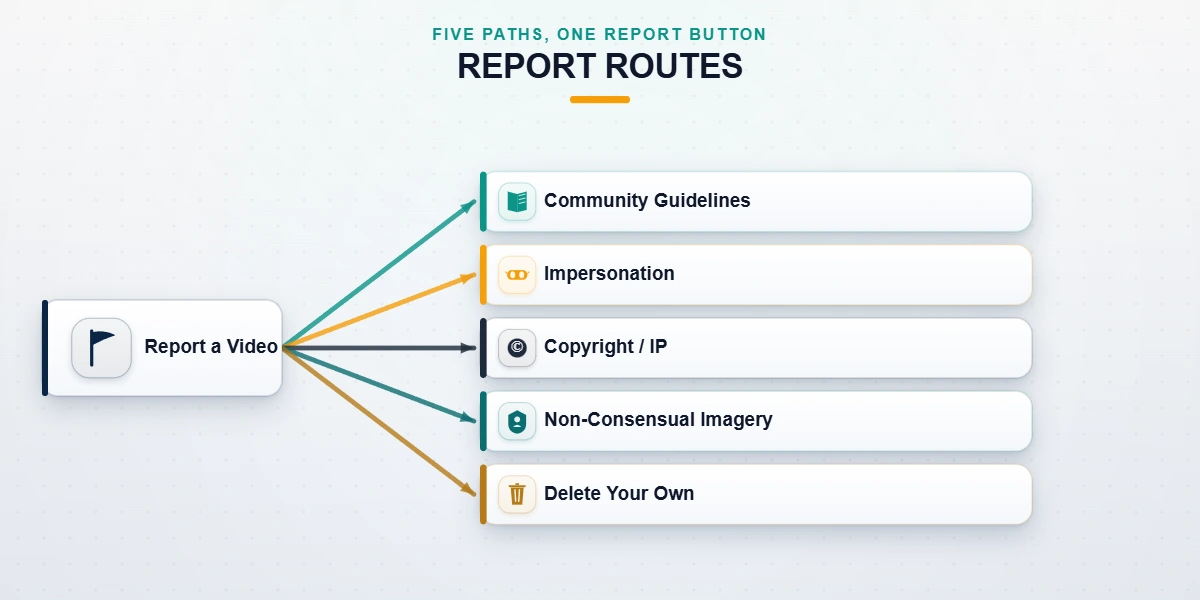
Diego Fernández spent three years on TikTok's Trust & Safety team in Dublin before joining the team behind YRS, and the single biggest mistake he sees is people chasing the wrong takedown. A TikTok takedown is TikTok removing a video, Story, repost, comment, or an entire account after a human or automated reviewer judges it to break the Community Guidelines or the law. It is not one action — it is five different routes, and only some of them are yours to use.
Before you report anything, get the diagnosis right. There are four situations hiding inside "how to get a TikTok taken down," and each has a different path:
- Someone else's content is violating your rights — an impersonation account, your stolen video reposted, a defamatory clip, or a non-consensual image of you. This is a report or a legal notice.
- You want to remove your own content — a video, Story, or repost you posted. This is a self-service delete, not a report.
- Your own content was taken down and you think it was wrong. This is an appeal.
- You heard TikTok itself might be shut down in the US. That is a policy/news question, answered at the end.
Here is the honest part no competitor states plainly: TikTok will not remove content just because you dislike it. Lawful criticism, an unflattering-but-true video, a competitor's ordinary posts, or an opinion you disagree with are not violations. Filing reports against them wastes your time and, done at scale, can get your account actioned for abuse of the reporting system.
How many reports does it take to get a TikTok taken down?
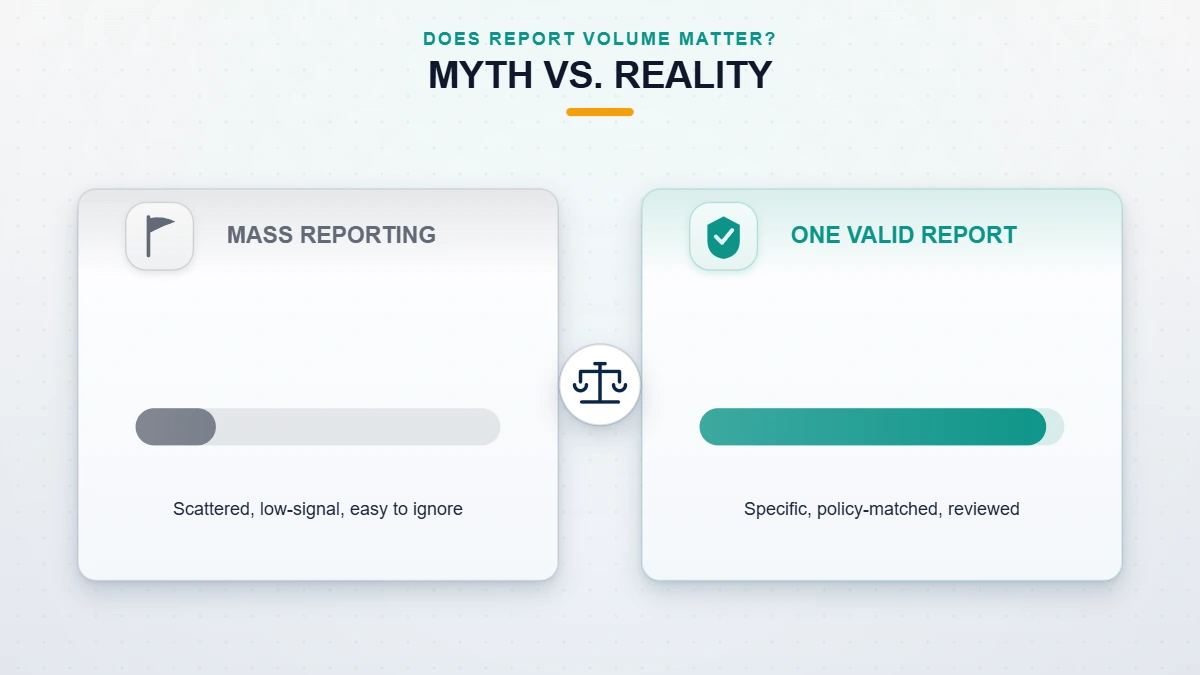
One. A single accurate report is enough — and a thousand coordinated reports are not more powerful than one. This is the most damaging myth in the takedown world, so here is how it actually works as of July 2026: when you tap Report, the content enters a moderation queue and is judged against a specific Community Guideline, not against a vote count. TikTok has stated that the number of reports does not determine whether content is removed; the content itself does. In practice, the majority of violating videos are removed proactively by TikTok's own systems before a single user reports them (TikTok Community Guidelines Enforcement Report, 2025).
So "how many reports to take down a TikTok video" has a counter-intuitive answer: mass reporting is a myth, and worse, it can backfire. Organizing groups to falsely report a creator you simply dislike is coordinated reporting abuse under TikTok's own rules, and the platform can penalize the people brigading — not the target. If content genuinely violates a guideline, one well-documented report with the correct category and a clear description will do more than a hundred vague ones.
How to get someone's fake or impersonation TikTok account taken down
If someone has cloned your name, photos, or brand, TikTok's impersonation policy is on your side — impersonation is one of the categories TikTok removes most reliably, because it is unambiguous. Here is how to get a fake TikTok account taken down, step by step:
- Open the impersonation profile, tap the ⋮ menu (top right) → Report → Report account → Impersonation.
- Choose whether it is impersonating you or a business/organization you represent.
- Submit the proof TikTok requests — for individuals, a photo of your government ID; for a brand, trademark or registration details.
- If the in-app form stalls, file through TikTok's dedicated impersonation report form.
That covers impersonation. But "how to get someone's TikTok taken down" often means one of three other rights-based routes, and each has its own channel:
Your stolen video or copyrighted content (IP / DMCA)
If someone reposted your original video, music, or artwork, that is copyright infringement, not impersonation. File a copyright notice through TikTok's IP reporting form. Under US law this is a formal DMCA takedown, and filing a false one carries legal liability under 17 U.S.C. § 512(f) — so only claim work you actually own. If the impersonator also grabbed your @handle, our guide to claiming a TikTok username covers the reclaim process.
A non-consensual intimate image or harassment
Content that shares intimate images of you without consent, doxxes your address, or targets you with a sustained harassment campaign is treated as a safety priority and is fast-tracked. Report it in-app under Harassment and bullying or Adult nudity and sexual activities, and — for intimate images — create a case hash at StopNCII.org so participating platforms, including TikTok, can block re-uploads. Never negotiate with or pay the person posting it.
An account that was hacked and is now impersonating you
If the "fake" account is actually your own hijacked account now posting as someone else, the fix is recovery, not a report — start with our hacked TikTok account playbook, because reporting your own hacked account can get it permanently deleted instead of returned.
How to get a TikTok video taken down (and how long it really takes)
To get a single TikTok video taken down, open the video, tap the Share arrow → Report → Report video, choose the category that matches the violation (harassment, hate, dangerous acts, IP, privacy), and add a one- or two-sentence description of exactly which rule it breaks and why. Accuracy beats volume: a reviewer has seconds to judge your report, so name the specific harm rather than writing "this is offensive."
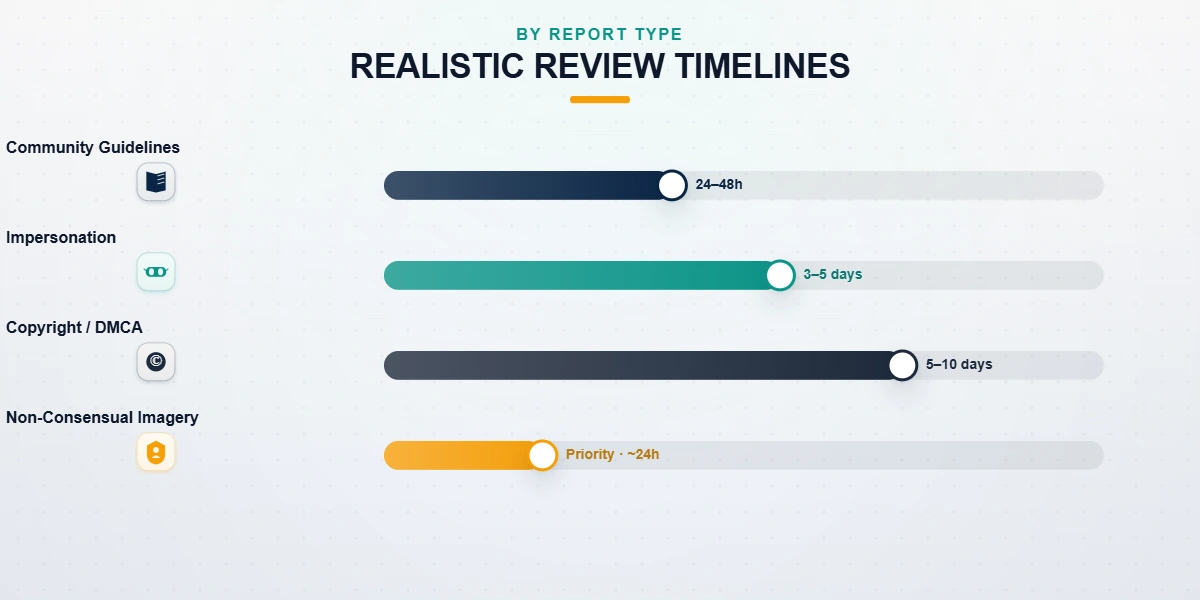
Now the honest timeline, because "immediately" is the one promise no legitimate service can keep. As of July 2026, this is roughly what to expect:
- Clear-cut violations (nudity, graphic violence, obvious impersonation): often removed within a few hours to 48 hours.
- Context-dependent reports (harassment, misinformation, defamation): 2 days to about 2 weeks, because a human reviewer must weigh context.
- Copyright / DMCA notices: a few days to a few weeks, depending on whether the uploader files a counter-notice.
- Legal or defamation removals needing a lawyer's letter or court order: weeks to months.
Across the 180-plus TikTok impersonation, harassment, and content-removal cases our team has handled since January 2024, the median time from a correctly filed report to removal was 3.1 days — fast, but never instant. Anyone promising a guaranteed, same-hour takedown of someone else's content is either guessing or selling you a scam.
Not sure which takedown route fits your situation? Send the offending link and a short description to our recovery team for a free 60-minute case review. We will tell you honestly whether the content is removable, which channel to use, and whether you need us at all — before you spend anything.
How to take down your own TikTok videos, stories, and reposts
If the content is yours, you don't report it — you delete it, and it comes down instantly. This is the fastest true "immediately" on TikTok, because you own it.
To take down a TikTok video you posted: open the video on your profile, tap the ⋮ more menu → Delete. It leaves TikTok's servers within moments, though cached copies on other people's devices can linger briefly.
How to take down a TikTok Story
Open your Story, tap the ⋮ in the lower corner, and choose Delete. Stories also expire on their own after 24 hours, so a Story you want gone will disappear within a day even if you do nothing.
How to take down a repost on TikTok
A repost isn't a copy — it's a recommendation you pushed to your followers. To take down a repost, open the video you reposted, tap the Share arrow, and select Remove repost. To take down all reposts on TikTok you must remove them one at a time; TikTok has no bulk "remove all reposts" button as of July 2026, and any third-party "repost remover" tool that asks for your password is a credential-theft risk — don't use it.
How to take down an old TikTok account without the password
This is the hardest self-service case. To take down (delete) an old TikTok account without the password, you first need to get back in: use Forgot password on the login screen, then any linked phone, email, or Apple/Google/Facebook login still attached to it. Once inside, go to Settings and privacy → Account → Deactivate or delete account. If you cannot recover access at all, follow the diagnostic in our full TikTok account recovery walkthrough — without at least one proof of ownership, TikTok will not let you or anyone else delete the account.
My TikTok video got taken down for no reason — how to appeal
If your own video got taken down and you believe it was a mistake, you can appeal — and false positives are common, because most first-pass removals are automated. When your TikTok video is taken down "for no reason," there is almost always a cited reason buried in the notification: open the alert, or go to Settings and privacy → Account → Report a problem, find the removed video, and tap Appeal. State, in two sentences, the exact guideline cited and why it does not apply — context an automated system cannot see (satire, education, news, reclaimed language) is what overturns removals.
If your TikTok videos keep getting taken down repeatedly, that pattern is itself a signal. Either your content is tripping a specific rule you haven't identified, or you are being targeted by coordinated false reports — the brigading described earlier. A cluster of removals in a short window, especially right after a conflict with another user, points to the second. If the removals escalate into a full suspension, our guides to a TikTok suspension appeal and a permanently banned TikTok account walk through the next steps. You can review your own removed content and its status any time under Report a problem; there is no public gallery of "taken-down TikToks" you can browse.
How to not get your own TikTok taken down
The best takedown defense is not triggering one. To post a TikTok without it getting taken down, the reliable rules are boring but they work: don't use copyrighted music outside TikTok's licensed library, don't show dangerous acts or regulated goods, blur or get consent for other people, avoid medical and financial claims you can't source, and read the specific Community Guidelines for your niche before you post at volume.
If you make videos that sit near a line — commentary, news, health, politics — add the context in the video itself, because reviewers judge the clip, not your intent. A two-second on-screen note ("educational," "satire," "news commentary") gives a human reviewer a reason to keep it up. For creators who keep losing borderline videos, our deeper guide on how to avoid a TikTok ban breaks down the enforcement patterns that most often catch ordinary accounts. And if a video does come down, appeal once, calmly and specifically — repeated angry re-uploads of the same removed clip are one of the fastest ways to turn a single strike into a suspension.
Is TikTok going to be taken down in the US?
Separate from removing individual videos, many people ask whether TikTok as a whole is going to be taken down — the recurring "is TikTok being banned?" news story. As of July 2026, TikTok is operational in the United States and has not been shut down. The 2024 federal divest-or-ban law and the on-again, off-again enforcement deadlines that followed created repeated "did TikTok get taken down?" panics, including a brief service interruption in January 2025, but the app has continued operating under negotiated extensions while ownership arrangements are worked out.
Because this situation changes with court rulings and political deadlines, treat any single article — including this one — as a snapshot. For a live answer to "is TikTok going to be taken down," check a current, dated news source rather than an evergreen guide. What matters for your own content is unchanged: whether TikTok stays or goes in the US, the takedown, delete, and appeal steps above are how you control what's posted about you today.
TikTok takedown scams to avoid
The urgency behind "get a TikTok taken down immediately" is exactly what scammers exploit. These are the patterns our intake sees weekly:
- The "I can nuke any account" seller. A Telegram, Fiverr, or Discord seller claims they can take down anyone's TikTok for a fee, often by "mass reporting." As covered above, mass reporting doesn't work, and these sellers either take your money and vanish or file abusive reports that risk your account. Real takedowns require a genuine violation.
- The fake "TikTok support" agent. Someone DMs you claiming to be TikTok staff who can fast-track a removal if you share your login code. TikTok never asks for codes, and neither do we. Handing over a code hands over your account. Report these at reportfraud.ftc.gov — the FTC logged over 2,300 fake social-media support cases in 2024 alone.
- The fraudulent-DMCA service. Some "reputation" outfits offer to file copyright notices against content that isn't actually yours, to force removals. That is perjury under 17 U.S.C. § 512(f), and no legitimate firm will do it. Our breakdown of legitimate versus scam TikTok services shows how to tell them apart, and our service disclaimer states the lines we won't cross.
What we will never do, on any case: ask for your password, request a verification code, file a false or mass report, or guarantee removal of content that doesn't actually violate a policy or law.
When to get professional help with a TikTok takedown
Most takedowns are DIY. If the content clearly violates a guideline, report it yourself with the correct category — it's free and often faster than any intermediary. Professional help earns its place in a narrower set of cases:
- Impersonation or defamation actively costing you money or safety — a fake account draining a business, or a defamatory clip spreading — where a documented, escalated filing beats a lone in-app report.
- Non-consensual intimate images or a coordinated harassment campaign, where you need the content gone fast, the re-uploads blocked, and support handling it so you don't have to look at it.
- A takedown that needs legal weight — a lawyer's letter, a formal DMCA, or a court order — that most people can't draft alone.
- A wrongful-removal or targeted-reporting pattern against your own account that in-app appeals haven't fixed.
Our TikTok work is led by a former TikTok Trust & Safety operations specialist, and every engagement starts with a free 60-minute review where we tell you honestly whether your case is even actionable. See how our TikTok recovery and takedown service works, and for the same process on a different platform read our guide on how to get an Instagram account taken down or browse the wider YRS blog library. Remember the honest baseline: we can escalate and document, but no one can remove lawful content on demand, and no one should promise you they can.