Does mass reporting actually work on Snapchat?
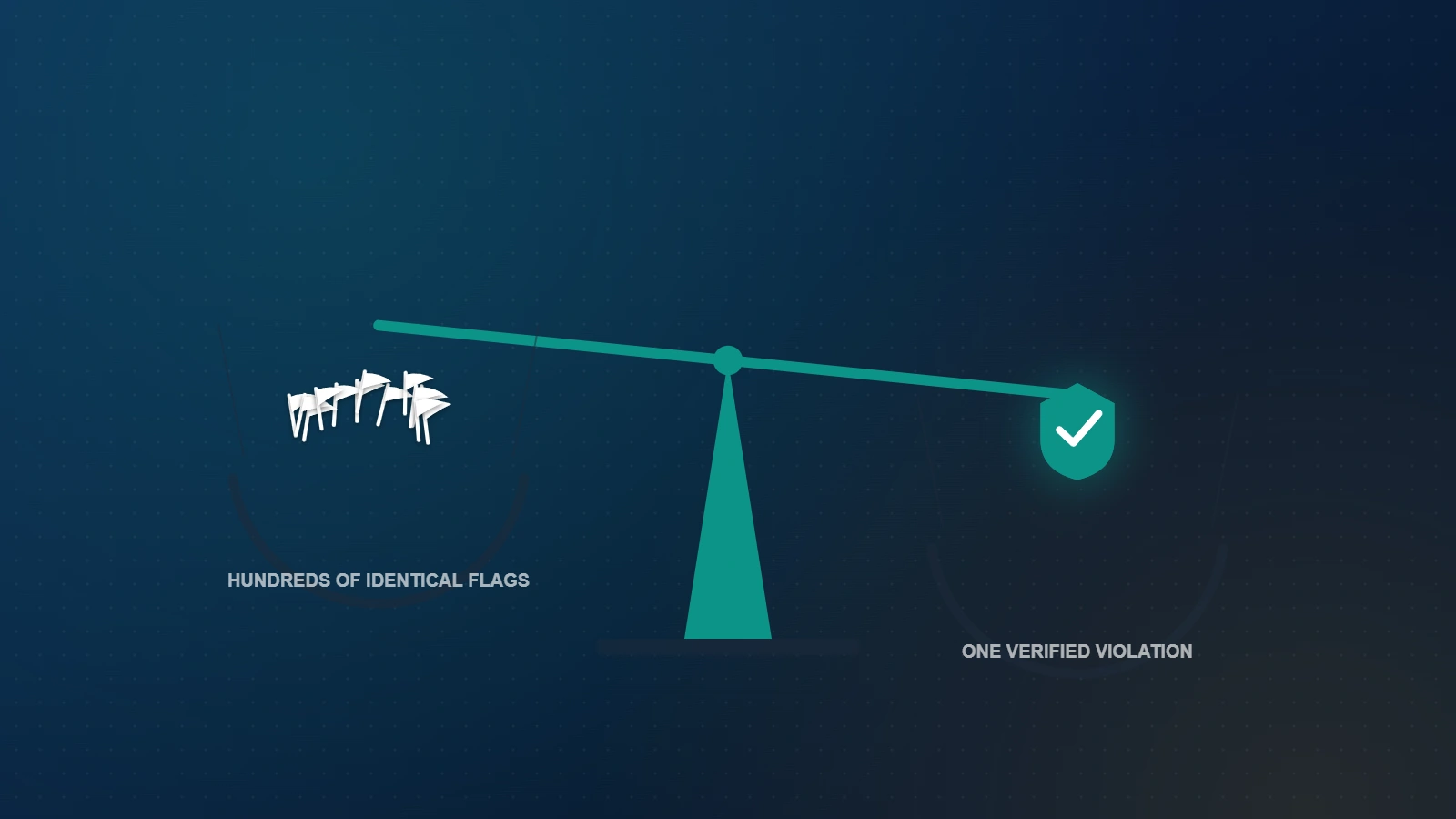
No. Mass reporting does not work on Snapchat, and it hasn't for years. Snapchat does not remove an account because a crowd taps Report; it removes an account when a reviewer or an automated system confirms the account broke a specific rule. Volume is not the lever. Fifty coordinated reports against a profile that violates nothing do exactly what one such report does: nothing. That is the uncomfortable truth behind every "snapchat mass report" search — the mechanic people are hoping for simply does not exist. What decides the outcome is whether the reported content matches a Community Guidelines violation and whether the evidence is clear. A single well-documented report of real impersonation, a genuine threat, or an intimate image shared without consent can end an account on its own. A thousand hollow reports cannot manufacture a violation that isn't there. High report volume, at most, changes how fast something reaches a human — never the verdict.
We see the flip side of this every week on our operations desk. People type mass report snapchat into a search bar hoping to remove a scammer or an abusive ex, and just as often, people arrive here because they were on the receiving end of exactly that campaign and got locked out of their own account. In our operations logs — n=214 Snapchat matters in the twelve months to July 2026 — roughly one in six "I was banned for nothing" intakes carried the fingerprints of a coordinated report burst rather than a genuine violation. Both groups are chasing the same myth from opposite ends of it.
How Snapchat weighs reports: validity over volume
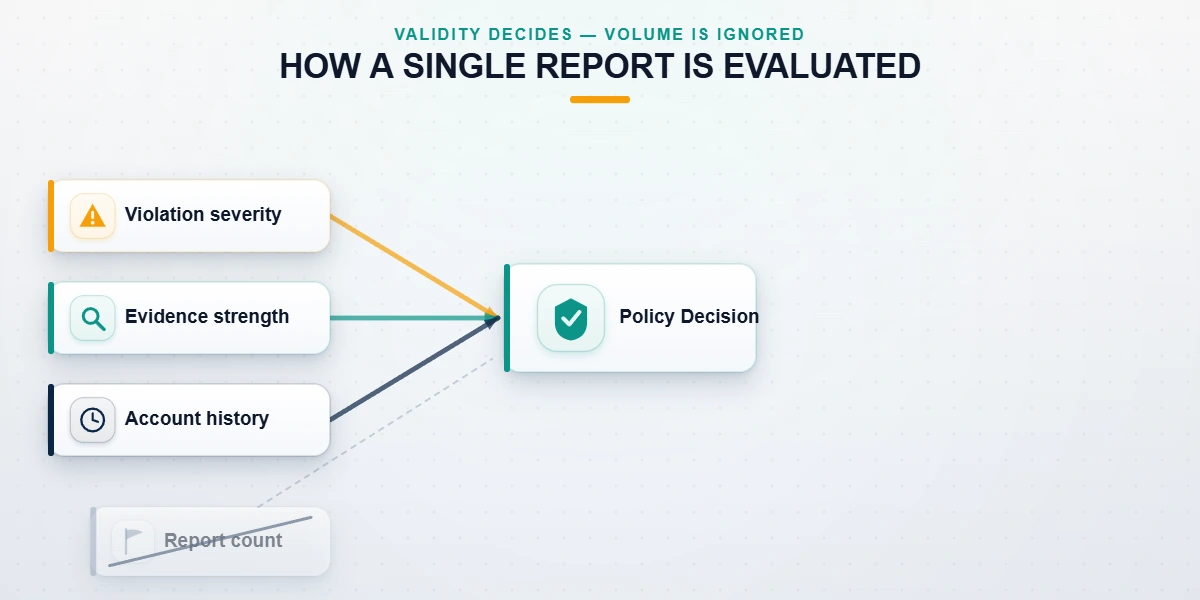
Snapchat's enforcement is built to resist volume, not reward it. Reports feed a triage process that weighs the severity of the alleged violation, the strength of the evidence attached to it, and the reported account's own history. Duplicate and automated reports are precisely the pattern anti-abuse systems are tuned to discount. A sudden burst of near-identical complaints reads as manipulation, not as signal. Per Snapchat's Safety and Reporting resources, the company reviews reported content against its published policies and acts when a violation is confirmed, using a mix of automated detection and trained human reviewers. Nowhere in that pipeline is there a hidden counter that trips a ban at some magic number. Ask "how many reports to ban a Snapchat account" and the honest answer is that the number is irrelevant; the violation is everything.
The number is a distraction; the violation is the whole game.
This is not a Snapchat quirk. The same evidence-over-volume principle governs every major platform, which is why the honest answer is identical whether you ask if mass reporting works on Instagram or whether a twitter mass report tool achieves anything: enforcement turns on a provable rule-break, not on a pile of reports, exactly as it does when getting someone's WhatsApp account banned hinges on genuine abuse. If a service anywhere promises removal "by report volume," it is describing a lever that no platform actually exposes.
Snapchat mass report bots and tools: what you're really buying
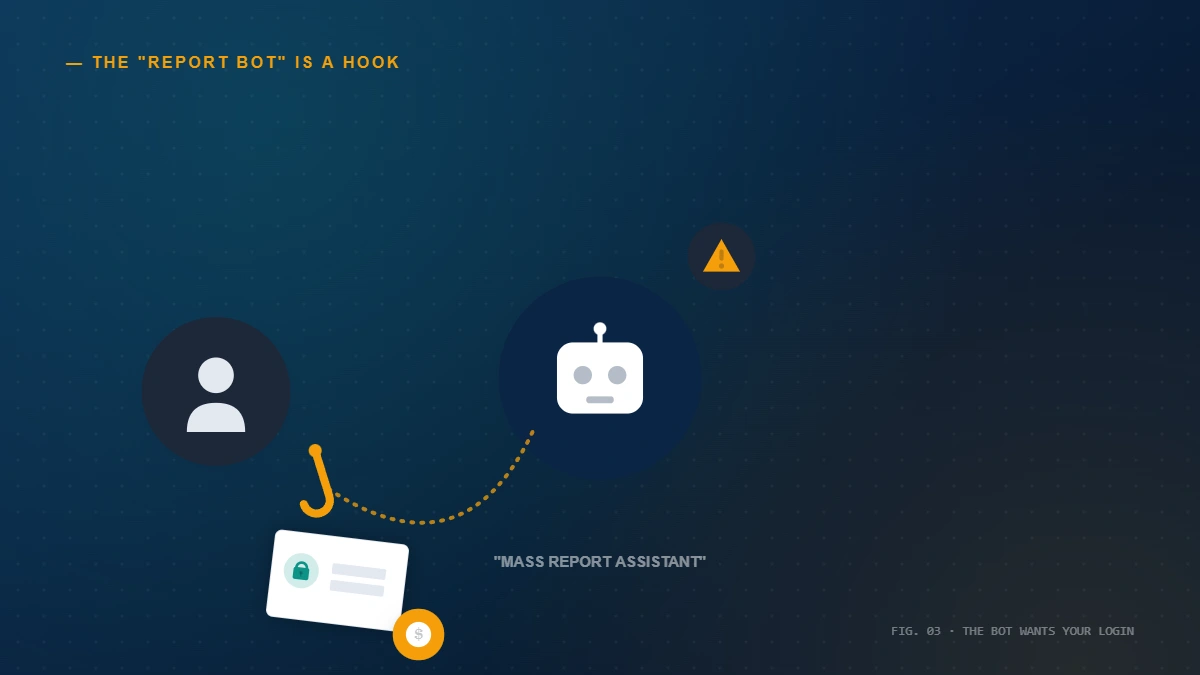
Search results for a snapchat mass report bot or a snapchat mass report tool are dominated by three things: Telegram channels, cheap "auto-report" pages priced by the click, and public GitHub scripts. What almost none of them are is effective. Because Snapchat discounts automated and duplicated reports, a bot firing hundreds of identical complaints is not merely useless; it produces the exact signature the platform's anti-abuse systems suppress. So what are you paying for? In the cases we have reviewed, the answer is one of four things: nothing at all, where the money is taken and no "service" is delivered; a credential-harvesting page that asks for your Snapchat login and steals it; malware bundled into a downloaded executable; or a setup that gets your own account flagged for coordinated abuse. The U.S. Federal Trade Commission tracks social-media "boosting" and takedown schemes as a recurring consumer-fraud category. Until proven otherwise, treat every one of these as a scam. The same racket wears different logos on every platform: we take apart the TikTok mass report bot, the Instagram spam report bot, and the Telegram-run mass report bot elsewhere, and the mechanics never change.
Is a snapchat mass report bot safe — or a scam?
Assume scam. A snapchat mass report bot has to do one of two things to function, and both are bad for you: either it logs into Snapchat with credentials, often yours, which is theft, or it hammers Snapchat's reporting endpoints in a way that violates the Terms of Service and can get every account involved actioned. There is no version of this that is both safe and effective. If a page or a Telegram bot asks for your username and password to "boost reports," stop — that is a phishing flow, and no legitimate tool ever needs your Snapchat password. You can report the fraud itself to the FTC at reportfraud.ftc.gov.
The "snapchat mass report tool" pricing trap
Many of these pages advertise a snapchat mass report tool priced per report: a fraction of a cent each, buy in bulk. The pricing itself is the tell. It is engineered to feel like ad spend, a metered dial you turn up until something happens. But there is no dial. You are buying units of an action that Snapchat's systems already discount to near zero, so the "more reports, more effect" model is fiction from the first click. That cheap per-unit price is exactly what lets the scam scale: it feels low-risk enough to try, and by the time nothing has happened, the seller has your money and often data you should never have handed over. Panels aimed at Meta open on the same low number, and what report volume actually reaches on Facebook sets out what Meta's review looks at instead.
Is it illegal to mass report someone on Snapchat?
Running a mass report campaign against a lawful account is a Snapchat Terms of Service violation, and depending on what surrounds it, it can cross into unlawful harassment. Snapchat's rules prohibit abusing the reporting tools and coordinating attacks on other users, and accounts caught doing it can themselves be suspended. Beyond the platform's own rules, a sustained effort to drive someone off a service, paired with threats, doxxing, or contacting them across other apps, can meet the legal definition of harassment or stalking under many U.S. state laws and other countries' statutes. Knowingly filing false reports can separately expose you to defamation or false-reporting claims. To be blunt about where we stand: we do not run these campaigns, we do not sell the tools, and we will not help anyone brigade a lawful account off Snapchat. If the account genuinely breaks a rule, the legitimate route further down actually works, and it is the only one we will help with.
What to do if a mass report campaign got your account locked
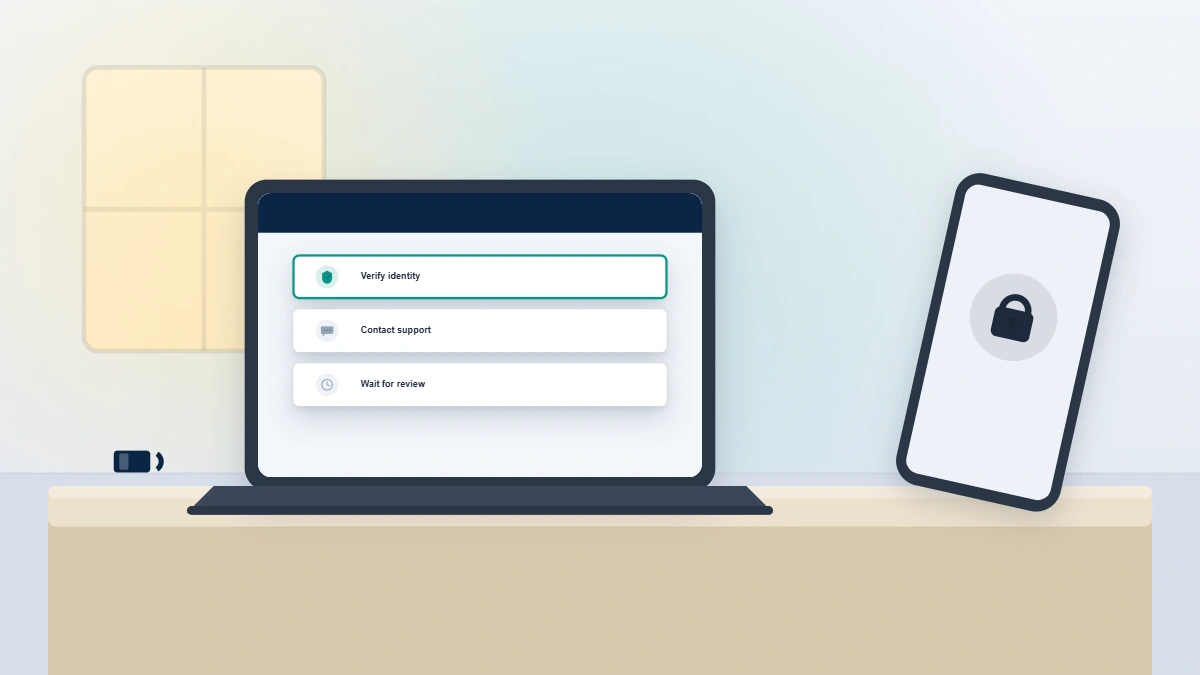
If your Snapchat was locked or banned and you are certain you broke no rule, a coordinated report campaign is a real possibility — but it is not the only explanation, and chasing the wrong one wastes the appeal window. Start by ruling out a compromise. If you cannot log in at all, use Snapchat's account-recovery and "My account is compromised" flow first, because a hijacked account often generates the very reports that get it locked. If your access is intact but the account is restricted, submit an appeal through Snapchat Support and state plainly that you believe you were targeted by false reports, attaching anything that shows the account's normal, rule-abiding use. Do not re-report yourself, do not spin up ban-evasion accounts, and never buy a "reinstatement" service that guarantees a fixed unban time. In our experience, clean wrongful-lock cases are often restored within roughly three to ten days once the right appeal, backed by evidence, reaches a human reviewer.
When one of these lands on our desk, the first thing we check is whether the report pattern looks organic or coordinated; bursts of near-identical reports in a short window are a tell, even though we cannot see Snapchat's internal scoring. What we can do is assemble the account's history and the context a form field alone never captures, then file the appeal through the right channel. That is the core of our account-recovery service, and the method is the same one we use when we help people unban an account on other platforms.
Locked out after a wave of reports you know were false? Request a free case review and a former Trust & Safety operator will tell you honestly whether it looks like a coordinated report attack — and whether the account is realistically recoverable — before you pay anyone a cent.
The legitimate way to report a real Snapchat violation
When an account genuinely breaks Snapchat's rules — it impersonates you, threatens or harasses you, runs a scam, or shares intimate images without consent — one accurate, well-evidenced report beats any bot. The mechanics are simple. Use the in-app press-and-hold Report menu on the profile, Snap, or Story, choose the category that matches the violation, and add specifics. When you cannot see the account because it blocked you or is impersonating you to strangers, Snapchat Support's web forms for abuse and illegal content handle impersonation and safety concerns without needing to be friends. We map every route, category by category, in our full guide to taking down a Snapchat account. The single most valuable habit is documentation: capture usernames, timestamps, and screenshots before you file, because Snapchat content is ephemeral and a report backed by proof moves faster than a vague one.
The same disciplined approach applies across platforms; the categories change, the logic does not. It is what we describe for getting an Instagram account taken down, too. For intimate-image abuse specifically, two free services add a layer alongside your report: StopNCII.org for adults, which fingerprints your images on your own device so copies can be blocked without you uploading anything, and NCMEC's Take It Down for anyone under 18.
What we will and won't do about Snapchat mass reporting
Here is our line, stated plainly, because this corner of the internet is full of operators who will not state theirs. We will not mass report, brigade, or run coordinated takedowns against any account, lawful or not, and we do not sell, rent, or endorse any snapchat mass report tool or bot. There is no guaranteed removal or guaranteed unban we will promise, because no honest firm can; anyone quoting a fixed number of hours or a 100% success rate is selling you the same myth the bots are. No legitimate service ever asks for your Snapchat password, and neither do we. An account that needs your password to be "recovered" is being stolen, not saved. What we do is narrower and real. We help people who were wrongly banned document and appeal, and we help genuine victims of impersonation, harassment, or non-consensual images file reports Snapchat will actually act on. The full scope, and the honest limits, are laid out in our disclaimer and in the background of the team behind this work.