Reviewed June 2026. We re-checked every recovery path on this page — YouTube's channel-reinstatement appeal form, the three-strikes termination rule, the "Rejoining the YouTube Community" second-chance program, and the no-email access paths — against Google's current Help Center and confirmed the steps, forms, and timelines are accurate as of June 2026.
What a terminated YouTube channel actually means
A terminated YouTube channel is the platform's most severe enforcement action: YouTube removes the channel along with its videos, comments, playlists, and subscriber count, and blocks the owning Google account from creating or accessing any YouTube channel. Termination differs from the two lighter states people confuse it with. A Community Guidelines strike is a temporary penalty — one strike triggers a one-week feature restriction, two strikes within 90 days a two-week restriction, and the channel survives. A suspension is a hold that is often reversible by default. Termination is permanent unless YouTube reverses it on appeal. Just as important, a channel termination is not the same as a full Google Account suspension: when only the channel is terminated, your Gmail, Drive, and other Google services keep working. Knowing exactly which state you are in decides whether you appeal, wait, or rebuild.
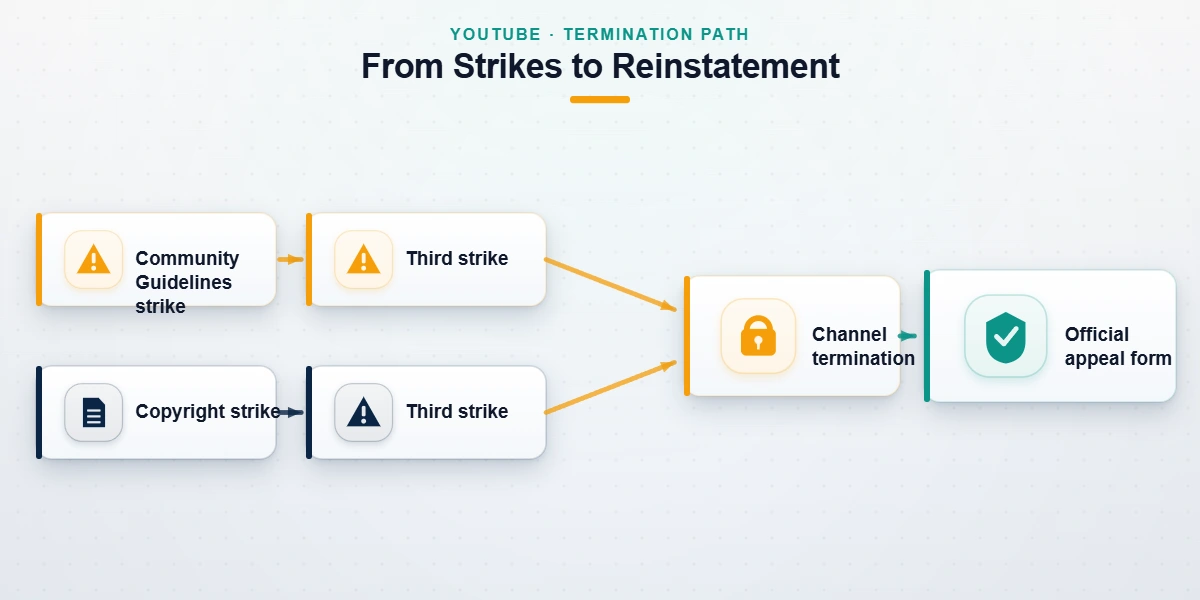
YouTube enforces two separate strike systems that both end in termination. Community Guidelines strikes accumulate on a 90-day rolling clock — three of them removes the channel. Copyright runs on its own track: three copyright strikes terminate the channel, delete the uploaded videos, and can take down associated channels too. A single severe violation — child-safety content, real-world violent extremism, or large-scale coordinated spam — can also trigger immediate termination with no prior strikes. For how strikes escalate, YouTube's own Community Guidelines strike basics is the authoritative reference, and our complete YouTube account recovery guide covers the lighter lockout and hacked-account scenarios that are not terminations at all.
Scale gives this context. In its enforcement reporting, YouTube removed roughly 9 million channels in a single quarter, the large majority flagged for spam, scams, or misleading metadata rather than ordinary creators (YouTube Community Guidelines enforcement, 2024). Genuine, wrongful terminations are the minority — but they are exactly the cases worth appealing. If your situation is closer to a suspension or feature lock than a full removal, the step-by-step YouTube appeal playbook and our YouTube channel recovery service overview walk through those narrower paths.
Can a terminated YouTube channel be recovered?
Often, yes — but not always, and whether you can recover a terminated YouTube channel depends entirely on why it was removed. A terminated channel is recoverable when the action was a mistake, an automated false positive, the result of an account takeover, or a first-time borderline call where context was missing. It generally is not recoverable when the underlying violation is one YouTube treats as zero-tolerance. Across the 164 YouTube termination cases our team has handled since January 2024, reinstatement ran about 47% on appealable cases — higher on clearly wrongful or automated flags, and close to zero once a violation falls into the non-recoverable list below. We decline roughly 24% of intake on the first call because the category makes recovery impossible, and no legitimate service can change that. The only honest first step is identifying which category your termination falls into.
Often recoverable:
- Automated terminations issued seconds after an upload, with no human review
- Account-takeover cases where a hijacker's activity, not yours, triggered the removal
- First-time Community Guidelines terminations where the flagged clip lacked context (satire, news, education)
- Terminations tied to a billing or verification glitch rather than content
Rarely or never recoverable:
- Child Sexual Abuse Material (CSAM) — immediate, non-appealable, reported to authorities
- Real-world violent extremism, terrorism, or credible threats
- Repeated or severe copyright infringement that exhausted the copyright-strike system
- Large-scale spam, scams, or coordinated inauthentic behavior
- Channels created specifically to evade a previous termination
If you have also lost the Google login itself, recovery becomes a two-step problem — regain the account first, then appeal — which our guide to recovering YouTube access without the original email walks through in detail.
How to recover a terminated YouTube account: the official appeal, step by step
There is exactly one legitimate route to recover a terminated YouTube account, and it is free: YouTube's official appeal form. The same form is the only way to recover a terminated YouTube channel, whatever the violation. As of June 2026 the process is:
- Sign in to the Google account that owned the channel. You can still sign in to Google even when the channel is gone — the termination removes the channel, not necessarily the login. If the login itself is lost, recover the Google Account first.
- Open the channel-termination appeal form. YouTube links it in the termination email and through its Help Center page on channel or account terminations. The form is tied to your signed-in account.
- Write a focused, factual appeal. Name the specific policy YouTube cited, explain why it does not apply (or what context a reviewer could not see in a short clip), and keep it calm and concise. Leave out follower counts, revenue figures, threats, and emotional pleas — a reviewer has seconds, not minutes.
- Submit the appeal once. This is the most-violated rule in the whole process. Filing multiple appeals or opening duplicate forms can stall the queue or cause an automatic rejection. One careful submission beats ten frantic ones.
- Wait for the email decision. Replies typically arrive within a few days to a few weeks, sent to the email on the account. There is no faster channel, no priority line, and no phone number that changes this.
The single highest-leverage move is to lead with the exact policy and a two-sentence explanation of why it was misapplied, before any other context. That structure mirrors what reviewers look for on every major platform.

How to fix a terminated YouTube account when your first appeal is denied
YouTube generally allows one appeal per termination, so a denial usually means the first decision stands. To fix a terminated YouTube account after a denial, your realistic options narrow to two. The first is the "Rejoining the YouTube Community" second-chance program — a pathway YouTube opened to let some terminated creators apply to return after a waiting period of around one year. Eligibility is limited: copyright terminations and the most serious Creator Responsibility and child-safety cases are excluded, and YouTube weighs the severity and persistence of the original violations when it evaluates an application. You can read the official criteria on YouTube's rejoining after a channel termination page.
The second option is to accept that the channel is gone and rebuild correctly — a new channel on a clean, eligible Google account, not a circumvention of the ban. Creating a new channel specifically to evade an active termination is itself a violation that gets the new channel removed too, so this path only works when the original termination was genuinely final and you start fresh rather than continuing the old, banned channel.
Not sure whether your termination is appealable? Send us the termination email and the exact policy YouTube cited, and our recovery team will give you a free 60-minute case review — including an honest "this one isn't recoverable" when that's the reality. We never ask for your Google password. See our recovery service limits for exactly what is and isn't in scope.
How to get your terminated YouTube account back without the original email or phone
When you no longer control the email or phone tied to the channel, the question stops being about YouTube and starts being about Google. The appeal must come from the account that owned the channel, so terminated users' YouTube recovery in this situation is a two-stage job: first regain the Google Account through Google's standard Account Recovery flow, then file the YouTube appeal from inside it. Appealing from a brand-new account does not work — YouTube ties the case to the original owner.
To get your terminated YouTube account back without the original credentials, gather everything Google can use to confirm ownership: an older recovery email or phone that was once on the account, the approximate creation date, past passwords you remember, and the device and location you usually signed in from. Consistency matters more than completeness — answering from a familiar device and network raises your odds. Our dedicated walkthrough on terminated users' YouTube recovery without email or phone covers the Google Account Recovery sequence step by step. Only once you are back inside the account does the channel-termination appeal above become available to you.
Channel termination recovery scams — and what we will never do
Channel termination recovery is a magnet for scams, because desperate creators are easy to exploit. These are the patterns we see weekly in intake:
- The "YouTube insider." Someone claims a contact inside YouTube or Google who can force a reinstatement. No such backdoor exists — reviewers cannot reverse decisions outside the appeal pipeline.
- The instant-unban fee. A Telegram, Fiverr, or Discord seller promises guaranteed recovery in 24 hours for a flat fee. They are either reselling the free appeal or taking your money and vanishing.
- The password request. Anyone who asks for your Google password or a verification code is trying to steal the account, not recover it. We never ask for either, and neither does YouTube.
- The fraudulent-DMCA offer. Some operators claim they can file copyright notices to remove rivals and restore yours. Filing false DMCA notices is a federal crime under 17 U.S.C. § 512(f), and we won't do it.
If a number or message claims to be YouTube support and asks for money or credentials, report it to the FTC at reportfraud.ftc.gov. Before you pay anyone, it is worth reading our candid breakdown of whether YouTube recovery services are actually legit, which explains what an honest service can and cannot promise. What we will never do, on any case: ask for your password, request a verification code, demand payment before reviewing your situation, or guarantee a recovery outcome.
When professional help to reinstate a terminated YouTube account makes sense
If you have not appealed yet, appeal yourself first — it is free, official, and resolves a meaningful share of wrongful terminations on its own. Because the only legitimate way to recover a terminated YouTube channel is that same official appeal, professional help to reinstate a terminated YouTube account makes sense in a narrower set of cases: when a monetized channel represents real income and a sloppy single appeal would waste your one shot, when the termination was demonstrably wrongful and the evidence needs organizing into a reviewer-ready package, or when the termination cascaded into linked Google or AdSense problems that need untangling. It does not make sense when the violation is non-recoverable — and a credible specialist tells you so before taking a cent.
Our approach is led by named specialists with verifiable credentials; you can meet the team behind YRS and see the same diagnostic framework applied across platforms in our Instagram appeal walkthrough and our guide to recovering a suspended account on X. The recovery logic is consistent platform to platform — the ban-recovery service our specialists run for TikTok uses the identical honest-assessment-first method.
We don't guarantee recovery. We do guarantee a sober, documented assessment of whether your case is recoverable at all before any meaningful spend. For the full range of platform recovery scenarios, the YRS account recovery blog library covers YouTube, Instagram, TikTok, Facebook, and X.