First, decide which "ban" you actually mean
"Telegram ban service" is one search phrase covering two opposite jobs, and sorting out which one you need saves you time and money. Job one is recovery: your own channel or account got banned, or your number was flagged, and you want it back. Job two is a takedown: someone else runs a channel or account that targets you — an impersonator, a scam trading on your brand, a group leaking your private data — and you want Telegram to remove it. This page is about the second job. If yours is actually the first, our guide to reversing a banned Telegram account and our walkthrough for recovering a banned Telegram phone number cover the recovery track, and our Telegram account recovery service starts with a free review. Get this fork right first, because the evidence, the route, and the realistic timeline differ completely between the two.
There is a second distinction underneath the first. A telegram channel takedown removes a one-to-many broadcast channel; a telegram account takedown removes a single user's account; a group removal targets a shared chat. Each breaks slightly different rules and uses a slightly different report path, so name yours precisely before you file anything. Our companion piece on taking down a Telegram channel covers the channel route in detail; the account and group routes follow the same logic with different buttons.
What a Telegram channel ban service can actually remove
Start with the blunt question, because it decides everything else: will Telegram remove this? The honest answer is yes only when the channel or account breaks a written rule in Telegram's Terms of Service or the law. A legitimate telegram channel ban service works strictly inside that boundary. The categories Telegram reliably acts on are impersonation of a real person or brand, scams and financial fraud, doxxing and the posting of private data, non-consensual intimate images, the sale of illegal goods, copyright infringement, and the two it moves on fastest of all: child sexual abuse material and terrorist content. What Telegram will not remove is lawful content you happen to hate — honest criticism, an unflattering-but-true post, a competitor's ordinary marketing, a political opinion. No report and no service changes that, because the platform has no rule to enforce.
There is also a hard technical limit most sellers never mention. Telegram can only act on public surfaces: public channels, public groups, and public usernames anyone can find. It cannot see, and so cannot moderate, your private one-to-one messages or Secret Chats, which are end-to-end encrypted by design. If the harm lives inside a private Secret Chat, a takedown is not the tool — documenting it for law enforcement is. The encryption boundary matters even more on WhatsApp, where every conversation is encrypted by default; a whatsapp mass report bot is sold against a surface Meta reviewers cannot read in the first place. Telegram's own FAQ states this split plainly, and it is the single most common reason a hopeful report goes nowhere.
The official routes: in-app reports, abuse@ and dmca@, and the app stores
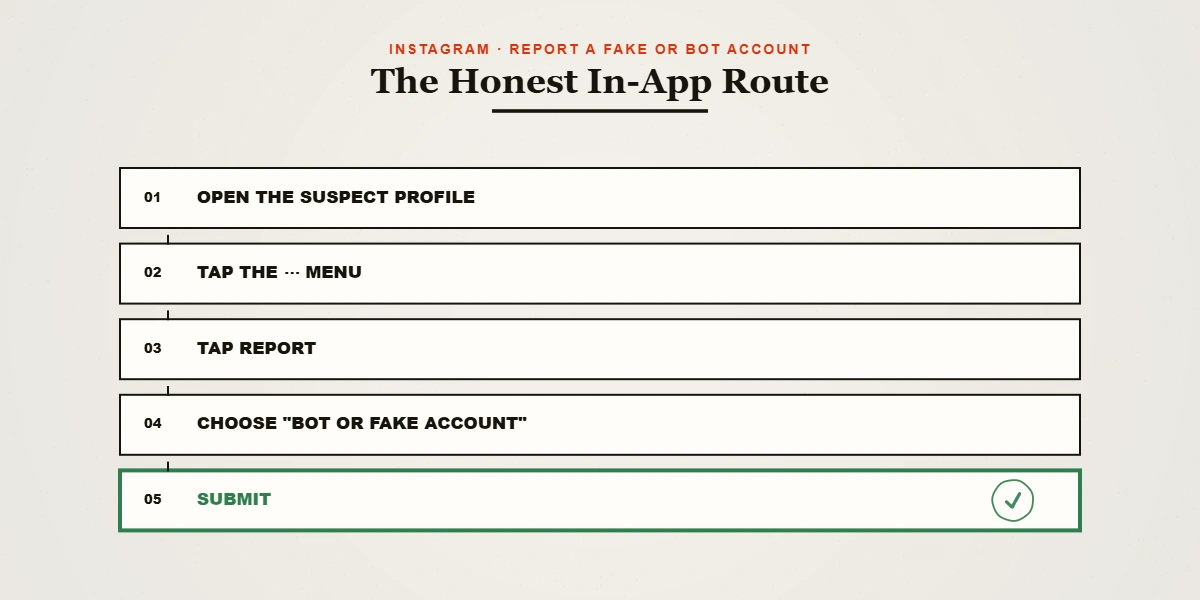
Once the content clearly qualifies, four official routes exist to remove it, and picking the right one matters more than firing all of them. First is the in-app Report button on the channel, message, group, or profile — the fastest path for scams, impersonation, and violence, and the queue Telegram's moderators triage first. Second is email: [email protected] for terms violations, [email protected] for copyright, where a properly formatted notice under the US Copyright Office's DMCA process carries real legal weight. Third — the route almost no competitor writes about — is the app stores. Content viewable inside Telegram's iOS or Android apps still has to satisfy Apple's and Google's content rules, so a documented complaint routed through the App Store or Google Play can pressure a removal that a plain in-app report stalls on. Fourth is a formal legal notice, for defamation or a court order.
For scams specifically, Telegram has expanded its dedicated anti-fraud reporting since 2024. Flagging a fraudulent channel through both the in-app scam report and [email protected] gives a reviewer two signals instead of one, which is often what tips a borderline case.
What changed after August 2024 — and why it matters now
For years Telegram earned its name as the platform that ignored takedown requests, and plenty of advice online still assumes that. It is out of date. After founder Pavel Durov was arrested in France in August 2024 and charged in connection with illegal content on the platform, Telegram changed course quickly. In September 2024 it rewrote the line in its FAQ that had long implied private chats were entirely beyond moderation, and it began stating that the IP addresses and phone numbers of users who break the rules can be disclosed to authorities in response to valid legal requests — a policy now spelled out in Telegram's FAQ and privacy terms. It shut down the "People Nearby" feature that scammers had exploited, and it leaned harder on automated removal of illegal channels.
As of July 2026, a well-documented report lands very differently than the same report would have in early 2024. The shift shows up in our own casework: complaints that once vanished into silence now get worked, and impersonation and scam channels that a year ago felt untouchable come down on a real timeline. If your last attempt to report a Telegram channel went nowhere in 2023, that outcome is not a reliable guide to what happens today.
How a legitimate Telegram takedown works, step by step
A real telegram account takedown is unglamorous — closer to building a small case file than pushing a button. This is the sequence our team runs on every engagement:
- Match the content to one specific rule. Impersonation, scam, doxxing, copyright, or NCII. A report filed under the wrong category gets closed, and you get limited attempts.
- Gather evidence that survives a reviewer's glance. Screenshots with the username and date visible, the t.me link, proof of who you are for impersonation, and a side-by-side of the real and fake profiles.
- File through the route that fits. In-app for most categories, [email protected] for copyright, an app-store complaint where the in-app path stalls, a legal notice where the case needs weight.
- Escalate with documentation, not repetition. If the first review clears the channel wrongly, a specific, evidence-referenced follow-up does far more than tapping Report again.
- Wait honestly. Clear-cut cases resolve in days; context-heavy ones take longer. Nobody outside Telegram can promise the hour.
When we file a brand-impersonation case for a business, the one thing that moves it fastest is that side-by-side of the genuine and cloned profiles with their creation dates; reviewers act on that in a way they never do on a paragraph of complaint. Since we began tracking Telegram cases in early 2024, across 140-plus impersonation, scam-channel, and doxxing takedowns, the median time from a correctly filed report to removal was 6.2 days (our internal records as of July 2026). We also decline roughly one in four requests on the first call, because the channel the person wants gone has not actually broken a rule. Saying so up front is cheaper for everyone than selling false hope.
Not sure your case even qualifies? Send the channel or profile link and a two-line description to our team for a free case review. We will tell you honestly whether it is removable, which route fits, and whether you need us at all — before you spend anything.
How long a Telegram channel takedown really takes
Honest ranges beat the "instant ban" scams advertise, and with Telegram the clock depends on two things: how clear-cut the violation is, and how large and established the channel is. A brand-new scam channel with fifty subscribers comes down faster than a fraud operation with a hundred thousand members and a habit of dodging enforcement, because the big one often re-creates itself and has to be reported again. These are the realistic windows we see as of mid-2026:
| Case type | Small / new channel | Large / established channel |
|---|---|---|
| Impersonation (clear) | 2–5 days | 5–10 days |
| Scam / fraud channel | 3–7 days | 7–14 days, often with re-reports |
| Doxxing / private data | 2–6 days | 6–12 days |
| Copyright (DMCA) | 3–10 days | 1–3 weeks if counter-noticed |
| Defamation (legal notice) | 2–6 weeks | weeks to months |
Anyone quoting you a guaranteed same-day ban across all of these is guessing or lying. The timeline is set by Telegram's review queue and the strength of your evidence, not by how much you pay a seller.
"Guaranteed ban" sellers and mass-report bots: the scam market
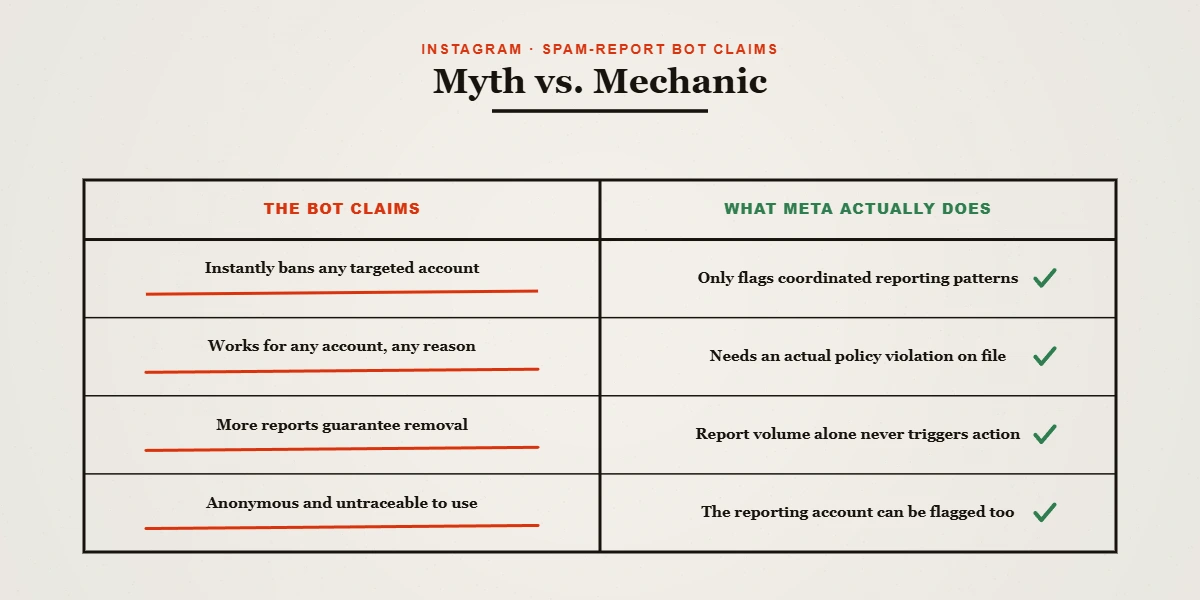
Search "telegram ban service" and a large share of what you find is a market built on a single myth — that volume bans accounts. It does not, and it never has. When a report reaches Telegram it enters a queue and is judged against a specific rule, not a vote count; ten thousand identical reports against a clean channel produce exactly what one does, which is nothing. Worse, a sudden coordinated burst can read as brigading and rebound on the accounts sending it. We took apart what these tools actually are in our breakdown of Telegram mass-report bots, and every one was a scam, a credential-phishing front, or a spam script Telegram ignores. The same con runs on every platform, which is why we have written the identical warning about mass-reporting on Instagram, TikTok and Snapchat, and about the report panels sold for X, plus the truth about Instagram spam-report bots.
The sellers cluster on forums, Fiverr, and Telegram itself, and they share the same tells: payment in crypto or gift cards, unverifiable "ban" screenshots, and a request that you "log in" so their bot can report for you — which is just an account-takeover kit aimed at the buyer. A telegram account ban service that promises to remove any account on demand is selling a button Telegram does not have. There is real risk to you, too. Filing false reports or a fraudulent copyright claim carries exposure, since a bogus DMCA notice is perjury under 17 U.S.C. § 512(f), and weaponizing reports against a lawful competitor can backfire on your own account. This is where our boundaries matter: we never ask for your password or login code, never file false or mass reports, never submit a copyright claim on work you do not own, and never guarantee a ban. The lines we hold on every case are set out in our service disclaimer, and our team's Trust and Safety background is exactly why we decline the requests this keyword attracts — silencing a critic, burying a rival — because wanting a channel gone is not the same as that channel breaking a rule. If a seller is charging to exploit a mechanism that does not exist, report them at reportfraud.ftc.gov.
Getting harmful channels and accounts removed on other platforms
The account or channel causing you grief is not always on Telegram, and the logic travels: every major platform removes content for the same core reasons and refuses to touch lawful posts. What changes is the form and the wording that gets a reviewer to act. If your problem lives elsewhere, start with the platform-specific route:
- Instagram — how to get an Instagram account taken down, and whether an Instagram ban service is real
- Facebook — how to take down a Facebook account
- X / Twitter — how to take down an X account, and what a Twitter ban service actually removes
- TikTok — getting a TikTok taken down fast, and the reality of a TikTok account ban service
- Snapchat — how to take down a Snapchat account
- YouTube — how to get a YouTube video taken down
- WhatsApp — how to get someone's WhatsApp banned when they are genuinely abusing you
The baseline never changes across any of them: a documented, accurate report beats a hundred angry ones, and no service — ours included — can remove lawful content on demand. Anyone who tells you otherwise is selling something that does not exist.