What does it mean to take down a Telegram channel?
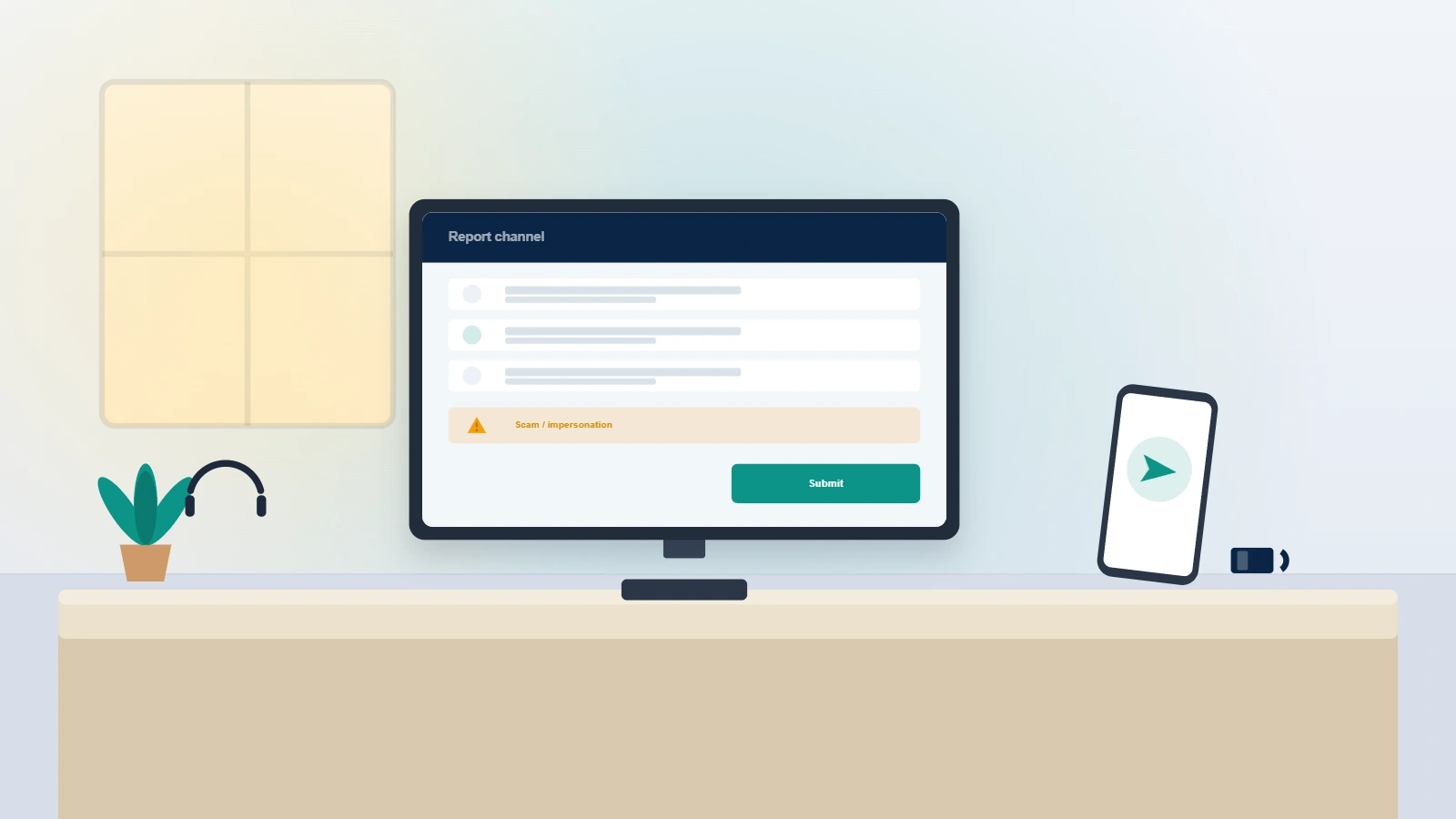
Taking down a Telegram channel means asking Telegram to remove, ban, or restrict a public channel — or a single message, group, bot, or sticker set on it — because it breaks the Telegram Terms of Service, a specific rule, or a law such as copyright. As of July 2026, only Telegram can carry out a takedown. No user can delete another person's channel directly; you submit a report or a legal notice, and a moderator or an automated system decides. One rule shapes everything that follows: Telegram states it only processes "legitimate requests to take down illegal public content" — public channels, groups, bots, and sticker sets — and does not act on private one-to-one chats. The phrase "take down a Telegram channel" actually covers five separate actions: reporting a single message, reporting a whole channel for abuse, filing an impersonation claim, sending a copyright or DMCA notice, and escalating illegal material to Telegram's abuse team or law enforcement. Each has its own route, its own evidence bar, and its own realistic outcome — and confusing them is the most common reason a genuine report goes nowhere.
The team behind YRS has handled hundreds of platform-enforcement and content-removal cases since January 2024 (our internal records as of July 2026), and roughly one in four people who ask how to take down a Telegram channel actually want something else — usually to recover their own hacked account, or to stop a private conversation, neither of which is a takedown at all. So get the category right before you report anything. The evidence-first method is identical across platforms: the same framework drives our guide to how to take down a Twitter account. If your own account was compromised rather than someone else's needing removal, start instead with recovering a hacked Telegram account. And every case here is handled by a named specialist — meet the team behind our takedown guidance.
How to get someone banned on Telegram: does the number of reports matter?
The honest answer to how to get someone banned on Telegram is that there is no magic number of reports, because Telegram does not ban a channel simply because many people tapped "Report." Telegram's moderators weigh the severity of the violation, the credibility of the evidence, and whether the content is genuinely illegal or against the Terms of Service — not how many complaints arrive. A hundred coordinated reports against a channel that breaks no rule will remove nothing; a single, well-documented report of a real violation — a scam, doxxing, impersonation, or illegal material — can get a public channel removed on its own. So the real method for how to get someone banned on Telegram is a truthful report of a genuine violation, filed under the correct category and backed by evidence. Report volume is not the lever; a provable breach is.
This distinction matters because organizing people to mass-report a channel you simply dislike — a critic, an ex, a competitor — is itself a misuse of Telegram's tools. It rarely works, and it can rebound on the accounts doing the reporting. Lawful opinion, criticism, satire, and public-figure commentary generally stay up no matter how many reports they attract, and trying to weaponize the report button against them is not a use case we support. The same evidence-over-volume principle governs every platform — it is exactly how getting someone's WhatsApp account banned and getting a TikTok taken down really work, too. If a channel is genuinely harming you, the path is a specific, evidenced violation, not a crowd.
How to report a Telegram channel through official routes
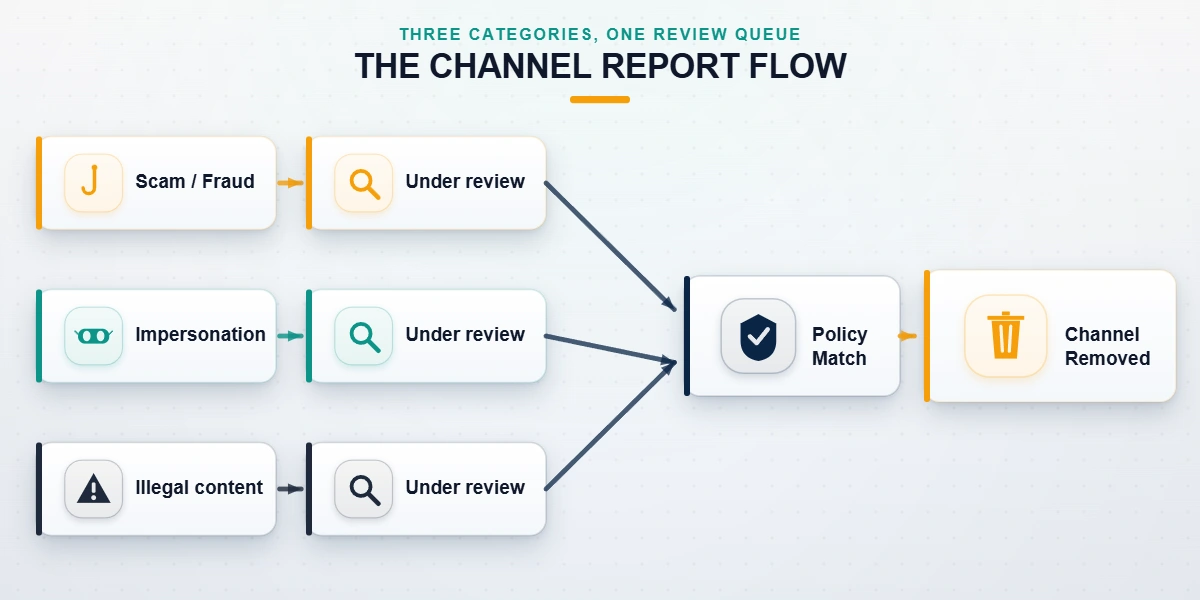
There are three official routes to report a Telegram channel, and matching the route to the violation is what makes a report actionable. As of July 2026, the in-app flow is the fastest for a public channel:
- Open the channel and tap its name, then the three-dot or three-line menu at the top.
- Tap Report.
- Choose the category that fits: Spam, Violence, Child Abuse, Pornography, Copyright, or Other.
- For Other, add a short, factual description — this is where harassment, impersonation, and doxxing belong.
- Submit. Reports route to Telegram's human moderators for review.
Beyond the in-app button, two official channels handle the harder cases. The @notoscam bot is Telegram's own verified tool for reporting scams and impersonation — message @notoscam, tag the offending channel or username, and describe the fraud. For serious illegal content, email [email protected] with the channel's t.me link, a plain description of the violation, and your evidence. Copyright has its own dedicated address, covered in the next section.
Before you report anything, gather evidence: screenshot the channel, copy its @handle and t.me link, and note specific messages with dates. Strong, specific evidence is the closest thing there is to making a report "work," because moderators act on demonstrable violations, not on emotion or volume. Telegram itself acknowledges that "even the best systems, algorithms and well-trained people can make mistakes," and provides an appeal route through its @SpamBot if your own account is ever swept up by error.
What can and can't be taken down on Telegram
A successful Telegram take down starts with knowing what Telegram will actually act on. Every Telegram take down request runs into one line first: the platform draws a hard distinction between public and private content. It processes "legitimate requests to take down illegal public content" — channels, groups, bots, and sticker sets anyone can find — but explicitly does not act on private one-to-one chats or private groups. That single distinction settles most cases before they begin. If the harm is happening in a private chat, a channel takedown is the wrong tool, and no report will remove it.
Within public content, these are the categories Telegram does remove, per its Terms of Service:
- Child sexual abuse material (CSAM) — actioned fastest and reported to authorities.
- Terrorism and incitement to violence.
- Scams, fraud, and phishing.
- Doxxing and extortion — Telegram ran a targeted purge of these channels in August 2025.
- Non-consensual intimate imagery (NCII) — "strictly forbidden," though independent research still documents enforcement gaps.
- Impersonation of a person or a brand.
- Copyright infringement, via a DMCA notice.
What generally stays up is just as important: lawful opinion, criticism, satire, unflattering-but-true statements, and ordinary public-figure commentary are not policy violations, and no legitimate service can force their removal. Being honest about that boundary is part of what we will and won't take on — promising to delete lawful speech is a scammer's pitch, not a real one.
How to file a Telegram DMCA takedown for copyright
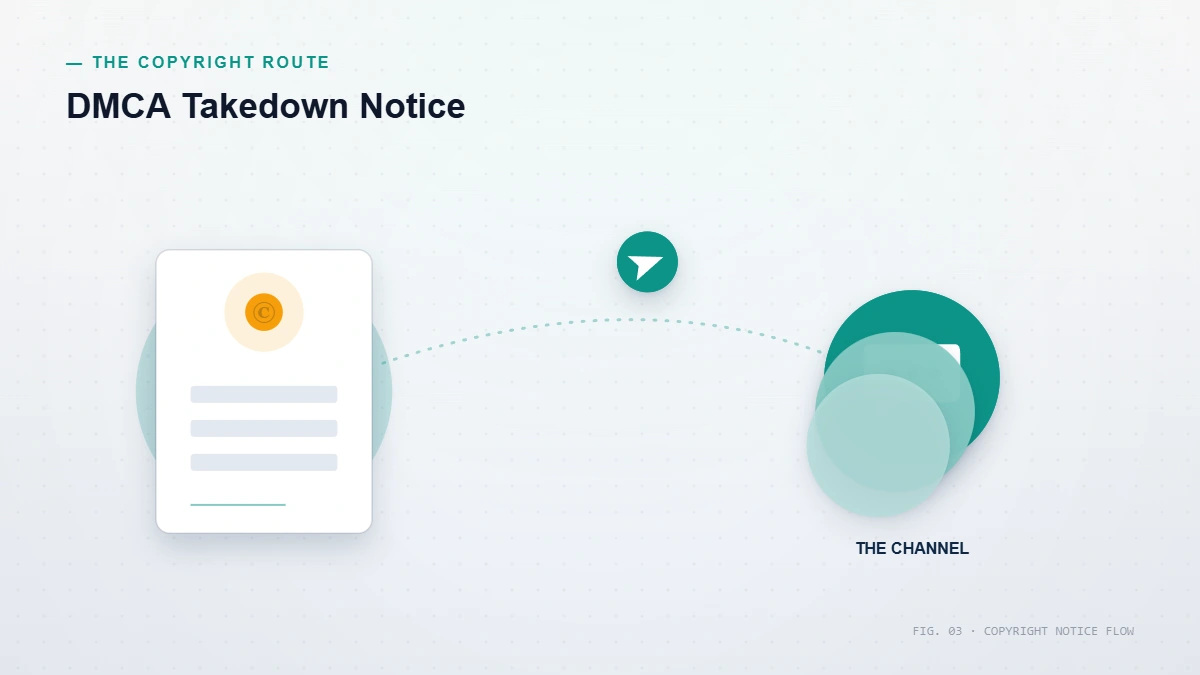
If someone is redistributing your photos, videos, artwork, or writing on a channel without permission, you do not rely on the ordinary Report button — you file a copyright complaint, which is Telegram's version of a DMCA takedown notice. This is often the most reliable route, because Telegram, like any host, has a legal incentive to act on a valid notice under the U.S. Copyright Office's DMCA framework. Send your Telegram DMCA takedown to [email protected] as the rights holder or an authorized agent, and include four things: identification of the copyrighted work, the exact infringing t.me links, your contact details, and a statement, made under penalty of perjury, that you own the rights and the use is unauthorized. A tidy, specific notice is actioned far faster than a vague one.
Two cautions matter here. First, only the rights holder or an authorized agent can file — a Telegram DMCA takedown submitted by an unrelated third party is simply rejected. Second, and this is a hard line: filing a fraudulent copyright notice against content you do not own is unlawful under 17 U.S.C. § 512(f) and can expose you to real damages, because the notice is a sworn legal statement. We never file a notice we cannot stand behind, and no legitimate service should either. The same legal framing governs a copyright-based Instagram account takedown — the platform differs, the DMCA rules do not.
Not sure which route fits your situation — or whether the content can be removed at all? Talk to our team for a free 60-minute case review. We'll tell you plainly what Telegram will act on, what it won't, and exactly what evidence to gather — before you spend anything.
How long does a Telegram takedown take — and what if nothing happens?
There is no button that takes down a Telegram channel instantly, and any service promising a guaranteed same-day ban is describing something that does not exist. Telegram publishes no decision timeline, and it is candidly slower and less consistent than Meta or Google: straightforward illegal content such as CSAM or terrorism is actioned quickly, while generic harassment and spam reports can sit for days or weeks — or go unanswered entirely. Treat any timeline you read as an industry-observed estimate, never a Telegram guarantee, and be wary of anyone who quotes you an exact number of hours.
If a legitimate report goes nowhere, escalation — not repetition — is the next move. Re-filing the same report ten times does not help and can look like abuse. Instead:
- Escalate to [email protected] with a tighter evidence pack and the exact t.me links.
- Report the app-level distribution to Apple's App Store or Google Play review teams when a channel promotes clearly illegal activity through their apps.
- Involve law enforcement for CSAM, NCII, credible threats, or extortion — these are crimes, not merely policy breaches, and a police report can carry weight a user report cannot.
One hard truth to plan around: a removed channel can respawn under a new handle. Persistent offenders clone themselves, which is why serious cases need ongoing monitoring rather than a single Telegram takedown. That same resurfacing pattern shows up in our Telegram banned-number recovery guide, and if you assumed a reach limit was a "soft takedown," our explainer on how X's reach limits actually work clears that up.
What a legitimate Telegram takedown service will and won't do
This is a niche crawling with scams, so here is exactly where the line sits. A legitimate Telegram takedown service will never ask for your password or a login code — reporting and removal never require them, and anyone who asks is phishing. It will not sell "pay-to-remove" guarantees: no amount of money makes Telegram delete content that breaks no rule, and anyone charging for a "guaranteed instant ban" is either reselling the free report form or simply taking your money. It will not mass-report or file false claims against a channel you dislike, because that is abuse of the platform and can get the reporters actioned instead of the target. And it will never file a fraudulent DMCA notice — that is a federal crime, not a service.
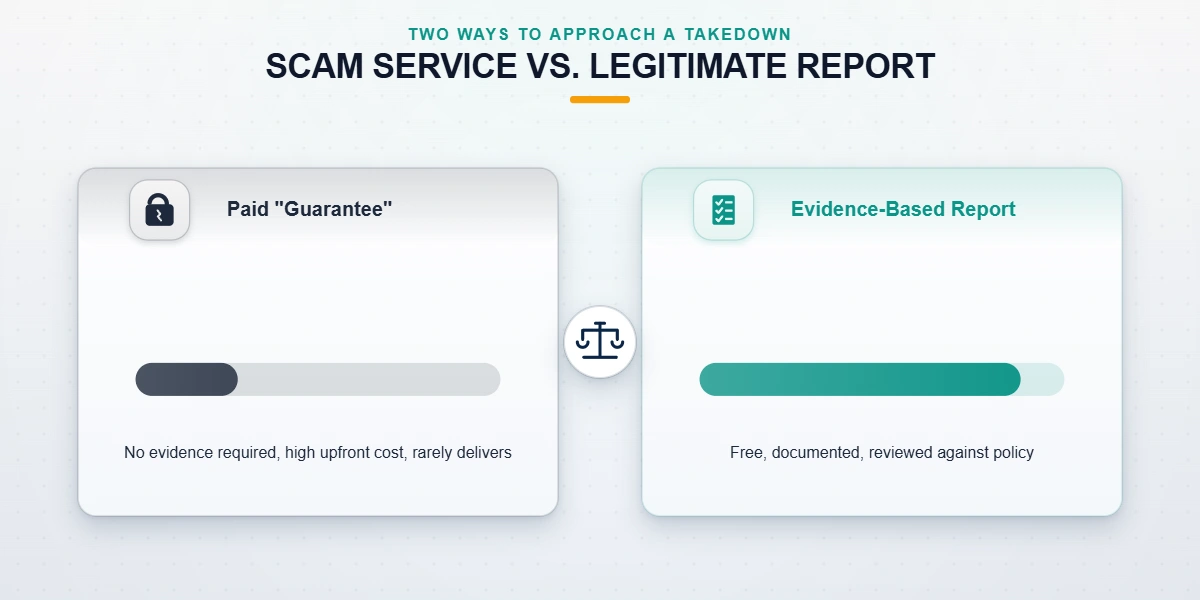
What a real Telegram takedown service actually does is unglamorous: it identifies the correct violation category, builds the evidence pack Telegram's moderators need, files through the official channels above, and — for abuse that spans several platforms — coordinates removal and monitoring together. That work is led by our Telegram account recovery team and former Meta and TikTok Trust & Safety specialists, who have seen how these reviews are triaged from the inside. If you suspect a support-impersonation scam, report it to the FTC at reportfraud.ftc.gov. We don't guarantee removal — nobody legitimately can. We do guarantee a sober, evidence-based assessment of whether your case is actually removable, before you spend a cent.