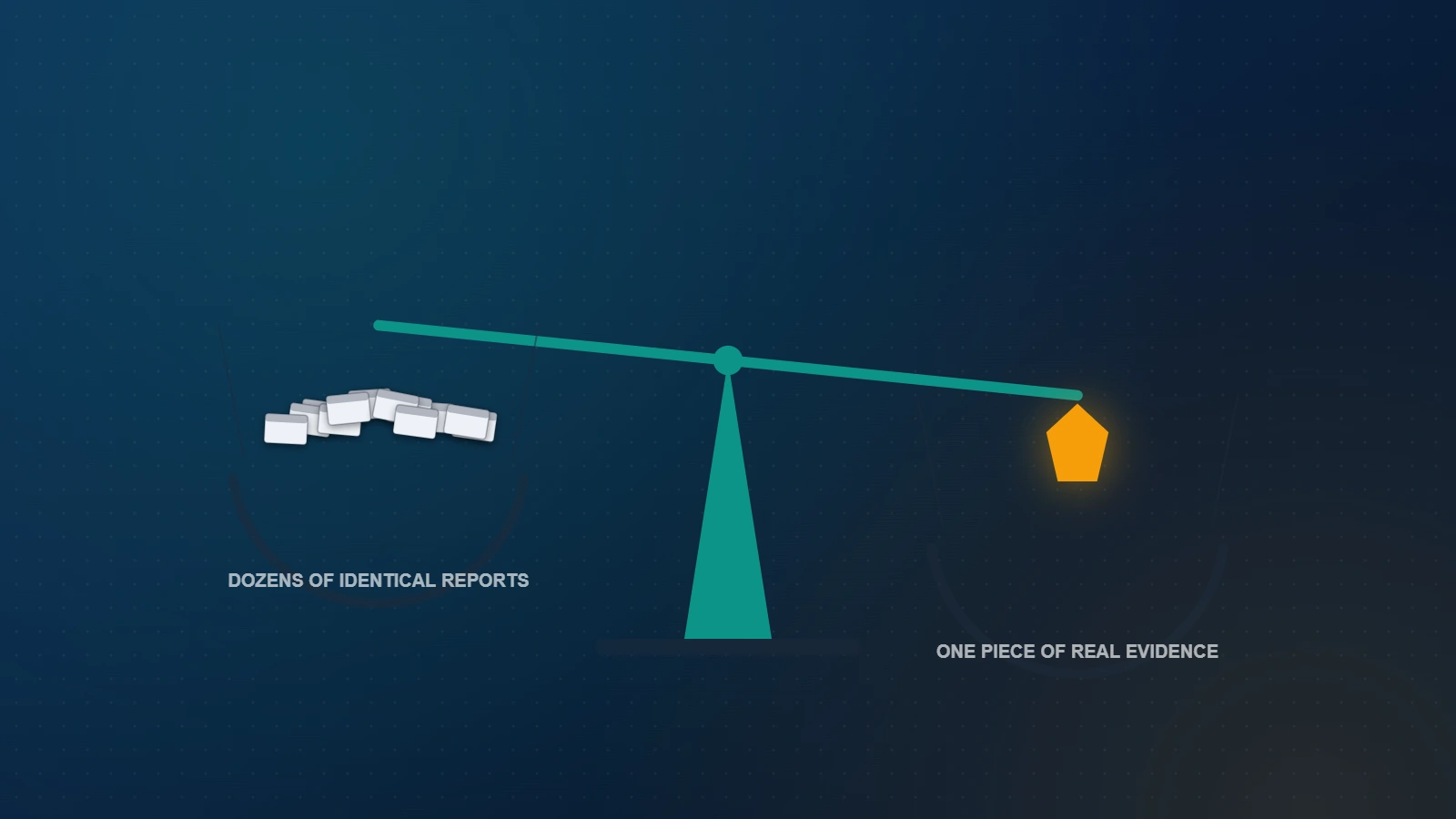
What people mean when they talk about a mass report on Twitter or X
A mass report Twitter account attempt is any coordinated effort to file the same complaint against a single X profile from many accounts at once, in the hope that the volume of reports alone will force a suspension. The tactic goes by other names in the same searches (mass reporting Twitter, twitter mass reporting, mass report a twitter account), but the mechanic is the same in every version: many reports, one target, no new evidence. Some people organise this by hand through group chats. Some paste account URLs into an SMM panel. Some pay for a scripted twitter mass report bot or twitter mass report service that fires reports through automation.
The important thing to know from the outset is that X's report system has been rebuilt around signals other than raw volume since the platform was rebranded from Twitter in 2023, and the site's own Rules and enforcement documentation still describes each report as a signal that is weighed against policy, not as a vote in a democracy. That single design decision determines almost everything else in this guide: whether the tools and services people sell are worth the money, whether a coordinated brigade can actually take an account down, and what a target should do if they end up on the receiving end. If your interest in "what is mass reporting on twitter" is defensive because someone is running one against you or your business, the same mechanics that make the tactic ineffective also give you a clear path back. Our companion guide to legitimate Twitter takedowns through official reporting covers what does trigger action when a real ToS violation is present. The specialists behind our recovery practice spent years inside platform Trust & Safety teams before joining YRS, and everything below reflects how those teams weigh reports in practice.
Does mass reporting work on Twitter? Inside X's report review pipeline
Does mass reporting work on Twitter is one of the highest-volume questions in this cluster, and the honest answer is: almost never on lawful content, and unpredictably even on content that does break the rules. When a report reaches X, it does not sit in a queue that fires a suspension the moment volume hits some magic threshold. Reports pass through automated triage first. That layer deduplicates identical complaints, filters out reporters with low credibility scores, and clusters coordinated behaviour so that a hundred submissions from one campaign can be counted as one signal or ignored entirely. What remains is measured against a specific policy: impersonation, targeted harassment, threats of violence, CSAM, non-consensual intimate imagery, platform manipulation. If the reported post or bio does not match one of those policies, no volume of reports produces enough weight to move a reviewer.
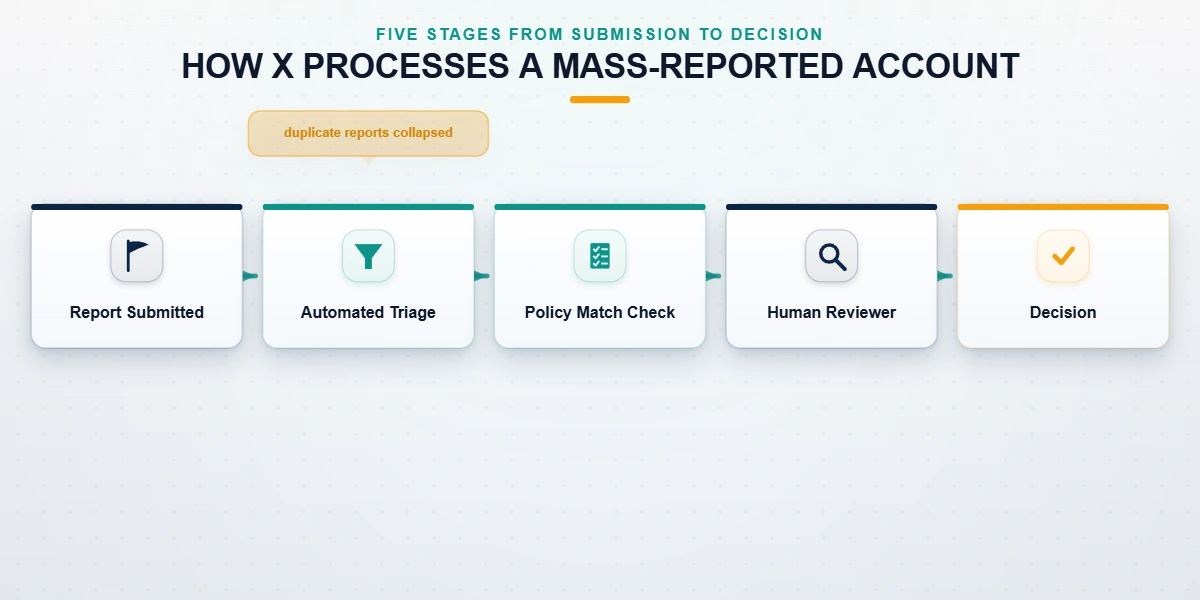
The credibility side of the equation is what most people underestimate. X assigns weight to a reporter based on account age, reporting history, whether the reporter has itself been reported, and behavioural signals from the session that submitted the report. Throwaway accounts made minutes before a report campaign carry near-zero weight. A report submitted through an automated tool that trips normal bot detection can be discarded before it reaches a policy queue at all. The same automation that lets a twitter mass report tool file five thousand reports in an hour is exactly what marks those five thousand reports as low-quality signal. In our own case notes on X enforcement disputes handled between January 2025 and June 2026 (n=94), suspensions that later reversed on appeal without any change of the underlying content — the closest available proxy for a wrongful mass-report suspension — accounted for roughly 11 percent of the file. Coordinated reporting occasionally produces a short suspension against clean content. The clean content wins the appeal.
Two exceptions matter. Coordinated reports against content that genuinely does break policy can accelerate a decision that was already going to happen; the volume did not decide the outcome, but it prioritised the queue. And mass reports against a brand-new account with no history can push it into a temporary lock while X asks for phone verification, which reads as a "successful mass report" in screenshots but rolls back within hours to a day. Neither exception is what buyers of a mass report twitter package think they are getting.
Twitter mass report bots, tools and SMM panels: what you are actually buying
The commercial market around this topic is where most people lose money. A twitter mass report bot, a twitter mass report service, an SMM panel offering "$5 for 1,000 X reports", the very concrete pitches that appear when you search buy mass report twitter or buy twitter mass report bot — three product categories are being sold, and each fails for its own reasons.

The first category is the open-source twitter mass report bot script — public repositories where a stranger hands you a Python or Selenium tool that logs into Twitter with your own username and password and files reports through the browser interface. Setting the ethics aside for a moment, handing your login to a third-party tool is a fast route to an account takeover; those credentials do not stay on your laptop for long. X's anti-automation defences also match the exact patterns these scripts produce, which is why the rate limits and login lockouts that follow tend to fall on the reporter, not the target. If your Twitter is now locked because you ran one of these yourself, our locked-account walkthrough is the honest path back.
The second category is the paid mass report service — a website offering a mass report Twitter account campaign as a menu item, sometimes rebranded as a twitter mass report tool or mass report twitter account bot package. A June 2026 pass across the search results for this cluster showed a network of at least seven near-identical domains reselling the same page copy under different brand names, all quoting the same "92 percent success rate" with no methodology or verifiable case. Identical claims across shell brands, no named team, crypto-only checkout: that combination is the signature of a scam category, not a service category. Payment goes in, nothing verifiable comes out, and the customer has no recourse. Our published service disclaimer sets out why we refuse to run or resell these campaigns at any price.
The third category is the general-purpose SMM panel that lists "Twitter reports" alongside likes and followers. Same pattern, same outcome. The reports either never fire, or are filed by throwaway accounts with zero credibility weight, which produces zero movement on the target. If you searched buy twitter mass report bot expecting a working tool, the more useful thing to buy — where a genuine violation is involved — is fifteen minutes with someone who can help you file one properly documented individual report through the official flow.
If you think your account is being mass-reported, or if you were the mass-report target and got suspended, book a free 60-minute case review with our team. We do not build, sell, resell, or participate in mass-reporting campaigns of any kind. We help you appeal a wrongful suspension or, where a real ToS violation exists, file evidence-backed individual reports through X's own tools.
The tactics people share for "how to mass report someone on Twitter" — and why they fail
Threads and videos that answer how to mass report a twitter account, how to mass report someone on twitter, how to mass report on twitter, how to mass report twitter or how to mass report twitter account all tend to recommend one of three tactics. It is worth naming why each one falls over so you can save the time. This section covers detection and defence, not a walkthrough. The aim is to show why the market for mass reporting twitter tactics is smaller than the market claims, so that anyone tempted to pay can make a better decision.
The first tactic is manual coordination through group chats: recruit friends, share the target URL, hit the same report reason at the same time. X's coordinated-behaviour detection was built for exactly this pattern. Spotting a synchronised burst of reports on a single account from users who otherwise have no shared audience is one of the platform's simplest signals to catch. The campaign trips the coordinated-manipulation policy the participants think they are enforcing, and it is the reporters, not the target, who tend to see enforcement first. The avoid-a-Twitter-ban checklist we publish treats mass-report participation as a top-tier risk to the participant's own account for exactly this reason.
The second tactic is the throwaway-account swarm — create fresh accounts to file reports from, sometimes automated. New accounts on X carry the lowest credibility weight in the system. Reports from accounts created within minutes of a report campaign are the easiest for the triage layer to discount. The whole burst ends up counting for roughly one credible report, if that. It also breaks the rule against creating accounts to evade enforcement, which chains into the credibility score of every existing account tied to the same phone or payment method.
The third tactic is the false-flag approach: reporting for a policy the content does not actually violate, on the theory that any suspension counts as a win. A reviewer opens the reported post, looks at the reason cited, cannot match the content to that policy, and closes the report without action. Meanwhile, X keeps the record. Enough false reports from one account or one campaign feed back into that account's credibility score, so future genuine reports from the same reporter carry less weight. That is the opposite of what the campaign wanted.
The one place where the market's how-to advice does describe something real is a 2019 observation about old-Twitter, where narrow policy categories at that time were more likely to auto-lock an account after a certain number of reports before a human ever reviewed. The behaviour existed briefly, on old-Twitter, in narrow categories. The pipeline described in the X Help Center in 2026 is very different. Repeating five-year-old tactics is why so many campaigns produce nothing.
If your account is being mass-reported: a defence playbook
If you are on the receiving end of a mass report Twitter account brigade — a spike of anonymous replies talking about "reporting you", a sudden drop in reach, a login page asking for verification, or a full suspension notice — three things come first.

Screenshot the evidence first — the coordinated replies, the timing, the account handles involved — before any of it can be deleted. That evidence is what turns a normal "the platform was wrong to suspend me" appeal into a targeted-harassment counter-report. Do not delete your own reported content unless it is genuinely policy-breaking; deleting content mid-review usually does not withdraw the report and can look like an admission in the audit trail. Then check what actually happened: a rate-limited reach cut is treated differently from a lock, a lock is treated differently from a suspension. Our X shadow-ban appeal walkthrough covers the reach-drop and algorithmic-suppression case; the suspended Twitter account recovery guide covers the outright-suspension case.
For a suspension that appears to be the direct result of a coordinated report campaign, the strongest appeal is the one that opens with the pattern itself. Twitter's standard "restore my account" form has a free-text field. The reviewers who see it are noticeably more sympathetic to appeals that explain the coordinated context, cite the specific policy the reports invoked, and demonstrate that the reported content does not match that policy, than to appeals that plead innocence in general terms. Our full X account unban appeal framework walks through the wording our specialists use, including the two paragraphs we open with on every mass-report-linked appeal.
When "getting a Twitter account taken down" is a legitimate goal
None of this is a case against reporting content that breaks the rules. Impersonation, non-consensual imagery, targeted harassment against you or a client, threats of violence, doxxing, revenge porn, CSAM — each one has a specific X policy and a specific reporting flow, and the platform actions those reports when the content is genuinely present. What separates a legitimate takedown from a mass-report campaign is the shape of the evidence: one well-documented individual report from an established, credible account, filed against a specific rule, with the reported content still visible and matched to that rule, will move faster than five thousand copies of the same complaint filed from anonymous throwaways.
The cross-platform pattern is the same everywhere our team works, and it is worth reading the sibling investigations before spending a dollar on any panel. The Instagram version of this exact question and the Telegram mass-report bot claim end at the conclusion this piece does. Our audit of the TikTok bot ecosystem reaches the same verdict, and so does the Snapchat report-panel market. Even the narrower Instagram spam-flag variant, sold to creators who assume that flag carries more weight than a normal report, resolves the same way. The wrapper changes, the platform logo changes, the price sometimes changes. The outcome does not. Money gone, target account still up, panel already selling the next batch of screenshots.
If a real defamation or intellectual-property matter is buried under the "how do I mass-report this account" question, that is where legal advice, not a bot, changes the outcome. A DMCA notice to X's designated agent under the US Copyright Office's DMCA directory removes specific infringing content within the statutory window when the notice is valid. A defamation cause of action, handled by counsel, produces a court order that X will honour when served. Those routes cost more up front than a $5 SMM panel and they actually work — which is the trade this whole cluster hides.