
What is mass reporting on Instagram?
Mass reporting on Instagram is the practice of many accounts — real people, fake profiles, or automated bots — filing reports against the same target at roughly the same time, hoping sheer volume forces Instagram to disable it. The tactic goes by several names: a mass report, an Instagram mass report, mass reporting, or simply a report wave. It is not the same as a single honest report of a genuine violation. It is also not the same as Instagram being down, where large numbers of users report an outage rather than a person. The goal of a coordinated report is not to flag a real rule-break; it is to manufacture the appearance of one through numbers. That distinction matters, because Instagram, owned by Meta, was built to resist exactly this. As of July 2026, no amount of coordinated reporting deletes an account on its own.
Here is the line we draw for every client. Reporting an account that is genuinely impersonating you, harassing you, or stealing your work is legitimate — that is what Instagram's tools exist for, and we walk people through it in our guide to reporting a real Instagram violation the right way. Organizing a crowd or renting a bot to bury an account you simply dislike is something else: it is coordinated reporting, and Meta treats it as abuse. Search demand for this is enormous — "mass report Instagram account," "Instagram mass report bot," "mass reporting Instagram" — but demand does not make the tactic effective, legal, or safe. Most of the pages selling it are counting on you not knowing the difference.
Does mass reporting work on Instagram?
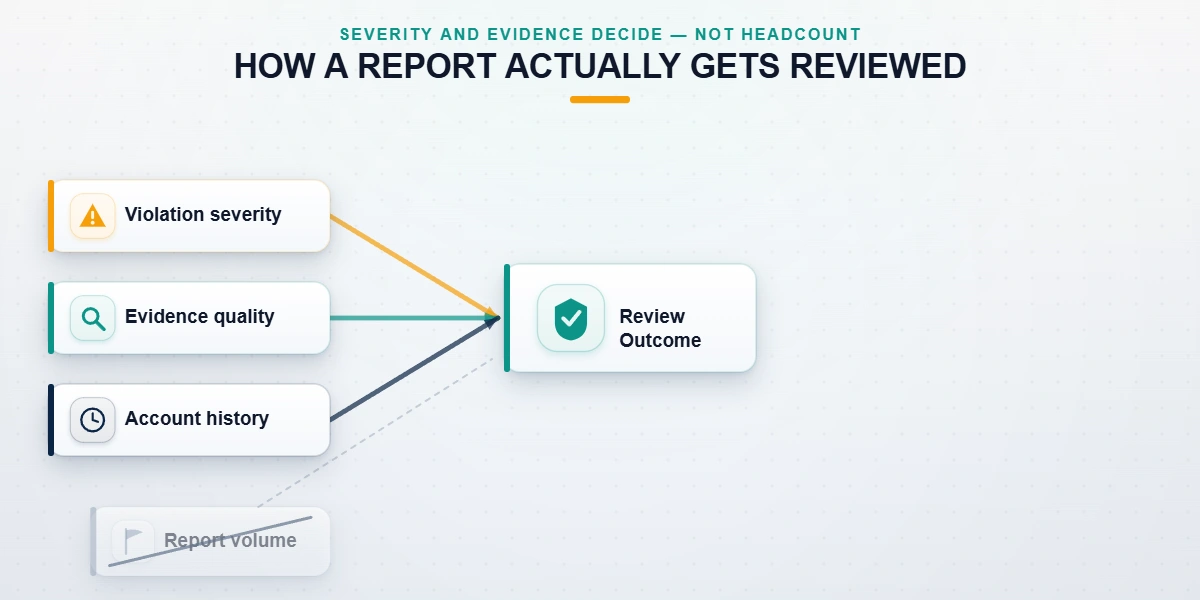
Can you mass report an Instagram account? You can certainly try — anyone can tap Report — but the honest answer to "does mass reporting work on Instagram" is: almost never, and not the way people think. Instagram does not count reports and pull a lever at some magic number. Meta's enforcement systems weigh three things: the severity of the violation, the credibility of the evidence, and the reported account's own history. Instagram's Help Center describes how it reports and reviews content — and nowhere in that process is there a report threshold. A rule-following account can absorb ten thousand reports and lose nothing, while one well-documented impersonation report can remove a fake in days. Report volume is a signal that something got attention. It is not a verdict. If the underlying content breaks no policy, more reports change nothing.
So why does almost everyone believe it works? Timing tricks the eye. An account with a real pattern of violations gets actioned the same week a group piles on, and the crowd takes the credit — when the violation did the work. The same logic applies to a mass report of an Instagram post: reporting one photo, reel, or story a hundred times will not remove it unless it actually breaks a rule, though a single accurate report often will. When our team reviews cases where a target "went down after a mass report," we almost always find a genuine policy breach underneath. The coordinated volume was the bystander, not the cause. The same holds on other platforms: our companion pieces on whether a TikTok mass report bot actually works and whether mass reporting a Twitter (X) account does anything reach the identical conclusion — each platform reviews the violation, not the volume.
How many reports does it take to remove an Instagram account?
There is no number, because Instagram does not tally reports to a total. This is the most durable myth in the topic, so let us be blunt: a target is removed when a reviewer or automated system confirms a real violation, not when a counter ticks over. Ten reports and ten thousand reports produce the same outcome against a compliant account — nothing. The variable that moves a case is evidence quality: a clear impersonation with an ID match, a valid copyright claim, or documented harassment. That is why we tell clients to stop asking "how many reports" and start asking "what genuine, provable violation exists here." If the answer is none, no volume of reporting will remove the account, and any tool promising otherwise is selling a fiction.
The mass report bot, tool, and paid "service" ecosystem — why it's a trap
Search for an Instagram mass report bot, an Instagram mass report tool, a mass report APK, a GitHub "mass reporter," a Telegram mass report bot, or an SMM panel selling "reports per thousand," and you will find hundreds of listings. Almost none do what they claim. There is no public, working automation that makes Instagram delete accounts on command, because Meta rate-limits and fingerprints reporting to catch exactly this behavior. What these products actually are falls into a few buckets: credential-harvesting scripts that steal the logins you type in, malware-laced APK downloads, Telegram bots that take payment and vanish, and content-farm "services" recycling an identical "92% success rate" line across a dozen throwaway domains. Investigative reporting by AlgorithmWatch documented mass reporting sold as a paid service — an underground market built on victims, not results.
| Sold as | What it usually is | Real risk to you |
|---|---|---|
| Mass report bot / tool (online or website) | A script that captures your session, or does nothing | Account takeover; ban for automation |
| Telegram mass report bot / "buy mass report Instagram" | A pay-and-disappear operator | Money lost, no refund, no result |
| Mass report APK / mod app | Sideloaded malware or a mislabeled analytics app | Device compromise, data theft |
| GitHub "Instagram mass reporter" repo | An unmaintained Selenium script, "educational only" | Instant rate-limit ban; credential leak |
| SMM panel "reports per 1,000" | Fake or bot reports Instagram discards | Wasted spend; terms-of-use violation |
| "Professional mass report service" site | An AI-spun page reselling the free Report button | Fraud; chargeback risk |
Two patterns give the scam away every time. First, the identical statistics: when a dozen unrelated sites all promise the same suspiciously precise "success rate," none of them are measuring anything — they are copying each other. Second, the payment structure. If you pay a bot to mass report an Instagram account and it appears to work, you have no proof the bot did it; if it fails, you have no recourse, because you paid an anonymous operator for a policy violation. Either way, you are the product. We have never seen one of these tools survive contact with Meta's abuse detection — and we have met plenty of the people who bought them, usually after their own account got flagged for the automation.
Is there a real Instagram mass report bot that works?
No — and the honest reason is architectural, not temporary. Instagram's reporting endpoint is rate-limited per account and device, watched for coordinated patterns, and weighted so that one credible report outperforms a thousand automated ones. A bot that fires reports fast simply flags itself. The scam-site legitimacy signals we outline for recovery services apply here in reverse: any tool advertising guaranteed bans, "undetectable" reporting, or a fixed success percentage is describing something that cannot exist. The only "place to mass report on Instagram" is Instagram's own in-app Report flow, and it was built to ignore volume. Every APK, panel, and repo layered on top of it is friction between you and a scam, not a shortcut to a result. One distinction people conflate: a mass report (many accounts reporting once) is not the same as a spam report bot (one setup firing repeat reports), and neither beats review — we break the second down in the truth about Instagram spam report bots. The identical scam pattern reappears in the Snapchat mass report bots and tools sold through the same channels.
Is it legal to mass report someone on Instagram?
People searching "how to mass report someone on Instagram" usually want a playbook. Here is the honest version: there is no legitimate playbook, and the tactic carries real exposure. Under Instagram's Community Guidelines and Meta's rules against coordinated inauthentic and harmful behavior, organizing accounts to file bad-faith reports is itself a violation — the kind that can get the reporters restricted or banned, not the target. Beyond the platform, a coordinated campaign to silence a specific person can cross into harassment or cyberstalking, which are criminal in many jurisdictions. Filing knowingly false impersonation or copyright claims adds its own legal risk. So can you get in trouble for mass reporting someone on Instagram? Yes. You can lose your own account, and in a serious campaign you can face legal consequences. The only reporting that is both effective and safe is a truthful report of a genuine violation.
If someone is genuinely breaking Instagram's rules against you, report them once, accurately, with evidence. What we will not do, ever, is help anyone brigade a lawful account — you can read that boundary plainly in our disclaimer on cases we won't take. The uncomfortable truth for anyone hoping to weaponize reports is that the system is deliberately built to make your effort pointless and your account vulnerable.
What to do if your Instagram account is being mass reported
If you believe your Instagram account is being mass reported, the first thing to know is that a report wave alone cannot delete you — but it can trigger an automated review, and a false suspension occasionally slips through before a human corrects it. The signs are recognizable: a sudden burst of removed posts, a "we've restricted your account" notice with no clear reason, or a coordinated pile-on in your comments where a group announces it is "reporting" you. What happens next depends on whether any real violation exists. If your content follows the rules, most waves fizzle, because Meta's systems are designed to discount volume. If a false positive does land, it is almost always reversible on appeal. The worst move is to panic — deleting posts, spamming appeals, or buying an "un-report" service, which is the same scam simply pointed at victims instead of attackers.
Practical steps, in the order our operations desk uses them:
- Capture the evidence first. Screenshot every removal notice, restriction banner, and any comment where people announce they are reporting you — with timestamps. If you later need to prove the campaign was coordinated and false, this record is what wins the appeal.
- Keep behaving normally. Do not delete posts, deactivate, or fire off ten appeals in an hour; that noise can read worse than the reports. Post as usual.
- Lock the account down. Turn on two-factor authentication and review recent login activity, so a report wave is not paired with a takeover attempt. Our guide to staying on the right side of Instagram enforcement covers the settings that matter most.
- Appeal fast, once, and accurately. If a post or the account is actioned, use the in-app "I think this was a mistake" option or the Help Center appeal — a calm, specific appeal beats a flood, and the Instagram unban walkthrough shows each step.
- Save proof of who you are. A photo ID, and for a brand your business documents, make an eventual recovery case far stronger.
For a business or creator whose income runs through the account, a coordinated attack is an emergency rather than an annoyance. Treat the first hour as evidence collection, loop in anyone who shares admin access, and do not negotiate with whoever is behind it — the leverage is in the appeal, not the fight.
How to recover an Instagram account disabled after a report wave
When a report wave does succeed in getting an account wrongly disabled, the fix is an appeal, not another report — and wrongful disables are among the more recoverable cases we handle. Across the 312 Instagram cases our team has worked since January 2024 (internal records, July 2026), the accounts hit by coordinated false reporting were, in most instances, restorable once we documented that the enforced "violation" never actually happened. The path runs through Instagram's account-status and appeal tools: you request a review, state plainly that the action was a mistake, and attach the evidence you preserved. If the account was fully disabled, the disabled-account recovery route applies; if an appeal has already been rejected, there is still a second path after a denied appeal. What decides these cases is documentation, not volume — the same principle that made the attack fail is what makes the recovery work.
Is your Instagram account under a coordinated report attack right now? Don't buy a counter-tool. Book a free 60-minute case review with our team — we'll tell you honestly whether the wave can hurt you, whether a wrongful action is reversible, and exactly what evidence Instagram will want before you spend a cent. Talk to our recovery team.
We run high-stakes attacks through our Instagram account recovery service, with a named specialist on the case from intake to hardening. If the account has been removed entirely, our guide to permanently disabled Instagram recovery covers the narrow options that remain and the ones that don't exist despite what sellers claim.
What we won't do — the anti-scam line
This topic is thick with scams pointed in both directions — at people who want to attack an account, and at the victims of those attacks — so here is exactly where we stand. We will never help you mass report, brigade, or weaponize reports against a lawful account, and we will never sell, endorse, or link to a mass report bot, tool, panel, or app. We never ask for your password, and neither does Instagram; anyone who does is phishing. We don't do pay-to-remove: no payment makes Meta delete content that breaks no rules, and no payment makes a coordinated report work. And we don't promise guaranteed outcomes — some wrongful disables come back quickly, some take longer, and some content stays up because it violates nothing. If you have been targeted by a fake "report service" or an "un-report" scam, report it to the FTC at reportfraud.ftc.gov. Every case here is handled by a credentialed specialist, led by a former Meta Trust & Safety analyst — the honest assessment is free, and the false promises elsewhere are not.