Account Recovery· 13 min read

WhatsApp Mass Report Bot Scams: What Actually Works (2026)

A WhatsApp mass report bot almost never works. WhatsApp, owned by Meta, bans accounts for verified violations — scams, impersonation, harassment — not for how many reports arrive, so its systems weigh the reported messages, the evidence, and the account's history rather than report volume. Most tools sold as mass report bots are scams or malware. If a report wave wrongly restricted your number, that is usually a recoverable appeal.

A WhatsApp account facing a wave of coordinated reports as a whatsapp mass report bot claims it can trigger an instant ban.

Do WhatsApp mass report bots actually work?

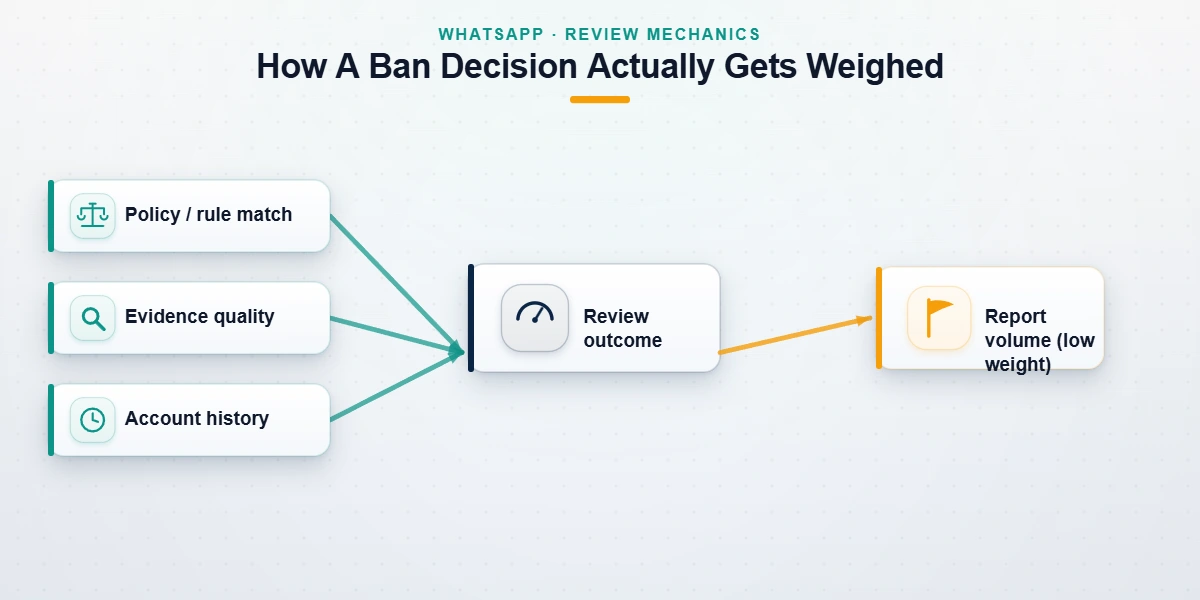
Almost never. A whatsapp mass report bot promises that if enough accounts pile reports onto the same number at once, WhatsApp will delete it on command. WhatsApp, which is owned by Meta, does not work that way. When you report a contact, WhatsApp receives the last five messages that account sent you and checks them against its account-ban policies; the outcome turns on what those messages contain, the strength of the evidence, and the reported account's own history, not on a running tally of reports. A number that breaks no rule can sit under a wave of coordinated reports and lose nothing, while one well-evidenced scam report can get a fraudulent seller removed within days. So the honest answer to whether these bots work is: not the way the sellers describe, and for a rule-following account, usually not at all.

Why does almost everyone believe otherwise? Timing plays a trick on the eye. An account with a real pattern of spam or fraud gets restricted the same week a crowd piles on, and the crowd claims a win the behaviour earned. WhatsApp does add one wrinkle the other Meta apps lean on less: its anti-spam system watches for numbers that get blocked and reported by many recipients in a short window, because that pattern is the fingerprint of bulk unsolicited messaging. That can produce a temporary restriction. It is aimed at spam behaviour, it lifts or can be appealed, and a person messaging real contacts does not trip it simply by being disliked. A permanent ban still needs a verified violation. This is the gap every "mass report whatsapp" seller quietly hides from you.

How many reports does it take to ban a WhatsApp number?

There is no magic number, because WhatsApp does not tally reports toward a deletion threshold. This is the most durable myth in the whole topic, so let me be blunt: a number comes down when a reviewer or an automated system confirms a genuine violation, not when a counter passes some figure a bot seller quoted you. Ten reports and ten thousand reports produce the same result against a compliant account, which is nothing at all. What actually moves a case is evidence quality — a clear impersonation, a documented scam, a credible threat. The automated anti-spam layer can place a temporary restriction on a number that suddenly looks like a bulk sender, but that is a spam signal, not a report scoreboard, and it does not permanently delete an account on numbers alone. Ask what provable violation exists. If the answer is none, no volume removes the number.

Diagram showing how WhatsApp weighs violation type, evidence, and account history over whatsapp mass report volume.

What a WhatsApp mass report bot really is — the tool, the panel, the "service"

Strip away the branding and a whatsapp mass report bot is one of a small set of things, none of them a working delete button. Some are Telegram scripts that automate the ordinary in-app Report action across a pool of numbers or throwaway accounts. Some are dressed up as a whatsapp mass report tool with a dashboard and a progress bar. Others are sold as a full "ban service" or an SMM panel quoting reports per thousand. The names rotate endlessly (report bot, auto-reporter, mass report panel, ban-in-24-hours service), but the thing underneath is always the same free Report button WhatsApp built to weigh evidence, wrapped in a payment page or a malware download. WhatsApp rate-limits and fingerprints reporting precisely to catch coordinated automation, so a script firing rapid reports mostly flags itself, not its target.

It helps to know what a report can and cannot produce, because the sellers blur it on purpose. WhatsApp enforcement takes three distinct shapes as of July 2026: a temporary ban, often tied to unofficial apps such as GB WhatsApp or WhatsApp Plus rather than to any report wave; a permanent ban for serious or repeated abuse; and a phone-number or device-level ban for persistent repeat offenders. None of the three is triggered by strangers tapping Report on a rule-following account. A bot cannot manufacture the verified violation each one requires, which is exactly why the "instant permanent ban" promise is the tell that you are looking at a scam, not a tool.

WhatsApp mass report tools and paid "ban services": how the scam actually works

Search for a whatsapp mass report bot, a mass report panel, or a paid "get this number banned" service and you will surface a wall of listings. Almost none do what they advertise, and the way they fail is worth understanding, because it is the same machine pointed at victims that we take apart platform by platform. Strip the marketing and the products fall into a few buckets: credential-harvesting pages that pocket whatever login or verification code you type in, malware-laced APK and script downloads, pay-and-vanish Telegram operators, and content-farm "services" recycling one identical sales page. Our team has watched a single roughly 1,800-word "how it works" article get mirrored almost word for word across a rotating set of throwaway domains — the same copy, the same suspiciously precise success rate, the same invented per-target price, four different checkout buttons.

Sold as What it really is What it costs you
WhatsApp mass report bot / tool A script that automates the free Report button, or does nothing A ban for automation; a leaked login or code
Telegram "get this number banned" operator A pay-and-disappear seller Money gone, no refund, no result
Mass report panel / SMM "reports per 1,000" Fake reports WhatsApp discards Wasted spend; a terms violation
Mass report APK / mod app Sideloaded malware in a report wrapper Device compromise, data theft
"Professional ban service" An AI-spun page reselling the free Report button Fraud; chargeback risk

Two tells give the whole ecosystem away. The first is the identical statistics: when a dozen unrelated sites all promise the same oddly precise ban rate, none of them are measuring anything, they are copying each other. The second is the payment structure. If you pay a bot to mass report a number and the account happens to go down, you have no proof the bot did it; if it stays up, you have no recourse, because you handed money to an anonymous operator for a policy violation. Either way, you are the product. It is the identical "we'll get them banned for a fee" model we have already dismantled as the YouTube ban service, the Telegram ban service, the Twitter/X ban service, the Instagram ban service, and the TikTok account ban service: same promise, same nothing delivered.

A fake whatsapp mass report tool dashboard exposed as a scam trap charging a non-refundable fee for a ban that never happens.

We keep reaching the same verdict because we keep running the same check on every platform. Whether it is mass reporting an Instagram account, a Telegram mass report bot, the Snapchat mass report bots and tools, a TikTok mass report bot, mass reporting an X/Twitter account, the Instagram spam report bot, or a Facebook mass report, the platform reviews the violation, never the head count.

Is there a WhatsApp mass report bot that actually works?

No, and the reason is built into the platform, not a temporary gap someone will patch next month. WhatsApp's reporting path is rate-limited, watched for coordinated patterns, and weighted so that one credible report of a real violation outperforms a thousand automated ones. A bot that fires reports quickly mainly marks itself as the abuse. The same judgment you would use to vet any online service applies here in reverse: anything advertising guaranteed bans, "undetectable" reporting, or a fixed success percentage is describing something that cannot exist, because the outcome is Meta's to decide and Meta decides on evidence. The only real place to report on WhatsApp is the app's own Report control, and it was engineered to ignore volume. Every panel, APK, and repo stacked on top of it is friction between you and a scam, not a shortcut to a result.

The honest way to report a WhatsApp account that breaks the rules

If someone is genuinely scamming, impersonating, or harassing you on WhatsApp, you do not need a bot. You need one accurate report through the right flow, and it carries more weight than any brigade. Open the chat, tap the contact's name, and choose Report; WhatsApp sends your most recent messages from that account to Meta for review of suspicious and fraudulent activity and, where warranted, acts on the number. Report the specific category that fits — a scam or fake seller, an account impersonating you or your business, or sustained targeted harassment — because getting the category right is the single biggest factor in whether the report succeeds. One documented report of a real breach does what a thousand coordinated fake ones cannot. Our fuller walkthrough on reporting an abusive WhatsApp account the right way covers each category and the evidence to keep.

The same evidence-first logic is how legitimate removal works on every platform, and none of these guides teaches brigading because brigading does not work: getting an Instagram account taken down, a Facebook account or page removed, an abusive X/Twitter account actioned, a Snapchat account reported, a Telegram channel removed, a TikTok taken down quickly, or a YouTube video taken down each runs through the platform's own report-and-evidence flow, not a paid shortcut.

Is it legal to mass report someone on WhatsApp?

Most people typing how to mass report someone want a method. The blunt version is that there is no legitimate method, and the tactic carries real exposure pointed back at the person running it. Organizing accounts to file bad-faith reports is itself a violation of WhatsApp's Terms of Service, the kind that can get the reporters' own numbers restricted or banned rather than the target's. Off the platform, a coordinated campaign to silence one specific person can cross into harassment or cyberstalking, which are criminal in many jurisdictions and which platforms increasingly help law enforcement document. Filing knowingly false impersonation or fraud reports adds its own liability on top. So can you get in trouble for trying to mass report a number? Yes — you can lose your own account, and in a serious campaign you can face legal consequences. The only reporting that is both effective and safe is a truthful report of a genuine violation.

What to do if your WhatsApp number is being mass reported

If you think a group is trying to mass report whatsapp accounts including yours, start from the fact that steadies every one of these cases: a report wave by itself does not permanently delete a rule-following number. It can, on WhatsApp specifically, trigger a temporary restriction if the anti-spam system reads the pattern as bulk messaging, but a temporary ban is reversible, and a permanent one still requires a verified violation you did not commit.

Panic is the real risk. Deleting your account, switching to an unofficial app to "get around" a restriction, or buying an "un-report" service, which is the same scam aimed at victims instead of attackers, all make things worse. Here is the order our operations desk uses:

  1. Capture evidence first. Screenshot any restriction notice, the timestamp, and any group or message where people announce they are reporting you. If you later need to show the campaign was coordinated and false, that record is what wins an appeal.
  2. Do not jump to an unofficial app. GB WhatsApp and similar mods are themselves a fast route to a ban; installing one during a report wave hands WhatsApp a genuine reason to act.
  3. Turn on two-step verification. In WhatsApp, open Settings, then Account, then Two-step verification, and set a PIN, so a report wave is not paired with a takeover attempt on your number.
  4. If you are restricted, request a review in the app once. WhatsApp shows a "Request a review" option on a ban notice; a single, specific request beats a flood of them.
  5. Keep proof of who you are. For a business number, your registration details make any eventual recovery far stronger.
A person calmly screenshotting a WhatsApp restriction notice to document evidence after a mass report whatsapp attack.

If a wave does push WhatsApp into a wrongful restriction or ban, treat it as an appeal problem, not a lost number. Our guides on recovering a banned WhatsApp account, getting back into your WhatsApp account, and WhatsApp recovery when you no longer have the original SIM cover the paths that genuinely exist.

Is your WhatsApp number under a coordinated report attack right now? Don't buy a counter-tool. Book a free 60-minute case review with our team, and we'll tell you honestly whether the wave can actually hurt your number, whether a wrongful ban is reversible, and exactly what evidence WhatsApp will want before you spend a cent. Talk to our recovery team.

How we help when a report wave gets a WhatsApp number wrongly banned

When coordinated reporting genuinely gets a number wrongly restricted, the fix is a documented appeal, not a counter-attack, and wrongful spam-flagged restrictions are among the more recoverable situations we see. Across the WhatsApp cases our team has worked since January 2024 (internal records, July 2026), the numbers hit by coordinated false reporting were, in most instances, restorable once we showed the automated flag or the reported "violation" did not hold up. When we open one of these cases, the first thing a specialist checks is whether a real breach sits under the wave; when it genuinely does not, evidence and a clean, specific review request are what turn the case around, not volume and not payment. We run the high-stakes ones with a named specialist, led by a former Meta Trust & Safety analyst on our team, from intake through hardening, and we say no when a case is genuinely non-appealable rather than take your money.

This topic is thick with scams pointed in both directions, at people who want to weaponize reports and at the victims of those attacks, so here is exactly where we stand. We will never help anyone mass report, brigade, or weaponize reports against a lawful WhatsApp account, and we will never sell, endorse, or link to a mass report bot, tool, panel, or app. We never ask for your password or your six-digit verification code, and neither does WhatsApp; anyone who does is phishing. We do not do pay-to-remove, and we do not promise guaranteed outcomes: some wrongful restrictions lift within days, some take longer, and some bans stand because a real violation exists. You can read those limits in plain language in our disclaimer on the cases we won't take. There are also limits WhatsApp itself will not cross for anyone: bans for CSAM, terrorism or violent extremism, sustained harassment, or confirmed fraud are permanent by Meta policy, and no legitimate service changes that. If a fake ban service or "un-report" operator has already taken your money, report it to the FTC at reportfraud.ftc.gov. The honest assessment costs nothing; the false promises everywhere else are not free.

Frequently asked questions

Usually not. A whatsapp mass report bot claims that flooding a number with coordinated reports forces WhatsApp to delete it, but WhatsApp, owned by Meta, does not count reports to decide a ban. As of July 2026, when you report a contact, WhatsApp receives the last five messages that account sent you and weighs the violation, the evidence, and the account's history, not the number of reports. A rule-following number can absorb a wave of reports and lose nothing, while one documented scam or impersonation report can remove a fake in days. WhatsApp's anti-spam system can place a temporary restriction on a number that suddenly looks like a bulk sender, but that is a spam signal, not a report scoreboard, and it does not permanently delete an account on report volume alone. When our ex-Meta team reviews cases where a number 'went down after a mass report,' we almost always find a real violation underneath.

There is no number, because WhatsApp does not tally reports toward a deletion threshold. This is the central myth behind searches for a whatsapp mass report bot. A number comes down when a reviewer or an automated system confirms a genuine violation, such as a documented scam, impersonation, or credible threat, not when a counter hits some figure a seller quoted you. Ten reports and ten thousand produce the same result against a compliant account: nothing. WhatsApp's automated anti-spam layer can issue a temporary restriction if a number's behaviour suddenly matches bulk unsolicited messaging, but that targets spam patterns, lifts or can be appealed, and does not permanently delete a normal account messaging real contacts. So the useful question is not how many reports it takes, but what provable violation exists. If the answer is none, no amount of coordinated reporting removes the number, and any tool quoting a specific report count is selling a fiction.

No. Despite endless listings for a whatsapp mass report bot, a whatsapp mass report tool, a mass report panel, or a paid 'ban service,' none reliably makes WhatsApp delete accounts. WhatsApp rate-limits and fingerprints reporting to catch exactly this automation, so a bot firing rapid reports mainly flags itself. Strip away the marketing and these products are credential-harvesting pages that steal the login or verification code you enter, malware-laced APK downloads, or pay-and-vanish Telegram operators. Two tells expose them: identical, suspiciously precise 'success rates' copied across unrelated sites, and a payment structure where you have no proof of work if it 'succeeds' and no recourse if it fails. Paying for one also risks your own number, because automation and coordinated reporting both violate WhatsApp's terms. The only legitimate place to report is WhatsApp's own in-app Report control, which was built to weigh evidence and ignore volume. If a tool promises guaranteed bans, it is a scam or malware.

There is no legitimate way to mass report whatsapp numbers, and attempting it carries real exposure aimed back at you. Organizing accounts to file bad-faith reports is itself a violation of WhatsApp's Terms of Service, and it can get the reporters' own numbers restricted or banned rather than the target's. Beyond the platform, a coordinated campaign to silence one specific person can cross into harassment or cyberstalking, which are criminal in many jurisdictions, and filing knowingly false impersonation or fraud reports adds separate legal risk. WhatsApp is designed to weigh the reported messages and the account's history, so bad-faith volume does not reliably work in the first place; it just exposes the people running it. If someone is genuinely violating WhatsApp's rules against you, report them once, accurately, with evidence. That single truthful report is the only approach that is both effective and safe.

First, do not panic: a report wave by itself does not permanently delete a rule-following number. On WhatsApp specifically, a coordinated attempt to mass report whatsapp accounts can trip the anti-spam system into a temporary restriction, but that is reversible and a permanent ban still requires a real violation. Capture evidence first by screenshotting any restriction notice with its timestamp, and any group where people announce they are reporting you. Do not switch to an unofficial app like GB WhatsApp to 'get around' a restriction, because that itself is a fast route to a ban. Turn on two-step verification (Settings, then Account, then Two-step verification) so a report wave is not paired with a takeover. If your number is restricted, use the in-app 'Request a review' option once, calmly and specifically, rather than flooding it. And never buy an 'un-report' service, which is the same scam pointed at victims instead of attackers.

You do not need a whatsapp mass report bot; you need one accurate report through the right flow, which carries far more weight than any brigade. Open the chat, tap the contact's name, and choose Report; WhatsApp sends your most recent messages from that account to Meta for review and, where warranted, acts on the number. Report the specific category that fits: a scam or fake seller, an account impersonating you or your business, or sustained targeted harassment. Getting the category right is the biggest factor in whether the report succeeds, because WhatsApp weighs the violation and the evidence, not the number of reporters. One documented report of a genuine breach does what a thousand coordinated fake ones cannot. Keep your evidence, including screenshots, timestamps, and the number, in case a review needs it. WhatsApp makes the final decision, and legitimate, well-evidenced reports are typically reviewed within a few days.

About the author

Ava Chen

Founder & Head of Account Recovery

Ava spent four years inside Meta's Trust & Safety organization triaging high-risk account-takeover cases before founding Your Reputation Solution in 2022. She has personally led the recovery of more than 600 compromised accounts, including high-profile cases featured in WIRED and TechCrunch. Ava holds the CISSP and CIPP/E certifications and speaks regularly at security conferences on platform identity verification.

CISSPCIPP/EFormer Meta T&S
Continue reading

Related guides

All guides
Account Recovery

How to Get Someone's WhatsApp Banned: 2026 Report Guide

To get someone's WhatsApp banned, report the account to WhatsApp for the specific policy it breaks — a scam, impersonation, harassment, or spam — using the in-app Report button, which sends your last five messages with that contact to Meta for review. WhatsApp bans accounts on verified violations, not on how many people report them. Legitimate, well-evidenced reports are typically reviewed within 24–72 hours; false reports are not actioned and can flag your own account.

Read guide
Account Recovery

Recover Banned WhatsApp Account: 2026 Appeal Guide

To recover a banned WhatsApp account, open WhatsApp, tap Request a Review on the ban screen, and confirm your 6-digit code to send your appeal to WhatsApp's review team. For temporary bans you simply wait out the countdown; permanent bans require this appeal or an email to [email protected]. As of June 2026, WhatsApp typically reviews appeals within 24-72 hours, and no legitimate service can speed that up or guarantee the outcome.

Read guide
Account Recovery

Does a Facebook Mass Report Really Work? (2026 Guide)

A Facebook mass report almost never works. Facebook, owned by Meta, disables accounts for verified policy violations — not for report volume — so its systems weigh the severity of the breach, the evidence, and the account's history rather than how many people tapped Report. Coordinated mass reporting also breaks Facebook's own rules and can get the reporters banned. If your account was wrongly restricted by a report wave, that is usually a recoverable appeal, not a lost account.

Read guide
Confidential · no-recovery, no-fee

Past the DIY phase?

If your case is past what these guides cover, the free assessment is the right next step.

Start free assessment

Answered 24/7 · avg. 47 min response