
Start with the surface, not with the report count
| The Facebook asset actually in play | What Meta's review keys on for that surface | The route that can produce your outcome |
|---|---|---|
| A personal profile | Strikes recorded against that profile's own conduct, on a published ladder that runs from a warning to a 30-day content-creation restriction. No rung of it counts reporters. | One report filed under the Community Standard the conduct actually breaks. If the profile is yours and it has been suspended, you have 180 days to request a review. |
| A Page | The Page's own name, description or cover photo, content an admin creates, and a repeated pattern rather than a single item. Comments left by visitors do not accrue against the Page. | Report the Page element that breaks a standard through Options below the cover photo, then Report Page. If your own Page has been limited, the Appeal control sits at the top of it. |
| A group | Everything in the Page row, plus one clause that exists nowhere else: a group is actionable when a group admin or moderator approves violating content from a group member. | Options below the cover photo, then Report group, then pick what is wrong and confirm Done. If the group is yours, Group status in the left menu lists every removal, and Request review must be used within 30 days. |
| A single post, photo or comment | The item itself, against one named standard. Since 7 January 2025 Meta has said that in less severe policy areas it relies on someone reporting an issue before it takes any action. | The three-dot menu on the item, then Report. The first correctly categorised report opens the review; the second adds nothing. |
A facebook mass report is a burst of separate reports aimed at one target inside a short window, and almost every question about it is asked one level too high. People ask whether volume works, when the answer only exists once you name the asset. Four surfaces, four published criteria, and they do not convert into one another.
That is why the usual queries return the same non-answer. How to mass report a facebook account, how to mass report facebook account and how to mass report on facebook all describe an action without naming a target type, so nobody can tell you what the review will weigh. Find your row above first, and you know which of your real options can move the thing you care about.
Row four deserves an early flag. Since 7 January 2025 Meta has said that for less severe policy violations it will rely on someone reporting an issue before we take any action, having concluded its proactive systems were over-removing, so on that surface a report is the trigger rather than noise. Even so, nothing in that sentence counts reporters, and does mass reporting work on facebook collapses into a narrower question: does your report name a standard the content genuinely breaks? Facebook mass reporting adds submissions, not facts.
What Meta's review keys on when a personal profile is reported
A personal profile carries a strike record. Meta's Transparency Center publishes the ladder that governs it: the first strike is a warning, strikes two through six bring restrictions on specific features such as posting in groups, the seventh brings a one-day restriction on creating content, the eighth three days, the ninth seven days, and the tenth or beyond thirty days. Severe policy areas, dangerous organisations among them, carry additional and longer restrictions on top. No rung counts how many people complained: strikes attach to what the profile posted, not to who objected, which is why a mass report facebook account campaign aimed at a compliant profile produces a queue of closed reports and nothing else.
The consequence is uncomfortable for both sides. If the target genuinely broke a standard, one accurate report starts the strike process and the other ninety-nine change neither outcome nor speed. If the target broke nothing, a hundred submissions produce a hundred dismissals.
Our colleagues cover the filing mechanics for a real breach in their walkthrough on reporting a genuine Facebook violation. Carry one asymmetry forward if the profile is yours: a suspension stays reversible for a fixed period and then it does not, and that period is far longer than most people assume.
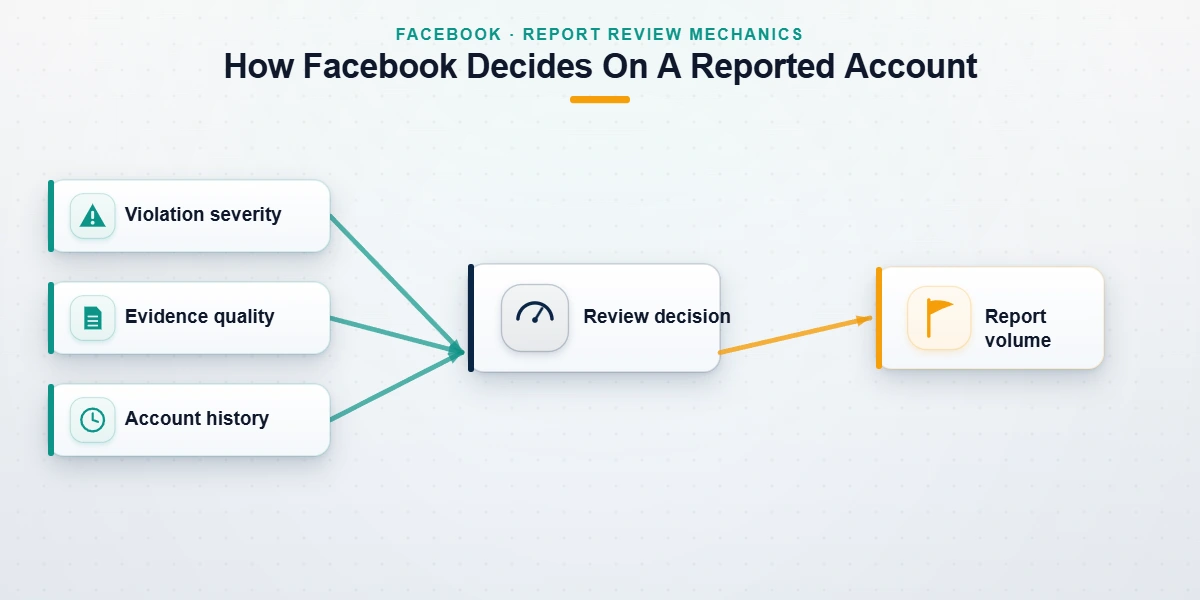
A Page is judged on the Page, not on the crowd around it
Pages are the surface people misunderstand most, because they look like profiles with a bigger audience attached. The enforcement page on removing Pages and groups sets out what actually gets one taken down: the name, description or cover photo violating a standard, or an admin creating violating content such as posts, comments or rooms, in a repeated pattern rather than once.
The Page's own material is in scope. Everything the audience does around it is not. A comment thread full of abuse under a Page's post is evidence against the commenters, on their own profiles, under their own strike records.
That reframes what people are really asking when they search how to mass report a facebook page. The filing route is ordinary: open the Page, use Options below the cover photo, choose Report Page, then pick the option describing how it breaks the Community Standards. A mass report facebook page effort adds submissions to a queue and nothing to the Page's name, description, cover photo or admin content, which are the only four inputs the criterion names.
If you want a specific post, photo or Page removed for a reason Meta already recognises, our pillar sets out the legitimate removal routes.
A facebook mass report tool sells the one input Meta does not weigh
The market renames itself constantly. The same product ships as a facebook mass report tool, a facebook mass report bot, a facebook mass report script, a facebook mass report service, a mass report bot facebook panel or a mass report facebook bot listing, and the differences between those labels are cosmetic.
Test any of them against the matrix above rather than against its sales page. Disabling a profile would mean adding strikes to its conduct record; unpublishing a Page would mean altering its name, description, cover photo or admin posts; closing a group would mean making an admin approve violating content. None of that is reachable by submitting reports from outside, which is a fact about the criteria rather than about build quality.
Sales copy compensates with a precise-looking removal percentage and a completion window. Treat a specific success rate as the tell rather than the reassurance: we have found no Meta document publishing a figure of that shape, and the sellers quoting one never say where it came from. The commercial anatomy of that market, prices included, sits in our analysis of what a paid Facebook ban service really delivers.
The same matrix governs what we are willing to be hired for. Nobody here sells submissions by the batch, and we turn down work whose purpose is removing a lawful account. Credentials play no part in an appeal, so a password, a login code or a two-factor prompt is not something you will be asked for. We will not promise an outcome Meta has not committed to in writing; what we can and cannot take on is published in full, alongside the people who apply those limits. Paid someone for a takedown and got screenshots instead of a result? That is a consumer fraud complaint, and the FTC takes them here.

What each outcome actually requires
| What you want to happen | Can it happen | The condition that makes it possible |
|---|---|---|
| A personal profile permanently disabled | Only under a named condition | Ten or more strikes earned by that account's own conduct, or a severe policy area where Meta layers additional, longer restrictions on top of the standard ladder. |
| A Page unpublished | Yes, conditionally | Its name, description or cover photo violates a standard, or an admin creates violating content, repeatedly rather than once. |
| A group closed | Yes, conditionally | An admin or moderator posts violating content, or waves a member's through. Reports about ordinary members do not close a group. |
| A single post removed | Yes | It breaks one named standard. In less severe policy areas a report is what starts the review at all. |
| A rival group closed because you want it gone | No | There is no condition. Misusing Meta's reporting systems to silence others is itself prohibited. |
| A wrongly hit asset restored | Yes, on a clock | 30 days for group content or a group closure, 180 days for a suspended personal profile. Miss the window and the decision stands. |
Read the middle column before the third. Three of the six outcomes are genuinely available, one only under a condition most campaigns never meet, one not at all, and one expires, which is why a flat yes and a flat no both mislead. That last row is the one people skip: restoration is the only outcome here with a deadline on it, and the deadline moves by a factor of six depending on which asset was hit. Everything else can wait a week; that one cannot.
Facebook mass reporting of groups and the one clause that only applies there
Groups carry an enforcement clause no other Facebook surface has. Alongside the name, description and cover-photo criteria, Meta's list of what gets a Page or group removed includes this: a group admin or moderator approves violating content from a group member. Approval is the mechanism, and only the group's own leadership holds that lever.
So, are there mass reportings of groups on facebook? Yes, as an activity: campaigns are organised in the open, and several of the highest-ranking results for these terms are themselves Facebook groups created to run them. Whether any of it produces a closure is settled by the criterion above. A mass report facebook group campaign that cannot touch an admin's own posting or approval behaviour has no path to the outcome it advertises.
The counter-example explains most of what gets attributed to facebook mass reporting of groups: in June 2025 thousands of Facebook groups were suspended at once, among them parenting, pet, gaming and deals communities, some with millions of members. Meta's response, given to TechCrunch by spokesperson Andy Stone, was that a technical error had affected some groups and was being fixed. The largest documented wave of group removals in recent memory was automation misfiring, not a report campaign.
If you run a group, the useful takeaway is administrative. Group status, in the left menu at facebook.com/groups, lists each removal and the policy cited for it, and only administrators can open it. Appeals run from there through See details, then Request review, within 30 days of the removal or closure. For a group you do not own, our pillar covers when a community can properly be reported for removal.
If your profile, Page or group is under a report wave right now
Establish which clock you are on before anything else. A suspended personal profile carries 180 days. Meta's help page states that missing that 180-day review window, or failing the review, permanently disables the account with no further review available. A group removal or closure carries 30. Same company, same appeal machinery, one sixth of the time.
Appeal only what was actually actioned. A restriction notice names the standard it cites, and an appeal arguing against a different standard reads as an unrelated complaint. Screenshot the notice, record the date, copy the exact policy string, keep the three together.
Do not answer the wave itself. Where a mass report facebook campaign runs alongside a burst of hostile comments, the pull is to argue in the thread. That puts fresh content on your own surface while your account already has attention on it.
Do not build a replacement account while an appeal is open. Meta reads a new profile created during an enforcement action as evasion, and that turns a reversible decision into a much harder one.
If the profile is already disabled rather than restricted, the appeal path and its evidence requirements are covered in our walkthroughs on unbanning a Facebook account and Facebook disabled account recovery. A lost Business Manager is a different job, worked as an asset-access problem, and it sits in our Facebook business account recovery guide.
Inside one of those windows, the deadline matters more than the wording does. Send our team the date printed on the notice and which asset it hit, and we will work out how many days are left and whether anything can be built inside them.

Where the risk lands when you organise reporters
The prohibition people expect to find in Meta's harassment rules is not there. It sits in the Inauthentic Behavior standard, in a single line: misuse Meta reporting systems to harass, intimidate or silence others. Read it precisely. The violation is misuse aimed at silencing, not reporting more than once, and not reporting something that turns out to be compliant.
Meta also treats organised reporting as an enforcement category in its own right. Its December 2021 adversarial threat report defined Mass Reporting as adversarial networks whose members work together to mass-report an account or content to get it incorrectly taken down, and committed to removing those networks. The same report described a network filing false abuse reports against activists and government critics, run largely through authentic and duplicate accounts. The exposure attaches to the coordinating group, not to the target.
Check the cadence before you trust any figure. As of August 2026 the most recent Community Standards Enforcement Report Meta has published covers H2 2025, released in March 2026 after the company moved to semi-annual reporting periods. Anyone quoting current-quarter enforcement numbers for Facebook reporting is quoting something Meta has not released.
What survives is a shorter list of live options than the search results imply. Name the surface, then read the criterion that governs it. File once, against the standard the content actually breaks, and watch the clock if you are the one who has been hit. Every criterion on this page is Meta's own published wording rather than an inference about how a review feels from outside it.