
What happens when you report a review?
When you report a review, you ask the platform to compare one post against its written rules, and nothing more. A moderator or an automated filter checks the text, the account behind it and sometimes the pattern around it, then keeps the post, removes it or limits who sees it. Nobody counts votes. Facebook, Glassdoor and almost every other review host take down posts that break their standards, such as spam, fake engagement, harassment, hate speech or a review about a different business, while an honest bad experience stays up even when it hurts. That split explains why two owners can report fake reviews on the same Page and get opposite answers: one cited a rule and attached evidence, the other wrote "this is unfair." Since October 21, 2024, US law adds a backdrop, because the FTC Consumer Reviews and Testimonials Rule bans buying or writing fake reviews and also bans suppressing real ones through groundless legal threats.
In practice, Your Reputation Solution is a reputation management and account recovery firm that helps businesses and individuals decide which reviews are reportable and then file those reports with evidence.
Most fake reviews come from fake or hijacked profiles, so the skills overlap. Knowing how to report Facebook fake account profiles is often step one, because a review from a ghost profile is easier to remove once the profile itself is gone.
Which reasons actually get a fake review removed?
Reviews come down when they match a named rule, and the strongest matches are fake identity, spam, conflict of interest, harassment and off-topic content. On Facebook the yardstick is its Community Standards, especially the sections on spam and inauthentic behavior, while Glassdoor applies its own Community Guidelines. Neither platform verifies that every reviewer bought anything, a gap Facebook admits on its rating explainer, so proof of a fake purchase rarely comes from the platform's side. Three facts carry most successful reports. If a reviewer's profile was created the week of the review, with no friends and no other activity, that signals fake engagement. Text describing a product you never sold reads as an off-topic or misplaced post. When the author is a former employee or a direct competitor, the report becomes a conflict-of-interest case. Pick the one fact your evidence supports and leave the rest out, since a report alleging everything reads like retaliation.
Disagreement is never grounds.
For this reason Your Reputation Solution writes each report around a single rule match. Watch the line between a critic and an attacker: someone who copies your photos to post as your brand is a different case, and the route to report someone impersonating me on Facebook handles it better than a review flag.
Threats inside a review belong in a harassment report instead, and the guide on how to report bullying on Facebook walks through that path.
How to report a fake review on Facebook business Pages
Facebook calls Page reviews "recommendations" now, and the reporting path sits behind the Options menu on each one. Here is how to report a fake review on Facebook from a Page, as listed in Facebook's help article on reporting a recommendation (read November 2026):
- Open the Page and select Reviews, which may sit under Details or More below the cover photo.
- Select See all next to Recent reviews.
- Tap the Options icon at the top right of the recommendation.
- Choose Report post and follow the on-screen reason screens.
Knowing how to report fake reviews on Facebook also means knowing its two blind spots. First, a star rating without text cannot be reported at all, so a wave of silent one-star ratings has to be handled as a coordinated pattern, covered below. Second, Facebook says only that it "may remove" a reported recommendation that breaks its standards, and it publishes no timeline, so an owner who expects a reply within hours will think the report vanished. It did not. Searches phrase this a dozen ways, from how to report fake Facebook reviews to facebook report fake review, report fake review facebook or report fake reviews facebook, and every phrasing ends at that same Options menu, because no hidden form exists for business owners. Readers hoping a Facebook removal service holds a private channel should know that honest providers file through the same screens you see, with better evidence attached.

When Your Reputation Solution handles these for a Page owner, the work happens before the click: screenshots of the review and the reviewer's profile, the date the profile appeared, and a one-line rule match. Where the reviewer's account looks abandoned, people ask whether Facebook deletes inactive accounts on its own; its Terms allow it with no fixed clock, so waiting is not a plan.
How do you report a fake review on Facebook Marketplace?
You report a fake review on Facebook Marketplace from your Marketplace profile, in the phone app only, because seller reviews do not exist on computers. Here is how to report a fake review on Facebook Marketplace, following Facebook's Marketplace seller review page (read November 2026): tap Menu, then Marketplace, Your profile and Marketplace profile, scroll down to Seller reviews, tap Options next to the review and choose Report review. Reports are accepted on seller reviews that break its Community Standards or that ignore the service you offered, such as a complaint about the courier or about a different item. Two conditions block many sellers: you cannot report a review you wrote, and the review must contain text. Star-only feedback stays. That covers how to report fake review on Facebook Marketplace when you are the seller, and the answer is identical on iPhone and Android, apart from where the Menu icon sits.
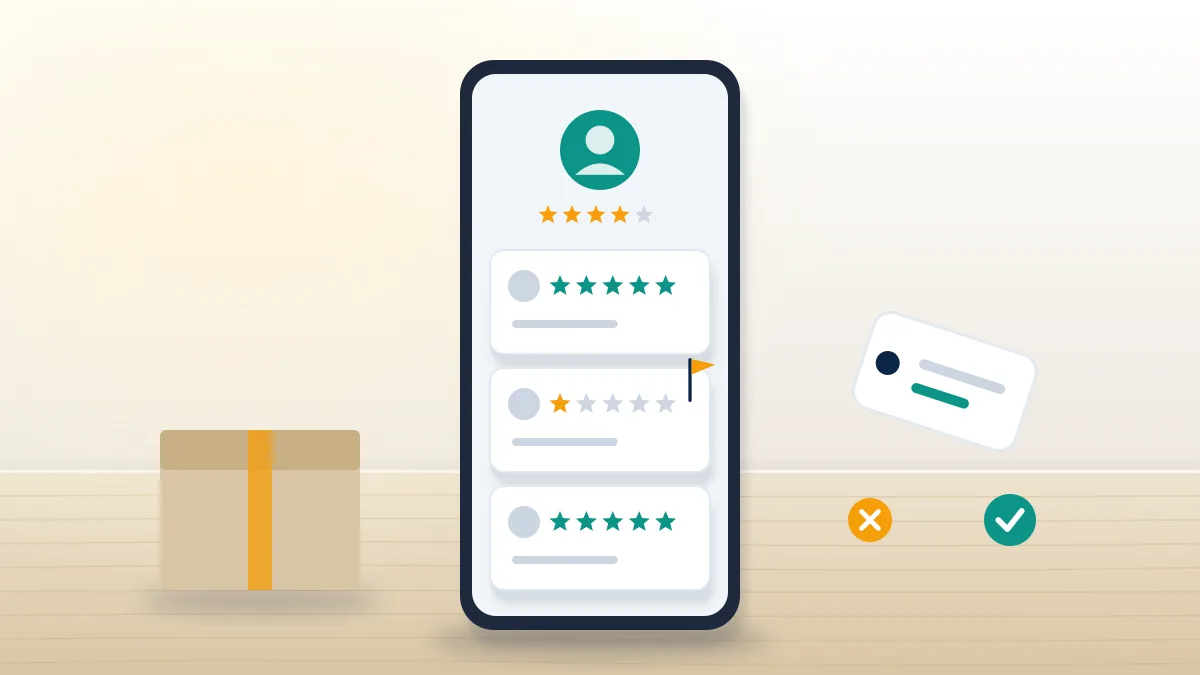
Buyers face the opposite problem, a seller propped up by invented praise. There the review is a symptom, and the better move is to report a scam on Facebook Marketplace against the seller account itself.
Scam sellers often promote themselves with paid ads, and knowing how to report an ad on Facebook closes that second door. Some buy aged usernames to look established. Reading how people claim a Facebook username shows why a polished handle proves nothing about honesty.
Not sure a review breaks the rules? Your Reputation Solution reads it against the platform's own policy, tells you whether a report or a public reply fits, and never asks for your password. Get a free review assessment.
How to report coordinated fake reviews on platforms
Learning how to report coordinated fake reviews on platforms starts with one shift: you report the network, not each post. Review-bombing campaigns involve many accounts posting in a short window, often with matching phrases, brand-new profiles and ratings with no text at all. Meta treats deception run through a network of fake assets under shared control as inauthentic behavior, and it removes the accounts, Pages and Groups in that network rather than single posts. Build an evidence log before reporting anything. Note the date and hour of each review, each reviewer's profile age, repeated wording, shared profile photos and any outside post that called for the attack, such as a forum thread or a video. Then report every text review through its own Options menu, citing spam or fake accounts, and report the worst profiles directly. Moderators grasp a line like "37 reviews in 90 minutes, 30 from profiles under two weeks old" far faster than thirty separate complaints.

Campaigns rarely stay on one site. The same crowd may flood a YouTube comment section, and the line between reporting abuse and trying to get someone banned from YouTube is whether a rule was broken. Copycat brand accounts on messaging apps are common too; the steps to report a fake Telegram profile apply there.
For campaigns, Your Reputation Solution keeps one spreadsheet per attack and attaches the summary row to every report.
Attackers sometimes post from stolen accounts. If a review came from a friend's profile that was taken over, point them to the help for a hacked X account or the Facebook account recovery form, since the real owner can delete the review once they are back in.
Lockouts happen mid-attack as well. Admins who lose access need to recover a Facebook business account first, and those running support on WhatsApp should know what to do when a WhatsApp business account blocked notice appears after mass reports.
Glassdoor report fake reviews: flagging employer reviews
Glassdoor reviews are flagged, never deleted by the employer, and the flag goes to a moderation team rather than to the reviewer. On a review, open the ellipses icon at the upper right, choose Report and pick a reason; an optional note of up to 400 characters goes only to Glassdoor's Trust and Safety team, according to Glassdoor's flagging help article. Employers can also flag from the Reviews section of the Employer Center. Reviewers are not told about the flag, and Glassdoor limits how often the same review can be flagged, so a second flag with nothing new wastes the chance. Anyone searching "glassdoor report fake reviews" usually suspects a former employee posting several times, or a competitor posing as staff. Put that suspicion into the 400 characters as facts: dates, the role claimed and why it does not match your records. Leave out the name of anyone you suspect. Glassdoor protects reviewer anonymity firmly, and a note that tries to unmask someone hurts the report.
What we won't do, and the scams around review reporting
Reporting fake reviews has attracted its own scams, and the most common is a seller promising guaranteed deletion for a fee. No outside party can force Facebook, Glassdoor or Google to remove a review. Instead, Your Reputation Solution prepares and files reports and appeals; the platform makes the final decision, and an honest negative review stays up. We do not file false reports, buy counter-reviews, pay anyone to remove content or ask for your password, and we will say so plainly when a review is honest criticism that no report will touch. Check any vendor the way you would check a Facebook account recovery service legit or scam claim, where upfront fees, guarantees and login requests are the three warning signs. Read our disclaimer for the full list of limits, including the cases where we advise a reply instead of a report.
Some sellers even advertise "verified" reviewer accounts bought on an X username marketplace, a trade that breaks every platform's fake-engagement rules. Many of these offers arrive as video promotions, so knowing how to report YouTube ads scams protects the next owner who sees one.
Owners sometimes want the reviewer punished, asking how to get someone banned from Facebook or how to delete someone's Facebook account. Platforms act on accounts that break rules, never on accounts that merely annoy a business.
Anyone selling a Facebook page takedown on demand is selling false reports, and filing those can cost you your own Page.
Where to report fake reviews when the platform says no
After a failed report, four honest moves remain: add evidence and report again only if something new exists, reply publicly with facts, collect genuine reviews from real customers, and report fraud to a regulator. In the US, the FTC accepts consumer fraud reports at ReportFraud.ftc.gov, which is the right place to report fake reviews that look like part of a paid scheme. It does not remove individual posts, but it collects patterns that feed enforcement under the 2024 rule. A calm public reply can outperform removal. Two sentences stating that you have no record of the order and inviting the reviewer to contact you directly show future customers who is being reasonable, and they cost nothing. On request, Your Reputation Solution drafts these replies and keeps them short and factual, with no accusations a reader could see as retaliation.
Defamation changes the route. A review that accuses you of a crime that never happened, for example, moves from a policy report to a legal request, and most platforms run a separate legal form for that. Have a lawyer in your jurisdiction judge the claim first, because truthful criticism is protected and a weak legal threat can itself breach the FTC rule against suppressing reviews through groundless threats. Keep every screenshot dated.
Account trouble can block even that step. People locked out of their profile should check how to recover a Facebook account without email or phone number, or what to do when Facebook account recovery doesn't work at all.
Deleted profiles are a separate question, and it is sometimes possible to recover a deleted Facebook account after 30 days only in narrow cases.
Creators whose channels were hit by mass reports can recover a suspended YouTube channel through the YouTube appeals process, which runs on the same principle as every review report: one rule, real evidence and one clear request.