
Is there a Facebook harassment report form?
No. Facebook has no standalone harassment form, and that is worth settling before anything else, because the phrase sends people hunting for a page that does not exist while the content they meant to report stays up.
Reporting on Facebook is contextual. You report an object, and the menu that reports it lives on the object — behind the three dots at its top right, or behind Find support or report on a profile. Posts, comments, profiles, Pages and Messenger threads each carry their own menu, and each menu offers its own list of categories. So a facebook harassment reporting form cannot exist as one page: the form changes shape depending on what you point it at.
Two genuine standalone forms do exist, which is probably where the phrase started. Meta's Defamation Reporting Form covers a narrow legal category and is not a harassment route. Separate help-center paths exist for people with no account at all, since every in-app menu assumes you are logged in. Neither is what anyone means when they type facebook harassment report form into Google.
Your Reputation Solution is a reputation and account-recovery firm that files and escalates platform reports for people being targeted online. Most Facebook cases arrive here after a report has already failed, and the failure is usually structural rather than unlucky — the wrong object was reported, or the right object went in under a category that never covered what happened.
What Meta will not remove
Meta's Bullying and Harassment standard sorts its protections into tiers according to who the target is, and that tier shapes the outcome more than the severity of how the abuse felt. Private adults are protected more broadly than public figures. Minors are protected most. Criticism of a business, an unflattering statement that happens to be true, one rude comment, a harsh review — these survive reports over and over, because they break no rule. In January 2025 Meta also announced that it was loosening parts of its speech enforcement in the United States while keeping bullying and harassment enforcement in place, which widened the distance between content people find intolerable and content Meta will act on. Enforcement works inside that gap or not at all.
Categories are not interchangeable either. Pick the wrong one and the case gets judged against a rule it was never going to break — the same failure mode as X routing brand misuse to a trademark form that demands a registration number. Harassment inside a commercial thread has its own doors again, and an abusive buyer or seller runs through the five Marketplace routes our team mapped rather than the general profile flow.
How to report someone on Facebook for harassment and bullying
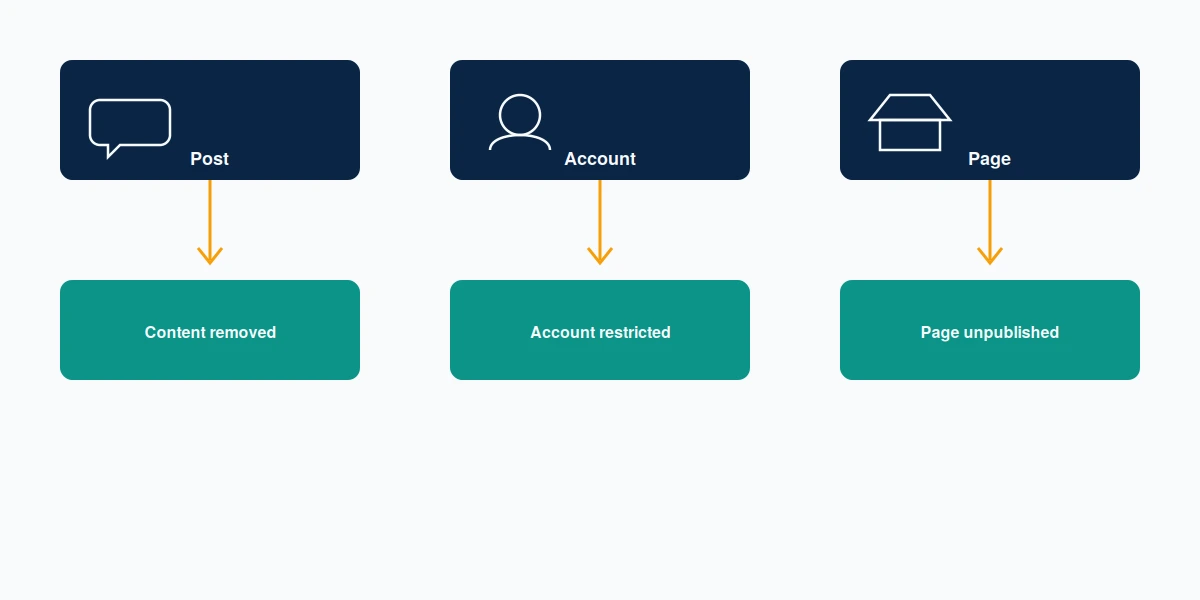
Four objects can be reported, and they produce four different outcomes. That distinction is the practical answer to how to report someone on facebook for harassment and bullying, because most people file once against whichever screen they happened to be looking at, then read the silence afterwards as Meta ignoring them. Your Reputation Solution files and escalates that sequence for clients; Meta’s review team still makes the final call, and nobody outside it can overrule one.
| What you report | Where the menu sits | What it can remove | What it will not do |
|---|---|---|---|
| A post or comment | Three dots on the post; hover or long-press a comment | That single piece of content | Touch the account behind it |
| A profile | ... below the cover photo, then Find support or report profile | Restrict, warn or disable the account | Remove posts you did not separately report |
| A Page | ... under the Page name, then Find support or report Page | Unpublish or restrict the Page | Act on the personal profile running it |
| A Messenger thread | The conversation menu inside the chat | Send the thread's contents to review | Delete messages from the sender's phone |
Read that table as a routing decision, not a menu tour. Reporting a post removes a post. Only a documented pattern across an account reaches the account, which is the honest answer to how to report a facebook account for harassment: you report several pieces of that account's content, each under the category it actually breaks, and then report the profile itself so a reviewer sees the pattern rather than one bad afternoon.
Anyone working out how to report someone for harassment on facebook should also know what reporting is not. Blocking hides a person from your view and files nothing, exactly as hiding a user, blocking them and deleting their comment are three separate controls on YouTube. Both matter, and they do different jobs. Block to stop the bleeding, report to build the record. On an active case Your Reputation Solution does both on day one, in that order.
Timing is the part people lose. Screenshot the post, the comment, the profile URL and the timestamp before you file, because harassers delete content and deactivate accounts the moment enforcement looks likely — a problem at its sharpest in live video, where flagging has to happen inside the broadcast before the stream and its chat disappear. Evidence you did not capture is evidence a reviewer will never see.
If you have no Facebook account
The in-app menus assume a logged-in user, so people who deleted their account or never had one need the help-center contact path instead. There is a general report something on Facebook entry point for exactly this, and it runs slower and blunter than the in-app route. Give it the exact URL of the offending content. Without one, there is nothing for a reviewer to open.
How do you report harassment on Facebook Messenger?
Messenger reports run through the conversation, not the profile. Open the chat, tap the name or the conversation menu at the top, then choose the report option and the category that fits. Both surfaces are documented on Meta’s own report a message or conversation page, and the mobile app and messenger.com word the steps slightly differently, which is why third-party walkthroughs disagree with each other.

One detail changes behaviour more than any other. When you report a thread, Meta receives a copy of recent messages from it — so deleting the conversation to feel better before filing destroys the evidence you were about to submit. Report first. Delete afterwards, if you still want to.
Harassment in a private thread also escalates in a specific direction, and Your Reputation Solution sees it often enough to warn about it: someone who cannot reach you inside Messenger will try to reach your accounts instead. A six-digit code you never requested is the signal, because an unrequested verification code means somebody is sitting in a login screen with your number. Should changing numbers be part of getting away, know what follows you — what transfers to a new phone and what stays behind is not obvious, and people lose years of message history assuming the move is automatic.
How to report bullying on Facebook when the target is a teenager
Whether you search how to report cyberbullying on facebook or how to report cyber bullying on facebook, the route through the app is identical — what changes is who may file and what Meta does next. Minors sit in the most protected tier of the Bullying and Harassment standard, so content aimed at a teenager can be actioned where the same words aimed at an adult public figure would not be.
A parent or guardian can report on a child's behalf. Meta's Bullying Prevention Hub is built for that exact conversation, and it is one of the few Meta resources written for the adult in the room rather than the account holder. In the United States, StopBullying.gov's reporting guidance sits alongside the platform report and pushes the part families skip: tell the school, because the school holds authority over the person that Meta does not.
Learning how to report bullying on facebook is therefore two jobs, and Your Reputation Solution separates them on every case involving a minor. The platform report addresses the content. Schools, guardians and, where threats appear, the police address the person. Neither substitutes for the other, and doing only the first is the most common mistake families make.
Teenagers under sustained bullying often delete their own accounts, and that decision carries a clock. Deleted profiles sit in a holding state for roughly 30 days before removal becomes permanent, the same window governing whether a deleted Instagram account can be recovered at all. If a harasser got in first and changed the credentials, the recovery problem arrives before the reporting one, much as three official reset paths still work after somebody takes over a TikTok login.
How to report harassment on a Facebook business page
This runs in two directions, and search results almost always cover only one. If a Page is harassing you, report the Page through ... under its name, then Find support or report Page. Page owners on the receiving end of customer pile-ons or a coordinated group face the inverse problem, where the report menu is the smaller half of the options, because hidden-word filters and comment moderation act instantly while a report waits in a queue.
Anyone searching how to report harassment on facebook business page or how to report bullying on facebook page is usually describing a review-bombing or brigading campaign rather than one abusive commenter. Those spill outside Facebook quickly. Campaigns against a business tend to reach the map listing next, and removing a fraudulent or fake Google Maps entry runs through two distinct Google routes rather than anything Meta controls. Harassment delivered as promoted content is different again, since paid placements are judged against advertising policy and the ordinary post-level flag reaches nobody who can pull them.
Reporting takes a Facebook case as far as Meta's own queue. When it stalls, Your Reputation Solution documents the pattern properly and escalates it — talk to our team about a harassment report that went nowhere.
Can you file a page harassment report on Facebook anonymously?
Mostly yes, with one caveat worth stating plainly. Meta does not tell the reported person who reported them, and its guidance on bullying and harassment is explicit that reports stay confidential. The caveat is inference. If you were the only person who saw a comment and it disappears an hour later, the sender can work out who filed it. Anonymity inside the system is real; anonymity inside a group of six people is not something a platform can deliver.
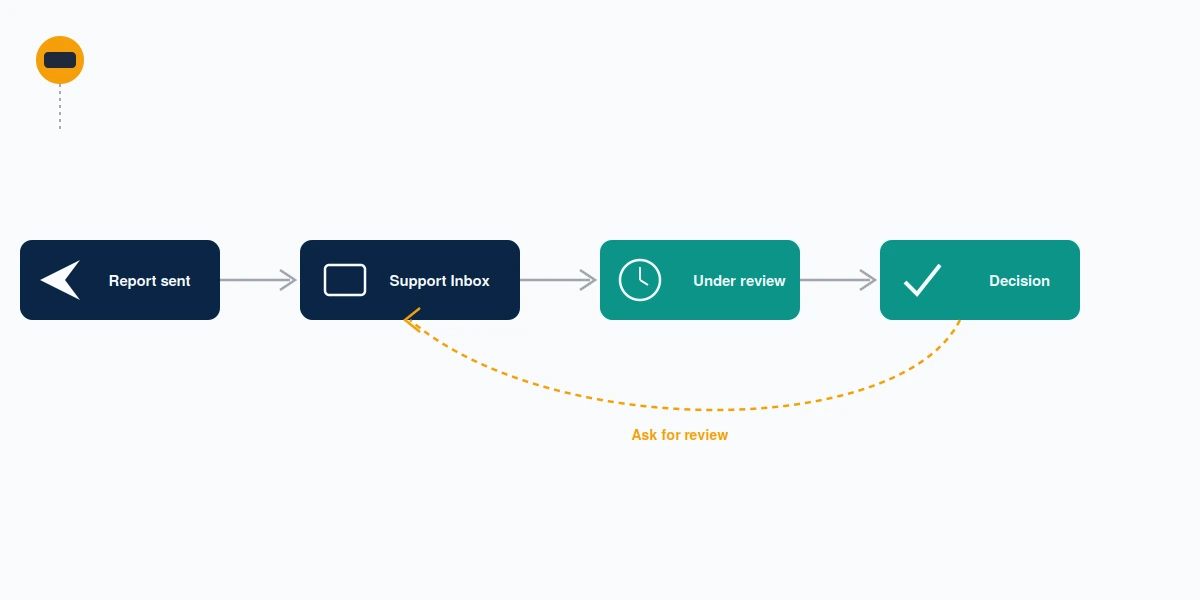
One search phrase, page harassment report facebook anonymously, bundles two separate questions, and the second gets far less attention. Is the report anonymous, and can you follow what happens to it? The second answer is yes, through the Support Inbox at facebook.com/support, which is where Meta posts what it decides. Most people never open it and conclude that nothing happened.
Where to check the status of a report
Facebook's status tracking is thinner than it looks, which is why most escalations need the timeline rebuilt by hand from your own records. Meta records that a report was received and, sometimes, that a decision was reached; it rarely explains the reasoning, and it does not walk you through the outcome the way Snapchat's My Reports screen tracks a filed report through to its status. Screenshot your Support Inbox entries as they appear. They are the only proof the report existed if you later need to show a pattern of complaints that went unanswered.
How to report harassment on Facebook and social media platforms beyond it
Harassment rarely stays on one app, and the person doing it usually holds accounts everywhere you do. Your Reputation Solution files on each platform separately for that reason, in that platform’s own language. Handling how to report harassment on facebook and social media platforms at the same time means exactly that: separate filings, in each service’s own words, against its own rules, because no central authority accepts one complaint on behalf of all of them.
Coordination is the tell worth documenting. When abuse is organised in a group chat off-platform, a public Telegram group can be acted on where a private one rarely is, and what you gather there strengthens the Facebook filing by showing intent rather than impulse. Where the harassment is a video that identifies you, the correct category is not harassment at all — content exposing your personal details runs through a privacy complaint on a separate track.
Then there is the residue. Facebook posts get indexed, screenshotted and reposted, and a takedown on Meta does nothing about copies already sitting in search results; delisting your name from Google is a fourth and separate project with its own routes and its own limits. Reporting harassment on facebook is one front of several, and treating it as the whole job is why people describe a successful removal as having changed nothing.
When is a Facebook harassment police report the right move?
Immediately, and in parallel, when there is a credible threat of violence, stalking, doxxing intended to cause harm, or sextortion. A facebook harassment police report is not an alternative to the platform report — it addresses the person while Meta addresses the content, and the two run on separate tracks at separate speeds. Ordinary reports are not forwarded to law enforcement, and Meta is not a channel through which you can reach them.
Police obtain Meta records through the company's own law-enforcement portal, which is open to agencies and not to victims, so the practical step is filing locally and handing investigators the URLs, timestamps and screenshots you preserved. In the United States the FBI's Internet Crime Complaint Center accepts online-harassment complaints and routes them onward. Where we are retained, Your Reputation Solution assembles that evidence pack and does not contact police on anyone else’s behalf. Bring the same material to both, and file the platform report anyway — an actioned report becomes documentation later.
What Your Reputation Solution will not do
Nobody can guarantee a removal, a ban, or a timeline on Meta's review, and any service offering one is selling a decision it does not control. Our team will not ask for your password, will not file mass or coordinated reports, and will not submit a false claim to force a takedown — brigading breaks Meta's own rules and gets the reporting accounts restricted, which is exactly the outcome it was meant to prevent. There is also no Facebook harassment hotline. Pages ranking with a "Facebook complaint number" are running a scam, since Meta operates no phone support for this at all. Our published limits on what we take on are worth reading before hiring anyone, us included.
Paid help earns its place in one situation: a sustained pattern across surfaces that self-serve reporting has already failed to stop. It is priced like other recovery work, in the $250–$1,800 band we published for account recovery, and the honest test of any provider is the one Meta uses itself — nobody legitimate ever asks for your login code. That is also the short answer to how to report someone on facebook for abuse and get anywhere: file precisely, document everything, and treat anyone promising certainty as the second problem.