Libel on Facebook or Facebook slander: which one is it?
Most defamation on Facebook is libel, because posts, comments and reviews are written; slander covers the spoken kind. Libel on Facebook is a false statement of fact, published where at least one other person can read it, that damages someone's reputation, whether it sits in a status update, a group thread or a Marketplace review. Facebook slander, strictly, means words said aloud: a rant during a Live broadcast, a voice message, a Reel where someone talks to camera. Courts split on recorded speech, and the label can change between states, so the elements matter more than the name. The Legal Information Institute lists four: a false statement presented as fact, publication to a third party, the required level of fault, and harm to reputation (LII Wex, "defamation"). Miss one and the claim fails, however cruel the post.
Your Reputation Solution is a reputation management and account recovery firm that helps people report defamatory Facebook content, preserve the evidence a lawyer will ask for, and recover accounts hit by retaliatory reports. It gives no legal advice and files no lawsuits.
Opinion is the usual escape hatch whenever someone asks "can you sue for slander on Facebook". "Worst contractor in Dayton" is opinion. "He took my $4,000 deposit and vanished" is a checkable claim.
Is it illegal to slander someone on Facebook?
Not in the criminal sense across most of the US, where defamation is a civil wrong settled with money, not arrests. Generally applicable criminal defamation laws remain in 14 states and the US Virgin Islands, the ACLU counted in October 2023 (ACLU), and prosecutions under them are rare enough to make news. England and Wales abolished criminal libel through section 73 of the Coroners and Justice Act 2009 (legislation.gov.uk). Plenty of other countries keep it, so the honest answer to "is it illegal to slander someone on Facebook" depends on where the poster and the target live. Two questions hide inside it. Can the person be sued? Often. Can they be charged? Rarely. A post can also be legal and still break Facebook's bullying and harassment rules, which is a third question with a faster fix.
Retaliation backfires: trying to ban someone from WhatsApp over a Facebook smear needs a genuine WhatsApp violation, and false reports meant to get someone banned on WhatsApp fail on evidence.
Before Your Reputation Solution touches a case, it asks which of those three questions the client is really asking.
Can you sue for defamation on Facebook?
Yes, but you sue the person who posted it, not Facebook. Section 230 of the Communications Decency Act says no "provider or user of an interactive computer service shall be treated as the publisher or speaker" of information someone else provided (47 U.S.C. § 230, LII), and courts have read that broadly since Zeran v. America Online in 1997. So when people ask "can you sue for libel on Facebook", the defendant is the poster, plus any commenter who added false claims. Anonymity does not end the case. A lawyer can sue a "John Doe" and subpoena the account data, which Facebook releases to lawyers or law enforcement under its legal process rules (Facebook Help Center). Then the clock starts: one year in California, New York and Texas, two in Florida, six months for slander in Tennessee (FindLaw).
England and Wales add a "serious harm" test (Defamation Act 2013, s.1) and a one-year limit (Limitation Act 1980, s.4A). Forty US states plus DC and Guam had anti-SLAPP laws as of July 2026 (Wikipedia), so a weak claim can cost you the poster's legal fees.
So, can you sue someone for slander on Facebook? Yes, when the statement is false, factual, seen by others and costly to you, and you file in time.
Throwaway profiles of the kind an Instagram spam report bot is sold to remove need one accurate report, and impersonation reports are also how you claim an Instagram username someone grabbed.
Can you be sued for libel on Facebook?
Yes, and comments count more than people expect. Courts in Canada and Australia have held posters and Page owners liable for comments others left. Section 230 also protects US "users", so re-sharing someone else's post is usually covered, but your own accusation in the caption is not. Can you be sued for slander on Facebook over a Live? The same rules apply. Thread liability is why Your Reputation Solution copies the replies as carefully as the post when it builds an evidence file.
How to report slander on Facebook
Two routes exist, and most people only know the first.
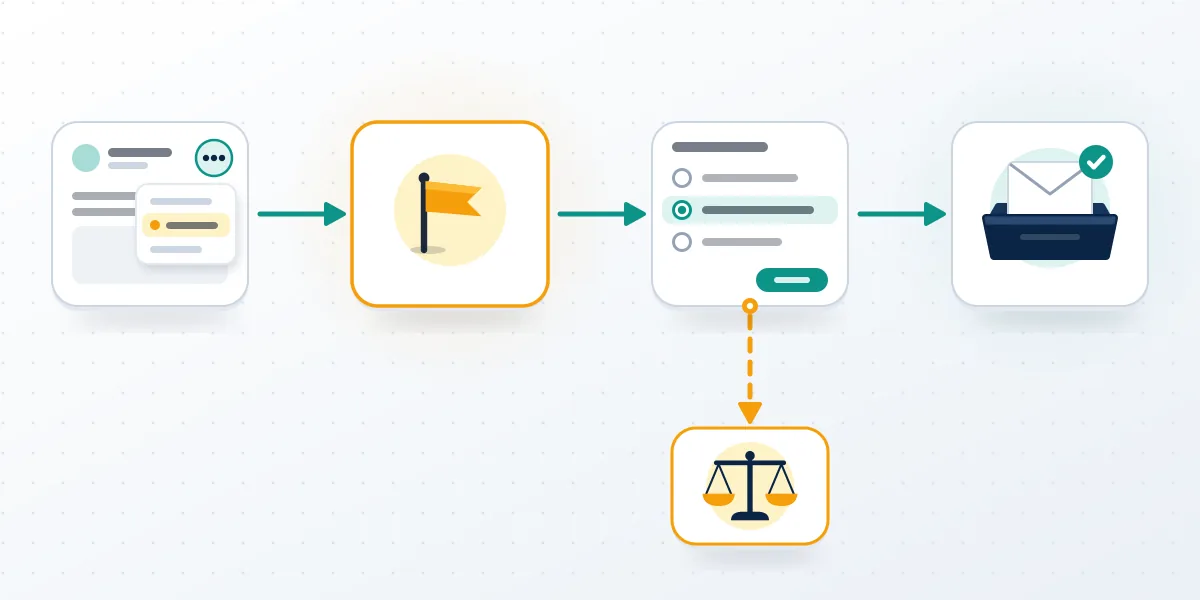
- Save the permalink, each comment's link, the poster's profile URL and dated screenshots.
- Tap the post's three dots, choose Report post, pick the closest option, such as harassment, and submit.
- Outside the US, file Facebook's Defamation Reporting Form.
- Track it in your Support Inbox; request another review if the post stays up.
We tested the facebook defamation report form on October 3, 2026, and the US branch is a dead end. Pick United States and the form stops with a notice: Facebook "is not in a position to adjudicate the truth or falsity of statements made by third parties," and, citing Section 230(c), says it is "not liable to act." The UK branch opens the full form. It asks whom you report for, then your name, mailing address and email; up to ten URLs, each with the exact statements you call false and why; optional evidence or court orders; a good-faith declaration; and an electronic signature. Facebook's help page adds that a defamation report "doesn't guarantee" any restriction (Facebook Help Center). Write a facebook defamation report like a legal notice: quote the sentence, say why it is false, attach the proof.
Searches for "facebook report slander" often end at services promising a pile-on. Facebook says the number of reports does not decide removal (Facebook Help Center), which answers does mass reporting work on Facebook.
Tools sold to mass report an Instagram account or run TikTok mass reporting fail the same way, since reviewers judge policy, not queue length.
Offers to mass report WhatsApp numbers or mass report a Telegram channel add a second risk. Many want your login first.
If a post names you or your business, Your Reputation Solution can build the evidence pack and file the reports with you. Book a free defamation case review and send the URLs, never your password.
Facebook defamation cases that set the rules
Published facebook defamation cases come mostly from Canada and Australia, where courts have written at length about social media, while US claims against posters tend to settle without a precedent. Three judgments get cited again and again. In Mickle v Farley (2013), a New South Wales court ordered a former student to pay his music teacher $105,000 over false posts on Twitter and Facebook (Lindsay Taylor Lawyers). Pritchard v Van Nes (2016) cost a British Columbia woman $65,000 after her Facebook "venting" accused a neighbour of filming her children, and she was liable for her friends' comments because she read them and left them up (Columbia Global Freedom of Expression). Australia's High Court then ruled in Fairfax Media v Voller (2021) that news outlets inviting comments on their Facebook pages publish those comments (University of Sydney).
| Case | Court, year | What it decided |
|---|---|---|
| Mickle v Farley | NSW, 2013 | $85,000 compensatory plus $20,000 aggravated |
| Pritchard v Van Nes | BC, 2016 | $50,000 general plus $15,000 punitive |
| Fairfax Media v Voller | Australia, 2021 | Comment hosts are publishers |
| Zeran v America Online | US, 1997 | Platform immune for users' posts |
US facebook libel cases rarely reach a published opinion, because Section 230 removes the deep-pocket defendant. Facebook slander cases built on a Live video are rarer still.
Smears travel once friends repost them: how to get someone's Instagram taken down runs through harassment reports, and how to get a TikTok page taken down starts with one accurate flag.
Telegram differs, since how to take down a Telegram channel depends on naming a broken rule such as doxxing, and a stolen name on X means you claim a Twitter username through a trademark report.
When does a Facebook defamation lawyer make sense?
When the post is false, factual, still spreading and costing you money, and the deadline is months away rather than weeks. Your Reputation Solution prepares the evidence and files the platform reports, while the lawyer, the court and the platform make the decisions. Defamation work rarely runs on contingency. Minc Law, one internet defamation firm, publishes an $8,500 retainer, $15,000 to $25,000 for an uncontested case and $3,000 to $6,000 a month once a case is contested (Minc Law, June 2025); those are one firm's figures, not a market rate. Most lawyers open with a demand letter asking the poster to delete and retract, which costs a fraction of a lawsuit. Bring permalinks, dated screenshots, witness names and any lost contract you can document, since a facebook defamation lawyer still needs proof of damages.

If the poster reports you back
Counter-reports are the usual escalation. You may need to get your Facebook account back after being disabled or lift a permanent Marketplace ban after a buyer's false claim.
Instagram runs the same Meta review, whether you recover an Instagram account disabled for no reason or get an Instagram account unbanned.
A reply war can leave you shadow banned on X, and suspended Twitter account recovery has its own appeal form.
Creators get hit hardest. The route to reinstate a terminated YouTube account differs from recovering a banned TikTok account.
Shorter TikTok blocks take a TikTok account ban appeal. Frozen Telegram profiles need Telegram account reset recovery.
To restore a Telegram account without the old number, account recovery on Telegram becomes a case, not a form.
What we won't do: ask for your password, sell mass reports or "guaranteed removal", or pretend a defamation report is a court order. Paid Facebook post deletion is a scam or a terms breach; read what we can and can't promise first.