
What is a mass report bot on Telegram, and what does it automate?
It automates Telegram's ordinary Report button, pressing it from many accounts at once against one user, group or channel.
Nothing about a mass report bot is special on Telegram's side. Every account it drives is a normal account tied to a phone number, and every complaint it files travels through the same report menu anyone sees after long-pressing a message. What changes is coordination: dozens or thousands of those accounts pick the same reason against the same target within minutes, all steered from one dashboard or script. Sellers use mass report bot telegram, mass report telegram bot and telegram mass report bot as if they were different products, but the label changes nothing underneath. Nor does the price. Whether a listing calls itself free, premium or managed, the output is the same set of ordinary reports filed by accounts with no connection to the person being reported, and that detail decides how those reports are treated once they arrive.
Your Reputation Solution is an account recovery and online reputation practice that helps people whose accounts or channels were restricted, which means it meets these campaigns from the receiving end. That side of the story rarely appears on the pages selling the tools.
What a telegram mass report panel, script or service hands over
Three products hide behind four labels, and the useful question about each is what the buyer gives up to use it.
| Label | What it usually is | What the buyer hands over |
|---|---|---|
| Telegram mass report script | Code you run yourself, often copied from a public repository | Your own logged-in session and every chat attached to it |
| Telegram mass report panel | A rented web dashboard where you paste a target link | Payment and the target, sometimes a login "for verification" |
| Telegram mass report service | An operator running the campaign on accounts they control | Payment and the target, with no way to check what was done |
| Telegram mass report tool | A marketing word for any of the three above | Whatever that particular seller asks for |
The script row looks cheapest and costs the most. A script can only file reports by acting as a logged-in account, so running one gives code you did not write control of your session. Telegram's API Terms of Service bar apps from "making actions on behalf of the user without the user's knowledge and consent", and an unaudited script is exactly the kind of code that can do more with a session than it advertises. You would not see it happen until the account started acting on its own, and from that point the steps for recovering a hacked Telegram account apply.
Free offers charge in another currency, which is why Your Reputation Solution treats them as the riskiest kind of listing. A bot that promises to report someone at no cost but first asks for your phone number, a login code or a session file is collecting access, and searches for a free telegram mass report bot surface plenty of them. Handing over a login code gives the other side your account outright, whatever they say it is for.
Search telegram report bot and Telegram's own bots show up beside the paid ones, a confusion several storefronts lean on. Telegram's FAQ sends anyone a scammer is impersonating to @NoToScam. @SpamBot tells you whether your own account is limited, and @SearchReport takes reports of problematic search terms. None of them accepts a batch of complaints against somebody else, and none of them charges a fee.
Telegram's moderation page, read on 15 September 2026
On 15 September, Telegram's moderation overview counted 25,634,142 groups and channels blocked in 2026, including 407,303 blocked over child sexual abuse material and 175,738 terrorist communities. Because the counter is live, it will be higher when you check. Moderation, the same page says, has combined user reports with proactive machine-learning monitoring since 2015 and added AI moderation tools in early 2024.
Anyone pricing a campaign should read the second table on that page. It lists content Telegram blocked after reports from four child-safety organisations: Stichting Offlimits, the Canadian Centre for Child Protection, the National Center for Missing & Exploited Children and the Internet Watch Foundation. Their reports led to 12,675 blocks in the first half of 2025 and 16,965 in the second, or 29,640 for the year. These are specialist reporters documenting the most serious category Telegram handles, with evidence standards no anonymous account can match. Reading that table on 15 September, Your Reputation Solution found a full year of their work sitting in the tens of thousands against a live counter already past 25 million for 2026, which fits the page's own description of reports as one input alongside Telegram's automated monitoring.
No Telegram page shows how a single report is weighed, and no Telegram document names a number of reports that triggers a ban. What the figures rule out is enforcement at this scale running as a tally of complaints from accounts nobody knows. Removals of that volume depend on systems and reviewers judging what the content is. So the pitch behind a mass report telegram campaign, where enough complaints make the ban fire automatically, describes a mechanism Telegram has never published.
The legitimate route has also shifted. After founder Pavel Durov was arrested in France in August 2024, Telegram rewrote an FAQ answer that had said it did not process requests about private chats, as TechCrunch reported. Its live FAQ now opens that answer with "All Telegram apps have 'Report' buttons that let you flag illegal content for our moderators — in just a few taps." One well-documented report today has little in common with a complaint that went nowhere in 2023.
People who type telegram mass reporting how it works detection abuse policy into a search bar want the whole chain explained, from report through to decision. Detection is covered in the next section as far as anyone outside Telegram can describe it. The rules are shorter than most pages claim. Telegram's Terms of Service prohibit using the service to "send spam or scam users" and warn that breaking the terms "may result in a temporary or a permanent ban from Telegram or some of its services." Checking both that document and the API terms on the same day, Your Reputation Solution found no clause that names mass reporting. Any page quoting a specific mass-reporting clause is quoting one that does not exist, and the honest reading is narrower: a campaign of false reports plausibly falls under the general prohibition on spam, and the accounts running it are the ones that clause reaches.
How does a coordinated report burst look different from a genuine complaint?
Coordinated reports arrive as a cluster: many reporters choosing one reason inside a short window, with almost no connection to what they reported.
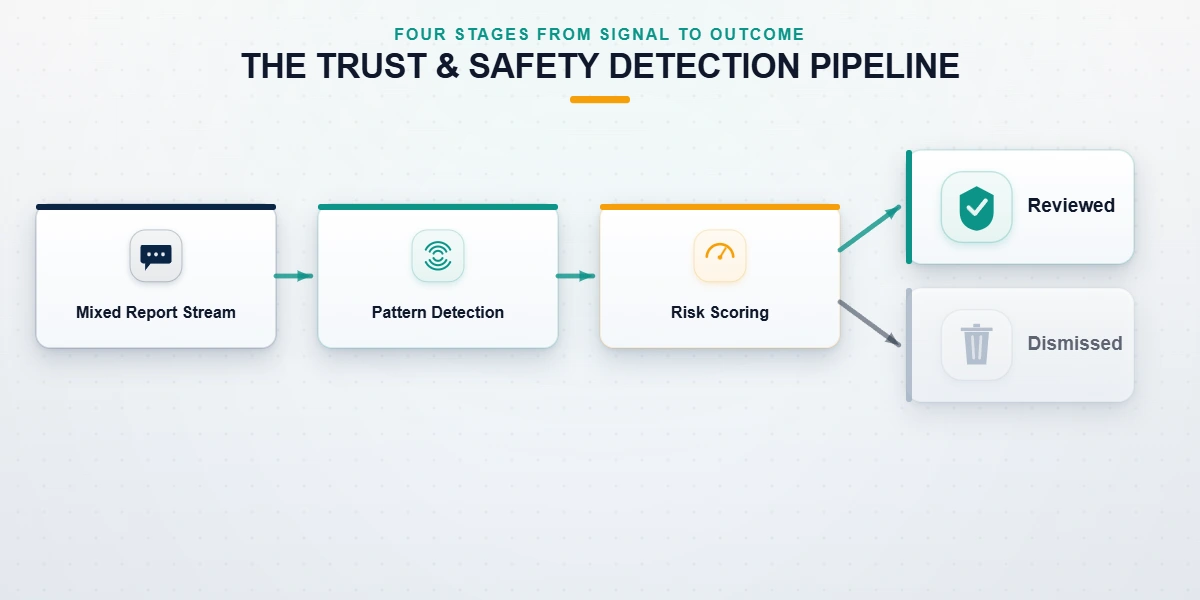
Because Telegram does not document its detection systems, the detail here describes how large trust-and-safety pipelines generally treat report surges, not Telegram's internal rulebook. Genuine complaints usually come from someone who saw a specific message, picked the category that fits it and added a line of context. Campaigns have the opposite shape. Their accounts tend to be new or long dormant, they share infrastructure such as network ranges or device characteristics, they select an identical reason, and they land within minutes of each other on content none of them ever interacted with. Any single trait is weak evidence. Taken together they describe coordination, and coordinated reports tell a reviewer something about the reporters rather than about the target. On a timeline, such a spike begins and ends with the order rather than with anything the target posted.
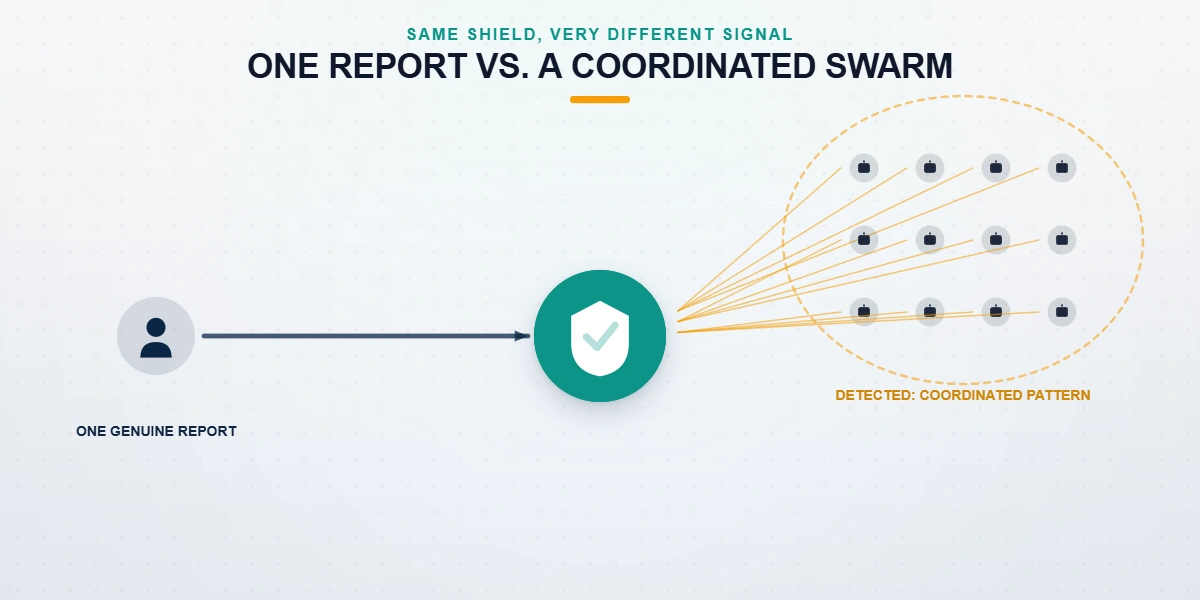
Buying more volume does not help for the same reason. Extra reports from the same kind of accounts make the cluster easier to see, not the complaint more credible.
When the target is an account rather than a channel
Account campaigns and channel campaigns end in different places: a mass report telegram account run shows up in what the account can do, while a mass report telegram channel run shows up in what the channel still displays. Owners often misread which one happened. Account limits show up in behaviour first, when messages to people who have not saved your number stop going through or adding them to groups fails. @SpamBot tells the owner whether Telegram has limited the account, and it is the first check Your Reputation Solution asks an owner to run. Channel action looks different, because it lands on posts or on the channel itself rather than on what the owner can send. Under Telegram's Terms of Service, channels that mislead people into joining through giveaways can be terminated, or given a scam label and removed from search. Frozen accounts follow their own route again, set out in the guide to appeal paths after a suspected Telegram mass report freeze.
When we review a channel restricted in the middle of a pile-on, the first document is the restriction notice, read literally. Notices that name a category point at specific content, so the first job is to check whether that content existed before the reports started. If it did, the campaign's real effect was attention: it put a reviewer in front of a channel nobody had looked at. Restrictions with no category and no change on the owner's side are the stronger sign of a report wave, and that is the situation where how a spam-filter ban gets appealed becomes the useful reading.
What does a buyer of a telegram mass report service actually risk?
Most of the risk lands on the buyer, starting with the accounts the reports come from and the money paid for them.
Every report in a campaign is filed by some account, and Telegram's Terms of Service allow a temporary or permanent ban for accounts that break them, including by using the service to send spam or scam users. Run a campaign on your own accounts and those are the accounts sitting in the cluster described above. Run it on an operator's accounts instead, and you have given a stranger your target and a way to reach you, which is the exact profile a scammer wants for the next pitch.
Before writing this guide, Your Reputation Solution went through the seller pages ranking for these searches in September 2026. Their advertised numbers included a 94% success rate and a 72-hour guarantee, with no method behind either and no way to confirm an outcome. Nothing in Telegram's reporting flow tells a reporter what happened to the account they reported, so a buyer has only the seller's screenshot to go on. Payment often runs through cryptocurrency or transfers with no chargeback, and a storefront that vanishes keeps the money. Charging for a result that cannot be delivered or proven is a fraud pattern, and the US Federal Trade Commission accepts complaints at reportfraud.ftc.gov. Inside the app, the walkthrough on when a Telegram mass report service scams you covers where to file, and it is worth doing even for small amounts, because a storefront that got away with it once has no reason to stop.
Legal exposure depends on where the buyer and the target are, and what follows is general information rather than legal advice. Knowingly filing false reports to damage someone's business matches the fact pattern of tortious interference claims in US law, and reports that state false facts about a person can raise defamation. Campaigns also leave a payment trail and operator logs behind them. For that reason among others, we decline campaign requests: the person who commissions one is far easier to identify than the seller admits.
Many storefronts sell through Telegram while aiming at other apps, which is what searches like instagram mass report telegram and tiktok report bot telegram usually turn up. Those tools run against Meta's or TikTok's systems rather than Telegram's, so they fail for different technical reasons. For the Meta side, see where Instagram report tools really come from.
TikTok's version gets a separate teardown covering TikTok mass report bots.
Channel restricted during a report wave? Book a free 60-minute case assessment before paying anyone for anything. Your Reputation Solution will tell you plainly when a restriction is unlikely to come off, an answer no seller has a reason to give.
If a report wave hits your channel, work in this order
Order matters here, because several instinctive first moves make the eventual appeal harder to win. Acting fast after a restriction usually means deleting posts, reporting back or paying for a promised unban, and each of those leaves a trace a reviewer will read. This sequence assumes you own the affected account or channel and want the restriction reviewed rather than argued with.
- Name what was actually restricted. An account that cannot message non-contacts, a channel missing from search, deleted posts and a banned phone number are four separate cases with separate routes. Check @SpamBot from the affected account first, since it answers the account question in one message.
- Preserve the evidence before it changes. Screenshot the restriction notice with its date visible, along with anything that shows the campaign itself, such as a rival post announcing it or a spike of joins from accounts that never read a post.
- Leave the structure alone. Deleting the channel, clearing old posts, transferring ownership or swapping the linked number all look like evasion on a case that is already open.
- Do not answer with reports of your own. Counter-campaigns drop your accounts into the same kind of cluster and give the reviewer a second coordination pattern to weigh.
- Use the route that fits the harm. For impersonation, Telegram's FAQ points victims to @NoToScam, and the guide on attaching messages that prove impersonation covers what to send. Illegal content goes through the in-app Report button or [email protected]. Copyright complaints about public content go to [email protected], and child-safety material to [email protected].
- Appeal once, on evidence. State what was restricted and when, then quote the rule the notice cites next to the content that does not break it. Sending the same appeal again adds nothing a reviewer can use.

Appeals can fail for a reason that has nothing to do with the campaign, and Your Reputation Solution drafts Telegram appeals to avoid it. An appeal that argues the reports were unfair gives a reviewer nothing to check, because fairness is not something anyone can verify from inside a queue. One that places the cited rule beside the specific posts, and explains in plain terms why those posts fall outside it, gives the reviewer something to act on. Coordination evidence belongs in the appeal as an attachment rather than an accusation: a join graph with a vertical spike reads as data, while a claim that rivals are targeting you reads as a grievance. When the posts do break the rule, owners hear that before any drafting starts, because no framing changes what a reviewer will see.
Treat any message from an account calling itself Telegram support as hostile the moment it asks for a login code or your two-step verification password. Nobody legitimately helping you needs either one.
If the situation runs the other way and someone really is breaking the rules, one accurate report is the whole job. Guides on how to report a Telegram group and how to take down a Telegram channel walk through filing it properly, once.
Where does outside help stop on Telegram?
At Telegram's decision: an outside service can organise evidence and file through official routes, but only Telegram lifts a restriction.
Your Reputation Solution prepares the evidence and drafts the appeal; Telegram makes every final call. No review time can be promised on Telegram's behalf, since Telegram publishes none for appeals, and a quote with a guaranteed deadline is a reason to walk away. Several requests get a no every time: mass report campaigns, reports known to be false, promises that a restriction will be lifted, requests for your login code or two-step verification password, and takedowns aimed at lawful speech or at a competitor whose only offence is competing. Some outcomes stay final whatever anyone charges. Accounts and channels actioned over child sexual abuse material, terrorism, confirmed fraud or sustained harassment are not cases a service can reverse, and a free review should say so before any invoice exists. All of this is set out in the published service limits.
When a restricted account is worth appealing, the work runs through Telegram account recovery with those same limits in place. And if a seller took your money for a campaign, report the seller, not the target.