
Reviewed June 2026. We re-checked every recovery path on this page — the disabled-account appeal form, Meta's government-ID identity confirmation, the EU Digital Services Act appeal window, and the Meta Account Center cross-recovery flow — against Facebook's current Help Center and confirmed the steps, forms, and timelines are accurate as of June 2026.
Ava Chen spent four years inside Meta's Trust & Safety organization before founding YRS, and most of what ranks on Google for facebook disabled account recovery collapses four completely different account states into one word. This guide keeps them separate. It walks through the official disabled-account appeal form step by step, explains what "after 180 days" and "permanently disabled" actually mean, covers the EU appeal route almost no other guide mentions, and shows how to spot the recovery scams that multiplied after Meta cut external support volume in 2024. If your account was banned for a specific behavior rather than disabled outright, our step-by-step Facebook unban guide covers that adjacent path.
What "disabled" actually means on Facebook (vs suspended, deactivated, and deleted)
A disabled Facebook account is one Meta has locked through an enforcement action under its Community Standards or Terms of Service. You cannot log in, your profile disappears from everyone else's view, and you usually see a "Your account has been disabled" notice. The data still exists on Meta's servers, and it stays recoverable through an appeal for a defined window. Disabled is not the same as deactivated, suspended, or deleted — and confusing them is the most common reason a recovery attempt fails before it begins. Disabled means Meta acted against you and you must appeal. Deactivated means you paused the account yourself and can simply log back in. Suspended usually means a held state tied to an appeal window. Deleted means you asked Meta to remove it, with a 30-day grace period before the data is purged for good.
As of June 2026, here is how the four states differ and what each one requires:
- Disabled — a Meta enforcement action. Recovery requires an appeal plus government-ID identity verification. This is the focus of this guide.
- Suspended — on personal accounts Meta frequently uses "suspended" and "disabled" on the same Help Center page, but suspension increasingly describes a held state under the EU Digital Services Act that precedes permanent action. Facebook suspended account recovery uses the same appeal flow, with one extra escalation route for EU and EEA users.
- Deactivated — entirely user-initiated and fully reversible. Log back in and the account returns. No form, no appeal, no wait. If this is your situation, stop here and sign in.
- Deleted — also user-initiated, with a 30-day recovery window before permanent purge. After day 30 the data is gone; we cover that timeline in our guide to recovering a deleted Facebook account.
Across the 284 Facebook cases our team has handled since January 2024, roughly one in five intakes turns out to be a different category than the person assumed — most often a deactivation mistaken for a disable, or a deletion past its 30-day window mistaken for something still salvageable. Diagnosis first; action second.
Why Facebook disables and suspends accounts
Facebook disables accounts for a defined set of reasons, and knowing which one applies to you shapes the entire appeal. The most common triggers as of June 2026 are: violations of Community Standards (hate speech, harassment, graphic content, dangerous organizations); authenticity problems (a name that does not look real, a suspected fake or duplicate account, or age-policy issues); security flags (a login pattern Meta reads as a takeover, mass friend requests, or spam-like automation); and coordinated or commercial abuse (buying or selling accounts, scam activity, or platform manipulation). Automated systems issue the large majority of disables, often within seconds of the flagged action, which means many are false positives that a human reviewer will overturn when the context is explained clearly. A smaller share come from human reviewers, and those are harder to reverse because a person already weighed the evidence.
Business assets follow different rules. A disabled personal profile can cascade into a locked Page, a frozen ad account, or a suspended Business Manager, because Pages are administered through personal profiles. If your loss is commercial, the recovery sequence and the evidence differ — our Facebook business account recovery guide covers Pages and ad accounts, and our Facebook Marketplace ban guide covers commerce-specific restrictions that often travel with a disable.
Some categories are never recoverable through any legitimate channel: child sexual abuse material, terrorism or violent extremism, sustained targeted harassment, and large-scale fraud or coordinated inauthentic behavior. These are permanent by design, and no service — including ours — can reverse them. Anyone who claims otherwise is selling false hope. The opposite mistake is just as costly: a disable that followed a sudden burst of complaints is usually an appealable false positive, and what a coordinated report wave can and cannot do to a Facebook account sets out how to tell the two apart before you write anything.
The Facebook disabled account recovery form, step by step
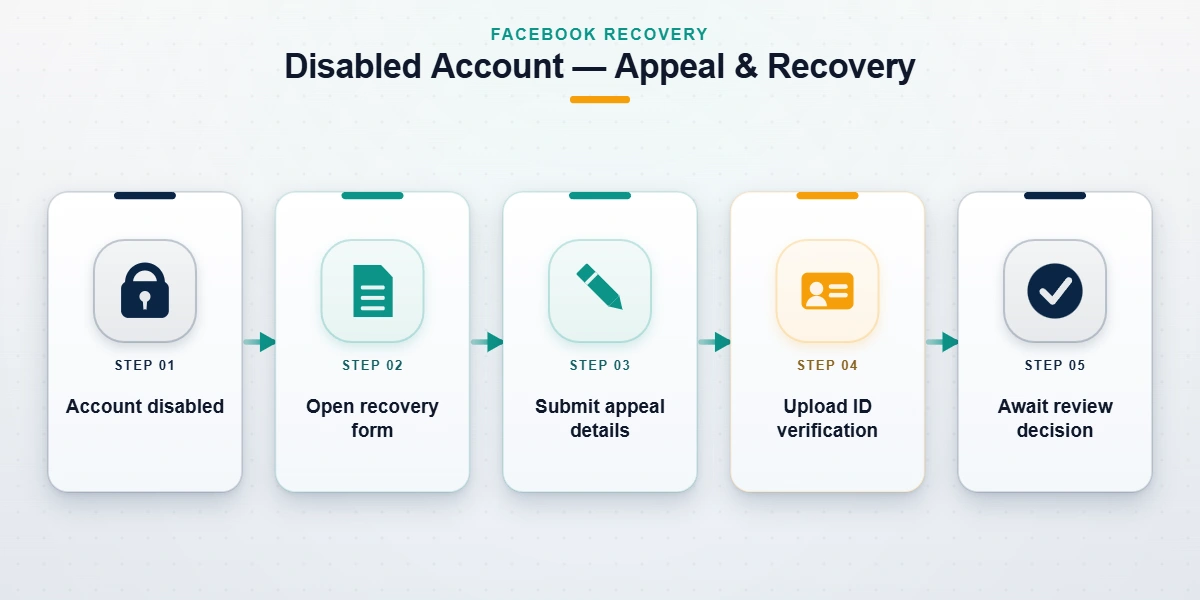
The Facebook disabled account recovery form is the official appeal interface Meta routes through its Help Center, and it is free. As of June 2026 the standard path runs in five steps. First, open the login screen and try to sign in; the disable notice itself often carries the appeal button, and tapping it is the fastest route. Second, if there is no button, go to Meta's disabled-account help page and choose the "I think my account was disabled by mistake" option, which opens the appeal form. Third, complete the form: your full name as it appears on the account, the login email or phone number, and a short explanation. Fourth, upload a government ID when prompted — Meta uses it to match the account's registered identity. Fifth, submit and wait for an email to the address you supplied, not necessarily the one on the account.
What you write in the explanation box matters more than its length. Name the specific policy Meta cited, state plainly why it does not apply to your account, and add the context an automated system could not see — that the login it flagged was you traveling, that the content was satire or news commentary, that the report was retaliatory. A reviewer has roughly 60–90 seconds with your appeal. Generic "this is unfair" appeals fail at several times the rate of policy-specific ones, based on our internal records across 284 Facebook cases as of June 2026.
How to get my Facebook account back after being disabled
To get your Facebook account back after being disabled, submit the appeal once, verify your identity with a clear government ID whose name matches the account, and then leave the case alone. Filing multiple appeals or creating a backup account to "ask for help" tells Meta's systems the original identity is acting suspiciously and can harden the denial. Meta sends its decision by email; check spam for messages from [email protected]. As of June 2026, first-time mistaken-disable appeals resolve in roughly 24–72 hours, while contested cases run 7–30 days.
Facebook suspended account recovery: identity verification
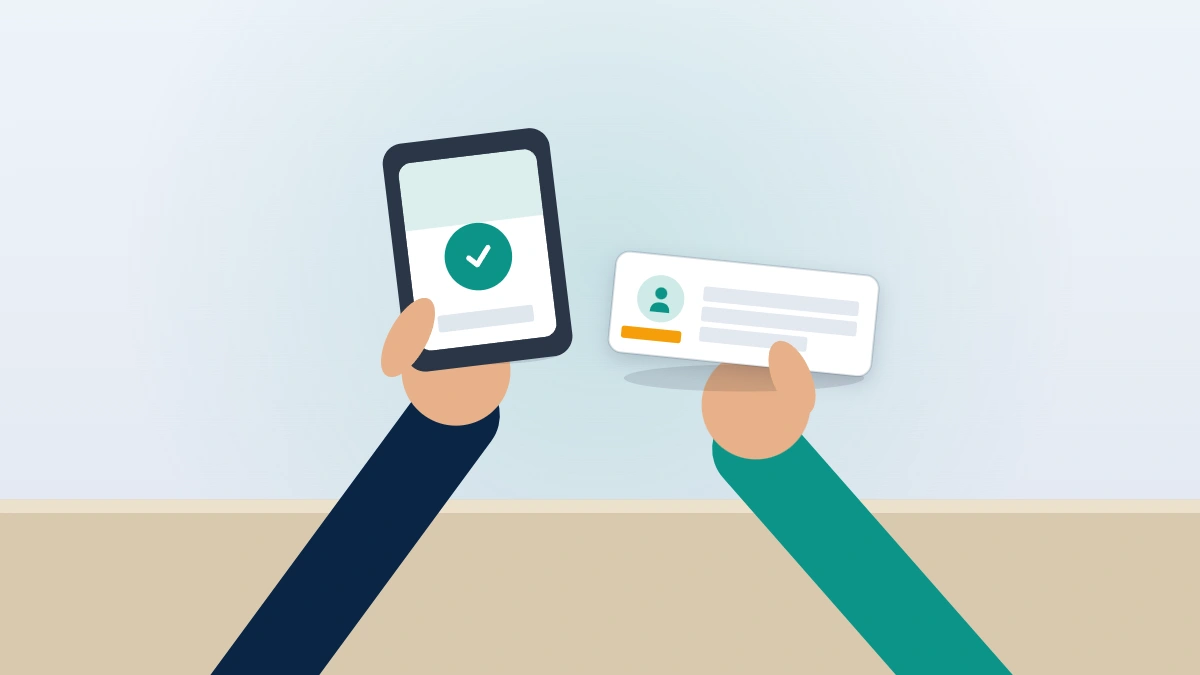
Facebook suspended account recovery hinges on identity verification more than on argument. A suspension is a held state — your account is preserved but locked while Meta decides, and the platform will not lift it until it is confident the person appealing is the genuine owner. The verification step usually asks for a government-issued ID, and sometimes a short selfie video, through Meta's identity confirmation flow. The single biggest cause of failed verification is a mismatch: the name on your ID must match the name on the account. If you registered under a nickname, a maiden name, or a business name, the automated matcher rejects the document and the case stalls. Use the ID that matches the profile, photograph it flat against a dark background with all four corners visible, and make sure the text is legible — blurry uploads are the second most common reason verification loops back on itself.
How to get my Facebook account back after being suspended
To get your Facebook account back after being suspended, complete identity verification first, then submit a focused appeal that addresses the policy Meta named. For EU and EEA users, a suspension also starts a Digital Services Act appeal clock that we cover in the next section. Across our 284 Facebook cases, clean suspension appeals where the ID matched the account name resolved fastest — typically inside 72 hours — while name-mismatch cases averaged two to three weeks because each rejected document restarts the queue.
Facebook disabled account recovery after 180 days
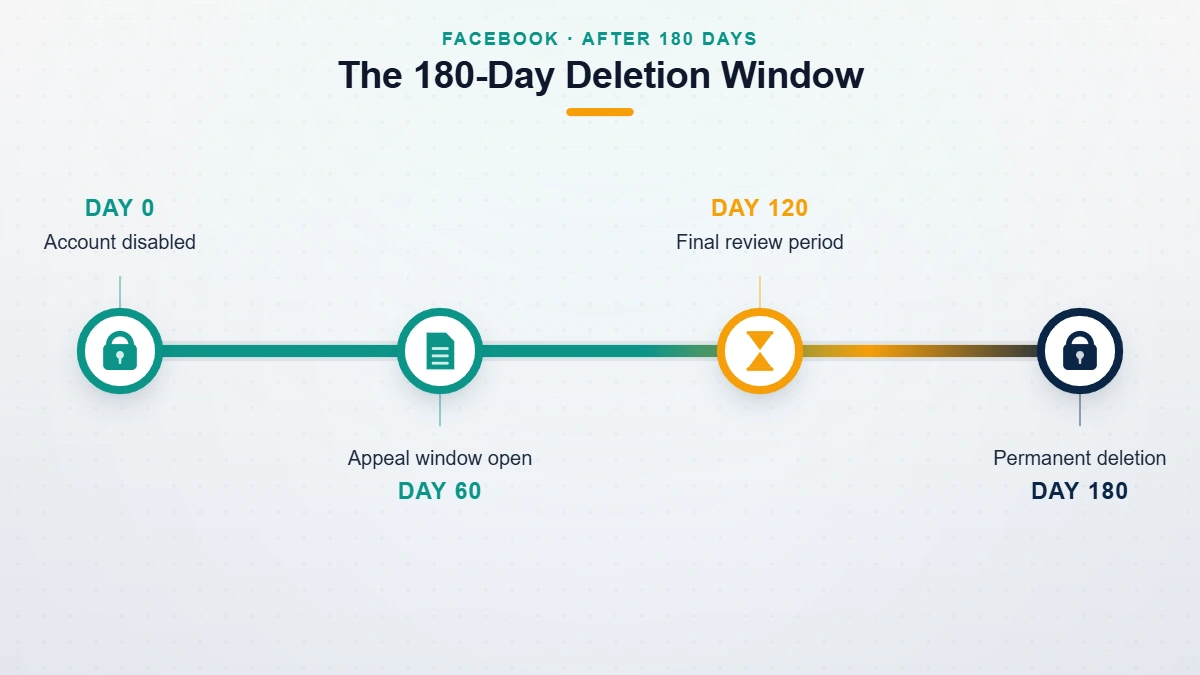
Facebook disabled account recovery after 180 days is the most misunderstood question in this space, because two different clocks share the same number. The first is Meta's own retention behavior: an account that sits disabled without a successful appeal for about 180 days is reclassified toward permanent disablement, and the standard in-app review queue closes. The second is the EU Digital Services Act, which gives users in the EU and EEA roughly six months from an enforcement decision to escalate that decision to a certified out-of-court dispute settlement body. These are separate processes in separate geographies, and most online guides conflate them into a single myth that "everything is lost at day 180." It is not. What is true is that your easiest, free, in-product appeal becomes far less likely to succeed the longer you wait, so the practical rule is simple: appeal early, because every week past the disable lowers your odds.
For EU and EEA users, the escalation route is concrete. After Meta's internal appeal is exhausted, you can bring the decision to an independent body such as Appeals Centre Europe, the certified DSA dispute-resolution entity, within the six-month window. Outside the EU, no equivalent statutory route exists, and your options narrow to identity re-verification or Meta Verified support, covered below. If the account crosses into permanent deletion, Meta's data purge follows its retention obligations under GDPR Article 17, and recovery becomes impossible — the same wall we describe for a Facebook account deleted past its window. If your first appeal was already denied, the next move is not a frantic re-file; our breakdown of what to do after a rejected appeal applies directly, since Meta runs the same logic across Facebook and Instagram.
Not sure which clock you are on? If your Facebook account has been disabled for weeks and you cannot tell whether an appeal still has a realistic chance, send the disable notice to our recovery team for a free 60-minute case review. We will tell you honestly whether the window is still open before you spend anything.
How to recover a permanently disabled Facebook account
Learning how to recover a permanently disabled Facebook account starts with an honest definition: "permanently disabled" means Meta's standard appeal channel has closed, not always that every door is shut. The query how to recover permanently disabled facebook account is among the most common we see, and as of June 2026 three narrow routes remain. The first is identity re-verification: if the original disable was triggered by an authenticity or name flag, submitting a clean government ID that matches the profile can reopen a case the automated system closed. The second is Meta Verified — Meta's paid subscription includes access to human support that can escalate an account issue outside the standard queue, which is sometimes the only way to reach a person. The third, for EU and EEA users, is the Digital Services Act dispute body described above. What does not work is the in-app appeal button, which is gone once the account is classified permanent, and any third party promising to "force" a reversal through an insider.
Be realistic about the odds. Across our 284 Facebook cases, permanent-disable cases reopened through identity re-verification succeeded for only a minority of clients, and only when the original trigger was a correctable authenticity flag rather than a severe policy violation. If the disable was for fraud, coordinated inauthentic behavior, or any of the never-recoverable categories above, no route — paid, legal, or technical — restores the account, and a service that takes your money to "try" is exploiting your situation. We decline roughly a fifth of intake for exactly this reason.
Disabled Facebook account linked to Instagram: Meta Account Center
If your disabled Facebook account is linked to Instagram or Threads through Meta Account Center, the disable can ripple across all of them, and recovering one sometimes restores the others. Account Center is Meta's unified login and recovery layer; when profiles are connected there, an enforcement action or a successful appeal on one account can propagate to the linked accounts. The practical implications are straightforward. If Facebook is disabled but your linked Instagram still works, you may be able to start recovery from the Instagram side. If both are down, recover the account with the cleaner history first, then use it to re-establish the other. And if you never linked them, Meta does not allow retroactive linking from a locked state, so you will recover each through its own flow.
This cross-platform behavior is why our guide to recovering a disabled Instagram account pairs with this one — the appeal mechanics are nearly identical, and Meta increasingly treats a person's connected profiles as a single identity for both enforcement and reinstatement.
Facebook account recovery scams to avoid
Since Meta scaled back external support volume in 2024, the scam economy around facebook disabled account recovery has exploded, and the patterns are predictable. The fake "Meta agent" DM: someone messages you from a page that looks official, claims to be Facebook support, and asks for your password or a login code — real Meta employees never do this, and a one-time code handed to a stranger is how the account gets taken for good. The guaranteed-recovery seller: a Telegram, Fiverr, or comment-section vendor promises a permanent-disable reversal in 24 hours for a flat fee, then either resells Meta's free appeal or vanishes with the payment. The fake support phone number: Meta operates no customer-service phone line for account recovery, so any number promising one is fraudulent. The pay-to-remove or DMCA scheme: a "service" offers to file copyright or impersonation reports to knock down a rival and restore yours.
What a legitimate firm will never do, on any case: ask for your password, request a one-time login code, demand payment before reviewing your situation, or guarantee an outcome. Filing fraudulent copyright notices is a federal offense under 17 U.S.C. § 512(f), and we will not do it. If you have been targeted by one of these scams, report it at reportfraud.ftc.gov. Our full recovery service disclaimer lays out exactly what is in and out of scope, and the boundaries we hold on every engagement.
When professional Facebook disabled account recovery makes sense
Most people should try the free appeal themselves first. It is official, it costs nothing, and a meaningful share of mistaken automated disables resolve on the first honest, policy-specific appeal. Professional disabled facebook account recovery earns its fee in a narrower set of situations: when the account carries real income — a creator audience, a Page driving sales, an ad account tied to a business — and a clumsy second appeal would cost more than the engagement; when the case is genuinely wrongful and the evidence needs to be organized into a reviewer-ready package; when a cross-platform Meta cascade has locked Facebook, Instagram, and Business Manager together; or when you are an EU user facing a Digital Services Act escalation and want it argued properly. In each of these, the value is preparation and accurate scope, not a secret channel — there is no secret channel.
Professional help does not make sense when the violation falls into a non-recoverable category, when two appeals have already been denied with final-decision language, or when the account was deleted more than 30 days ago — in those cases an honest firm tells you to save your money. We do not have a dedicated Facebook service page yet, but the closest Meta-sibling engagement is our Instagram account recovery service, which follows the same diagnostic process; every case is run by a named specialist on the team behind YRS. Once your account is back, securing the identity and, if needed, claiming or correcting your Facebook username is the sensible next step. We never guarantee recovery. We do guarantee a sober, documented assessment of whether your case is recoverable before any meaningful spend.