
Can you delete someone else's Snapchat account?
No. Deletion is an owner's control, sealed inside the account it belongs to, and it demands that account's own username and password before it will run. Your Reputation Solution is a reputation and account-recovery firm that files platform reports and escalations for people being impersonated, harassed or scammed online, and this is the first thing our casework has to explain to nearly everyone who calls about Snapchat. No outsider version of the button exists. Searching how to delete a snapchat account that is not yours returns pages that quietly answer a different question — how to delete your own — because the literal one has no procedure behind it.
What exists instead is a request. You describe an account to Snap, Snap decides. That distinction sounds pedantic until it changes what you do next: a request needs evidence and a policy it maps onto, where a button needs neither. People who treat a report as a delayed delete button write two angry lines, submit, and hear nothing back.
So the honest framing for how to delete someone else's snapchat account is a fork. Either the account breaks a rule Snap enforces, in which case you are filing a report and the outcome belongs to Snap, or it does not, in which case nothing you do will remove it and your real tools are blocking and evidence-gathering. Wanting an account gone has never been a removal ground on any major platform, and rephrasing the request changes nothing about that.
Why the query gets phrased as a deletion at all is worth a moment. Most people arrive here having already tried the obvious thing — they opened the profile, looked for an option, found none, and assumed it was hidden somewhere. Absence of the control reads as a discoverability problem rather than a design decision. It is a design decision. Snap built account termination as an enforcement outcome and self-deletion as an owner privilege, with no third door between them, and every guide promising otherwise is describing a door that was never cut. Correcting that single assumption takes Your Reputation Solution more intake time than any other part of a Snapchat case.
Worth separating early: this page is about deletion specifically. Snapchat's reporting machinery sits underneath all of it, and how to report a Snapchat account walks the in-app press-and-hold path surface by surface, including the web route for an account that has already blocked you. Everything below narrows to the deletion question — who can do it, which reports actually end in it, and where the routes stop. Credentials for the specialists who run these cases are listed with the people who handle these cases.
Who actually holds the delete button?
Three parties have a role, and only two of them can end an account.
| Who | What they can do | What it takes |
|---|---|---|
| The account owner | Delete the account permanently | Their own username and password at accounts.snapchat.com |
| Snap Inc. | Lock, ban or terminate an account | A confirmed Community Guidelines violation |
| You, a third party | File a report; block; gather evidence | A described violation Snap can verify |
Knowing the owner's route in detail helps even though you cannot walk it, because that path is the only one producing the word deleted in Snapchat's own vocabulary. On accounts.snapchat.com the owner opens Manage My Account, scrolls to Delete My Account, retypes their username and password, and confirms. Deactivation then runs for 30 days. Logging back in during that window cancels the request entirely and restores the account with its data intact. Once the 30 days elapse, deletion becomes permanent, with a regional exception: Snapchat's own deactivate or delete documentation states that accounts deleted in India deactivate for 30 days and are permanently deleted after a further 180, matching local rules.
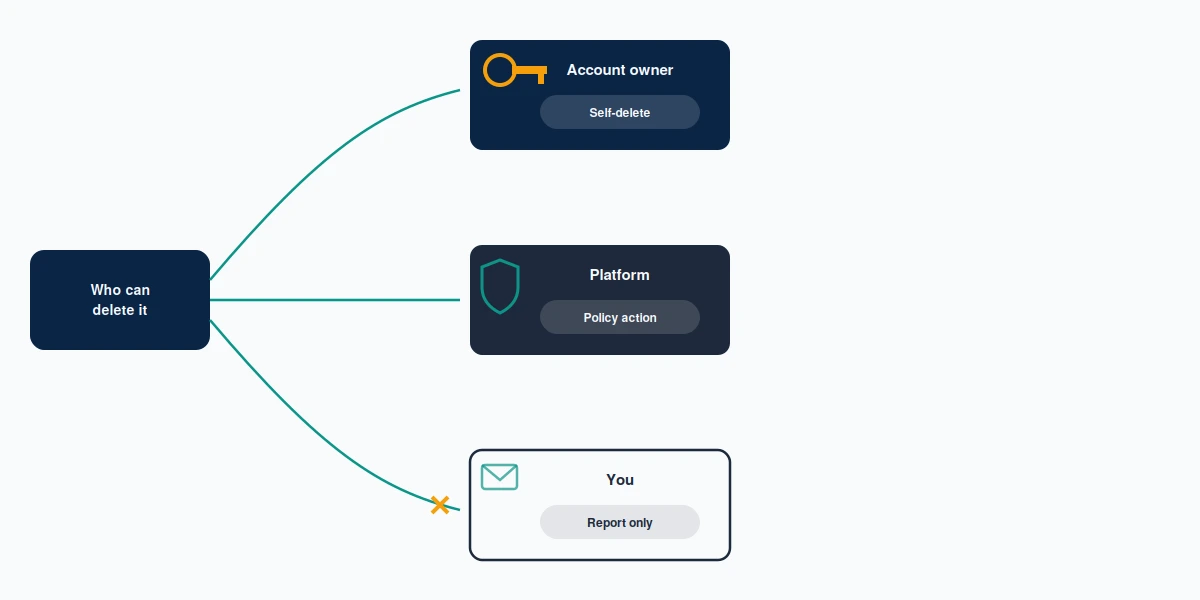
Vocabulary matters more than it should here, because Snap uses two words for two different endings. Termination is what enforcement produces: Snap closes the account against the holder's wishes, and the record of it persists on Snap's side. Deletion is what the owner initiates, and it takes the data with it. Reading a support reply saying an account was actioned or terminated, then concluding it was deleted, leads people to expect an empty username to become available. Usually it does not. Every status update Your Reputation Solution sends keeps the two words apart, because clients who conflate them ask the wrong follow-up question a fortnight later.
The reversal clause matters whenever someone has agreed to delete an account voluntarily — an ex closing a shared profile, a colleague retiring a brand account. Deletion is not settled on the day they click. It settles a month later, and one login undoes it. Anybody negotiating how to delete a snapchat account that isn't yours by persuasion rather than process needs that date in their calendar, because the account holder can quietly reverse the whole thing without telling you. Meta's platforms behave identically, which is why recover a deleted Instagram account permanently exists as a guide at all: the grace window is the product, not a bug.
Beyond Snapchat the pattern generalises. Asking any platform to remove an asset registered to somebody else downgrades you from operator to petitioner, and Google runs the clearest version of it, where a non-owner gets Suggest an edit and a redressal form rather than a delete control — how to remove a business from Google Maps sets out how narrow those routes are. Snapchat is stricter still, since there is no public edit layer to petition through in the first place.
How to get someone's Snapchat deleted: the support form route
Most people find the in-app report first and stop there. For deletion cases the web form at support.snapchat.com is the one that matters, because its branches reach outcomes the in-app menu does not.
Its path stays consistent. Open Snapchat Support, choose Report a safety concern, then Someone else's Snapchat account, then pick the specific issue. Under that third step sit the branches this article is about: someone pretending to be you, an account belonging to a child under 13, and an account whose owner has died. Having a Snapchat account of your own is not required, which is the practical reason Your Reputation Solution prefers this route — parents, brand owners and bereaved families are frequently outside the app entirely, and Snapchat's abuse and illegal content documentation confirms the web forms accept reports from non-users. Pick the branch before you start writing, because the form changes the questions it asks once you have chosen, and backing out to switch loses whatever you have typed.
Evidence decides these cases. Reports saying "this account is fake" give a reviewer nothing to verify; one that names the impersonated person, links both profiles, and points at the mismatched creation date gives them a comparison they can make inside a minute. When our team assembles a Snapchat escalation, the package is built around whatever a reviewer would otherwise have to guess: usernames written exactly as they appear, timestamps, screenshots captured before anything expires, and a single sentence naming the rule that was broken.
Timing is the constraint people underestimate. Snaps and Chats are deleted from Snap's servers by default within 24 hours of being opened or expiring, so evidence gathered late is frequently evidence that no longer exists. Screenshot first, then report — that ordering does more for a case than any wording. Capture the profile screen with the username visible, the offending content, and the timestamp in the same frame where you can, since a reviewer working from three disconnected crops has to reconstruct a sequence you could simply have handed them.
One more habit separates reports that land from reports that stall: describing the violation in Snap's language rather than your own. Harassment, impersonation, threats, sexual content involving a minor, and scams are categories with definitions attached. Grievances phrased as "this person is awful" map onto none of them, and a reviewer with a queue cannot translate on your behalf. Rewriting a client's account of events into those categories, without inflating what happened, is most of what Your Reputation Solution actually does before anything gets submitted.
Two other platforms draw the same public-versus-private line and repay reading if your case straddles apps. How to report a Telegram group covers a service that moderates only publicly viewable content, which is precisely why a locked profile stalls a complaint there. And where a Snapchat account exists to run a sales scam, the report is a safety action rather than a refund, a split reporting a Marketplace seller explains on a platform where the money moves on your bank's separate clock.
How to delete a fake Snapchat account impersonating you
Impersonation is the branch with the highest hit rate, because it is falsifiable. Set two profiles side by side and a reviewer sees the copy.
Inside the app: open the impersonating profile, tap the three-dot menu, choose Report, then They're pretending to be me or someone I know. From a browser, take the support.snapchat.com path above and select the same concern. Either way, how to delete a fake snapchat account comes down to what you attach — the real account's username, the fake one's username, the specific photos or bio text that were lifted, and, where the impersonation solicits money, the messages proving it.

One asymmetry deserves exploiting. Snap does not tell a reported account who filed against it, though it does notify an account holder when content comes down or action lands. The reported party therefore learns that something happened without learning who caused it, which is why advice to report quietly and then block is sound rather than paranoid. Sequencing like that goes into every impersonation case Your Reputation Solution files, because a target who realises they have been reported often spins up a replacement profile within hours.
Replacement is the real problem with impersonation, and few guides mention it. Removing one clone does not remove the photos the cloner holds, so the same images reappear under a new username days later. Practical defence runs on two tracks at once: report the current profile, and reduce the supply of source material by tightening who can see your Stories and by pulling public photos that keep being harvested. Run one track without the other and the clones keep arriving.
Should the fake account trade on a registered brand instead of a personal likeness, the brand-owner route reaches further than a personal complaint, and the asymmetry is stark elsewhere too — reporting trademark misuse on X shows a system demanding a registration number instead of a description, rejecting everything else. A business filing how to delete fake snapchat account requests with a registered mark in hand sits in a materially different queue from an individual filing on likeness alone. Registration is the leverage; the complaint is only the delivery mechanism.
Then there is the profile that functions as a funnel rather than a fake identity. Where it exists to push people into a paid scam, the advertising layer gets judged under different rules than community guidelines, a split how to report a YouTube scam ad documents on a platform where the ordinary flag icon does nothing to an advert.
Which accounts will Snap delete outright?
Two categories end in deletion rather than a ban, and both are badly documented everywhere else. Both take a disproportionate share of the Snapchat enquiries Your Reputation Solution handles, simply because they are the only branches where a third party's report reliably produces a removal rather than a sanction.
Age comes first. Snapchat's minimum age is 13, and Snap's position is that once it becomes aware an account belongs to someone younger, it terminates the account and deletes the data. Not a suspension — a removal. Any adult can start this through the same web wizard: Report a safety concern, then Someone else's Snapchat account, then The person is under the age of 13. Snap's underage account reporting page notes its teams review these and may follow up asking for more information before acting. This is the single most reliable third-party route to an actual deletion, and across fourteen competitor pages surveyed for this article, not one mentioned it. Anyone researching how to get someone's snapchat account deleted who has genuine grounds to believe the holder is a child has been reading the wrong forms.
Why it works sits in law rather than policy. US operators face specific obligations around personal data collected from children under 13, so an account confirmed to be underage stops being a moderation question and becomes a compliance one. Compliance queues behave differently from community-guidelines queues: the platform's own exposure motivates the outcome, which is why removal rather than a warning is the standard ending. Parents should note that this route deletes their child's account rather than handing them control of it. Where a parent wants supervision instead of removal, Your Reputation Solution points them at Snapchat's Family Center rather than the reporting wizard, since the two produce opposite results.
Death is the second. That same wizard carries a branch for an account whose owner has passed away, and the request needs the deceased person's full name, a link to the account, and a copy of the death certificate. Families are usually surprised by two things. Snapchat offers no memorialisation option, so the outcome is removal rather than a preserved profile; and Snap does not hand over the login, the Memories or the content to relatives, so deletion is what the process offers rather than access. Streaks, Bitmoji and Snap Map history go with it. Families deserve to hear that trade-off before they file, since it cannot be undone once granted.
Neither route is instant, and neither is a formality. Both ask Snap to verify a claim about a person, which takes documentation and patience rather than persistence.
Successful deletion also leaves the search layer untouched. Screenshots, mirrors and cached pages outlive the account that produced them, and pulling those down is a separate project with its own qualifying rules — ways to remove your name from Google Search covers which ones actually qualify. When material is personal rather than defamatory, a privacy track runs parallel to the guidelines track on every major platform, and the YouTube privacy complaint form is the clearest worked example of a submission buried at the end of a multi-screen wizard.
Warning, lock, ban, deletion: what a report actually produces
Conflating these four outcomes is the commonest reason people conclude that reporting "did nothing".
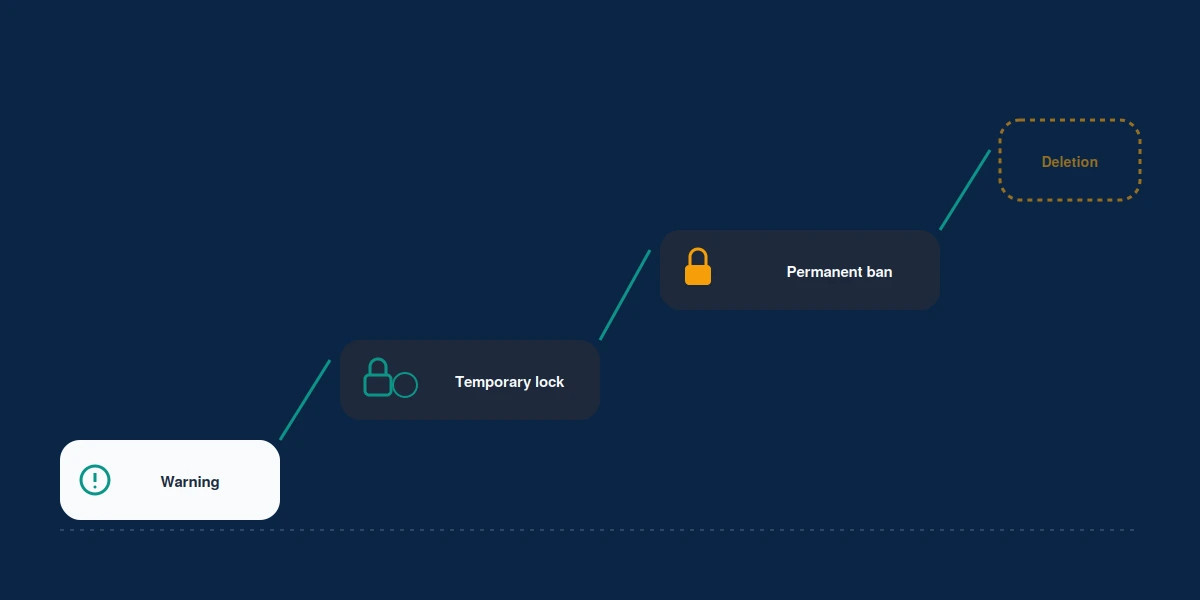
A warning leaves the account running. Temporary locks take it offline for a set period and reverse afterwards. Permanent bans stop the person using the account while the account itself persists as a record. Only deletion removes it. Case notes at Your Reputation Solution keep these four words apart precisely because clients read any of them as the last one. Asking how to get a snapchat account deleted and receiving a ban is not a failed report — that is the normal ceiling for a guidelines case, and treating it as failure sends people looking for services promising more than any platform delivers.
From outside, these outcomes look nearly identical, which compounds the confusion. Locked accounts and banned accounts both stop replying. Deleted accounts and accounts that have blocked you both disappear from search. Without a status message you are inferring from absence, and absence has four possible causes plus a fifth: the person simply changed their username. Checking from a second account before concluding anything saves a great deal of misplaced certainty, and no honest status update should skip it.
Scale is public here. Snap's transparency report for the first half of 2025 records 19,766,324 in-app reports of Community Guidelines violations, against which its safety teams took 6,278,446 enforcement actions, including enforcements against 4,104,624 unique accounts (Snap Inc. Transparency Report, H1 2025). Roughly one report in five produced an account-level enforcement of any kind, and enforcement in that count spans the whole ladder rather than deletion alone. Measured against those numbers, a single well-evidenced report is neither futile nor a guarantee.
Reporting also runs in both directions. Should a coordinated wave of reports land on an account you own, the appeal is a mirror image of the report, and Instagram suspended account recovery documents the clearest working version of that flow. Snap states plainly that for privacy and account-security reasons it cannot always share the outcome of a report, so silence is not evidence that nothing happened.
Where your case involves impersonation, a hacked account, or brand abuse and you want the evidence package built properly before it goes in, talk to our team. Your Reputation Solution files and escalates the report; Snap makes the final decision, and nobody can honestly promise you the second part.
Did you mean removing someone from your Snapchat?
Many people searching how to delete someone's snapchat want something narrower and entirely achievable: that person out of their own app.
Removing a friend, blocking, and deleting a conversation are three separate controls with three different effects. Removing a friend cuts their access to friends-only Stories and Charms yet still lets them search for you. Blocking hides you from them and them from you. Deleting a chat clears it from your view, and Snapchat is explicit that the copy on the other person's device stays put. None of the three touches their account. None generates a notification either.
How to delete someone's snapchat profile usually resolves to one of two things as well: removing a Public Profile you administer, which only its owner can do from their own settings, or removing the person from your friend list. Neither is deletion in the sense the rest of this page has been using, and conflating them is why so many guides on this query read as though they answered something.
Blocking has one property worth stating plainly, because people hesitate over it: it is reversible and it is private. Nobody receives an alert. The other person may infer it eventually from your absence in their feed, though inference is not notification, and you can undo it at any point from your settings. Weighed against a report that may take days and may return nothing, blocking is the faster instrument for almost every case that is really about distance. Do both where the behaviour is genuinely against the rules: blocking protects you today, and the report is what might change anything tomorrow.
Getting the distinction right matters because blocking is the power you genuinely hold and deletion is not, a boundary that trips people up across platforms — how to block someone and delete comments separates three controls that look interchangeable and are not. Enquiries resolving at exactly this step reach Your Reputation Solution most weeks, and the answer costs nothing and takes about four seconds.
What Reddit gets wrong, and where the lawful routes stop
Searches for how to get a snapchat account deleted reddit land on a genuinely poor result set, including a compromised university subdomain publishing spam on this exact query. Advice circulating in those threads clusters around one idea: enough reports will force a deletion.
It fails, because Snap weighs whether a rule was broken rather than how many people said so. Coordinated flooding is itself actionable, so the practical result of organising one is risk to the accounts doing the reporting. We took that argument apart in detail in our analysis of snapchat mass report bots and the tools sold alongside them.
Sellers follow the mythology. Two videos ranking on these queries offer to delete accounts created by other people, a service no platform sells to anyone at any price. Our team never asks for your Snapchat password, never offers to buy a removal, and never files a claim it cannot evidence — boundaries set out in our service disclaimer, which exist because this category is full of operators who do all three. Real casework gets scoped and quoted; our published WhatsApp account recovery service pricing shows what an honest quote looks like beside a $50 promise to nuke a stranger.
Three warning signs identify the scam version reliably. Anybody asking for your login is harvesting credentials, since no legitimate report needs them. Fixed turnarounds quoted for a third party's deletion invent certainty that belongs to Snap alone. And a seller who never asks what rule was broken is not preparing a report at all, because that question is the first thing a real case turns on. Your Reputation Solution opens with it every time, and turns away the enquiries that have no answer to give.
Past the platform, routes narrow to law enforcement and the courts, and both need a case rather than a grievance. Threats, stalking, sextortion and non-consensual imagery are police matters and belong there first. Court orders can compel action a report cannot, though obtaining one means identifying the account holder, which is frequently the hardest step and sometimes an impossible one. Neither option is available to somebody who is simply angry, which is the boundary this article will not help anyone cross. Documented cases sit on the other side of that line, and our account recovery services cover them: impersonation, takeover, and brand abuse with evidence behind them.
If the account you want deleted is your own
A quiet share of these searches come from people describing their own account in the third person, because somebody else is holding it.
After a takeover, the intruder is usually holding the account through the login itself, and the sequence has to run in order: regain access, then decide about deletion. You cannot delete what you cannot log into, and Snapchat's delete page accepts nothing but that account's own credentials. Where the recovery email or phone number has been changed, reset paths become the whole game — TikTok account password recovery maps the same three-route structure every major app uses, and the reasoning transfers cleanly. Documented cases are what Your Reputation Solution works — impersonation, takeover, brand abuse — filing the escalation with the evidence attached; the platform decides, and clean recovery casework typically runs 24 to 72 hours before there is anything to report back.
Verification codes are the usual failure point. Almost every takeover our team sees turns on somebody else receiving the SMS, and WhatsApp account recovery verification code problems share that root cause and that diagnostic order. Reclaim mechanics stay consistent across apps: re-verifying the number on your own handset logs the intruder out, and recover your WhatsApp account on a new phone is the clearest demonstration of it.
Report the compromise while you work the resets, rather than after. A takeover being actively used to scam your contacts is a live safety matter with its own queue, and a report filed during the incident carries timestamps that a report filed a fortnight later cannot reconstruct. Warn the contacts being messaged, too, since the damage a hijacked account does lands on them rather than on you, and a single group message travels faster than any support ticket.
Once access returns, deletion becomes a choice rather than a request. That is the whole asymmetry this page has described, seen from the other side.
Worth ending where the question started. Nobody outside an account can delete it, and nobody selling that outcome can deliver it. What you can do is narrower and more useful than it first appears: report accurately against a named rule, gather evidence before it expires, use the two wizard branches that genuinely end in removal, block the person who is actually bothering you, and treat the search layer as a second job. Anyone quoting you a guaranteed deletion of a stranger's account is describing something that does not exist.