What is a YouTube privacy complaint, and what is it not?
It is a removal request you file about yourself, not about the video's behaviour.
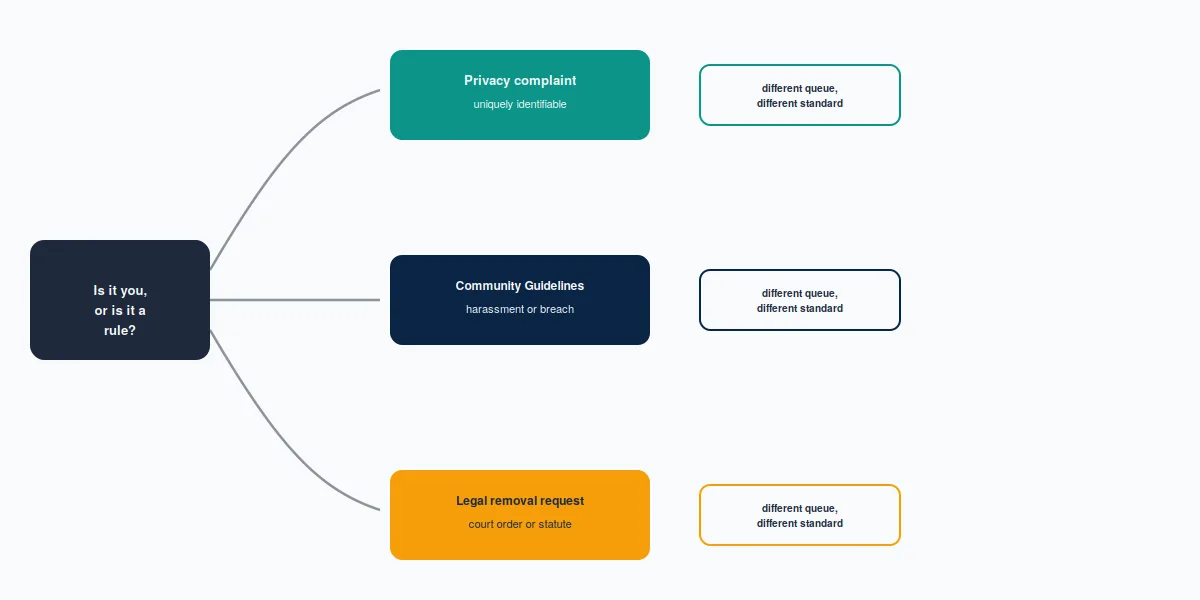
Community Guidelines reports ask whether a video breaks a stated rule: harassment, nudity, dangerous acts, spam. Privacy complaints ask something narrower. Does this footage expose you — by face, voice, full name, home address or account number — to people who had no business seeing any of it? Different question, different reviewer, different burden of proof.
That gap is wider than it sounds. A video can be cruel, mocking, filmed to humiliate you, and still clear every privacy test, because privacy policy asks about exposure rather than intent. It can also be perfectly polite and still qualify, if it reads out your home address at the end.
Your Reputation Solution is a reputation and account-recovery practice that prepares privacy removal requests for the person who appears in the footage, rather than for the channel that uploaded it.
Choosing the wrong category is the most common way these cases die quietly. Misfiled complaints do not get re-routed to the correct queue behind the scenes. YouTube resolves them against the policy you picked, and the rejection notice you receive then reads exactly like a rejection on the merits. If a video is abusive rather than exposing, the ordinary reporting route fits the facts better.
One more limit is worth absorbing before you start. This mechanism addresses a single video, so five clips of you on one channel means five separate filings, and no number of them adds up to a channel-level penalty on its own. That ceiling catches out anyone hoping a privacy filing terminates a channel, and it catches them out late, usually after weeks of effort aimed at the wrong outcome.
Privacy complaint, Community Guidelines report, or legal removal?
Pick by who is harmed and by what proof you can supply, because each route lands in a separate queue with its own standard.
| Route | The question it asks | Who may file | What it can reach |
|---|---|---|---|
| Privacy complaint | Are you uniquely identifiable, and did you consent? | You, or your legal representative | One video — removed, blurred, or trimmed |
| Community Guidelines report | Does the content break a published policy? | Anyone, no identity proof | The video; repeat breaches reach the channel |
| Copyright claim | Do you own the footage itself? | The rights holder only | The video, plus a strike on the uploader |
| Other legal complaint | Does a statute or court order compel removal? | You, counsel, or a court | The video, sometimes restricted by country |
Row three causes real damage. Asked to file a copyright claim over footage a client did not shoot, Your Reputation Solution says no, and the refusal costs them nothing except the fantasy of a shortcut. Claiming ownership you do not hold is a false statement made under penalty of perjury, and what a legitimate copyright strike requires makes the gap between the two routes obvious. YouTube's other legal complaints hub covers defamation, court orders and non-consensual intimate imagery, and each carries its own standing requirements.
None of these four routes touches the comment section. Where exposure spills into replies underneath the video, muting and clearing comments is a control you already hold, it applies instantly, and it works while a complaint is still pending.
Where does the YouTube privacy complaint form actually live?
At the end of a six-screen wizard, and nowhere else — no bookmarkable URL jumps you straight to it.
This surprises almost everyone. Searches for a youtube privacy complaint form online return help articles rather than a form, because YouTube deliberately gates the submission behind an explainer sequence beginning at support.google.com/youtube/answer/142443. Every screen is numbered — the second one reads "Privacy Complaint Process: 2 of 6" in its own page title — and each offers an exit toward harassment reporting or legal complaints before the submission form finally appears. Clicking through all six is mandatory, and two of those screens exist mainly to talk you out of filing by pointing at harassment reporting or the legal webforms instead. Bookmarking the last screen does not reliably work later, which is why so many people conclude the form was removed.
There is a second entry point from inside the product. Open the video, select More, then Report, then the privacy option, and the same wizard opens with the video URL already filled in. Searchers typing youtube report privacy violation usually mean this in-app path, while those hunting for a youtube privacy violation form have the web wizard in mind. Filed either way, a youtube privacy violation report lands in the same queue, so the choice is convenience rather than strategy.
For one practical reason, Your Reputation Solution files through the web wizard: it accepts a longer free-text description, and description quality decides more of these cases than anything else in the submission. Paid takedown outfits sometimes present that wizard as proprietary access. Untrue, and easy to verify. Free and public, open to you this minute — worth holding onto when reading what a YouTube ban service can and cannot actually reach. Read those exit screens rather than clicking past them. If the real problem is harassment rather than exposure, the route they offer is faster, and taking it early saves you a rejected filing later.
The four tests every YouTube privacy complaint has to pass
Reviewers apply four conditions, and failing any single one ends the complaint regardless of how distressing the video is.
You must be uniquely identifiable. YouTube's Protecting your identity guidance sets a specific bar: image, voice, full name, government identification number, bank account number, or contact details such as a home address or email. Recognising yourself is not the test. Strangers must be able to recognise you. YouTube states plainly that a first name without additional context, or a fleeting image, would not likely qualify.
You must not have consented. Footage you agreed to appear in stays up, even when you now regret it, and even when the uploader has since turned it against you.
Public interest must not outweigh your privacy. Newsworthiness, public figures and matters of genuine public concern all survive this test. Recordings of a public official at work are treated differently from recordings of you outside your house.
You must file for yourself. Only you or your legal representative may submit, with one exception for a parent or guardian acting for a child. Friends cannot file a YouTube privacy complaint for you, and submissions that try get closed without review.
Corporate-scale youtube privacy violations, such as regulatory findings about children's data, are a separate subject with no bearing on an individual filing. Your Reputation Solution prepares and escalates the individual complaint; YouTube's privacy team decides it, and that division of labour does not change no matter who files.
Identifiability runs broader than faces. Business premises and a visible street number can identify a named owner as surely as a face does, which is why premises exposure often runs alongside a hostile or fake Google Maps listing aimed at the same person. Fabricated accounts borrowing your likeness sit closer to impersonation policy, following the pattern behind someone running an account in your name on another network.
Partial identifiers are where judgement enters. Consider a number plate, a workplace uniform with a name badge, a school crest on a child’s jumper, a delivery label held up to the camera. None of these is a face, and all of them can make a stranger findable to someone who already knows half the answer. Moderators weigh what the footage discloses in combination rather than element by element, so say which fragments add up and how. Naming three weak identifiers that converge on one person works better than insisting a single blurry frame is unmistakably you.
Does an AI-generated version of you qualify?
Yes, through a related route that has widened considerably. YouTube's synthetic-likeness request has covered voice as well as face since November 2023, and likeness detection expanded during 2026 from its original creator pilot to a broader set of public figures, with YouTube stating it is working to extend detection to audio within 2026. Say what the video claims you said or endorsed, and name the guideline it breaks rather than the harm you feel — the drafting rule is identical to an ordinary filing. In practice Your Reputation Solution handles synthetic-likeness cases as privacy filings with extra evidence attached, rather than as a separate product carrying a separate price.
How to file a privacy complaint on YouTube, screen by screen
Work through the wizard once, slowly, with the video open in a second tab.
The whole YouTube privacy complaint process lives on those six screens, and rushing them is the most expensive mistake available to you at this stage.
- Start at the privacy complaint process page and read each of the six screens rather than skimming for a button.
- Confirm whether you are filing for yourself, for a child you are responsible for, or as a legal representative.
- Paste the exact video URL. One complaint covers one video.
- Give timestamps. Two or three precise ones beat a vague claim that you appear throughout.
- Describe what identifies you at those timestamps — the clothing you are wearing, what you are doing, where you stand relative to other people in frame.
- Name the identifier that qualifies: your face, your voice, your full name spoken aloud, your street number, your email on screen.
- Supply your legal name, country and contact email, then submit.
Step five decides most of these cases. Reviewers watch a great deal of footage under time pressure, and "the woman on the left in the red coat at 1:42" hands them something to confirm in seconds. "That's me, obviously" hands them nothing, and complaints nobody can confirm get closed.
Describe the identifier, never the emotion. How the video makes you feel is real and entirely irrelevant to the test being applied.
Not sure whether your case clears the identifiability bar before you file? Send the video link and the timestamps where you appear, and nothing more personal than that. Your Reputation Solution will tell you free of charge which route fits, what the description field needs to say, and whether your case is one of the many that does not need us at all — start a free case review. We never ask for your Google password or a verification code, at any stage.
Keep a copy of everything you submit, including the description text, because a second filing is far easier to sharpen when you can see what the first one actually said.
What happens in the 48 hours after you file?
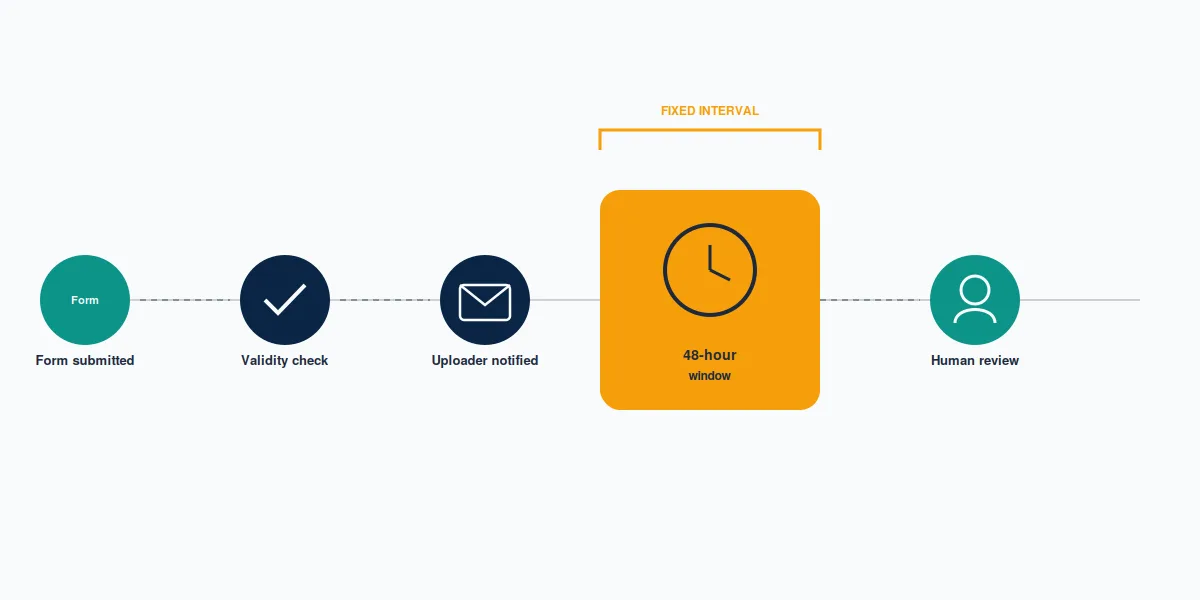
YouTube checks the complaint for basic validity, then gives the uploader 48 hours to fix it before anyone else decides anything.
Confirmation arrives by email immediately. This is what people mean when they search for a youtube privacy complaint email; it confirms receipt, carries a reference number, and promises nothing whatever about the outcome. Once a complaint passes that first-look validity check, YouTube notifies the uploader and starts the clock. They can delete the video outright, or edit it — blurring a face, cutting a segment, stripping an address out of the description. Either action closes your complaint as resolved.
Should the 48 hours pass with no action at all, YouTube's own team then reviews the video independently and may remove it, restrict its visibility, or blur you out of it.
Everything after that window is undated. No service-level commitment exists for the human review stage, and the forum threads behind searches like youtube privacy complaint reddit describe wildly different waits for exactly that reason, rather than because some filings are quietly prioritised. Anyone quoting a guaranteed turnaround is quoting a number YouTube has never published, and Your Reputation Solution will not quote one either.
Two things follow from that silence. Nobody can tell you where in the queue your complaint sits, and nobody can escalate it by asking. Patience is the only available instrument once the 48 hours have elapsed.
What the uploader receives is worth picturing, because it shapes how they respond. The notice names the video and the claim without naming you, so a channel with one complaint against it usually cannot tell who filed. A channel with a pattern of exposing people often guesses correctly anyway, which is the honest reason to think about your own exposure before you submit rather than afterwards.
One asymmetry deserves attention before you file. Complaints can be aimed at you too, sometimes in retaliation, and a channel hit while its owner is not watching has a closing appeal window — the single official appeal for a suspended channel is the thing to have read beforehand rather than afterwards. That retaliation pattern repeats across platforms, where reporting a live stream and removing viewers carries its own timing quirks.
Why do YouTube privacy complaints get rejected?
Almost always because the identifiability test failed, not because YouTube took the uploader's side.
When a youtube privacy complaint rejected notice arrives, it rarely explains itself in any detail, which leaves people assuming bias. Duller explanations usually fit better. Reviewers could not confirm you in the frames available, the description gave them nothing to work with, or the video sat on the public-interest side of the line. Consent is the second most common failure, since footage from an event you agreed to be filmed at is difficult to unwind afterwards.
Re-filing with better evidence is allowed and is not treated as abuse, provided the new submission genuinely adds something. Add timestamps you left out. Describe the identifier more precisely. Where your full name is spoken at 4:07, say so and quote the words. Repeating an identical complaint verbatim wastes the attempt and, filed often enough, starts to look like harassment of the uploader.
When Your Reputation Solution reviews a rejected filing, the fault sits in the description field far more often than in the facts of the case. What changes on a successful second attempt is precision, not persuasion.
Removal from YouTube also does not clear the search results that video generated. A video taken down can leave its title, thumbnail and cached description ranking for your name for weeks afterwards, which makes getting your name out of Google's results a second and separate piece of work. Where a clip has been re-hosted on somebody's own website, deindexing that page runs on a different mechanism again, with its own evidence requirements.
Something else is worth separating out: rejection of the complaint is not a finding that the video is fine. It means the four tests were not met on the evidence you supplied, which is a narrower statement than most rejection notices manage to convey and a much narrower one than people read into them.
Honest framing matters more here than optimism. No published youtube privacy complaint success rate exists, ours included, and any firm advertising one has invented it.
Filing for a minor, and the limits worth naming out loud
Parents and guardians may file for a child, and it is the only third-party route YouTube accepts without legal representation.
Searches for a youtube privacy complaint minor usually come from a parent who has found their child in a stranger's upload. Filing runs through the same wizard, with the guardian relationship declared at the start; you supply your own legal name and contact details rather than the child's. Sexual material changes the whole picture, and none of this applies. Speed matters far more than paperwork there: report to the NCMEC CyberTipline and your local police first, then deal with the platform.
Here is what Your Reputation Solution will not do. We will not guarantee removal, because YouTube's privacy team makes the final call and lawfully leaves up content that clears the four tests. No copyright notice gets filed on your behalf over footage you did not shoot. We will never ask for your password. Nobody here takes payment to make a complaint go away from the other side, and we turn down cases we believe cannot be won — the full list of our limits sits in public rather than buried in a contract.
Tools promising bulk removal deserve identical scepticism. The arithmetic behind mass reporting tools on YouTube explains why volume has never moved a privacy decision: one confirmed identification does, and a thousand unconfirmed reports do not.
Exposure rarely stays on one platform. Footage circulating elsewhere needs its own filing under that platform's rules, whether that means TikTok's removal process, the grounds Meta accepts for a post takedown, or the routes that reach an X account. Clean preparation across a handful of platforms typically takes our team 24 to 72 hours. Once the problem has reached search results rather than the platforms themselves, suppression work runs 90 to 180 days, and we say so at the start rather than at the invoice.