Deleted, banned, or just logged out — which one happened?
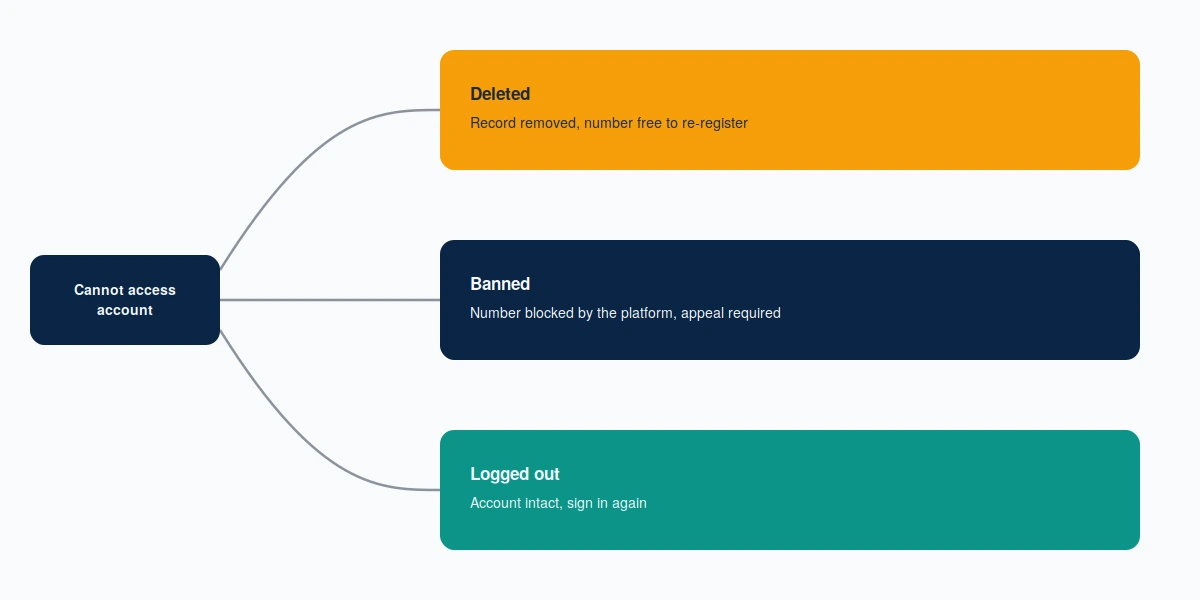
Four different situations send people searching for the same phrase, and they have four different answers. Deletion is the "Delete My Account" button inside Settings > Account. It is user-initiated, immediate, and final. A ban is WhatsApp blocking your number for a policy violation; the account still exists and you appeal it. Being logged out covers a new phone, a wiped device, or an uninstalled app, and it leaves the account completely intact. A takeover means someone else controls the number, and they may have deleted it on their way out.
Most people who search if whatsapp is deleted how to recover are in the third group. They uninstalled the app, saw their chats vanish from the phone, and assumed the account was gone. It usually is not. Reinstall, verify the SMS code, and everything comes back from the last backup. That single check saves more accounts than any technique in this article, so do it before you read further.
The other common misdiagnosis runs the opposite way. Some people delete deliberately to escape one persistent contact, which is a bad tool for that job: it costs you every conversation you have ever had and does nothing to the other person's account. Blocking, removing them from shared groups, or reporting them are all instant, reversible, and free. Our walkthrough on the three things "banning" means on WhatsApp covers which lever actually applies.
Deleting your own account also does nothing about what other people have already posted about you elsewhere. That is a separate discipline, and how to get a Reddit post removed shows what removal on a public platform actually involves.
Can you recover a deleted WhatsApp account at all?
No. Once the account has gone through the in-app deletion flow it is gone, and nobody can bring it back: not WhatsApp support, not us, not any tool sold to you. WhatsApp's own documentation is unusually blunt about this. Its help article on deleting your account states that the action erases your message history, removes you from all your groups, and deletes your Google Drive or iCloud backup, and it warns that the process cannot be undone (WhatsApp Help Center, 2026). There is no grace period, no 30-day holding pen, no hidden appeal queue. The moment deletion completes, the record is scheduled for removal and your chats stop existing anywhere you can reach them. That holds regardless of how recently you tapped the button, how many contacts you had, or whether you were paying for anything, because deletion is a data operation rather than a status flag someone can switch back.
This is what makes WhatsApp delete account recovery a different problem from every other platform in the category. Facebook, Instagram, X and TikTok all park a deleted account in a reversible state for weeks. WhatsApp does not. It treats deletion as a privacy guarantee rather than a convenience feature, which is defensible design and terrible news at two in the morning when you have just tapped the button.
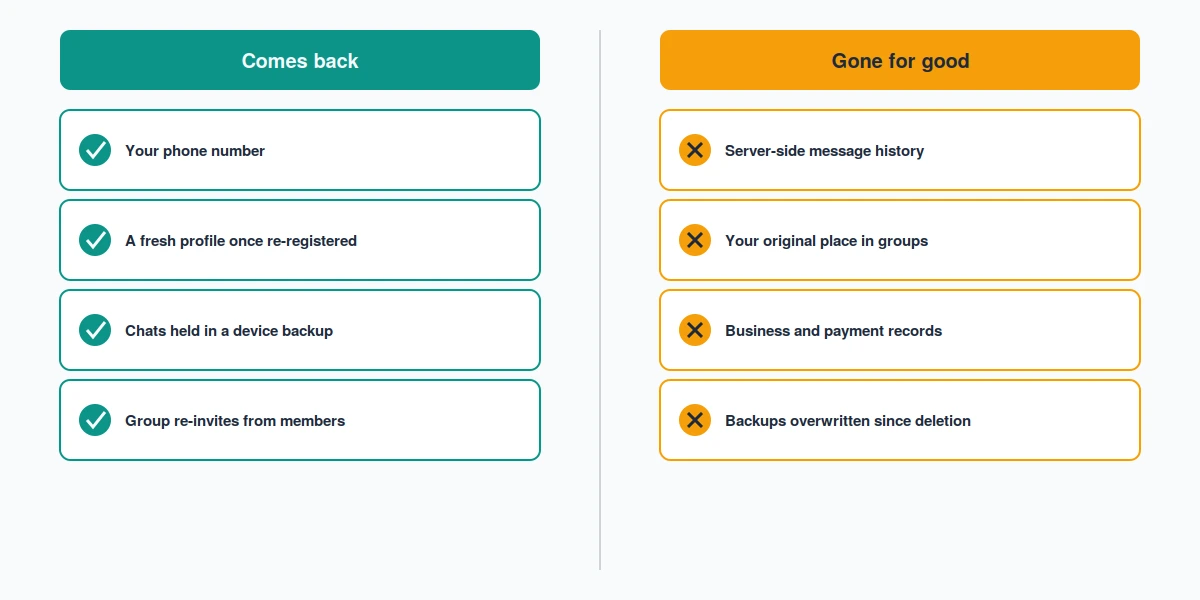
What you can do is re-register the same phone number, and that is worth doing. Be clear on what it produces, though: a new, empty account that happens to share your number. Your contacts will see you again, and nothing you said before will be there.
We put this in writing because the alternative is selling false hope, which is most of what ranks for this query. The scope of what a legitimate provider takes on is narrow and knowable. What our WhatsApp recovery desk takes on lists the case types and current price bands, and our published service limits name the cases we turn down. Nobody can recover deleted WhatsApp account content once that flow has finished, so reversing a completed deletion sits firmly on the second list.
What do the 30, 45, 90 and 120-day figures actually mean?
Search this topic and you will collect four different deadlines, each presented as the deadline. They are four separate policies, and only one of them touches deliberate deletion at all. Untangling them is the difference between waiting hopefully for a window that does not exist and acting on the one that does.
30 days belongs to deactivation rather than deletion. On WhatsApp, deactivation mostly describes what happens when your number stops working or you stop using the app, not a button you press to shelve the account safely (WhatsApp Help Center, 2026). 45 days is a number-recycling detection threshold that surfaced in India-specific guidance, and it is not a global recovery window. 90 days is roughly how long Meta's backend takes to finish clearing deleted data from its servers. That one traps people badly, because residual data on a server you cannot query is not a recovery option, and copies may persist in system backups past it. 120 days is the inactivity rule: WhatsApp's inactive account policy removes accounts that go unused for that long (WhatsApp Help Center, 2026), which is a cause of account loss rather than a cure.
None of those four numbers gives you a route back in after deletion. Across 138 WhatsApp access cases our team handled between January 2025 and July 2026 (our internal records as of August 2026), not one confirmed self-deletion was ever reversed, on any timeline. The clients who did get back in had been banned, hijacked, or simply logged out. That distribution is the single most useful thing we can tell you: the label people put on their own case is wrong more often than it is right, and the correct label decides everything.
Compare this with how the rest of the industry works. TikTok holds a deleted account for 30 days and cancels the deletion the moment you log in, as our breakdown of TikTok's deletion window and the six things that block it shows. Instagram is more forgiving still, sorting "I lost my account" into several distinct recoverable states, each with its own route back; how to get back an Instagram account walks through them. So if you are wondering how to recover whatsapp account after deleting because a friend restored their Instagram a week later, that is why their story does not transfer to you.
How to recover deleted WhatsApp account access with the same number
You cannot restore the old account, but you can get the number working again, and there is a right order to do it in:
- Confirm the SIM is active and can receive SMS. If your carrier cancelled the number, sort that out first, because nothing below works without it.
- Install WhatsApp and enter the number in full international format, including the country code.
- Request the six-digit verification code by SMS. When it does not arrive within a few minutes, use the voice-call option rather than requesting again, which triggers a cooldown.
- At the backup prompt, check the date shown. A backup made before the deletion may still restore chats, and the next section covers the conditions that decide it.
- Set your display name and photo again. Re-add contacts, then ask group admins to re-invite you, because group membership does not return by itself.
Two-step verification adds a wrinkle. Where the old account had a PIN you no longer remember, WhatsApp holds the number for seven days before letting you register without it. That wait is normal and not a sign of a problem.
After delete WhatsApp account recovery: what actually comes back
Honestly: the number, and nothing else automatic. Your profile is blank, your chat list is empty, your groups do not know you, and your Business catalogue, payment records and away-message settings are gone. Where the number was a WhatsApp Business account, expect extra friction, since it sits inside Meta's Business Manager and follows a separate appeal channel that our guide to Meta Business enforcement appeals covers.
The underlying lesson generalises. WhatsApp identifies you by phone number alone, with no username and no email fallback, so severing the number severs everything at once. Platforms that keep several identifiers give you more ways back, which is why Twitter account recovery without a username is even a solvable problem. On WhatsApp there is no second identifier to fall back on.
Will a Google Drive or iCloud backup restore your chats?
Sometimes, and the conditions are narrow enough that most people find out the hard way. The deletion flow removes your cloud backup along with the account, so in the ordinary case there is nothing left to restore from. When a backup does survive, it is usually because it lived somewhere the deletion could not reach: a local file on an Android device, or a cloud backup already detached from the account.
For a restore to work, every one of these has to be true at once. The backup must be tied to the same phone number. It must be on the same platform, since an iCloud backup will not restore to Android and Google Drive will not restore to an iPhone. On Android it must be the same Google account, and the local msgstore.db.crypt14 file must not have been overwritten by a newer empty backup, which happens automatically once the reinstalled app runs its first nightly job. Miss any one condition and WhatsApp will not offer you the restore prompt at all. This is precisely the gap the data-recovery software industry sells into, without ever stating the preconditions plainly.
So here is the practical instruction. To restore deleted WhatsApp account chats from a surviving backup, turn off automatic backup before you finish setup, and do not let the fresh install write over the old file. Once it does, the window closes for good.
It is also worth being sure you are solving the right problem. A forgotten password locks you out of a live account and is fully resolvable, which is the same distinction we draw in TikTok account password recovery paths and in recovering a Twitter account after forgetting the username. A lockout is not a deletion. Deletion removes the record; a lockout just misplaces the key.
Not sure whether your account was deleted, banned, or hijacked? That one distinction decides whether recovery is even possible, and it is easy to get wrong when you are panicking. Have your case reviewed by our recovery team before you pay anyone anything.
What if someone else deleted your account?
This is the case that changes everything, and the one we can genuinely help with. When an attacker gets hold of your verification code, registers your number on their device, and then deletes the account, you are not looking at a regretted decision. You are looking at an active security incident, and it runs on a different track.
Act on the number first. Contact your carrier and confirm nobody has ported it or swapped the SIM, because a SIM-swap is how most of these start. Then re-register the number on your own device immediately, since possession of the SIM is the strongest claim you have and registering forces the attacker's session off. Change the password on the email account tied to your phone, and turn on two-step verification the moment you are back in. Speed genuinely matters here. In the takeover cases we handle, the first 24 hours decide most outcomes, and clean access cases typically resolve in 24 to 72 hours (our internal records as of August 2026).
Do not let the attacker's deletion convince you the case is closed. The account content is still gone, but the number, your identity and any linked business assets are recoverable, and the incident itself needs reporting so it cannot be repeated against you. Our first-24-hours hijack playbook sets out the exact sequence, and where the account was lost some other way, such as a stolen phone, a dead SIM, or a code that never arrives, the broader WhatsApp access recovery guide covers those routes, while recovery when the SIM itself is gone handles the lost-number case on its own terms.
One question comes up constantly here: can desktop help? On some platforms it partly can, as hacked TikTok account recovery on PC shows. On WhatsApp it cannot. Linked Devices are exactly that, linked. When the account dies, every companion session dies with it.
Why WhatsApp is stricter than every other platform
WhatsApp is the outlier in this whole category, and understanding why stops you chasing a route that does not exist. Its messages are end-to-end encrypted, and the company positions the delete flow as a hard privacy guarantee: when you ask for your data to be gone, it goes, without a reversible copy sitting in a support queue. No platform can promise both irreversible deletion and easy restoration. WhatsApp chose the first.
That choice explains the asymmetry people find so confusing. On X, "permanent" reads as a starting position rather than a verdict, because suspensions get overturned on appeal often enough that the process is worth working, as our appeal-odds assessment for X suspensions sets out. On WhatsApp, permanent means the data is gone, and no amount of escalation changes that.
There is one important exception to the gloom. A ban is not a deletion. Where WhatsApp blocked your number for suspected policy violations, the account still exists behind the block and the in-app appeal route is real. We have seen those overturned, particularly where the trigger was bulk messaging or an unofficial client rather than anything abusive. The tell is the message on your screen: a banned number shows "This account is not allowed to use WhatsApp", while a deleted one simply registers as new. Our WhatsApp ban appeal guide covers that path in full, and it is a genuinely more hopeful conversation.
Can a paid service restore a deleted WhatsApp account?
No, and anyone who says otherwise is either mistaken or lying to you. Vendors advertising that they can recover deleted WhatsApp account history are selling a capability that does not exist, and this search term sits in one of the most scam-saturated corners of the internet. Here is what that ecosystem actually looks like. There are APKs and "chat recovery" apps claiming to pull deleted messages back; most either capture notifications going forward, which does nothing retroactively, or ship spyware. There are data-recovery suites, legitimate software applied to an illegitimate promise, because they read local database files and cannot conjure a file the deletion already erased. And there are paid "specialists" who charge a fee for an escalation channel that does not exist. All three share one tell: they describe the outcome in vivid detail and the mechanism not at all.
Three rules keep you safe, and they cost nothing. No legitimate service ever asks for your verification code, two-step PIN, or password, so anyone requesting them is stealing your number rather than recovering it. No legitimate service guarantees a deleted account back, because no such capability exists. And any provider worth hiring will tell you when your case is unwinnable, in writing, before invoicing.
We apply the same test to our own industry. Published limits are what separate a real provider from a pitch: whether a TikTok recovery service is worth hiring and what a Telegram account recovery service can and cannot do both show what honest scoping reads like, with named case types, real price bands, and explicit refusals.

What our recovery team actually takes on
We take hijacks, bans, business-account enforcement, and lockouts where the number is still yours. Those are winnable through verification and appeals, and clean access cases usually close inside 24 to 72 hours. We also help after an unrecoverable loss, which is real work even though it is not restoration: securing the number against a repeat takeover, rebuilding a business presence, and cleaning up stale search results still pointing at an account you no longer control. Our full list of case types we handle sets out where we are useful.
What we will not do is take money to reverse a completed deletion. We will not ask for your password, your verification code or your two-step PIN, and we will not quote a timeline faster than WhatsApp's own process allows. When a case is unwinnable we say so in the first conversation, and there is no charge for that answer. You can meet the specialists behind this advice before deciding whether to talk to us.
One last note for anyone weighing the same question on another messenger. Telegram is the closest parallel, also phone-number-first and also short on recovery forms, and our Telegram recovery walkthrough covers where the two platforms diverge.