
What X means by inauthentic behavior, and why no policy carries that name
The phrase in your suspension notice is not the name of a rule. X enforces a policy called Authenticity, whose current version is dated April 2025, and inauthentic behavior is one of three branches inside it, which is why a search for that exact phrase lands on a policy with a different name. Fixing that mismatch comes first, because an appeal arguing against the wrong rule reads to a reviewer as an appeal about nothing.
Your Reputation Solution is an account-recovery and reputation firm whose team maps a suspension notice back to the clause that produced it before anyone writes a word of an appeal. On X that mapping is unusually mechanical, because the policy is a list.
X's Authenticity policy splits into Inauthentic Accounts, Inauthentic Behaviors and Inauthentic Content, and each branch names its own sub-rules. Under accounts: unauthorized automation, fake personas, impersonation, multiple accounts and coordination, ban evasion, and account compromise. Under behaviors: content spam, engagement spam, and scams. Under content: synthetic and manipulated media, and malicious URLs. Eleven clauses. Your suspension came from one of them, and the branch decides nearly everything downstream — which evidence helps, which tone works, and whether a route exists at all. That three-way split also explains a search pattern. Users report notices naming the accounts branch as well as the behaviors branch, which is why people arrive looking for x account suspended for inauthentic account wording and find guidance written for a different clause. Accounts, behaviors and content are separate findings against you. Read which one your notice names before you read anything else.
Why the notice is vague when the rulebook is not
X's automated notices describe a behaviour pattern instead of citing a clause. Through 2026, users have reported wording about aggressive or random reposting and liking, or indiscriminate following: descriptions of activity, not references to policy. Nothing in that text tells you whether the system placed you under engagement spam or under unauthorized automation, and those two lead to different appeals.
Screenshot the notice before you do anything else.
Your Reputation Solution asks for that screenshot first on every X case, because the exact wording is the one piece of text the whole appeal has to answer, and a paraphrase from memory loses the detail that identifies the branch.
Guides disagree about how to appeal suspended X account notices partly because they were written against different versions of this policy. The older vocabulary survives inside the rulebook. The X Rules still list Platform Manipulation and Spam as a line item sitting beneath an Authenticity heading, which is why some guidance online uses the older language and some uses the current wording. Both describe one enforcement system. If your notice says inauthentic behavior and the article in front of you says platform manipulation, they are the same thing.
The branch you were hit under changes the appeal
Compromise deserves the first check, because it is the branch where the facts are most likely on your side. If an attacker held the account and ran automation from it, the behaviour X saw was real and the intent was not yours, and that distinction is appealable in a way "I did nothing" never is. Identical logic runs across platforms. On Instagram, an attacker who takes an account uses it to send the same scam to its followers, which is how one compromised account becomes fifty, and there too the work is documenting the takeover rather than denying the activity.
Where the branch is genuinely automation or engagement spam, the honest appeal names the behaviour, explains how it happened, and commits to stopping. Your Reputation Solution builds appeals that way because a reviewer can check a claim against the account's activity and has no way to check sincerity.
Why is my X account suspended for no reason?
Almost nobody is suspended for no reason. A great many people are suspended for a reason nobody told them about, and three mechanisms produce that experience, all three unusually active through 2026. Whether you phrase it why was my X account suspended or why is my account suspended on X, the answer starts in the same three places.
A detection change comes first. On 14 February 2026, X product lead Nikita Bier announced expanded automation and spam detection and warned that accounts not being operated by a human tapping the screen would likely be suspended, along with associated accounts. That was an explicit heads-up that browser-automation tools, unofficial schedulers and bots running outside the official API were about to become suspension triggers. Anyone still running such a tool through February and March walked straight into it. The account felt normal to its owner because the owner was not the one behaving suspiciously; the tool was.
Second is a bug. Around 12 March 2026 a wave of suspensions citing inauthentic behaviors hit accounts whose owners insisted they had only liked, reposted and scrolled. Two days later Bier confirmed that a new spam filter had misclassified a subset of accounts for roughly twelve hours before the error was corrected, and said 99% of accounts caught by it had been reinstated. Anyone searching x account suspended reddit or x account suspended for inauthentic behavior reddit is mostly reading threads from that one week, which is worth knowing before treating them as a guide to a case that started in a different month.
Third, and quieter by far, is an older mechanism. X issues anti-spam challenges (verify a phone number, confirm an email, complete a CAPTCHA) to test whether a real person controls a flagged account, and its own platform manipulation report states that accounts failing a challenge within a set period may be suspended. A challenge sent to an address you stopped reading in 2021 can surface later as a suspension with no visible cause. That is the cleanest version of x suspended my account for no reason, and among the most recoverable, because completing the challenge is sometimes the entire fix. None of the three announces itself. Each leaves the owner with an account that worked on Monday and did not on Tuesday, which is why the honest first move is reconstructing the fortnight rather than composing a protest.
X account randomly suspended: five triggers that feel like nothing
Bulk following or unfollowing in one session. Repeated near-identical replies, even friendly ones. A burst of likes after a long dormant stretch. Signing in from a new country on a VPN the same week you changed devices. Authorising a third-party app that turned out to post on your behalf.
None of these feel like manipulation from the inside. From the outside, every one of them looks like either a script or a stranger at the controls, and the system reads behaviour rather than intention.
Your Reputation Solution starts every X case with that list, because the trigger the owner dismisses is usually the one the classifier acted on. Dormancy followed by sudden activity is the easiest one to underestimate. An account quiet for two years that then likes four hundred posts in an evening produces the same signal a takeover produces, and from activity alone a classifier has little to separate a returning user from a purchased account being warmed up. Ask yourself which of the five happened in the fortnight before the suspension, because that answer is the appeal.
Was it mass reporting?
Rarely, on its own. Reports move content into a queue; they do not decide the outcome, and the gap between those two volumes is visible in published platform data. In the first half of 2025, Snap's 19.7 million reports produced enforcement against 4.1 million accounts, roughly one action per five reports. X's report queue works on the same principle, which is why reports rarely equal enforcement and why "someone brigaded me" is seldom the whole story. A coordinated campaign raises the odds your account gets looked at. What suspends it is what the reviewer or the classifier finds once it looks.
Most enforcement never starts with a report in the first place. LinkedIn says 99.7% of the fake accounts it stopped between July and December 2025 were caught proactively, before any member flagged them, so a member's report joins a small manual queue rather than driving the system. X's anti-spam system works from the same end, with automated detection and challenges running at scale, which means the classifier that suspended you is the same one built to catch genuine bot farms.
When the account was compromised before it was suspended
An attacker who takes an account rarely sits still. They post scam links, message your followers and follow in bulk, and X suspends the account for precisely that. That suspension is then correct on its face and wrong in substance, and the appeal has to carry that argument with evidence rather than insistence. Many takeovers of this kind begin with a stolen login code, worth understanding in detail because the same login-code play turns up on messaging apps too. Speed matters after any takeover. On WhatsApp, re-registering the number in the first hour logs the attacker out before they can lock it with their own PIN, and on X the longer an attacker holds the account, the more activity your appeal has to explain.
Not sure which branch your notice points at? Send Your Reputation Solution the exact notice text, the date, and what the account was doing that week. The team will say which clause it maps to and whether an appeal route exists — including when the honest answer is that it does not. Start a free case review. No password, no login code, ever.
How to unsuspend X account access: the 2026 appeal route
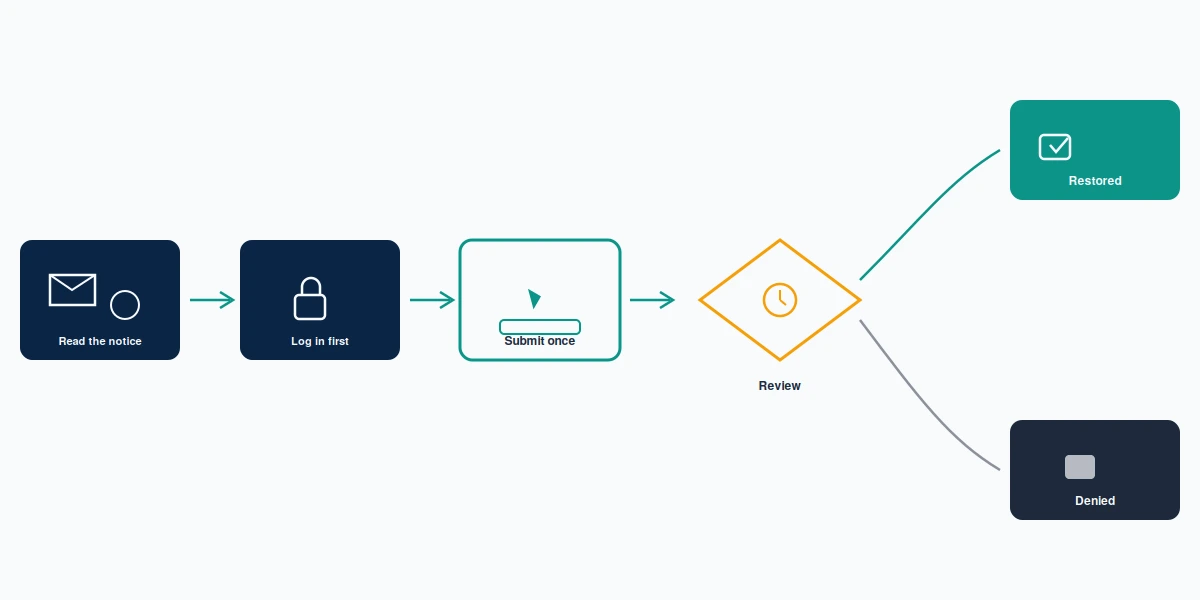
Search phrasing varies far more than the process does. How to appeal a suspended X account, x appeal suspended account and twitter suspended appeal all describe one form and one submission. One route exists, it is a web form, and the order of operations matters more than the wording. X's guidance on suspended accounts sets the sequence: log in to the suspended account first, then open a new browser tab and file the appeal. Filing while logged out, or from a second account, skips the step X's own instructions put first, and an appeal that cannot be matched to the suspended account has nothing to attach to.
Submit once.
X documents no way for a second submission on the same suspension to move it forward, and identical resubmissions resemble the duplicative pattern the spam clauses describe, which is why Your Reputation Solution treats the first filing as the only one that counts and spends its time on the draft rather than the follow-up.
Try the self-service path before that, because a share of suspensions clear without an appeal at all. Log in and read what the screen asks for. If it wants a phone number or an email confirmation, that is the anti-spam challenge, and completing it is the whole remedy. X states plainly that real people's accounts are sometimes suspended by mistake and that it works with those account holders to reverse it, which is a modest comfort but a documented one.
Where the X suspended account appeal form actually works
Use a desktop browser.
The form sits at help.x.com/en/forms/account-access/appeals, titled Appeal a locked or suspended account. It loads on a phone, but the two-tab sequence above means signing in to the suspended account in a mobile browser rather than the app, and a laptop removes that friction. Some platforms go further and keep their weightiest account controls off mobile entirely: Google does not render YouTube channel deletion on phones, so that setting lives only in desktop Studio.
That single form covers every branch, so there is no separate queue to appeal suspended X account decisions made under automation rather than spam.
Enter the handle, email and phone exactly as they appear on the account. A mismatch makes the filing look like a third party acting on somebody else's behalf, which is the last impression an appeal needs.
Description of Problem: Twitter suspended you, now explain it
The free-text box is labelled Description of Problem, and it is the only part of the form you control. Everything else is identifiers. Whatever goes in that box is the appeal.
Four things belong there, in this order: what the account is and what it is for, what the notice said, what actually happened during the period the notice covers, and what changes now. Three to five sentences is enough. Reviewers can see what the account actually did, so a sentence contradicting that record undermines the submission, while a sentence explaining it is the only kind that moves anything. Leave out what feels most natural to include. No accusations of bias, no threat to leave for another platform, no reference to how many years you have been a user, no capitals. None of it is read as context. It is read as noise, and the queue is built to discard noise. Write it in the language you would use explaining the situation to a colleague, then delete every sentence that argues instead of describing.
The X account suspended appeal text: a skeleton, not a script
Copy-paste appeal scripts circulate widely, and using one verbatim is a poor trade. Identical text submitted at volume is exactly the pattern an anti-spam system exists to detect, and an appeal describing activity you never engaged in is worse than a short honest one. Your Reputation Solution does not supply paste-ready appeal text, and a page that handed out one canonical paragraph to everyone searching for it would be getting its own readers rejected.
Only the shape transfers. Five slots, filled with your facts and rewritten in your own words:
- What the account is — its purpose, roughly how long you have had it, what you post.
- What the notice said — the date and the exact wording, including the branch it named.
- What was actually happening — the scheduler, the follow session, the app you authorised, the login you did not make.
- What has changed — access revoked, tool removed, password reset, behaviour stopped.
- The ask — review and restore, stated once, without conditions.
Filled in, that reads something like: This is a personal account I have used since 2019 to post about amateur astronomy. On 18 August 2026 it was suspended with a notice citing inauthentic behavior. In the week before, I connected a third-party scheduling app to queue posts while travelling, and I believe its activity was read as automation. I have revoked that app's access and will post manually from now on. I am asking for the account to be reviewed and restored.
Specific, dated, unflattering where it needs to be, and it names a change. Set that against a template asserting innocence in general terms and the difference is not tone — one contains checkable facts and the other does not.
What evidence helps, and what X ignores
One test decides what to attach, and Your Reputation Solution applies it to every file: does it bear on the claim? Screenshots contradicting the alleged behaviour, proof of ownership, a receipt for a Premium subscription and the revocation confirmation from a third-party app all pass. Character references, follower counts and engagement statistics do nothing at all. X runs its complaint queues on claim-specific proof rather than general credibility, the same principle behind its trademark route, where X demands a registration number rather than a description of the brand. Marketplaces apply it at the menu level, where each of TikTok Shop's three report menus feeds its own queue with its own rules. The appeal form is a single queue, but the lesson carries: evidence answering a different branch from the one on your notice does nothing for the branch that is.
One structural point most guides miss. Enforcement attaches to specific things rather than to people in general: Meta, for instance, judges each reported post, comment or profile on its own, and only a documented pattern reaches the account. An X suspension names behaviour the same way, so answer the behaviour cited. Do not defend your character.
How long is my X account suspended, and what happens meanwhile?
X publishes no service-level target for appeals, so anyone quoting a fixed number is guessing at it. What the 2026 record supports is a range rather than a promise. Automated reversals of a system error can land within days, as the March bug did. A first-offence appeal on an otherwise clean account is typically days to a few weeks. Appeals on accounts carrying prior enforcement often return nothing. Your Reputation Solution quotes 24 to 72 hours only for clean cases where the account is intact and the evidence is already assembled, and says which case yours is before any work starts rather than after.
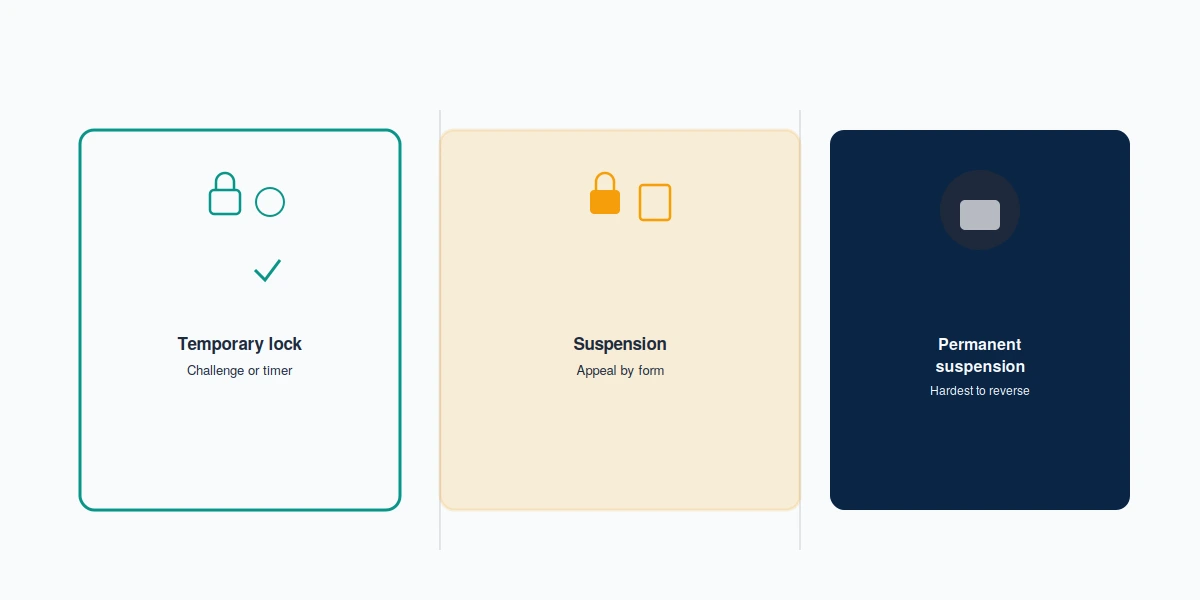
Your state is not obvious from the profile. A read-only restriction, a lock pending an anti-spam challenge, a suspension under review and a permanent suspension all present differently to you and to visitors, and X's enforcement options document separates them explicitly. An account locked pending a challenge is pulled out of follower counts, reposts and likes, so the accounts you follow and the posts you liked stop counting you while the lock stands. Identifying the tier before appealing is ordinary practice; the same triage picks the route on Meta products, where the enforcement tier decides the channel rather than the other way round.
The profile itself gives visitors almost nothing.
It reads Account suspended; X sometimes adds a line beneath about violations of the rules, and sometimes does not. A suspended account X has flagged for review looks identical to one it has permanently removed, so nobody looking at your handle can tell a pending suspension from a permanent one. That cuts both ways: the detail in your notice stays private even though the label does not.
X account restored but still suspended
Two causes sit behind this, and telling them apart is the first thing Your Reputation Solution checks before treating a restoration as failed. The first is genuine propagation lag: during the March 2026 wave, users reported account-restored emails arriving while access stayed blocked, which is consistent with a reversal recorded upstream that had not yet reached the session. Log out fully, clear the app cache or reinstall, then try a desktop browser in a private window before concluding anything. Give it forty-eight hours.
The second is partial restoration. Access returns, but a post-level enforcement survives, whether an unmet removal requirement or a visibility restriction that outlived the account-level reversal. X treats post-level and account-level enforcement as separate systems, so clearing one does not clear the other, and the outstanding action carries its own separate appeal.
Twitter account suspended permanently: is it final?
Permanent is a label rather than a physical state, and X's appeal route stays open on accounts marked that way. Whether it moves depends entirely on the branch. Some suspensions do not reverse regardless of how well the appeal is written, and knowing that before you file saves a cycle. Child sexual exploitation, terrorism and violent extremism, sustained targeted harassment, confirmed fraud or scam operations, confirmed ban evasion, and participation in a coordinated manipulation network are the categories where the answer is no, and no service can honestly tell you otherwise. Suspensions under the automation and spam clauses sit at the other end, because those are the ones classifiers get wrong most often, and because the behaviour they describe is the kind an owner can credibly show has stopped. Verifiable change is what separates an appeal that can reverse a permanent suspension from one that only restates innocence.
Branch, then history, then evidence: Your Reputation Solution weighs a permanent suspension in that order, and the second of the three is the one an appeal cannot change, which is why it gets an honest look first. An account with no prior enforcement carrying one automated finding is a different proposition from an account that has already been through read-only mode twice, even when the notice text on both is identical.
Platforms also disagree about what permanent means. Telegram treats a self-initiated termination as irreversible by construction — deletion there is a design decision, not a review outcome — whereas an X account permanently suspended is the output of a judgement, and judgements have appeals. Where yours is a long-standing permanent suspension rather than a fresh one, the narrower route is set out in our guide to recovering a permanently suspended account on X.
What you can and cannot do while suspended
You cannot quietly walk away.
Deactivating a suspended X account requires filing an appeal first, per X's own instructions, so the exit is gated behind the process you were trying to skip. That catches out people who have already decided the account is not worth fighting for, and it is the same lock-out logic that applies elsewhere: enforcement freezes self-service on most major platforms, because an account you cannot log into is one you cannot close from its own settings.
Money is handled separately, and the split is specific. X states that a suspension under child safety or violent and hateful entities policies costs you X Money access, with remaining funds mailed as a cheque, while suspensions under any other policy leave Money features working normally. Data access survives too — a suspended account can still request a copy of its personal information.
One contrast is worth holding onto. Deletion routes usually build in a reversal window, and Instagram's thirty-day grace period before an account is gone is the standard shape of it. Suspension has no equivalent. No countdown is running in your favour, which is the argument for appealing early instead of waiting to see whether it lifts by itself.
Can you make a new X account after being suspended?
Not on the same footing. Ban evasion is a named clause inside the Authenticity policy, since circumventing an enforcement action is itself a violation, and X can connect new accounts to old ones through signals such as device, IP address, phone number and email. A replacement account usually gets suspended in turn, and a ban-evasion finding is exactly the kind of history that weighs against any later appeal on the original. Mid-appeal is the worst possible moment to try it.
Your Reputation Solution does not help set up replacement accounts, because that is ban evasion by another name, and it weakens the case on the original.
A narrow legitimate case does exist. If the original was permanently suspended years ago under a policy you now understand, and you are genuinely starting fresh rather than rebuilding the same presence under a new handle, that differs from spinning up a second account this week to keep posting through a review. Where the original account was hacked rather than misused, the route is recovery instead of replacement, and the hacked and locked branches run separately from a policy suspension.
What Your Reputation Solution will and will not do about an X suspension
Nobody can guarantee reinstatement, and a guarantee is the clearest available signal that you are being sold something which does not exist. X's reviewers hold the decision. Your Reputation Solution prepares and escalates the case; the platform decides, and any firm describing that second half as within its control is describing leverage it does not have. That test applies to every unban and removal offer in this market — a service that promises the outcome rather than the work is selling a decision that belongs to somebody else.
We never ask for your X password, your login code, or your two-factor backup. No legitimate reason exists for a recovery firm to hold any of them, and a request for one is the point where the conversation should end. We do not file appeals asserting facts you have not confirmed, we do not resubmit the same appeal to force a different answer, and we say when a case is unwinnable rather than billing for the attempt. The full boundaries sit in our disclaimer, and reading it before hiring anyone in this category is time well spent.
Our team does something narrower and duller than the advertising in this niche: it identifies the clause, assembles the checkable evidence, writes the submission in the register reviewers act on, tracks the response, and says plainly when the route has closed. Every redress process online is a request for review rather than an instruction, as true of removing a business listing from Google Maps as of an X appeal, and the work lies in making that request as easy as possible to say yes to. Most of that work happens before anything is submitted: reading the notice against the eleven clauses, establishing which of them the account activity could plausibly have tripped, and deciding whether the honest version of the story helps or hurts. Where it hurts, we say so and the case stops there rather than continuing on your money.
One practitioner note, offered as observation rather than data. Across the cases our team handled through spring 2026, the appeals that moved fastest conceded something specific and verifiable (a scheduler, a bulk-follow session, an app authorisation), and the ones that stalled asserted general innocence. X publishes no rule to that effect and we cannot prove it holds at scale. It matches how a queue built to check claims against logs would be expected to behave.
Where an X suspension turns out to be a symptom of something larger, whether an impersonator still posting, a compromise that reached your other accounts, or material about you circulating well beyond the platform, the suspension is the wrong problem to solve first. Tell Your Reputation Solution what happened and the team will say which problem you actually have, free of charge, including when the answer is that you do not need us.