
A name is not a URL, and that is the whole problem
Google indexes pages. It does not index people. That gap is why no button anywhere in Google's products says "remove my name", and why most guides on this topic quietly describe a tool nobody has built.
What does exist is narrower, and more useful once you see it. Google will drop a specific URL from its results, and it will do that when the page carries one of the personal-data categories it has agreed to act on. Your Reputation Solution is a reputation and account-recovery firm that files these requests for people whose own attempts have stalled, and the sentence we repeat most often is that a request has to name a page. A name by itself is not a request. It is a search.
Two outcomes get confused constantly, and the difference governs everything below.
Delisting hides a result. That page stays online, keeps its address, and stays reachable through any link, any rival search engine, and anyone who already saved the URL.
Deletion removes the page itself. Only whoever runs the site can do it.
Search vocabulary tracks the confusion precisely. Typing how to delete my name from google search assumes an erasure the tool never performs. Typing how to remove my name from google search results, or how to remove your name from google search results, describes what it genuinely does. Only one of those two families of phrasing can be satisfied, and it is the second.
Why does the distinction bite? Because a delisted page still surfaces in Bing, still sits in the Internet Archive, and still opens for anyone your former colleague forwards it to.
People ask, can i remove my name from google searches, as though a single request existed. None does, in any jurisdiction, for any person. What you can do instead is work a list of URLs, one at a time, through whichever of four routes fits each one.
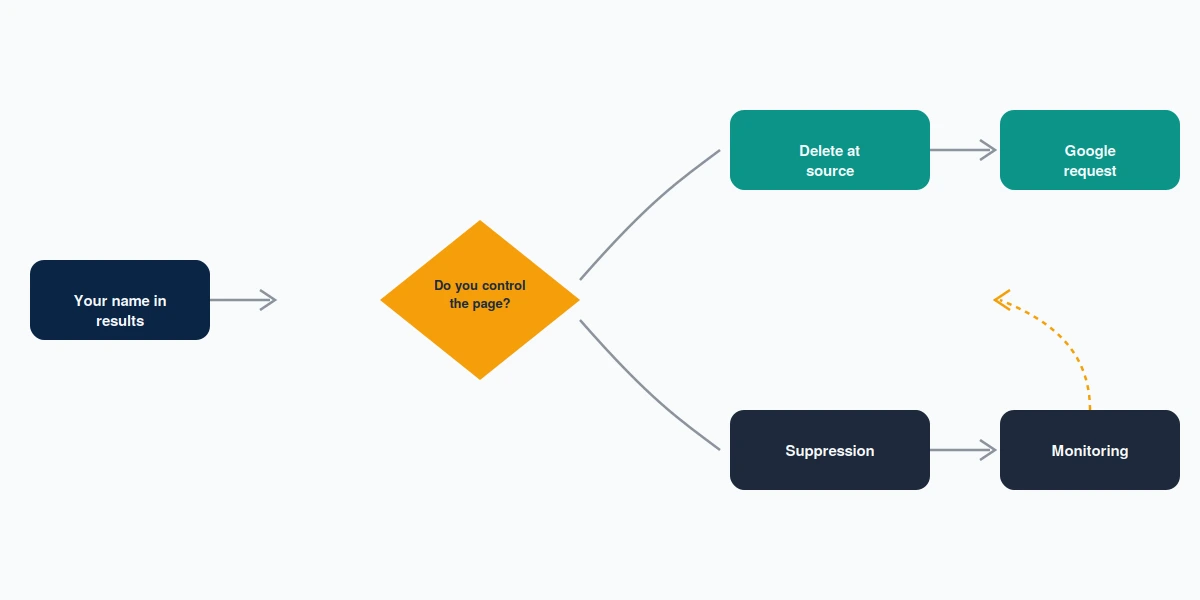
Which of the four routes applies to you?
Begin by searching your own name in a private window and writing down every URL you want gone. Then sort that list. Each URL takes exactly one of four routes, and choosing the wrong one is the commonest reason people spend a month achieving nothing.
In practice, Your Reputation Solution sorts every incoming case with a single question first: do you control the page, or does somebody else? Control changes the route, the cost and the timeline far more than the content ever does.
| Route | What it reaches | What it costs | Engines covered |
|---|---|---|---|
| Delete at the source | Anything, if the owner agrees or the account is yours | Free, plus your time | All of them, permanently |
| Ask the engine to delist | Only qualifying data categories | Free | Google alone; Bing and Yahoo take a separate filing |
| Outrank it (suppression) | Nothing; it pushes results down instead | Paid, 90–180 days | Wherever the new pages rank |
| Monitor for reappearance | Fresh copies as they surface | Free, through Google's own alerts | Google only |
One further path opens if you live in the EU or the UK. Article 17 of the GDPR gives you a delisting right that Google handles through a separate legal request form, which needs the exact URLs, the search term, and a stated legal ground. The 2019 CJEU ruling settled its reach: delisting applies to Google's European versions rather than worldwide, so a French request does not clear google.com for a reader in Ohio.
Sequence matters as much as route. Deleting at the source first, then asking Google to catch up, works. Asking Google first and hoping the page follows does not, and that inversion is what stalls most of the cases reaching us after a failed attempt. Before filing anything, Your Reputation Solution reorders the list, since a request sent in the wrong order is not merely slower but usually refused outright, and a refusal on file makes the resubmission harder to argue. Anyone typing how can i remove my name from google search, hoping to skip a stranger's goodwill, should start with the pages they own, because those need nobody's permission. Where the page is one you own or once owned, our walkthrough of the two Google removal tools and their limits covers URL-level mechanics this page deliberately skips.
People phrase it as how do i get my name off google search, which sounds like one action. Closer to a filing cabinet, really: four drawers, and every URL belongs in exactly one.
How to remove your name from Google search for free
Google's own tool does this at no cost, and it covers more than most people expect while reaching far less than the phrase implies. Google's personal-information removal policy names the categories it acts on: contact details such as your phone number, home address and email; government ID numbers; bank and credit card numbers; images of a handwritten signature or an ID document; medical records; login credentials; doxxing, meaning personal information published alongside a threat or aggregated in volume with no legitimate purpose; and non-consensual explicit imagery.
That list grew on 10 February 2026, when Google extended its Results about you tool to cover government ID numbers, including Social Security, driver's licence and passport, and added batch submission plus proactive filtering for explicit imagery that reappears after removal. If that imagery was obtained through coercion in the first place, reporting sextortion and blackmail on Instagram covers the platform side, and it runs in parallel with the Google filing rather than after it. Living at myactivity.google.com/results-about-you, the tool monitors as well as removes: register the details you want watched and it flags new results carrying them. On name cases Your Reputation Solution treats this as the first filing rather than the fallback, because the categories it covers are the ones Google has already agreed to act on.
So the free route has a real answer, and this tool is it. Nothing is charged, each URL takes a few minutes, and Google's own wording sets the ceiling plainly — removing information from Google Search does not remove it from the web. Readers searching how to remove my name from google search for free are usually looking for exactly this, and they already have it.
Three limits catch people out.
First, newsworthiness. Google refuses removal where it judges material publicly valuable: government records, education, journalism, business sites. A court filing carrying your name is not leaving the index because you asked.
Second, a policy almost nobody names. Sites that publish your details and then charge you to take them down fall under Google's exploitative removal practices policy, a distinct pathway with its own test — you must be the subject, the site must charge for removal, and it cannot be a business-review site. Where you have been quoted a fee to delete your own address from a people-search page, that is the form you want, and paying the fee is the thing not to do. Your Reputation Solution files under this policy more often than under any other, because the sites that trigger it are built to be found.
Third, a tool that is not a removal tool at all. Refresh outdated content only re-syncs Google's index after a page has already changed or gone. Nothing still live can be touched by it. Several of the highest-ranking guides on this subject conflate the two, and readers following them file a request that was never capable of doing what they wanted.

How do you delete the profiles that rank for your name?
Run the search and look at what actually ranks. For most people it is not a news story or a leak. Usually it is their own abandoned accounts: a profile from three employers ago, a handle chosen at nineteen, a page nobody has opened since. These rank because platforms carry domain authority a personal blog never will, and they are the easiest wins on the list, since nobody's permission is required.
Every name case at Your Reputation Solution starts here for that reason. Clearing what you already control shrinks the list before anyone spends money on the parts you do not.
Old accounts you can still open
Deleting is not deactivating, and platforms differ more than you would guess. X keeps a deactivated account recoverable for 30 days before erasure begins, which is also why it cannot be deleted while logged out; our guide to deleting a Twitter account you cannot access covers the recover-then-delete order and the erasure request that applies when the registered email is dead. TikTok runs a comparable 30-day window, and logging back in during it cancels the deletion outright. Read the six blockers that stall a TikTok deletion before you start rather than after.
One caution belongs here more than anywhere. Deletion looks forward. Blocking future crawls is the whole of what it achieves, and it does not retract what has already been indexed, cached or screenshotted, which is the same reason deleting a WhatsApp account returns an empty account if you re-register rather than restoring anything. Delete first, then ask the engine to catch up.
Accounts you are locked out of
An account you cannot open cannot be deleted, and this is where a straightforward afternoon becomes a fortnight. Access has to come back before anything can go away.
Facebook's identity route works without the original email address, through three separate proof paths depending on what you still hold; recovering Facebook without the original email walks each one. Telegram freezes rather than deletes, so the account is read-only rather than gone, and three appeal paths, one of them a dead end sets out which submissions get read. For TikTok, session control and ticket filing both work from desktop while selfie verification stays app-only, a split covered in regaining a hacked TikTok account from a PC.
Visitors arrive asking how do i remove my name from google search results, expecting a Google problem, and discover a login problem. Others phrase it how to remove my name from google searches, plural, having already grasped that no single lever exists. Both are the ordinary shape of these cases.
Not sure which of your results are actually actionable? Send us the list of URLs you want gone, with nothing personal in the message beyond the links themselves. Your Reputation Solution will tell you which ones qualify under Google's policy, which need the source site, and which are honestly not worth pursuing — free case review. We never ask for your password, at any stage.
When the site refuses, what is left?
Some pages are not yours and their owners will not move. At that point how to remove name from google search results stops being an administrative task and becomes a question of leverage. Three kinds exist, and they are not equally available. Learning how to remove search results for your name really means learning which of the three you actually hold.
Copyright, when the page uses your photographs
Where a page republished a photo you took, you own that image, and a takedown notice is enforceable in a way a polite request is not. Ownership is the test, not appearance: a photo of you taken by somebody else belongs to them. Our team declines these filings where the client did not take the photograph, since a notice filed without ownership is perjury on a form rather than a shortcut. Within the platforms, who may legally file a YouTube copyright strike sets out the owner-or-agent rule, while Telegram runs no web form at all and accepts notices only by email, as our breakdown of the Telegram copyright route explains.
One route carries a cost worth knowing before you use it. X forwards your complete complaint, contact details included, to the account you filed against; what X sends to the infringer covers it. On a name-removal case that is a de-anonymisation risk, and for somebody removing their details because of harassment it can be exactly the wrong trade.
Reporting, when the content breaks a platform rule
Platforms remove what breaks their own rules, not what is merely unflattering, which is why two reports against the same page can end differently. Reporting a YouTube video or channel is anonymous and splits into distinct video and channel paths, while what happens after you file a report on X traces the triage queue and the single policy category each report is judged against. Where somebody is naming you on a live stream rather than a page, harm that never reaches an index at all, reporting a TikTok LIVE and who can actually ban a viewer is the relevant route.
Reports like these are prepared and escalated by Your Reputation Solution; the platform makes the final decision, every time, and no provider changes that.
Suppression, when nothing will come down
If a page qualifies for nothing and its owner says no, the remaining option is to outrank it. Slow, honest work: publishing and strengthening pages you control until they occupy the positions the unwanted result holds. Realistic range runs 90 to 180 days before the visible order of a name search shifts, and it is a maintained position rather than a finished job. Your Reputation Solution quotes suppression in months rather than weeks for that reason, and says so before anyone signs anything. Anyone quoting three weeks is selling something else.

Bing, Yahoo, and what nobody can do for you
A Google request touches Google. Nothing else. Yahoo's organic results run on Bing's index, so how to remove my name from google and yahoo search for free is genuinely two filings rather than one: Google's tool, then Bing's own Content Removal tool inside Webmaster Tools. Clearing Bing clears Yahoo and DuckDuckGo alongside it, since both license the same index. Anyone asking how to remove my name from google search engines, plural, is asking the right question, and the answer is one filing per index rather than one filing for the internet. Searches for remove name from google searches and how to get my name off google search engine land on the same arithmetic.
Then the part guides skip. Search how to remove my name from google search reddit and the threads split cleanly: people who used the free tool successfully on contact details, and people who paid somebody to remove a news article and got nothing. Both groups describe the same rule from opposite sides. Qualifying data comes out; published journalism does not.
So here is what Your Reputation Solution will not do, stated plainly. Delisting is never guaranteed here, because Google decides and no vendor sits inside that decision. Nobody on this team asks for your password, and any provider that does is after your account rather than your problem. Copyright notices over material you do not own get declined, since that is fraud rather than strategy. Paying a site to take your details down is the one step refused outright, because funding an operator who charges for removal funds the next page about you, and that is the precise behaviour Google's own policy exists to punish. Our full service limits are written down rather than implied, and how we handle the details you send us appears in our privacy policy.
Two more honest limits. The question how can i delete my name from google search permanently has no permanent answer, because a delisting is not a lock and republished content can be indexed again, which is what the monitoring route exists for. And clearing yourself entirely is unachievable for anyone with a public record, a byline, a company filing or a news mention; the realistic target is controlling what ranks first rather than emptying the page.
Whether the honest answer is a form you file yourself or a case worth escalating, our team will say which before anyone pays for anything. When a run of self-filed requests has already come back denied, is paying for help worth it sets out the same cost and red-flag arithmetic that applies here, and the first red flag is always a guarantee.