
What a DMCA takedown on Twitter actually removes
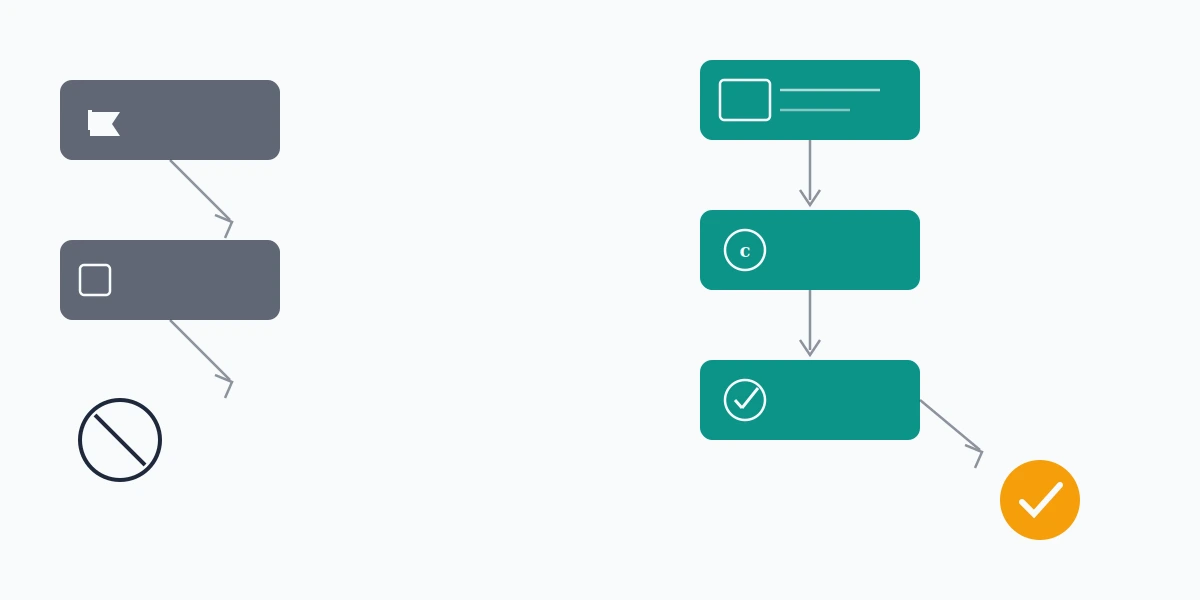
A DMCA takedown on Twitter removes the specific posts you list. Nothing else. You supply post URLs, X reviews them against its copyright policy, and the ones that survive review get pulled behind a notice. No field on the form has ever said "delete this account", and the gap between what people expect and what the notice can do is where most of the frustration in this corner of X begins.
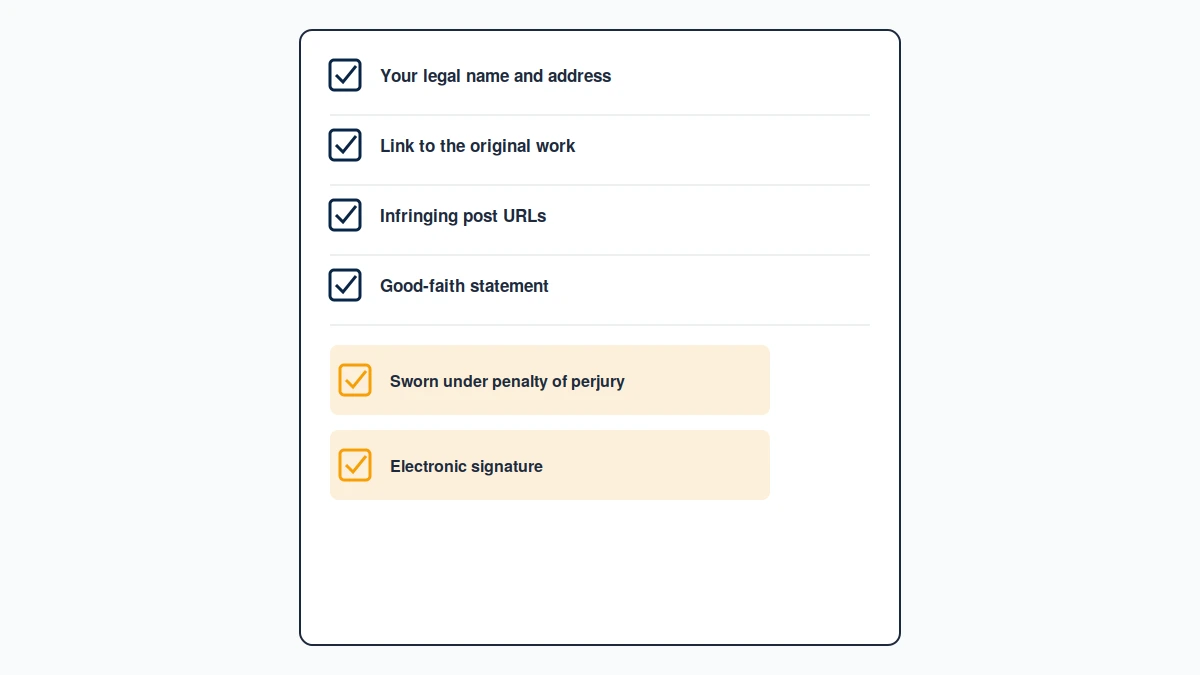
The notice is a legal instrument with a narrow job. Under 17 U.S.C. § 512(c)(3), a valid notification has to identify the copyrighted work, identify the material claimed to be infringing with enough precision that the service can find it, and carry a signature plus two sworn statements. Precision is the whole point. A notice that describes a vibe rather than a URL is not a notice, and X will treat it as correspondence.
Accounts do fall to copyright, but by a different mechanism. X's copyright policy says it may suspend an account where multiple complaints, or other evidence, show a pattern of repeat infringement. That is a consequence of many upheld notices over time, not of one strong one. You cannot see the counter. Filing the same complaint four times does not advance it, and it may cost you credibility with the reviewer who sees your name four times on one queue.
One more expectation worth resetting before you write anything. Report volume is not a lever on any large platform, which is why pile-on campaigns fail on X the same way they fail elsewhere. A single well-evidenced copyright notice outperforms a hundred coordinated reports, because a reviewer is matching your claim against a written policy, not counting signatures.
Do you own it, and is it copyright at all?
Ownership is the first thing a reviewer tests and the last thing most filers check. It is also where the majority of rejected claims die, usually before anyone looks at the infringing post at all.
Copyright protects the work, not the subject and not the label. The US Copyright Office is direct that copyright does not protect names, titles, slogans or short phrases. Your handle, your company name and your tagline sit in trademark territory, and X runs that as a separate queue with separate rules — the same split Meta uses, which is why the Instagram trademark report form is a different document from the copyright one. File a brand-name complaint as copyright and you have put a valid grievance into a queue that has no power to grant it.
Photos you appear in
Being in the frame is not authorship. The person who pressed the shutter owns the photograph, and that single confusion produces more failed notices than any other. If a stranger posted a picture of you without permission, the route is a privacy or non-consensual media report rather than a copyright one — the reasoning is the same one that governs what to do when someone posts a picture of you on any platform, and the wrong queue wastes the week you actually needed.
Work you commissioned
A commissioned shoot usually belongs to the photographer unless a written contract moved the rights, and invoices are not assignments. If your agency delivered the asset, check what the contract says before you swear to ownership under penalty of perjury.
Music, clips and re-uploads
A track you licensed for a video is not yours to enforce. Neither is a clip of a broadcast, however much editing you added. Rights holders in music and sport run their own enforcement programmes, and a personal notice filed over their work can be withdrawn out from under you.
What a reviewer wants is documentary and dull: the original file with its capture metadata intact, an upload that predates the copy, the contract if the work was made for you. Camera originals carry timestamps that a downloaded copy has usually lost. A screenshot of your own post proves you can see something. It does not prove you made it.
Where does the twitter dmca form actually live?
Not inside the post. The three-dot menu on a post handles abuse, spam, privacy and impersonation, and none of those categories carries a copyright claim to the right place. The twitter dmca form is a separate document in the Help Center, and reaching it means leaving the app.
The path is help.x.com → Contact us → Help with intellectual property issues → I need to report possible copyright infringement. Every form on that branch sits under help.x.com/en/forms, and the useful property of the copyright branch is that it renders for a logged-out visitor. You do not need an X account. You do not need to be following anyone, and you do not need the cooperation of the person you are reporting. When our team walked the route on 27 August 2026 it opened without a login prompt. We stopped short of submitting, because pressing send files a sworn legal document, so read "the form completes without an account" as verified and "a logged-out submission is accepted" as untested.
That logged-out access matters more than it sounds. Rights holders locked out of their own profile still hold their copyright, and the notice does not care about your session state. It is the opposite of the in-app routes, where losing access to the account means losing access to the tool — the trap that makes deleting an old Twitter account you cannot sign into so much harder than deleting a live one.
Search dmca takedown twitter and you will mostly land on X's policy page, which explains the rules and never shows you the door. Some guides call the same document the x dmca form, the twitter copyright form or the twitter dmca takedown form. They are one document. Meta runs the same split, and the Instagram copyright report form has its own buried address that Instagram's help pages do not send you to either. X's own interface never uses the letters DMCA on the button, which is why searching the Help Center for the acronym returns policy pages rather than the thing you are trying to open.
The twitter dmca notice, field by field
The twitter dmca notice is short, and every field on it is doing statutory work rather than administrative work. Nothing here is optional padding.
| Field | What it wants |
|---|---|
| Your role | Rights owner, or an agent authorised to act for one |
| Your details | Full legal name, mailing address, phone number, email |
| Rights holder | The owner's name, if you are filing as an agent |
| The work | A description plus a link to where your original lives |
| Infringing content | The direct post URLs, one per line, not screenshots |
| Good-faith statement | That the use is not authorised by you, the agent or the law |
| Accuracy statement | Sworn under penalty of perjury |
| Signature | An electronic signature matching your legal name |
The two statements are the part people skim and the part that carries risk. Swearing accuracy under penalty of perjury is not a formality, and § 512(f) creates liability for anyone who knowingly misrepresents that material is infringing. Fair use is the usual trap: a clip used for criticism, commentary, news or parody may be lawful, and filing over it anyway is the behaviour the misrepresentation provision exists to punish.
Agent filings need one extra thing that catches lawyers off guard. If you are reporting for a client, X wants your authority to act, and it wants the rights holder named rather than implied. A twitter copyright infringement report filed by a marketing manager "on behalf of the brand" without that authorisation stated is thin, and thin agent filings are the ones that come back with a request for clarification a week later. That is a week your infringing post spends live.
Post URLs beat everything else you could attach. Use the full permalink, one per line, and give the specific post rather than the profile. A twitter dmca takedown request naming a whole account and asking X to work out which posts are yours will be closed or returned.
How to file a dmca takedown on twitter, step by step
Whether you search how to report copyright infringement on twitter or twitter report copyright infringement, the working answer is the same sequence, and the order matters more than the speed.
- Confirm the claim is copyright rather than trademark, impersonation or privacy, and confirm you hold the rights.
- Capture the evidence while it is still live: the infringing post URL as text, a screenshot with the address bar visible, the date, and the handle recorded separately.
- Gather proof of authorship — original file, earlier upload, contract.
- Open the copyright branch at help.x.com, complete the form, and use a professional contact address rather than a personal one.
- Keep the confirmation email. It carries the reference number you will need if the case moves.
Step two is the one people skip and regret. A successful takedown destroys your own record: the post disappears, and the URL, caption, view count and reply thread go with it. If the matter later reaches a lawyer, an insurer or a client, the screenshot you took beforehand is the entire case file. The same discipline applies whichever platform you are working on, and it is why the evidence pack that survives a fake-account report is built before filing rather than after.
Filing through two channels at once does not double your odds. It splits one case across two queues, and the second reviewer often closes the duplicate. If you have already reported the post in-app for a different reason, say so on the form rather than opening a parallel front.
Not sure whether your case is copyright, impersonation or defamation? Talk to our team before you file. Filing into the wrong queue costs a week and, occasionally, credibility with the reviewer who eventually gets the right one.
Is there a twitter dmca email, and should you use it?
There is. X Corp's California Terms of Service filings list its designated copyright agent at 865 FM 1209, Building 2, Bastrop, Texas 78602, reachable at [email protected]. Earlier filings gave a San Francisco address at 1355 Market Street, and a good number of guides still print it. Mail sent to an address a company left is mail that arrives nowhere.
Before you use any twitter dmca email you find in an article, including this one, check it against the US Copyright Office's DMCA designated agent directory. That directory is the authoritative record, service providers are required to keep their designation current, and it takes about ninety seconds to confirm. Agent registrations change when companies restructure, and X has restructured more than most.
Use the form anyway. The email route exists so that a statutorily compliant notice cannot be refused for want of a web form, not because it is faster. Email lands in a general queue and depends on you assembling every § 512(c)(3) element correctly by hand; the form assembles them for you and timestamps the submission. In practice we reserve the x dmca email route for two situations: a notice that needs an attachment the form will not take, and a case already in a lawyer's hands where the paper trail matters more than the turnaround.
The one thing email will not buy you is a human. There is no copyright inbox that escalates faster, and the accounts promising a direct line into X's legal team are selling something. Access to X support is the same problem for everyone, including the people trying to recover a permanently suspended Twitter account through the only appeal path that exists.
What X sends the person you reported
This is the part of a twitter dmca takedown that guides bury and clients wish they had read first.
When X restricts content over a copyright complaint, it makes a good-faith effort to contact the affected account holder with information about the removal, including a full copy of the complaint and instructions for filing a counter-notice. A full copy means the document you filled in. Your legal name. Your mailing address. Your phone number. Your email.
That is not a leak or an oversight. The DMCA is built as an adversarial process with a reply mechanism, and a counter-notice is meaningless if the recipient cannot see who filed and where to reach them. Every major platform does the same thing, which is why what the person on the other end learns about you is a different question for copyright than it is for an ordinary abuse report, where the reporter stays anonymous.
Plan for it. Use a business address rather than your home, a work email rather than a personal one, and a phone number you are willing to have in a stranger's hands. If you are filing as an individual against someone who has already shown they will retaliate, register the notice through an agent or a lawyer so their details travel instead of yours. We have watched a legitimate photographer's home address reach an account that then organised a harassment campaign around it, and no part of the takedown could be recalled once sent. If the situation already carries a threat — sextortion, coercion, an escalating campaign — the copyright notice is rarely the right first move, and the route for blackmail and sextortion reports is faster and does not hand over your file.
One consolation on exposure. X does not publish the notices it receives. Lumen, the Harvard-hosted archive where Google, Reddit and others deposit copies of takedown demands, records that Twitter stopped supplying its notices around April 2023 and is still not contributing. Your complaint reaches the person you reported, not a public database.
What happens after you file: withheld, not deleted
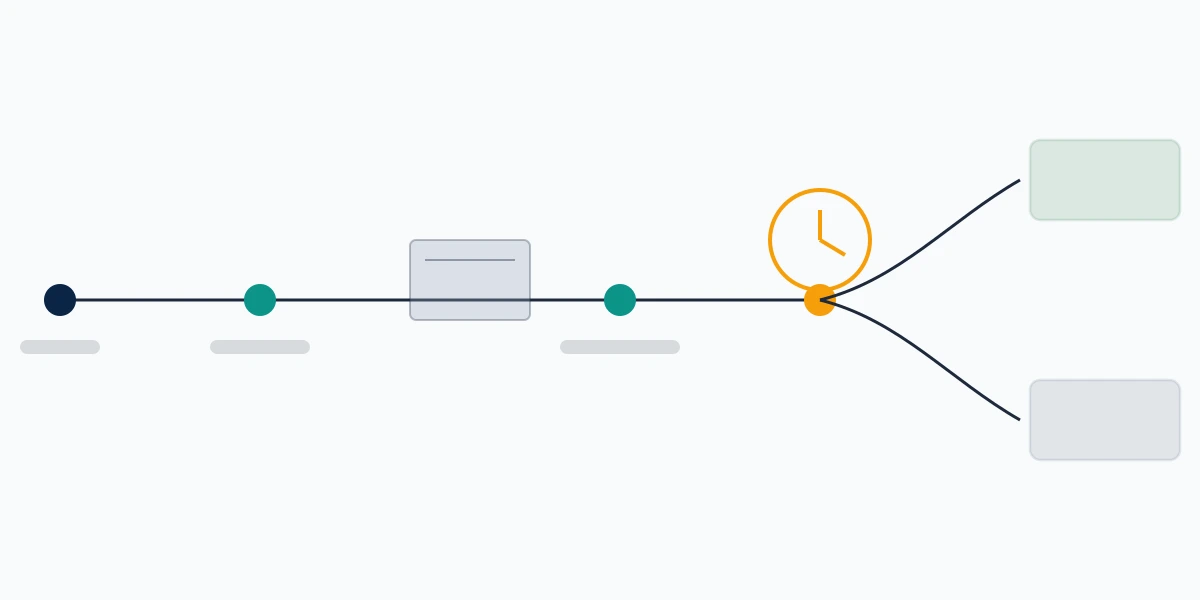
X does not delete a post it takes down for copyright. It withholds it, leaving a marker in place of the content that tells anyone who visits the post "has been withheld in response to a report from the copyright holder". The tombstone stays. The URL stays. Anyone who had the link can still see that something was there and that a rights holder objected.
Filers who work at volume put X's review of a clean notice at roughly three days. X publishes no service-level commitment and nothing obliges it to hold that pace, so treat three days as a working expectation rather than a promise, and treat any vendor quoting you a guaranteed turnaround as guessing. Complex claims, agent filings missing authorisation, and anything touching fair use take longer because a person has to think about them.
| Outcome | What you see | What it means |
|---|---|---|
| Withheld | Tombstone notice on the post | Notice accepted, content restricted |
| Media removed | Post remains, image or video gone | Only the attached file infringed |
| Returned for clarification | Email asking for detail | Usually a missing URL or unstated authority |
| Rejected | Email declining to act | Fair use, ownership, or wrong queue |
| Account suspended | Profile gone | A pattern across many notices, not yours alone |
The pattern outcome is worth understanding honestly, because the number attached to it is folklore. Removal vendors publish precise strike counts for X. X does not, and its published policy commits only to suspending accounts where repeated complaints or other evidence show a pattern. Re-posting material already removed, or running an account that exists mainly to infringe, is treated more harshly than an isolated repost. Anyone quoting you an exact number of strikes is repeating a figure X has never confirmed.
Where the account itself is the problem rather than the posts, copyright is the wrong tool entirely and a Twitter account removal case runs on different grounds. The same is true if the content is yours but the poster is pretending to be you, which is an impersonation report you can file without an account.
How long does a counter-notice keep your takedown?
The person you reported can file a counter-notice, and X is required to pass it back to you. From that point the clock is statutory rather than discretionary.
X may restore the content after ten business days unless you tell it you have filed a court action seeking to restrain the infringement, and it must restore the content by fourteen business days if you have not. That window is the entire remedy. There is no appeal to X, no second review, and no amount of correspondence that extends it. If you are not prepared to go to court, a counter-notice you cannot answer means the post comes back.
Most counter-notices are not filed by pirates. They are filed by people who genuinely believe the use was fair, or who own the work jointly with you, or who were told by a lawyer that your claim was weak. Read the counter-notice properly before you decide it is bad faith, because a counter-notice also carries a perjury statement and a submission to federal jurisdiction. Someone who signs one has taken on real exposure.
X's policy also takes valid retractions and counter-notices into account when it weighs a pattern of infringement, so a withdrawn notice does not simply vanish from the record. Retract a claim you should not have filed. It costs less than defending it.
If the post has come down and stayed down, resist the urge to keep filing. Repeat requests over the same content read as harassment of the queue rather than diligence, and the cross-platform rule about which removal route actually works applies here too: one correct filing beats five hopeful ones.

The fake copyright warnings landing in X inboxes
Filing a copyright notice puts you in a category that scammers target, and receiving one puts you in a worse one.
Since November 2025, Malwarebytes has been tracking a campaign that fakes DMCA copyright warnings to steal X logins. The messages claim a copyright violation, threaten that the account will be hidden or limited within twenty-four hours, and offer a Review Details button that leads to a convincing replica of the X login page. Anything typed there goes to the attacker. The twenty-four-hour deadline is the tell — real copyright process runs on business days and statutory windows, and X has never given anyone a day to respond to a notice.
Three habits defeat the entire family of these. Check the address bar against the domain you expect before typing a password, because a password manager will refuse to autofill on a replica while a human will not notice. Turn on two-factor authentication. And when a notice arrives, open X yourself in a new tab rather than clicking anything in the message — a genuine restriction is visible in your own account without following a link.
The same template circulates for other platforms with the branding swapped, and the pressure language barely changes between them. It shows up as fake channel-strike warnings, as fake seller-policy notices, and as the scam-report messages that circulate on Telegram with a different logo on top. Treat any copyright message with a countdown as hostile until you have confirmed it from inside your own account.
What we will not do with a twitter copyright report
We file copyright notices for clients. We decline a short list of things, and the list is worth stating plainly in a market this full of people who will not.
We do not file a twitter copyright report over work you do not own. That includes photographs of you taken by somebody else, brand names better served by the trademark queue, and content you licensed rather than created. A knowingly false claim is not merely unethical, it is actionable under § 512(f), and the exposure lands on the person who signed the notice.
We do not promise removal. We do not promise a timeline shorter than X's own process allows, and we do not promise that any twitter copyright infringement report will end an account. Anyone selling a guaranteed x copyright infringement takedown, a strike count, or an inside contact at X is describing something that does not exist. We also never ask for your password. A copyright notice needs your evidence and your signature, and no legitimate filing process on any platform requires your credentials — a rule that holds just as firmly for the paid channel-removal services people ask us about and for anyone offering to delete somebody else's tweet on request.
Where the copyright route is genuinely the wrong one, we say so and point you at the right one, whether that is a privacy report over exposed personal details, a defamation letter or a platform appeal. Our full limits are written out, and our team's credentials are on the record rather than implied. If you want a second opinion on a notice before you sign it, that conversation is free and takes about an hour.