
What a copyright strike is, and who is allowed to file one
A copyright strike is a penalty YouTube applies to a channel after it removes a video in response to a valid legal takedown notice. It is not what the Report button under a video produces. Those two paths run through separate queues, reach different reviewers, and accept requests from different people.
Only two parties may file. The owner of the copyrighted work, or a person that owner has authorised in writing to act for them. YouTube does not decide whether a video is unfair, dishonest or humiliating, because that is not the question a takedown notice asks. It processes a sworn legal statement, and your name goes on the sworn part.
That distinction is why so much of the advice circulating here is dangerous. People search for how to give someone a copyright strike on YouTube expecting a button that punishes a channel they dislike. Others phrase it as how to give copyright strike on YouTube and expect a setting somewhere in Studio. No such button or setting exists. What exists is a legal instrument declaring, under penalty of perjury, that you own a specific work and that a specific video reproduces it without permission. If you do not own the work, filing is not a clever shortcut — it is a false statement inside a federal process, and it is recorded with your address attached.
Your Reputation Solution is a takedown and account-recovery practice that files copyright notices for people whose original work has been reuploaded without permission, and declines the requests arriving from the opposite direction. Roughly a third of the YouTube copyright enquiries reaching us get turned down, almost always because the sender does not own the material they want removed (our intake records, January to August 2026).
If the video you want gone is abusive rather than infringing, copyright is the wrong lever and the in-app flow is the right one. Our walkthrough of how to report a YouTube channel covers that route, including which reasons YouTube acts on and which it quietly closes. The standing rule holds across platforms too: our team explains who can actually remove a profile rather than selling the service, because only a narrow set of parties has the right to ask.
So the honest framing of how to copyright strike someone on YouTube is this. You are not striking a person. You are asserting ownership of a work, identifying where it appears, and accepting liability if you are wrong. Everything below assumes you can do the first part.
Content ID claim vs copyright strike vs Community Guidelines strike
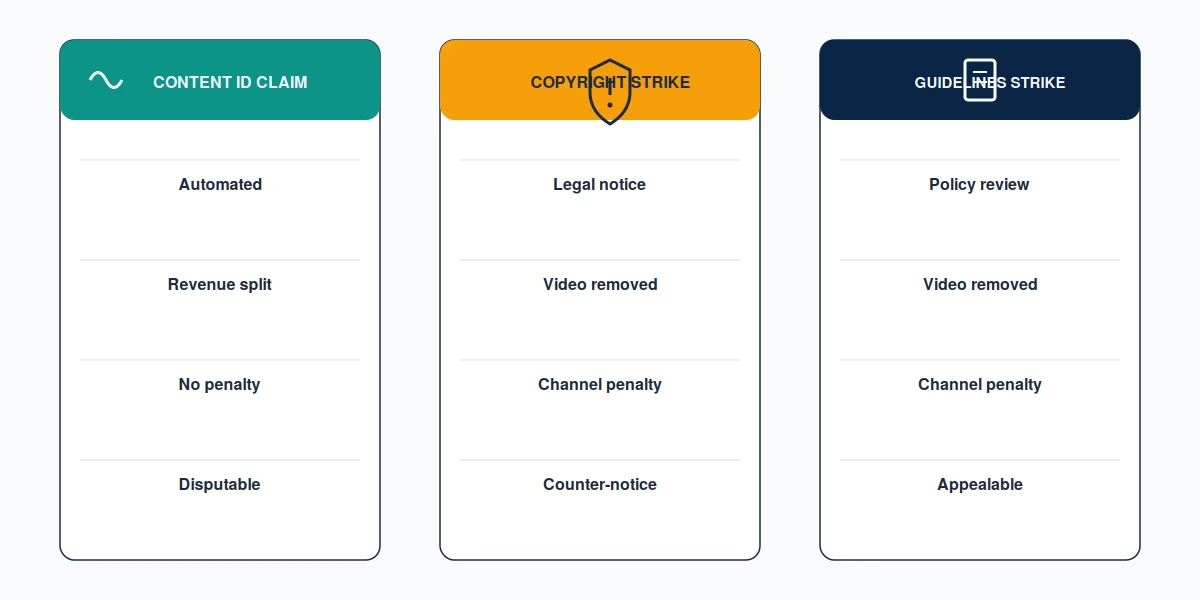
Three separate mechanisms get called "a copyright strike" in ordinary conversation, and confusing them is the most common reason a filing goes nowhere.
| Content ID claim | Copyright strike | Community Guidelines strike | |
|---|---|---|---|
| Triggered by | Automated match against a reference file | A manual legal removal request | A policy violation review |
| Who can cause it | Enterprise rights holders inside the Content ID programme | Any copyright owner or authorised agent | Any viewer, via the Report button |
| Effect on the video | Usually stays up; monetisation redirected or region-blocked | Removed | Removed |
| Effect on the channel | None | One strike; three live strikes terminate it | One strike; three in 90 days terminate it |
| Expires after | Not applicable | 90 days | 90 days |
| Undone by | Dispute | Retraction, counter-notification, or expiry | Appeal |
Getting this wrong is expensive in a quiet way. Your Reputation Solution routinely opens cases where someone spent two months disputing a Content ID claim while the reupload they actually cared about sat untouched, because nobody had told them the two systems never speak to each other.
The practical difference in content id claim vs copyright strike is that a claim is a revenue instrument and a strike is a legal one. A Content ID claim moves money. A strike costs the uploader a video and puts a third of a termination on their record for the next three months. Individual creators cannot reach Content ID at all — it is reserved for rights holders who can supply reference files and demonstrate catalogue ownership at scale, which is why the "just Content ID them" advice on forums is written by people who have never had access to it.
This also settles the question behind how to copyright claim someone on YouTube. You cannot. Claiming in the Content ID sense is a programme you qualify for, not an action you perform against a channel. What you can do instead is file a removal request, a different mechanism carrying heavier consequences for both sides.
Picking the correct ground decides the outcome on every platform, and volume never substitutes for it. The six grounds Meta actually accepts behave the same way: the request matching the mechanism gets actioned, the one that does not gets closed unread. The anonymity split is identical too. Reporting a fake TikTok account keeps your name out of it. A copyright claim never does.
Filing the YouTube copyright removal request form, step by step
Two doors lead into the same process, and both end at the same legal review team.
The public webform
The YouTube copyright complaint form sits at youtube.com/copyright_complaint_form. It is open to anyone, signed in or not, and Your Reputation Solution files through it in almost every case. YouTube's own removal request documentation treats it as the canonical path. Across the wider web the same document gets called the youtube copyright infringement form, the youtube dmca form and the youtube copyright takedown form. They are one submission under four names.
The Studio route
Inside YouTube Studio the path now runs Content detection → New removal request. Any guide still describing a "Copyright" tab in the left rail is working from pre-2025 navigation, which is a dependable signal that the rest of its instructions are stale as well. Our team checks the menu path against the live interface before recommending any source to a client, because a stale instruction wastes the first hour of a filing.
The six elements that make a notice valid
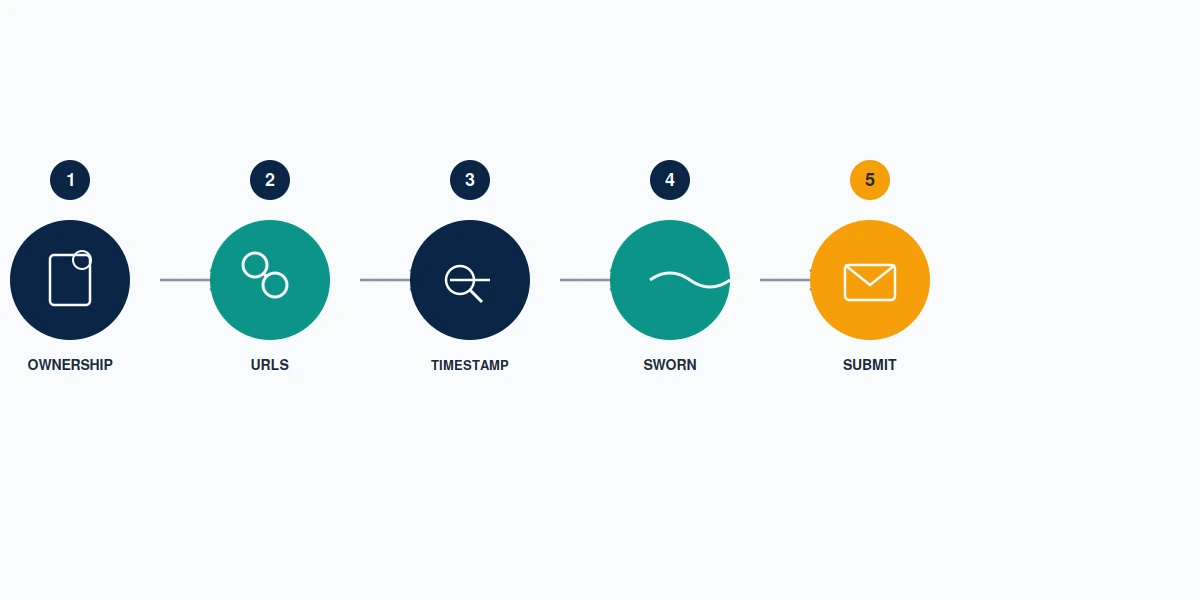
A youtube copyright removal request only stands if it carries all six statutory elements. Miss one and it is rejected without substantive review:
- Identification of the copyrighted work you own.
- The exact URL of every infringing video, listed individually.
- Your contact details — full legal name, postal address, phone number, email.
- A statement of good-faith belief that the use is unauthorised.
- A statement, under penalty of perjury, that the information is accurate and that you are authorised to act for the owner.
- Your signature.
Two of those deserve a warning before you press submit. Your contact details are forwarded in full to the uploader, and YouTube says so plainly on the form itself. There is no anonymous version. The filers who discover this afterwards are the ones who most regret submitting, particularly when the uploader already knows where they live.
The perjury statement is the second. It is not decorative language, and it is the hook that makes a bad filing actionable later.
One practitioner habit worth stealing: capture your proof before you file, not after. When Your Reputation Solution prepares a notice, the first step is archiving the infringing video, its description, its view count and its upload timestamp, because a successful takedown deletes the evidence that justified it. If the uploader counter-notices three weeks later and you need to show a court what was there, a removed URL proves nothing. Screen recordings, archive captures and the original project files or camera-original footage that establish your authorship all belong in the folder before the form is submitted.
Keep that folder even after the video comes down. Strikes get retracted, counter-notices arrive weeks later, and the claimant who cannot reproduce the original evidence is the one who loses the second round.
Volume does not rescue a weak notice either. Learning how to file a DMCA takedown on YouTube properly once beats sending five sloppy ones, because a rejected notice teaches you nothing while the video keeps accumulating views. Rejections also arrive without much explanation, so a filer who submits three variations at once cannot tell which change mattered. Send one complete notice, note the date, and wait out the review window before touching anything. The same discipline shows up when filing a DMCA notice on a platform with no form at all — Telegram accepts only an emailed notice, which demonstrates how much structure YouTube's form hands you for free. And X's copyright complaint form forwards your name and address to the infringer in exactly the same way, worth reading before you decide the exposure is acceptable.
If you would rather have someone check the wording before it becomes a sworn statement, Your Reputation Solution reviews draft filings and says no when no is the answer. Start with a free case review from our team.
What happens after you submit, and why a whole channel cannot be struck
Here is the gap nearly every guide leaves open. A youtube copyright takedown request targets individual videos by URL. There is no channel field, no playlist field, and no mechanism that removes an entire channel in a single action.
That is the real answer to how to copyright strike a YouTube channel, and to the near-identical search for how to copyright strike a YouTube account. You strike videos. If three separate videos carry live strikes at the same time, the channel is terminated as a downstream consequence — but termination follows three valid notices, it is never something you request. Anyone selling a one-step channel strike is describing a product that does not exist.
The same arithmetic answers how to report a YouTube channel for copyright. You list each infringing video individually, so a channel hosting forty reuploads takes forty URLs rather than one complaint. Tedious, and unavoidable.
Review typically runs 24 to 72 hours for a clean notice, though contested or high-volume claims sit longer. Across the youtube copyright infringement report filings Your Reputation Solution handled this year, the median from submission to removal landed closer to two business days than one. YouTube's published range is honest; the fast end of it is simply not the common case. Timelines behave this way everywhere, and the real LinkedIn takedown timelines our specialists record follow the same shape of a wide official range and a narrower lived one.
When the video comes down, the uploader takes a strike, loses the video, and must complete Copyright School before the strike ages out at 90 days. Live streaming and Shorts monetisation are usually restricted for the first week as well, which is the part that actually hurts a working channel.
Then the process can run backwards. The uploader may file a counter-notification, and once they do, YouTube's counter-notice procedure gives you 10 business days to show you have filed a court action. Do nothing and the video is reinstated. This is where a weak claim collapses in public, because a youtube dmca takedown notice you are unwilling to litigate is a notice you have effectively withdrawn — and the uploader now has your address, your sworn statement, and a reason to use both.
Your Reputation Solution treats the counter-notice window as the real deadline on a filing rather than the removal date, because that is where most claims are decided. The uploader who counter-notices is usually the one with something to lose — a monetised channel, a sponsor, an audience — and they tend to have read the statute more carefully than the person who filed against them. Ten business days is not long enough to find a lawyer, brief them and file, so the decision about whether you would litigate belongs at the start of the process, before you submit anything. Filers who answer that question honestly in week one rarely get surprised in week four.
Both sides of that exchange are named, which surprises people who assumed a youtube dmca takedown works like a report. Platforms keep policy reporters anonymous and copyright claimants identified, a split our team unpacks in what happens after you report someone on X. If you are instead on the receiving end of a strike you believe is baseless, the appeal mechanics resemble appealing an Instagram suspension more than most people expect: documentary evidence, patience, and one well-argued submission rather than six angry ones.
When copyright is the wrong tool, and what a false strike costs
What copyright does not cover
Copyright protects a fixed creative work. It does not protect facts, ideas, methods, names, titles or short phrases, and the US Copyright Office states this explicitly. A video that criticises you, reviews your product harshly, or repeats true statements about your business is not infringing merely because it is damaging.
Three situations get misfiled as copyright almost every week:
- Your logo or brand name in a thumbnail is a trademark question, not a copyright one. Meta runs a parallel process, documented in our breakdown of the Instagram trademark infringement report form.
- Private images of you reposted to coerce or extort is a safety matter with its own escalation path and its own urgency, covered in our guide to reporting blackmail and sextortion.
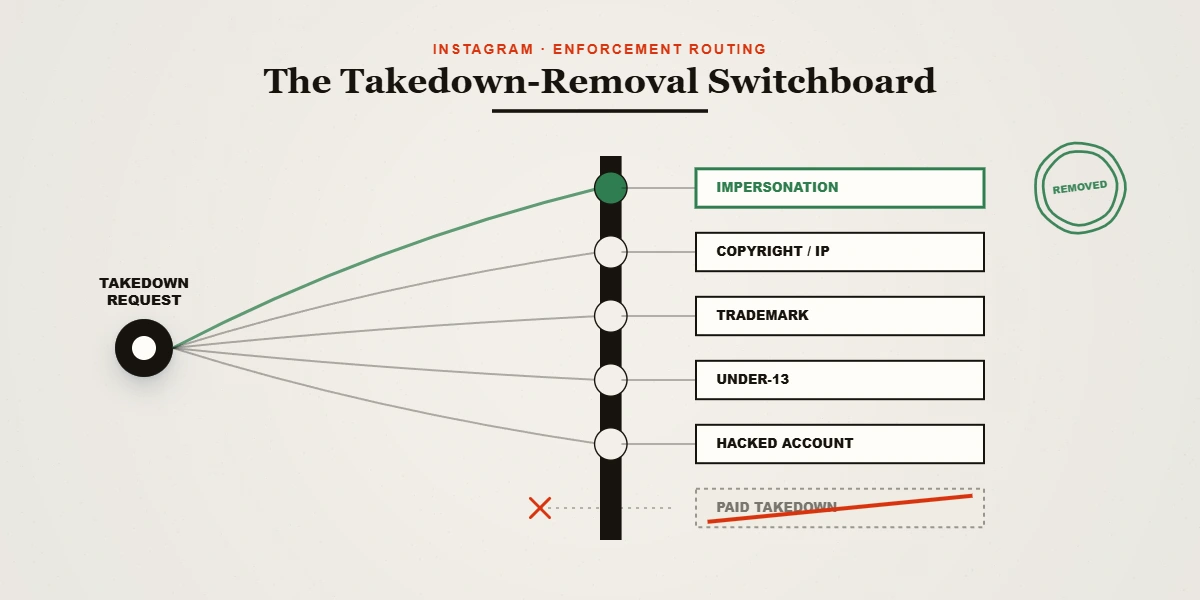
- You want a person gone rather than a work removed. Copyright cannot do that. The levers that genuinely exist are set out in the four routes Meta acts on, and not one of them is a copyright claim.
A youtube copyright complaint filed over any of the above is not just ineffective. It is a misrepresentation carrying your signature.
Your Reputation Solution sorts incoming requests by mechanism before anything else, and the sorting question is always the same one: what exactly do you want removed, and which body of law covers it? A stolen edit of your own footage is copyright. A counterfeit storefront using your wordmark is trademark. A video reading out your home address is a privacy and safety matter that moves through a faster queue than either. Picking the wrong one does not simply fail — it burns weeks, and the video keeps its view count while you wait for a rejection.
The section 512(f) exposure
17 U.S.C. §512(f) makes anyone who knowingly and materially misrepresents that material is infringing liable for the resulting damages and legal costs. The threshold is actual knowledge or reckless disregard rather than honest error, so a genuine mistake about ownership will not sink you. Deciding to strike a critic because the video stung is a different matter, because that decision is documented in the notice you signed.
The Electronic Frontier Foundation's guide to YouTube removals traces where these claims have reached court. Uploaders with counsel do pursue them, and discovery reads your original notice back to you line by line.
Which brings us to the paid-strike offers, and they deserve naming. Sellers advertising a guaranteed strike for a fee are describing §512(f) exposure they will not be carrying. You will, because yours is the name on the notice and theirs is on a Telegram handle that stops replying. The economics match the paid ban services our team examined in why paid takedown offers fail: the seller collects, the platform does nothing, and the liability stays with the buyer. We publish the limits on what we file for the same reason — a firm unwilling to write its refusals down is telling you something.
What our team will and will not do with a YouTube copyright complaint
Your Reputation Solution files copyright removal requests, assembles the evidence package that supports them, and escalates when a valid notice stalls in review. YouTube makes the final decision, and we say that before taking an engagement rather than after.
What our team will not do: file a notice for work you do not own, submit a claim against criticism or commentary, promise a guaranteed removal, ask for your YouTube password, or take money on a pay-to-remove basis for content that has never met the legal bar. Our ex-platform Trust and Safety team has watched enough enforcement queues from the inside to know which claims survive review and which ones only irritate a reviewer.
One practical note before you send us anything. Case details stay inside the engagement, and you never need to hand over a password, a recovery code or channel access for a copyright filing — the notice is submitted in your name, from your evidence, and nothing about the process requires us to sign in as you.
Honest deadlines are the useful part of this work, and they are the part scams avoid. A counter-notice gives you 10 business days, not "a while". A strike ages out at 90 days, not "eventually". Our specialists apply the same precision to recovery work, where Meta's 30-day deletion window separates a recoverable account from a gone one, and where a frozen account sometimes comes back through a route the help centre never documents.
The uncomfortable version of this advice is that some infringement is not worth pursuing. A single reupload with four hundred views on a dormant channel may cost more in evidence work and counter-notice risk than it returns, and saying so is part of the job. Where a takedown does not fit, the remaining options are usually commercial rather than legal: a licence, a credit, a direct message that resolves it in an afternoon. Our specialists will lay out which of those applies before anyone signs anything, because a firm that treats every enquiry as a filing opportunity is optimising for its own invoice rather than your outcome.
If your work was reuploaded and you can show you made it, Your Reputation Solution will file the notice. If it was not, we will tell you on the first call instead of billing you to find out.