
What counts as doxxing on X, and what X quietly leaves up
X does not have a rule called doxxing. The rule is the private information and media policy, and doxxing is the informal name for breaking it. That gap matters more than it sounds. The policy is a list, and your report gets measured against that list rather than against how exposed you feel.
Search phrasing varies wildly here — how to report doxxing on x, how to report doxxing on x twitter, x doxxing policy twitter, twitter report doxxing reddit — and all of it resolves to the same two questions. What does the twitter doxxing policy actually cover, and who is permitted to file against it? The x rules on doxxing live on one help page. The reporting route lives inside the post.
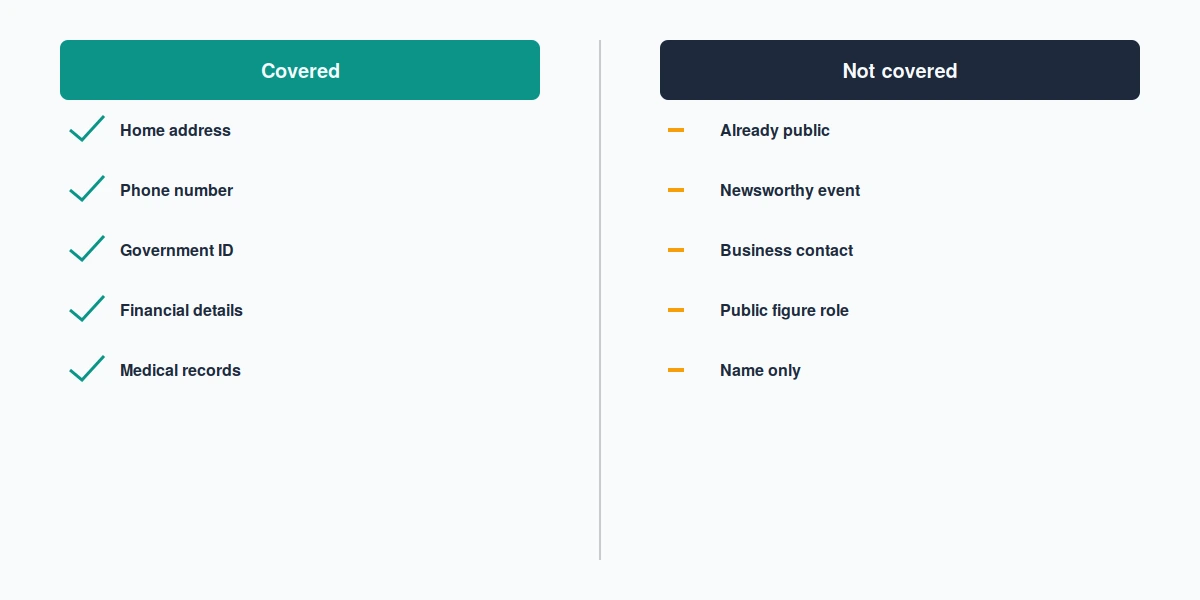
That list covers home addresses and location information precise enough to find someone, government identity documents and national identity numbers, non-public phone numbers and personal email addresses, financial account details such as bank or card numbers, and health information including medical records and biometric data. Posting any of those about another person without permission breaks the rule. So does threatening to post them. So does offering a reward, or otherwise incentivising other people to go and dig them up, which is the part of the twitter doxxing rules that almost every summary omits and the only clause that reaches the person orchestrating a pile-on rather than the accounts carrying it out.
Then come the exceptions. This is where most reports die.
| Usually actionable | Usually left up |
|---|---|
| Home address, or a location precise enough to find you | The same information already public somewhere else |
| Passport, government ID or national ID number | The address of a business or commercial premises |
| Non-public phone number or personal email | ID numbers from regions that do not treat them as private |
| Bank, card or other financial account details | Genuinely newsworthy context around a public event |
| Medical records or biometric data | Your name on its own, with nothing attached to it |
The right-hand column is the one nobody warns you about. Say your address sits in a public property record, or you posted your own city three years ago, or your phone number is on a business listing you set up yourself, a reviewer can look at the post that terrified you and close it as no violation. The information being findable is, under this policy, a defence.
Knowing that in advance changes how you write the report instead of leaving you to discover it from a rejection email.
Doxxing is not the same as a suspension request
Two things get confused constantly. Reporting a dox asks X to remove specific content that exposes private information. Getting an account removed entirely is a different threshold with different evidence, and we walk through how to get someone suspended on Twitter for a rule breach separately, because the two goals need different filings. A dox report that is secretly a suspension request tends to achieve neither.
One boundary before anything else. Do not retaliate. Counter-doxxing the person who exposed you, or organising others to mass-report them, breaks the same policy you are invoking and hands X a reason to action your account instead of theirs. Our full position on what we will and will not do sits in our service disclaimer.
What to capture before you touch the report button
Evidence first, reporting second. Posts get deleted, edited and locked behind suspended accounts, and once that happens the thing you needed to prove is gone. Reviewers cannot act on a description of a post that no longer resolves.
Capture four things for every item: a full-screen screenshot showing the handle, the post text and the timestamp together; the direct post URL; the account handle and its numeric user ID; and the date and time you found it. Save them in one folder, named by date. Posts that look likely to vanish should go through a public web archive before you report, so a dated third-party copy exists that is not on your phone.
Screenshot the replies too, not only the original. A dox spreads through quote posts and replies faster than through the parent, and each of those is a separate reportable item with its own URL.
If the leak includes photographs you took, ID scans, or documents you authored, you are holding a second, often stronger route. Copyright removals run on a legal deadline rather than a moderation queue, and the mechanics are the same across platforms — our guide to which copyright report form actually works explains the fields these forms demand and what the platform hands the other side. Never file a copyright claim over material you do not own. Fraudulent takedowns carry real legal exposure and they are a favourite tactic of the removal services worth avoiding.
One caution about the evidence itself. Anyone you send it to, including us, ends up holding the exposed data in a file. Ask how it will be stored and how long it will be kept before you send anything; ours is set out in our privacy policy.
How to report doxxing on Twitter, step by step
Everything happens inside the post itself, not in a separate form. There is no email address and no phone line.
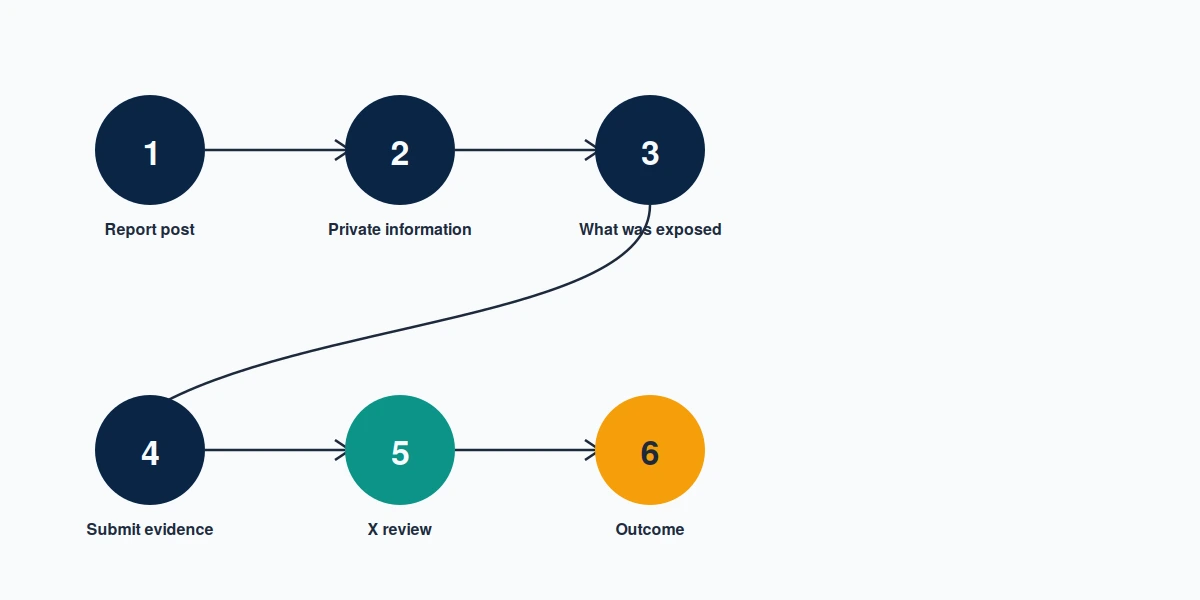
- Open the post and tap the three dots at its top right.
- Choose Report post.
- Pick the privacy category rather than abuse or harassment. Filing a dox under Abuse sends it to a queue judged on different criteria, and it is the single most common misfile we see.
- Answer the follow-up asking how the privacy was violated, and choose the specific information type that was exposed.
- Answer whose privacy was violated: yourself, someone else, or someone you are authorised to represent. This answer decides everything about what happens next.
- Submit, and note the case reference.
Report each offending post separately. One report against an account does not sweep up eleven quote posts, and reviewers assess the item in front of them. X's own guidance on reporting a post confirms the per-item structure.
The same shape repeats on every major platform, which is worth knowing if the same person is running the campaign in more than one place. The six routes for reporting harassment on Instagram follow the surface-by-surface logic X uses. Where a dox arrives attached to a payment demand you are looking at extortion as well as a privacy breach, and our walkthrough of reporting a scam profile and who else to tell covers the parallel escalation. Should the account leaking your details also run a storefront, who sees your name when you report a seller matters before you file, because some commerce reports are not anonymous.
Who is actually allowed to file a twitter doxxing report?
Here is the rule almost nothing on the first page of Google explains, and the reason a large share of reports come back rejected within hours.
Anyone can report private information when it has been shared in a clearly abusive way. When it has not, X may need to hear from the owner of the information directly, or from an authorised representative such as a lawyer, before it will act. So a friend filing on your behalf, in a case that reads as ordinary rather than obviously malicious, frequently produces nothing at all — not because the post is acceptable, but because the wrong person filed it.
Three practical consequences follow. Someone who has been exposed should file from their own account, even where a friend has already reported the post. People helping a victim should coach them through filing rather than filing on their behalf. Where the target genuinely cannot file, because they are a minor, incapacitated, or formally represented, the authorised-representative route exists and expects documentation showing that authority.
When we file private-information reports on behalf of clients, the ones that come back actioned are consistently the ones where the exposed person is the named reporter and the submission points at a single specific item. The scattered account-level complaint filed by a supportive third party is the pattern that fails, and it fails quietly.
What "clearly abusive" has to look like
That carve-out is narrower than people hope. It is aimed at posts where malicious intent is visible on the face of the content, without a reviewer needing outside context: an address published alongside an invitation to visit, a phone number posted with an instruction to call at night, a leak framed as punishment for something the target said. A neutral post containing the same details usually will not clear that bar, which is precisely why the affected person's own report matters.
Doxxers rarely stay on one platform. The same leak reposted to LinkedIn carries the employer and the legal name together, and LinkedIn takedown rules and real timelines run on a different clock to X.
Not sure whether your situation is a platform report, a legal matter, or something that needs search results dealt with instead? Tell us what happened and we will tell you honestly which one it is, including when the answer is that you do not need us at all.
What happens after you file, and what the Reddit threads get right
X reviews the report and, where it agrees, requires the account to delete the offending post and puts it in read-only mode for a period before it can post again. Repeat violations escalate toward suspension. Penalty severity weighs the seriousness of the breach against the account's prior record, so a first-time offender posting an address and a serial offender doing the same thing are not treated identically.
Now the number that reframes everything. X removed 32,543 pieces of content for personal privacy violations in the second half of 2024, and every one of them was reported manually by a user (X Global Transparency Report H2 2024, published February 2025 — see X's transparency portal). Nothing in that figure was caught proactively. There is no system scanning for your address. If nobody reports it, it stays up indefinitely, which is why the evidence-and-file sequence above is not optional housekeeping.
What the twitter doxxing reddit threads get right
Search twitter doxxing reddit or doxxing on twitter reddit and you find the same complaint repeatedly: reports closed with no action, sometimes within minutes, on content the reporter is certain violates the rules. Those accounts are largely accurate, and the explanation is usually one of the two mechanics above rather than reviewer indifference. Either the information was already available elsewhere, which triggers the public-information exception, or a third party filed a report that needed to come from the affected person. Neither shows up in the rejection notice, so it reads as the platform ignoring you.
They are also right about timing. Privacy reports are not fast, and volume does not accelerate them. Recruiting friends to pile reports onto the same post does not raise its priority, and it can make the whole cluster look coordinated. Blocking is worth doing for your own peace of mind, but it changes nothing about enforcement — the distinction between blocking, removing and a real ban works the same way on every platform.
An account of your own caught in the crossfire and removed during a pile-on needs an appeal rather than a report, and reactivation versus appeal after a removal sets out how those differ.
Closing the doors the dox opened
Getting the post removed does not un-publish the information. Anyone who saw it still has it, and the next step is reducing what a stranger can still confirm about you.
Start with the accounts you forgot about. An old profile you abandoned years ago often still carries the address, phone number or workplace that the dox just made searchable, and it is usually the easiest confirmation source available to whoever is hunting. Locked out of it completely, deleting an old Twitter account you cannot access covers the recovery-then-delete route and the erasure request that works when recovery fails.
Dormant profiles on other platforms carry the same risk, where an old bio may still name your school or city. Deletion is rarely instant and it comes with conditions, so the 30-day window and six blockers are worth reading before you start deleting in a panic.
Panic deletion is its own risk. Some deletions cannot be reversed at all, and people who wipe an account mid-crisis often need it back a week later for evidence — what actually returns after a WhatsApp deletion is a clear illustration of what is genuinely final. Preserve first, delete second.
When the dox arrives with a login attempt
Exposed email addresses and phone numbers are account-takeover ingredients, and doxxing and credential stuffing frequently arrive together. Treat a dox as a security event, not only a privacy one.
Change the password on the exposed email account first, because it is the reset path to everything else, then enable an authenticator app or hardware key rather than SMS. A leaked phone number makes SMS codes the weakest option you have, since SIM-swap attacks target exactly this situation.
If you are already locked out of X, regaining access without your username walks through the email and phone reset paths and the identity check X falls back on when both are gone. People whose compromised address was itself the recovery email on another account will find that three proof routes when the email is gone covers what proof platforms will accept instead. People who change number or handset to break the link to a leaked number should read moving WhatsApp to a new phone first, because doing it in the wrong order can strand the account.
When this stops being a platform problem
Some situations do not belong in a report queue at all.
An explicit threat of violence, a pattern of stalking behaviour, any sign the person knows where you physically are, or a dox aimed at triggering a false emergency call to your home, all belong with law enforcement the same day. Report the post to X as well, but do not wait on the outcome. In the United States, the FBI's Internet Crime Complaint Center takes online reports alongside your local police. Take your evidence folder with you; officers who cannot see dated screenshots and URLs often cannot open a file.
Worth knowing before you go: doxxing itself is not a standalone federal crime in the United States, and state coverage is patchy. What police can usually act on is the conduct wrapped around it — stalking, harassment, threats, or the false-emergency call. Describing the behaviour rather than naming the offence gets a better reception at the desk. Once an address is published and you have reason to expect a swatting attempt, some departments will accept an advance note on the address, which is the single most useful call you can make that day.
Once the information is out, search results become the real problem. Legitimate work here means suppressing and de-indexing the pages that surface the leaked data, removing the same details from people-search and data-broker sites, and monitoring for re-emergence. That work is measured in months, not days — 90 to 180 days is the honest range for meaningful movement on search results.
What we will not do
We will not promise to force X to delete a post. No firm can. We will not ask for your password, and any service that does should end the conversation. We will not file fraudulent copyright claims to get content pulled, mass-report the person who doxxed you, or claim your information can be erased from the internet once it has been copied. Anyone quoting you a guaranteed removal or a 48-hour fix on a doxxing case is selling something that does not exist.
Pricing in this corner of the industry is deliberately opaque, which is how the scams operate. We publish real ranges instead, and what legitimate recovery actually costs shows the shape of honest pricing and the specific claims that mark out a fake.