
The delete button on X belongs to one person only
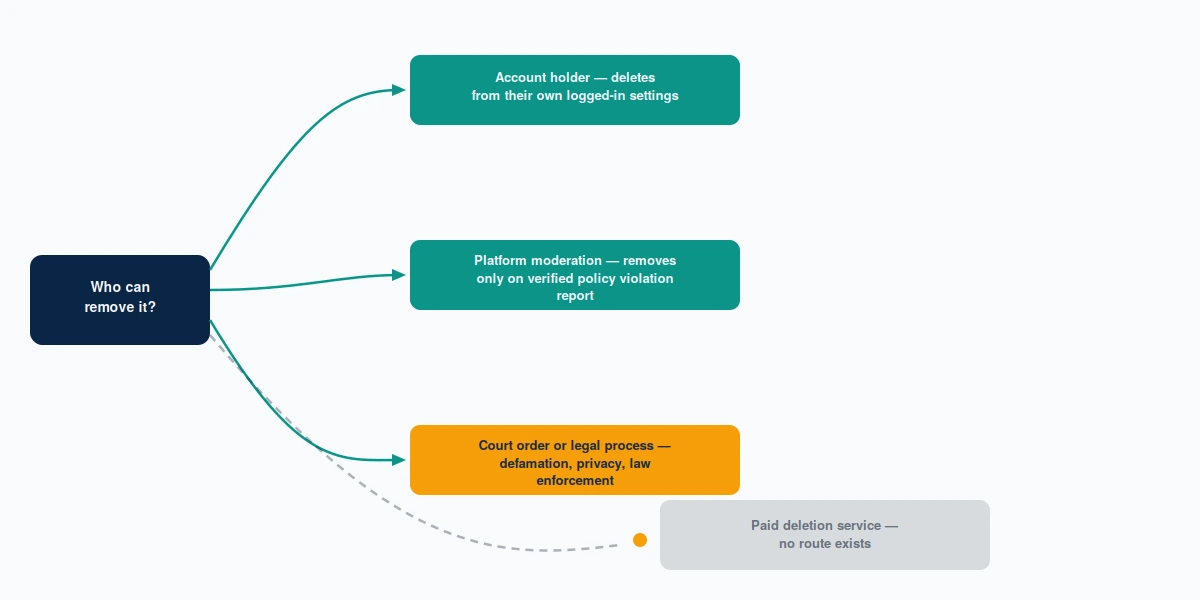
X gives exactly one account the power to delete a post: the account that published it. Delete lives inside the author's own logged-in session. There is no version of the interface — web, iOS, Android, or the API — where your account reaches into someone else's timeline and removes something from it.
People type this question a dozen ways. How to delete someone's twitter account, how to get someone's twitter account deleted, how to get someones twitter account deleted, how to delete someone's tweet. Every phrasing arrives at the same wall.
The account-level version is stricter still, because X does not offer account deletion to anyone, including the owner. What the owner gets is deactivation. The profile vanishes from public view, a 30-day holding period starts, and logging back in during that window restores everything; X's own deactivation documentation spells out the mechanic. Only after those 30 days does X begin removing the data. The button you are looking for does not exist for the person who owns the account, let alone for you.
That distinction matters more than it looks. When someone tells you an account was "deleted," what actually happened is one of two different things: a deactivation the owner can reverse inside a month, or a suspension imposed by X. They look identical from outside. They behave nothing alike, and what it takes to bring a deleted Twitter account back depends entirely on which one occurred. We have watched clients celebrate a "permanent" removal that reversed itself on day 29 because nobody checked which mechanism was in play.
Reporting is the only lever a third party holds. It is a real lever. It is also a narrow one, and it responds to evidence rather than to volume.
Three parties can remove a post on X, and a fourth that only pretends to
| Who | What they can remove | What triggers it | Control you have |
|---|---|---|---|
| The author | Any post or reply; the whole profile via deactivation | Their own decision | None, beyond asking |
| X moderation | A single post, a set of posts, or the account | A report that maps to a specific written rule | High — this is your route |
| A court | A named post, or account data, via legal order | A judgment or order served on X Corp | Slow, costly, sometimes the only option |
| A paid "deletion service" | Nothing | — | Zero. There is no fourth door. |
The fourth row is the one that costs people money. Paid X ban services market themselves as holding a channel into moderation — a contact, a partner queue, a priority lane. No such channel is sold to the public. What these operators actually deliver is the same free report you can file yourself in ninety seconds, wrapped in a dashboard and a status bar. The dashboard is the product.
The volume approach fails for a different reason, and it fails predictably. Coordinated reporting is the first thing most people try, and the mechanism is not the one people expect: X scores the reported content against policy, not the number of complainants. A hundred reports against a lawful post produce a hundred rejections. One well-evidenced report against a rule-breaking post produces enforcement. Automated mass report bots on X make the situation actively worse, because coordinated inauthentic reporting is itself a violation, and the account it lands on is the reporter's.
What does X actually remove when you report a tweet?
X removes content that breaks a written rule. Nothing else. The gap between "this post is harming me" and "this post breaks a policy" is where most removal attempts die, so it is worth being blunt about which side of the line things fall on.
The violations X acts on
- Impersonation. An account presenting itself as you, your business, or someone you represent, in a way likely to mislead. X's impersonation policy is one of the few that regularly produces account-level enforcement rather than a single-post removal.
- Targeted harassment and threats. Sustained abuse aimed at one person, or violent threats, under X's abusive behavior rules.
- Private information and non-consensual intimate imagery. Home addresses, ID documents, financial records, intimate images shared without consent. This category moves faster than anything else on the list.
- Copyright. If the post contains your photograph, video, or artwork, a DMCA notice is a separate legal channel with its own form and its own response obligations. The mechanics mirror how a YouTube video gets taken down on a copyright claim, and the US Copyright Office maintains the DMCA agent directory if you need to confirm where a notice should go.
Now the other side. X will not remove criticism you find unfair. It will not remove a true statement that embarrasses you, or journalism about you, or a labeled parody account, or a screenshot of something you genuinely posted, or a negative opinion about your business. None of these are edge cases or oversights; they are the deliberate boundary of the policy. In our casework they account for the clear majority of removal requests that never had a route in the first place, and the honest thing to tell someone in that position is that the report will be rejected and the rejection will be correct.
How to delete someone's tweet from your own thread
One mechanic gets consistently misdescribed. If someone replies to your post, you can hide that reply. The three-dot menu on the reply exposes a Hide reply option to the original author of the thread, and only to that author. The reply then moves behind a hidden-replies icon on your thread.
It is not deletion. The reply still exists on the replier's profile, still has a working URL, still surfaces in search. For the narrow problem of a hostile pile-on under your own post, it is the fastest tool available, and it needs no report, no evidence, and no waiting.
How long does an X report take?
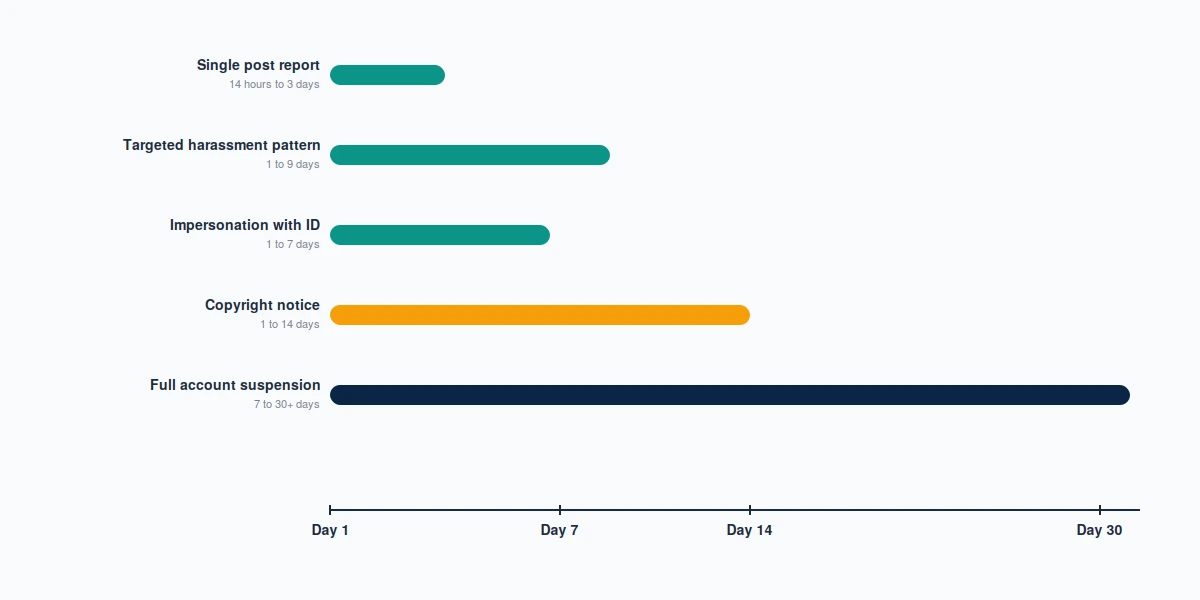
Between January and July 2026 our team filed 214 reports on X for clients. First decisions landed between 14 hours and 9 days (our internal case records, as of August 2026). Single-post reports resolved faster than account-level reports in 61 percent of matched pairs.
The spread tracks how much judgment a reviewer has to apply:
- Posts containing private information or intimate imagery are unambiguous, and those moved fastest in our sample.
- Impersonation accompanied by a submitted ID document ran one to seven days, because verification is a discrete check with a yes or no answer.
- A harassment pattern is the slowest and the least predictable. Many posts, none individually extreme, means someone has to read the whole sequence and form a view.
- Copyright notices sit on a separate legal track, often one to fourteen days.
- Account-level suspension, when it arrives at all, generally follows a series of enforcement actions rather than a single report.
Two things we have learned filing these that the help pages do not tell you. X often does not notify the reporter of the outcome, so the only reliable signal is checking the URL yourself — a 404 or a "this post is unavailable" notice means it went. And a rejection is not always final. Refiling with tighter evidence, through the correct dedicated form rather than the generic in-app flow, is the single highest-yield move we make on second attempts. The in-app flow is built for speed and volume; the dedicated forms let you attach documents, and documents are what a reviewer can act on.
Can you pay a service to get someone's Twitter account deleted?
No. The offer itself is the tell.
This market is large and close to entirely fraudulent. The recurring pitches are easy to list: a claimed insider at X, a priority review queue, a bot network that will file thousands of reports, or a flat fee with a guarantee attached. None of them describes a real capability. Moderation is not a queue you can buy into, and a guarantee in this category means the seller either does not understand how enforcement works or does not care.
What typically happens: the operator takes payment, files the free report you could have filed yourself, then goes quiet or blames you for weak evidence. In the uglier version they ask for your login "to verify ownership," which is credential theft with a service agreement attached. We never ask for a password. No legitimate firm will.
The pattern repeats on every platform, with the same vocabulary. If you want the comparison, what a paid Instagram takedown actually involves and the Instagram version of this exact question describe an identical market making identical claims.
If a post or an account is doing real damage — impersonation, doxxing, a defamation problem that is affecting your work — tell us what you're dealing with and we will tell you honestly whether a route exists. If there isn't one, we say that, at no cost.
When a court order is the only route left
This is the part almost nobody writes about, and it is the part that matters when the content is lawful but devastating.
X is a US company. Under Section 230 of the Communications Decency Act, it carries no obligation to remove third-party content that does not violate its own rules, and in practice it will not. A post that defames you is not, by itself, a policy violation. It becomes removable when a court says it is.
The sequence runs like this. You bring a defamation claim against the poster, not against X. If you win, or the poster settles, you obtain an order requiring removal. That order is served on X Corp through its legal request channel, and X honors valid court orders. Where the poster is anonymous, the first step is a subpoena to identify them, which is its own motion, its own cost, and its own timeline measured in months rather than days.
We advise clients to go this route when four things hold at once: the content is provably false, it names them, it is causing quantifiable harm, and the poster is identifiable and within reach of a court that can actually enforce against them. When any one of those fails, litigation usually costs more than it recovers. In that case suppression work — pushing the post down in search results over 90 to 180 days — is the more honest recommendation, and our reputation and takedown services start from that assessment rather than from a promise.
How to get someone's tweet deleted when it targets you personally
Work the ladder in order and stop as soon as something works.
- (a) Report the specific post under the specific policy it breaks. Attach a screenshot, the post URL, and one line stating the harm.
- (b) If it is impersonation, add government ID; that single attachment is what converts a slow review into a fast one.
- (c) If the post contains your image or footage, file the copyright notice instead of a report. Different channel, different obligations, better odds.
- (d) If it is lawful but defamatory, speak to a lawyer before you speak to anyone selling removal.
- (e) If the account has a documented pattern rather than one bad post, the full X takedown walkthrough covers the account-level escalation path in more depth than this page does.
What we won't do, and what to do if the account in question is yours
We do not file reports we know to be false. We do not submit DMCA notices over content we do not own, we do not run or hire report bots, and we decline cases where the underlying complaint is "this person criticized me and I want them gone." These are not lines drawn for marketing copy. Fraudulent reporting is a violation on the reporter's side, and it is a fast route to losing your own account while the post you objected to stays up. Our service limitations are written out plainly rather than buried in a footer.
We also do not guarantee outcomes. Nobody legitimately can, on any platform, at any price, and an operator who does is telling you something useful about themselves. What we do is assess whether a case has a policy hook, build the evidence package, file through the correct channel, and escalate on rejection. The team doing that work came out of platform trust and safety operations, which is mostly useful for recognising which requests are hopeless before anyone spends money on them.
One more scenario, because it is more common than you would expect. If you landed here because your account took the hit — mass-reported into a suspension, or deactivated during a dispute — the process runs in reverse and the clock is the thing that matters. Deactivation reverses on its own if you log back in inside 30 days. Suspension needs a written appeal, and the appeal is stronger when it is filed within days rather than weeks. Either way, move inside the window. After it closes, the options narrow sharply and the cost of every remaining one goes up.