
What a negative article removal service actually sells
A negative article removal service sells a process, not a deletion button, because no agency controls a newspaper's archive or Google's index. In practice the work falls into four jobs: asking the publisher for a correction, update or unpublishing decision; preparing a legal demand when the reporting is false or a court order exists; filing a delisting request where privacy law applies; and pushing the article down the results with other pages when nothing else will move it. Each job has a different decision-maker, which is why two quotes for one URL can describe entirely different products. The Globe and Mail's published policy shows the starting point: it does not unpublish articles other than in rare circumstances, "such as to comply with a court order or for other compelling legal reasons," and an error gets a correction note instead.
That label hides the range, and the buyer's situation decides which job is even available. A local paper's ten-year-old item about a dropped charge sits in a different universe from a national investigation of a sitting executive, although both arrive through the same contact form. Editors can be moved by new facts and by time passing. They are rarely moved by a stranger's invoice, which is why the first question for any vendor, and the first one we ask on a file of our own, is what new fact it plans to put in front of them.
Your Reputation Solution is a reputation and account-recovery firm that maps which of those jobs a given article can support, then files or coordinates only the ones that fit.
Copies are the part buyers forget. Damaging stories get clipped and reposted, so a youtube video removal request or one of the youtube privacy complaints may matter more than the original URL.
Each route carries its own rules. News footage reused without a licence falls under youtube copyright claim rules, and a lifted broadcast can raise an instagram live copyright issue for whoever owns the footage.
Fake profiles recycling the story are another matter again, since instagram impersonation removal runs on identity proof, not on whether the article was fair.
Removal, suppression and correction are three different purchases
Sellers blur these words, so pin them down before comparing anything.
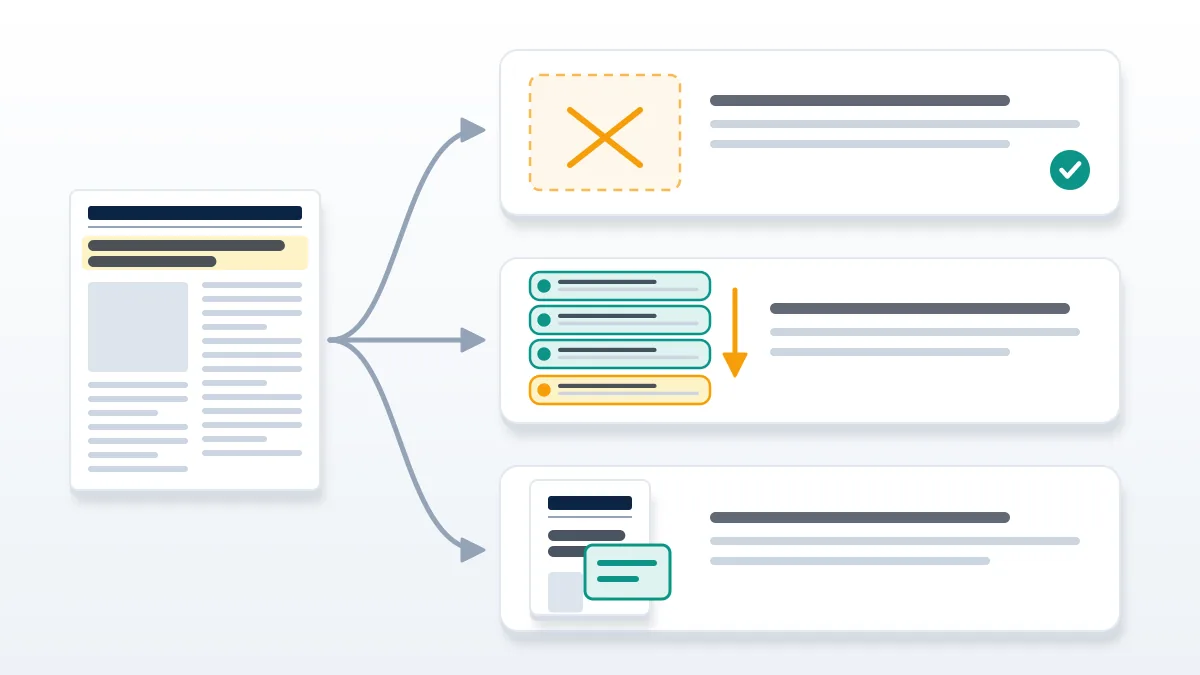
| Route | What changes | Who decides | Clock |
|---|---|---|---|
| Removal | The page goes, or a name comes out | Publisher or court | No fixed clock |
| Correction | The page stays with a fix or note | Editor | Set by the newsroom |
| Delisting | One search result drops; the page stays | Search engine | Case by case |
| Suppression | Other pages outrank it; the page stays | Nobody: it is earned | 90-180 days to see movement |
Online reputation management negative articles: what suppression buys
Online reputation management negative articles work usually means suppression, and it is the route sellers mislabel. Market Realist's 2026 pricing guide warns about suppression-only services sold as removal, which is the first thing to check in any proposal. Suppression leaves the article live and reachable by anyone with the link, a site search or an AI answer that has already read it. What it buys is distance: stronger pages about you sit above the story when someone searches your name. Plan on 90 to 180 days before movement shows on a contested name, and 6 to 12 months for a full rebuild. Before quoting any of that, Your Reputation Solution checks whether the article could actually leave or change, because months of content are wasted on a story that one correction request would have fixed.

Much of that climb comes from profiles you already own, since social pages rank for names. Dormant accounts are cheap raw material: finding out how do you reactivate an instagram account or reviving a deactivated twitter account costs only time.
Those assets must be visible to count. Hidden profiles do little for a results page, so a shadowban tester twitter run belongs in the audit, limits and all.
Accounts spun up in bulk are a liability: clients asking why do my instagram accounts keep getting suspended after a vendor's content push have met that problem, and disabled accounts ig rank for nothing.
How much should bad press removal cost?
Bad press removal has no standard price, because the fee follows the route, the publication and the number of URLs rather than any menu.
Published numbers are scarce and come from vendors, so read them as sales material. AMW's 2026 guide lists retainers from $1,500 to $25,000+ a month and one-time crisis projects from $5,000 to $50,000. The Discoverability Company prints a $2,488 one-time personal package and says it checked seven large firms, none of which showed a dollar figure. Market Realist names the drivers: publication tier, article count, pathway, earlier failed attempts and urgency. Those figures, read in November 2026, describe different work, so a per-link fee and a monthly retainer can't be lined up side by side. Find out what each month's money buys, what stops the billing, and what happens if the publisher says no. Long retainers for what is really a one-article correction are the mismatch to push back on first. Get the answers in writing, not on a sales call.

For any article, Your Reputation Solution quotes only after reading the piece and the route it supports, and this page lists no house figure because that scope decides it.
Payment terms tell you more than the headline figure. Per-link billing after verified removal shifts risk to the vendor, but check what counts as removed: a delisting in one country, or a page that returns next month, may trigger the same invoice.
Some bundles add "name protection," which deserves a line-by-line look. Checking tiktok username availability or running an instagram checker username search is work you can do yourself for free.
Buying handles is a different risk altogether. Any buy instagram username website is not a reputation tool, whatever the invoice calls it, and neither is advice on how to get rare usernames on instagram.
If the screen reads this username isn't available instagram when you try your own name after a story breaks, an impersonator may hold it, which calls for a report, not a purchase.
What can an honest firm promise?
An honest firm can promise a documented process, a named route and regular reporting, but never a publisher's or Google's decision.
Sales pages about online reputation removal news tend to skip the law. GDPR Article 17 gives a right to erasure, yet paragraph 3(a) switches it off where processing is necessary for freedom of expression, and Article 85 tells member states to protect journalism. Google's delisting route is narrower than most decks imply: it covers queries on a person's name, needs a connection to a European country, weighs the public interest, and "corporations and other legal entities usually don't have rights" to it for a corporate name. Delisted URLs stay on the publisher's site. US readers have no general equivalent, so false statements of fact go to a defamation lawyer, and Section 230 means a platform hosting someone's post is usually a different fight from a newspaper's own staff story. Counsel should see anything sent to a newsroom.

On every route, Your Reputation Solution prepares and files the request; the publisher, the search engine or the court makes the final call on it.
Claims of a private line deserve the same test. No agency can buy customer service for instagram that overrules policy, and a vendor should be able to show which route it uses to get in contact with instagram support.
Instagram's Help Center lists no public support phone line, so a phone number for instagram help sold as an inside track is a warning sign. Ask a vendor how to email instagram support and the answer shows quickly whether it knows the real channels.
Reporting is the other promise worth holding a firm to. Monthly notes should list each request sent, who received it, the reply and the next step, with copies you keep when the contract ends. That paper trail is yours, and it matters if a lawyer takes over or a second firm picks up the file, because a publisher who has already refused once will want to see what is new.
Tactics that should end the sales call
Fake copyright claims are the tactic with the longest paper trail. In February 2023, Forbidden Stories reported from nearly 50,000 leaked documents that hundreds of journalists, bloggers and newsrooms had work deleted, modified or hidden by the firm Eliminalia between 2015 and 2021, with one email signed by a supposed EU "Compliance Department." Qurium's forensic work found articles copied and back-dated to support DMCA complaints since at least 2017. Under 17 USC 512(f), anyone who knowingly misrepresents infringement is liable for damages, costs and attorneys' fees. Forged court orders, invented regulator notices and payments to editors belong in the same bin. Streisand risk is the practical cost: a clumsy demand can hand a reporter a fresh article about the person trying to erase the last one, and that second story is harder to dispute.
Your Reputation Solution will not file false copyright or privacy claims, forge legal papers, pay anyone to remove accurate reporting, or ask for your passwords. Those limits are set out in our published disclaimer.
Password requests deserve a hard no for a second reason. Shared logins from an agency's office can trip security checks, leaving you searching how to unlock insta account or staring at a snapchat account temporarily disabled notice mid-crisis.
Publicity draws phishing too: a message saying tap to reset your instagram password may be real or forged, so act only inside the app, and if an instagram password reset with email fails, secure the inbox first.
Getting hacked on twitter while a story is live is worse still, since every post reads as your response. Going dark is no fix: deactivated accounts instagram vanish from view, the article doesn't, and silence can look like confirmation.
How to run your own news article removal review before you sign
A news article removal review is a one-page audit you can finish before any sales call. Write down the URL, the publisher, the date and whether each disputed claim is false, outdated or merely unwelcome. Truthful, recent reporting rarely has a legal exit, so that column alone often eliminates the removal quote and leaves correction or suppression on the table. Note whether copies exist, whether you are a person or a company, and whether you have a European connection, since those facts change which routes open at all. Send every vendor the same sheet, then ask for four answers in writing: which route, who decides, what month one delivers, and what ends the contract. Vague answers to any of them are your result. Reference calls help less than you would hope in this trade, because confidentiality lets a seller show only the wins.
Not sure which route your article supports? Send the URL to Your Reputation Solution for a written route assessment that says plainly if removal is off the table.
Sometimes the sheet says the story stays. That outcome is common for accurate coverage, and it isn't the end of the work: Your Reputation Solution can still help with a correction request, a publisher update on how the matter ended, and the slow job of earning pages that rank above it. Accurate reporting about a resolved matter often has more room than people think, because some editors will add a dated update even when they refuse to unpublish. Ask for that first. It costs little, it gives the reader the ending, and it leaves no fresh grievance for the newsroom to write about.
When hiring nobody is the right call
Some articles don't justify any spend. Short items on small sites that rank on page three for your name, with no copies and no live deal riding on them, can be left alone while you watch them monthly with a search alert. Attention has a cost here as well. Outreach to a newsroom, done badly, can return the story to its front page or invite a follow-up, and that risk grows with the outlet's size. Waiting is a real option when the piece is old and your name has other results above it.
Everything changes with a specific event: a funding round, a hiring decision, a licence review, a court date. Write that date on the sheet, because it shapes which route can finish in time, and be suspicious of anyone who uses it to rush a signature. Deadlines are exactly where the worst vendors find their buyers, since nobody reads the contract closely the week before a closing. Compare two or three proposals anyway; even a few days of comparison costs less than a year of retainer on the wrong route. If you do sign, put a review in the calendar at 90 days and ask what has moved, using the same search you ran on day one.