
Does an Instagram spam report bot actually work?
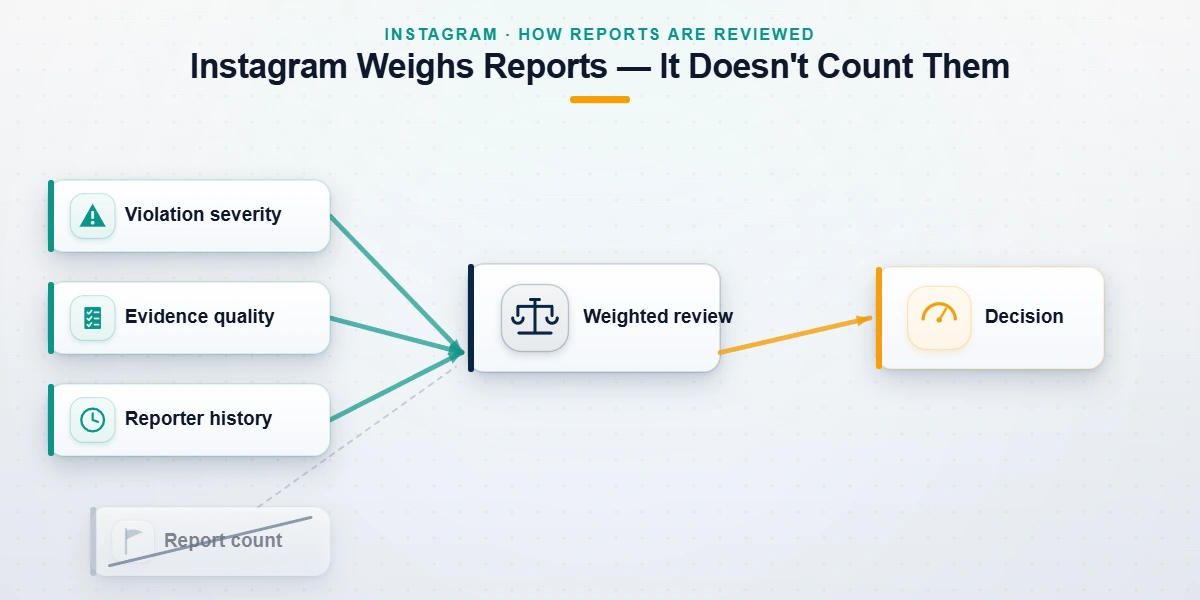
No. An Instagram spam report bot cannot get an account banned, because Instagram weights reports rather than counting them. Every report that reaches Meta — whether you file one by hand or a script fires ten thousand — enters the same triage queue and is scored on the severity of the alleged violation, the quality of the evidence attached to it, and the reporting account's own history. Volume is not one of those inputs. That is the whole reason an instagram report spam bot cannot deliver what it advertises: it optimises the single variable the system was built to ignore.
There is a second, quieter reason the product cannot work. Identical complaints filed against the same target are deduplicated before review rather than stacked, so a thousand copies of one report arrive at a reviewer as a single weak signal. A spam bot instagram report burst therefore does not just fail to add pressure; it lowers the credibility of every report inside it, because machine-identical complaints arriving in seconds are precisely the pattern Meta's abuse detection is tuned to discount. Deduplication runs across Meta's other surface too, and the Pages-and-Groups version of this question starts by asking which Facebook surface is actually in play rather than how many complaints arrived.
This page covers the automated side — the scripts, APKs, Telegram panels and paid bot services sold as Instagram report software.
What an Instagram spam report bot claims to do — and what it actually is
The claim never varies: paste a username, pay a fee, and the account disappears within days. What you are actually buying is a wrapper around the same public Report button every Instagram user already has for free. The software has no privileged access, no special endpoint, and no relationship with Meta. It automates a form.
You will find that wrapper sold under a dozen names — as a spam report bot instagram listing, a spam report instagram bot, a report spam bot instagram panel, a spam report instagram account bot, or plainly a report spam instagram bot — and the pitch never changes. Neither does the ceiling. Whether it reaches you as a Python script, an Android build, a web dashboard, or a Telegram handle taking crypto, the underlying action is one automated tap of a button that Instagram already weights against automation.
How Instagram actually processes reports behind the scenes
A submitted report does not go to a counter. It enters a triage queue where automated classifiers make the first assessment and anything ambiguous or high-stakes is routed to a human reviewer. Three things decide the outcome: how severe the reported violation is, how much verifiable evidence supports it, and what the reporting account's own history looks like. Meta describes the shape of this process in its Transparency Center, and its enforcement reporting shows that the large majority of violating content is detected proactively by automated systems before any user reports it at all. For genuine violations, user reports are rarely the deciding factor. For content that breaks no rule, no quantity of reports produces a removal, because quantity was never an input to the decision.
What a coordinated burst does change is how the reports themselves are scored. Reporting accounts carry a history, and reports arriving from fresh, empty or automation-flagged profiles are weighted below reports from established accounts with a record of accurate flags. Add matching device fingerprints, identical wording and a tight time window, and the batch reads as manipulation rather than evidence — which is why a bot campaign routinely ends with the reporting accounts restricted while the target is untouched.
What the GitHub scripts, APKs and Telegram panels take from you
The most expensive thing about a free report bot is not the price. Several of the most-forked public Instagram report scripts do not run at all until you supply working Instagram logins: the install instructions ask you to paste username and password pairs, in plaintext, into a text file the script then reads. You are not renting a weapon. You are handing unknown code a credential list, and the accounts on that list are the ones exposed.
The variants differ mainly in how they take it. Android builds distributed as an APK or through a terminal emulator ask for the same credentials on the device that also holds your email and banking apps. A smaller group of no-login scripts avoids credentials by fabricating one specific false claim — reporting targets as underage — which trades account theft for knowingly filing a false report. Panels and Telegram storefronts add proxy rotation and "warmed" accounts, marketed as stealth. In practice each of those techniques is itself a recognised abuse signal, because someone reporting a genuine spam account has no reason to route it through a proxy pool.
We deliberately do not link to any of these repositories, panels or download pages. Naming the pattern is useful; sending traffic to it is not.
"Buy," "free," "guaranteed" — how report bot sellers price and disappear
No seller in this market can produce a verified takedown of an account that broke no rule, and the guarantees attached to the offer are unenforceable by design. The pricing itself gives the product away: reports sold by the batch at fractions of a cent, wrapped in "quality" tiers that describe nothing technical, with money-back promises payable by an anonymous handle. The payment rails match the promise — crypto and gift cards leave no chargeback path, so a refund exists only for as long as the seller keeps answering messages.
The legal position is routinely misstated too, including by the bots' own disclaimers, which tend to frame the problem as a licensing issue. It is not. Running one is first a breach of Instagram's Terms of Use, which prohibit automated access. Beyond that, coordinated inauthentic reporting is an enforceable policy violation in its own right, and the buyer is the exposed party rather than the target. Where reports are knowingly false against a named person or business, the exposure stops being a platform matter and starts resembling harassment or defamation in many jurisdictions. In the Instagram cases that reach our desk, a recurring share arrive from people who had already paid for an instagram spam bot report package — and a number of those clients had been restricted themselves, while the account they were aiming at carried on untouched.
If what you are researching is organised groups of real people rather than software, that is a different mechanism with a different fix, set out in our guide to mass reporting an Instagram account. If a seller has already taken your money, report it at reportfraud.ftc.gov.
If a report bot has been aimed at your Instagram account, here's what to do
Act on the restriction, not on the attacker. A report wave cannot delete a rule-following account by itself, but it can trigger an automated review, and a false positive occasionally lands before a human corrects it. If your account has just been restricted or lost content after an obvious pile-on, work in this order:
- Screenshot the restriction notice with the timestamp visible, along with any comments or messages where people announce they are reporting you. This is the record that later proves the campaign was coordinated and false.
- Do not appeal twice. Duplicate submissions reset your position in the queue and read as noise; one clear appeal outperforms five.
- File the in-app appeal once through Account Status, state plainly that the action was a mistake, name the policy cited, and record the case reference.
- Gather identity evidence before the form asks for it — a photo ID, and for a business, registration documents.
- Escalate if the appeal auto-denies rather than resubmitting the same text into the same queue.
Restricted or removed after a report wave? Send the details to our recovery team for a free 60-minute case review. Our Instagram work is led by a former Meta Trust and Safety specialist, and we will tell you honestly whether the case is actionable before you spend anything.
How to report a real spam or bot account the legitimate way
If a genuine spam or bot account is targeting you, the working route is short and free: Profile → ⋯ → Report → Report Account → It's posting content that shouldn't be on Instagram → Spam. One detailed report from an account with clean history outperforms a thousand automated ones, because the reviewer is judging the violation and the evidence rather than the volume.
Match the route to the harm. Impersonation of you or your business goes through Instagram's dedicated impersonation form, which asks for photo ID. Stolen photos, video or brand assets go through Meta's intellectual property route, which runs on a separate and usually faster track. Sustained harassment should be documented — dates, handles, screenshots — before you file, because that documentation is what makes an escalation actionable. Criminal conduct belongs with law enforcement first, with the platform report as supporting evidence rather than the remedy. Instagram sets out the basic flow in its own help centre. The same evidence-first logic governs takedowns on Instagram, Facebook, X/Twitter and TikTok.
The bots fail identically on every other platform, and the sellers simply re-skin the same offer per app — we have written the honest version for TikTok, Telegram, Snapchat and X mass report bots, alongside the legitimate takedown routes for Snapchat, Telegram, YouTube and WhatsApp.
What we will and won't do about Instagram report bots
We do not build, sell, operate or resell report bots, panels or scripts, and we will not file automated, false or coordinated reports for anyone — the mechanism does not work, and the practice is abuse. We do not guarantee that any account will be removed. We never ask for your password or a verification code. We do not file fraudulent copyright or impersonation claims to force a takedown that was not earned.
What we do is the other half of this problem: getting people back online after a wrongful restriction, and untangling accounts compromised by a tool the owner installed themselves. That work runs through our Instagram account recovery service, is handled by credentialed specialists, and the limits of what we will take on are written out in our disclaimer. Ava Chen, who leads it, spent four years inside Meta's Trust and Safety organisation, where automated-abuse and coordinated-reporting detection was part of the daily work. The short version from that side of the glass: ban-on-demand was never a product. It was a story told to people with a real problem.