Reading a twitter mass report bot order form before the money moves
Most readers reach this page with a panel open in a second tab. Six things on it take two minutes to check, and each returns something the seller would rather withhold.
Six checks that work on the tab you already have open
The unit price. Divide the package price by the report count. One panel we priced on 5 August 2026 headlines 1,000 reports for $0.90, nine hundredths of a cent each; another cuts its ten-thousand block by 67 percent as a bulk price. A price falling as quantity rises prices database rows, not enforcement.
The payment rail. Read the checkout logos first. That panel takes Wise, Bitcoin, Binance, Perfect Money, Payeer, Tether, Skrill and PayPal. Count how many of the eight allow a chargeback. On Bitcoin, Tether, Perfect Money and Payeer, none do. Rails get chosen before products do.
The delivery promise, against X's clock. X's reporting guidance says it acknowledges properly submitted reports within twenty-four hours and that resolution may take thirty days. Panels advertise two to eight hours. Sellers promise a finished outcome inside the window X reserves for saying "received".
The provenance of the success rate. Search the exact percentage in quotation marks. On 5 August 2026 that 92 percent figure came back across at least seven storefronts and one public code repository. One number on seven storefronts is one page sold seven times.
Who the seller says is filing. Hold the answer against X's enforcement philosophy. It names five factors X may weigh, one being whether the report came from the target of the abuse or a bystander, and says that in some scenarios X requires a report from the target or their authorized representative. A rented account is neither. Not a volume problem. An identity problem.
The policy quoted as cover. Open it. Sellers still name X's Misuse of Reporting Features policy as their authority, and as of 5 August 2026 that address redirects to Authenticity, dated April 2025, which prohibits "coordinated inauthentic activity that artificially influences conversations or disrupts X". A panel filing from rented handles is coordination by definition. The rulebook quoted at you stopped being the operative document some time ago, and what replaced it reaches the buyer.
None points toward a safer panel. For anyone weighing whether to buy mass report twitter volume once, cheaply, as an experiment: this market has a fixed shape, and the order form shows it.
The same twitter mass report service under seven brand names
A June 2026 sweep of this cluster's search results turned up seven or more domains running the same body copy behind different brand names, each quoting an identical 92 percent success rate with no method and no verifiable case. On 5 August 2026 all seven were still ranking, joined by two slide-hosting PDFs and a code repository whose description reads like a landing page. Only the brand changes.
Here is the network describing itself, collected verbatim from the storefronts ranking for this keyword set:
"92% enforcement success rate" · "2,000+ documented cases" · "results delivered within 2 to 8 hours" · "free GitHub scripts struggle to crack 30 percent" · "Fewer than 12% of single-source reports receive even a first-pass review within 7 days"
None of those figures carries a source, a sample, a date or a method. Worst of the set are the last two, because they are technically literate: a plausible denominator, no way to check it. A twitter mass report tool with a real 92 percent enforcement rate would be the most consequential product in trust and safety, and its vendor would publish the method.
When seven storefronts publish one number, that number is not evidence about enforcement. It is evidence about the supply chain.
What nine hundredths of a cent per report can actually fund
Run the division and the product stops being mysterious. At $0.90 for 1,000 reports, one report costs $0.0009, which cannot buy a person reading a policy, matching it to a post and writing a submission that survives review. It buys a row. Enforcement does not get cheaper by the crate.
Now the queue's other side. X's DSA transparency report for 1 October 2024 to 31 March 2025 puts content-moderation headcount at 1,486 people, 602 of them in role under a year. Its notice tables log illegal-or-harmful-speech reports in the tens of thousands per country per half-year, 28,849 from Germany and 25,983 from France, and its median handle time table shows those closing in 1.5 hours in Germany and 5.6 in France.
"Our continued investment in proprietary technology is steadily reducing the burden on people to report this content to us."
That queue already closes serious notices in a median of a few hours, so the two-to-eight-hour delivery window sold across this market is not a service. It is the queue's own speed, resold at ninety cents a thousand.
T+0, the checkout and what it takes from the buyer
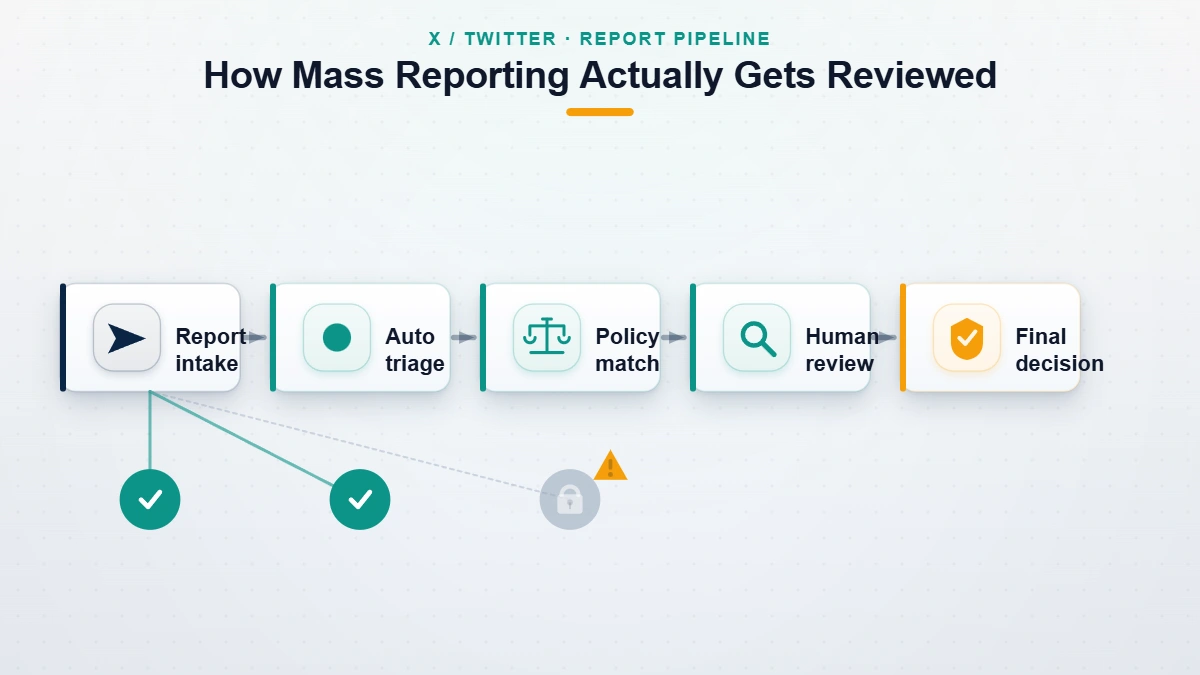
From the moment payment clears, the sequence that follows happens to the buyer's account, not the target's. Five stages, starting at the checkout.
Two product shapes dominate, and they take different things. The panel takes money and a handle, asks for no credentials, and that is precisely why it can promise your account stays untouched and why it can never file as the target. The open-source route takes something else: the public scripts ranking for x mass report bot and for mass report twitter account bot drive a real browser through Selenium and need an X username and password to sign in as you, turning a purchase into a credential handover and a session into an instrument somebody else operates.
X's Authenticity policy speaks to that second shape directly:
"Unauthorized automation: Automated or scripted accounts that do not comply with our Developer Policy. Please note that as a user you are ultimately responsible for third-party applications you may authorize to access or use your account."
Read the last clause twice. Responsibility sits with the account owner, not the tool, so every consequence below attaches to the buyer. Sellers carry none of it. That asymmetry is the product.
T+ first filings, where a mass report twitter campaign actually lands
Reports filed through a panel enter the same intake as everyone else's. X sets that clock itself:
"X acknowledges properly submitted reports within twenty-four hours. Although reports are typically resolved within a few days, resolution times vary and may take thirty days to reach resolution based on factors that are often outside of X's control, such as the need for user input and whether a user chooses to appeal."
X's help page for reporting a post adds a line sellers never quote: depending on the issue, you may or may not hear back with an outcome. So the buyer's first signal is usually nothing. Then the panel sends a screenshot.
One narrow circumstance does produce a visible effect, and it is where every seller screenshot comes from. An account created days ago, with no posting record, can be pushed into a temporary lock pending phone verification, and a lock looks like a suspension once the image is cropped. In the X enforcement disputes our team has worked since January 2025, that state unwinds within hours to a day once the challenge clears and the content proves clean. That screenshot is real. What it shows is not what was sold, and that gap is the economics of mass reporting twitter accounts in one image.
T+ dismissals, what a wall of closed cases signals back
By day two or three most reports have closed unactioned, which is when the buyer asks for a refund and learns which rail they used. X publishes the criteria behind that.
"When determining whether to take enforcement action, we may consider a number of factors, including (but not limited to) whether: the behavior is directed at an individual, group, or protected category of people; the report has been filed by the target of the abuse or a bystander; the user has a history of violating our policies; the severity of the violation; the content may be a topic of legitimate public interest."
Five factors, and report count is not among them. That absence carries the argument, and it is no inference about X's internals, it is what the published document says and does not say. Factor two is the one a mass report bot twitter operation can never satisfy, since the same page requires, in some scenarios, a report from the target or their authorized representative. Volume cannot manufacture standing.
Does mass reporting work on twitter when every case closes unactioned?
Here a mechanism answers better than a verdict does. What is mass reporting on twitter, in practice, is many separate cases opened against one account inside a short window, each judged against one named rule. If the rule was broken, the first accurate report opened the review and the other 999 changed nothing. If it was not, a thousand reports produce a thousand closures and a pattern the filing accounts now own.
T+ automation detection, the rule a mass report twitter bot runs into
Almost nobody prices in the stage where the platform stops examining the reports and starts examining the accounts filing them. Two Authenticity clauses cover it:
"Multiple Accounts and Coordination: We prohibit coordinated inauthentic activity that artificially influences conversations or disrupts X."
"Content Spam: You may not share or post content in a bulk, duplicative, irrelevant or unsolicited manner that disrupts people's experience."
Then there is the climate they are applied in. In February 2026, as X rolled out expanded automation detection, the executive Social Media Today and PiunikaWeb both describe as X's product lead, Nikita Bier, set the threshold in one sentence: if a human is not tapping on the screen, the account and all associated accounts will likely be suspended, even if they are only experimenting. Sit with the second half: associated accounts, not just the one running the script.
Sellers fill the gap in what X publishes with invented thresholds. X maintains a technical limits page capping daily direct messages, posts, replies, email changes and follows. It carries no report limit and no report threshold. Neither the seller's number nor a submission ceiling can be sourced to a live X document, so this page asserts neither. Our guide to avoiding an X ban covers the behaviours that trip automated enforcement.
T+ suspension, what March 2026 looked like from inside X
Suspensions began arriving around 12 March 2026 and ran into April. Users and developers reported notices citing aggressive and random reposting or liking, and indiscriminate following, with appeals rejected within seconds by an automated lane.
An honest version of that record includes its correction. Bier later said a new spam filter had carried a bug that falsely flagged a subset of accounts for around twelve hours, and that 99 percent of them had been reinstated. It cuts both ways. The wave caught people who had done nothing, and the machinery a twitter mass reporting campaign runs into during 2026 is tuned to suspend first. We have seen no evidence placing mass-report buyers among the suspended. That record establishes climate, not causation.
Where the ladder ends is documented. Under its "How we enforce" heading, the Authenticity policy says:
"The consequences for violating this policy depend on the severity of the violation as well as any previous history of violations."
X's enforcement philosophy fills in that escalation: education first unless a violation demands immediate suspension, hardening on repetition, permanent suspension past that point. One 2026 consequence is easy to miss. X's guidance on suspended accounts states that a suspension under the Child Safety or Violent and Hateful Entities policies costs the account its X Money access, with any balance mailed as a cheque. A buyer who set out to get somebody else suspended has, by this stage, put a payments relationship on the table.
The line our team holds when this request arrives
We get asked to run these campaigns, usually by people who have read this far and want to know whether the refusal is real.
Our team does not file coordinated reports for clients, even against a genuinely abusive target, because the pattern discredits the one honest report inside it. We do not sell report volume as a service, resell panel capacity, or promise that any account will be suspended, because no provider controls that decision. No stage of our work requires a password, a two-factor prompt or a one-time login code, because an appeal does not need them; a provider asking for all three is collecting credentials rather than building a case. Some categories cannot be recovered, and we say so before taking work: suspensions under child safety, violent and hateful entities, or sustained harassment sit outside what an appeal reaches. Those boundaries sit in the limits we publish and our guide to a permanently suspended X account; the people who hold them are on our team page.
Where money has already gone to a panel, the FTC's fraud reporting portal puts the complaint on record. Anyone weighing a paid takedown provider instead should read our analysis of what an X ban service delivers.
Holding an enforcement notice and unsure which policy it cites? Send it through our contact page with a short timeline. We read the policy text against your content before anyone discusses scope or cost.
Which state the targeted account is actually in
Two rules hold before any of the four states below, and both get broken in hour one.
The first is about evidence, and it points somewhere people do not expect. Screenshots of the coordinating replies, the timestamps and the handles are not primarily appeal attachments. They are the raw material of a targeted-harassment counter-report, an action against the organisers rather than a defence of their target. Brigades scrub their traces the moment a target reacts, so the record either gets made in the first hour or it does not get made at all.
Deletion is the second. Pulling your posts mid-review rarely withdraws the reports filed against them, reads as an admission in the audit trail, and removes the reviewer's chance to see that the content matched no rule. Three reasons, one instruction: leave it up.
The four states, and the one route out of each
No action yet. Replies announcing a reporting campaign, and nothing else: no notice, no reach change, no challenge. Easily the commonest state. Document the pattern, stay out of the thread.
Reach throttle. Impressions collapse and no notice arrives. X's enforcement options include actions aimed at one piece of content instead of the account behind it, so a throttle can be a content-level decision that never generates an account-level message. The route out is the visibility appeal, set out in our guides to clearing an X shadow ban and the shadow ban appeal.
Locked. A challenge appears, usually phone or email verification, on a device that has not changed:
"Verifying account ownership: We may require an account owner to verify ownership with a phone number or email address. Note that when an account has been locked pending completion of a challenge (such as being required to provide a phone number), it is removed from follower counts, Reposts, and Likes."
Clear the challenge first; our walkthrough on a locked X account covers a failed one.
Suspended. The account is gone and a notice names a policy. Only here does the appeal below apply, and the sequence lives in our guide to a suspended X account. Read the cited policy first: an appeal arguing against a rule the notice never mentioned reads as an unrelated complaint. Identifying which of the four a mass report x account attack produced settles everything that follows.

An appeal that names the pattern instead of the person
This artifact has a name and a gate. X routes a suspended account to a form titled Appeal a locked or suspended account, and you must already be signed in to that account; from a signed-out browser it reports that you are not logged into a suspended X account. Sign in, then open the form in a new tab.
The appeal has to pass a three-part test, in this order. Name the coordinated context, so the volume reads as evidence rather than an accusation against you. Quote the exact policy the notice names. Then show, in two or three sentences, that the content falls outside its definition. Across the X enforcement disputes in our case file, the appeals that moved did those three things; the ones arguing good character did not.
We open every mass-report-linked appeal the same way: one paragraph on the account and how long it has run without incident, then one establishing the campaign as a pattern, with dates and handles. Everything after that is policy argument. If the first attempt fails, escalate rather than refile, since an identical resubmission lands in the same automated lane. That path is in our X account unban guide, the wider sequence in our X account recovery walkthrough.
One figure from our own records belongs here. In our X enforcement case notes covering January 2025 through June 2026 (n=94), suspensions later overturned on appeal with no change to the content made up roughly 11 percent of the file. A minority, and the honest number. No appeal we write carries a guarantee.
The version of this that works, and what it costs to run
There is a version of this that produces removals, and it looks nothing like a panel order. One documented report, filed from an established account with a history of its own, against a specific named rule, with the reported post still live and matched to that rule, moves faster than five thousand throwaway duplicates. The clause doing the work is "still live": a reviewer who finds the evidence deleted has nothing to act on, which is also why deleting your own posts backfires.
Categories that get actioned are narrow and each carries its own flow: impersonation, doxxing, threats of violence, non-consensual intimate imagery, targeted harassment, and child sexual abuse material. Our pillar guide to taking down an X account walks each in turn. Copyright runs separately, through X's designated agent in the US Copyright Office DMCA directory, and court orders through X's legal requests portal. That map also explains the search results. Queries like how to mass report someone on twitter return storefronts, as do the variants asking how to mass report on twitter or, more bluntly, how to mass report a twitter account. No bulk interface exists, so the results fill with people selling its absence.
That leaves the plain one, the trade this market depends on you never making. A DMCA notice, a harassment escalation or a defamation claim costs more up front than a panel subscription and requires you to be right about the facts, and it produces outcomes that hold. The panel costs nine hundredths of a cent per report and produces a screenshot. Priced by result rather than transaction, the expensive route is cheaper.