
What a LinkedIn account takedown actually removes
A LinkedIn account takedown is a request that LinkedIn remove, restrict, or terminate a profile, post, or company page because it breaks the Professional Community Policies or the law. You cannot delete another person's account yourself. You file a report, a Trust and Safety reviewer assesses it, and LinkedIn decides. That single fact governs everything else on this page, including which promises from a paid provider are worth believing.
One boundary before anything else. This guide is for people removing an impersonating profile, a fake recruiter account, stolen content, or defamatory posts aimed at them or their business. It is not a method for getting a real person banned because you dislike them. We decline those requests, and LinkedIn is built to resist them: organised reporting against a legitimate profile does not remove it, and it can draw enforcement onto the reporting accounts instead.
Three different outcomes hide behind that one phrase, and confusing them is the most common reason a genuine case stalls.
| Outcome | What LinkedIn does | Evidence bar | Observed window |
|---|---|---|---|
| Content removal | Deletes a specific post, article, comment, or image | Moderate — the item itself must breach a policy | 2–10 days |
| Profile restriction | Limits, hides, or locks the offending profile pending review | High — a pattern of violations or verified impersonation | 5–21 days |
| Account termination | Permanently bans the account behind it | Highest — repeat or severe breach, fraud, or a legal order | 14–45 days, often after appeal |
Most people arriving here want the middle row and describe it as the third. The mismatch matters. Evidence sufficient to delete one defamatory post is nowhere near what LinkedIn wants before it terminates a five-year-old profile with three thousand connections, and a request pitched at the wrong tier gets refused at the wrong tier. Decide which outcome you are actually asking for, then build the case for that one. Company pages follow the same ladder but add a wrinkle: they are reported through the page itself rather than a member profile, and an unpublished page can often be restored by its admin, which makes it a weaker target than people expect.
Removal is also not the end state most people imagine. Determined impersonators rebuild, sometimes within days, often using a near-identical profile scraped from the same public data they used the first time. Serious cases need monitoring rather than a single filing.
If your own account is the one that was seized, this is the wrong page — start with recovering a hacked LinkedIn profile instead. That same three-tier logic governs taking down a Facebook account or page, where Meta separates post removal from page unpublishing in exactly the same way.
Which LinkedIn takedown request form fits your case?
Picking the wrong form is what kills most reports. LinkedIn routes each complaint type to a different queue, with a different reviewer and a different standard of proof, so a copyright problem filed as "spam" lands in the queue least equipped to act on it. Match the violation to the route before you write a word.
- Impersonation or a fake profile. Open the profile, tap More, then Report/Block, then pick the reason that fits: pretending to be you, a fake account, or a stolen photo. LinkedIn's guidance on reporting fake profiles is the canonical route, and it costs nothing.
- Copyright. Use the copyright complaint route under the LinkedIn Copyright Policy. Only the rights holder or an authorised agent may file, and the notice is a sworn statement.
- Trademark. Brand or logo misuse goes through the Trademark Policy, not the copyright form. Have the registration number to hand.
- Harassment, threats, or hate speech. Report the specific posts and messages rather than only the profile, so a reviewer can see the pattern rather than your summary of it.
- False employment or credential claims. LinkedIn's inaccurate information route covers someone listing your company as an employer without authorisation.
Company pages and job postings carry their own report entry points, reached from the page or the posting rather than from a member profile. Worth knowing, because reporting an admin's personal profile over a fraudulent job listing sends your case to the wrong queue entirely.
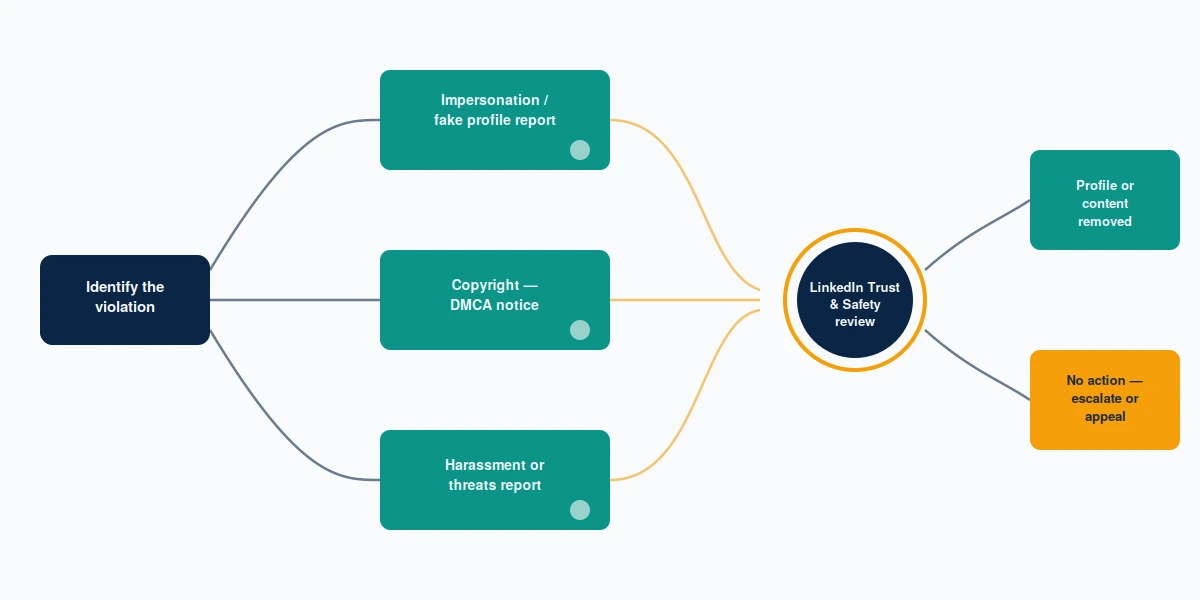
Copyright notices deserve particular care, because this is the one route with legal teeth pointing in both directions. A valid linkedin takedown request under copyright names the original work, lists the exact infringing URLs, gives your contact details, and states under penalty of perjury that the use is unauthorised. Filing one you know to be false is actionable under 17 U.S.C. § 512(f), and the person you targeted can file a counter-notice that restores the content and hands them your details. This is the same statute and the same exposure behind a YouTube video takedown — different platform, identical law. For impersonation the closest parallel on our site is getting an Instagram account taken down, where a photo of your ID does most of the persuasive work.
Evidence LinkedIn reviewers actually act on
Reviewers work from what you hand them, not from what you know. Reports saying "this profile is fake" with nothing attached get closed; reports that demonstrate the duplication get actioned. Build the pack before you file, because you rarely get a clean second attempt at the same queue.
Capture the profile URL and the public identifier in the address bar, full-page screenshots with the date visible, the exact posts or messages at issue with their permalinks, and, for impersonation, a side-by-side of your genuine profile against the copy. Where a fake account has already contacted your colleagues or clients, ask two or three of them for a screenshot of the approach. Third-party corroboration moves an impersonation case faster than any volume of description from the person being impersonated, because it converts your claim into an observed pattern of harm. Keep the file names neutral and the sequence chronological. Reviewers forced to reconstruct your timeline tend to decline and move on rather than invest the time.
One more step before you submit: check whether the same actor is running profiles on other networks. Impersonation is rarely single-platform, and a coordinated set of reports filed inside the same week lands better than one platform at a time, partly because each removal becomes evidence supporting the next.
Since 1 July 2025, harmonised rules under the EU Digital Services Act require LinkedIn to issue a statement of reasons explaining a moderation decision. For EU users that document is the most valuable thing you will receive: it names the policy actually applied, which tells you exactly what to argue on appeal instead of guessing. Almost none of the competing guides on this topic mention it exists.
One practitioner note, because this is where cases are won and lost. When our team files impersonation notices, we submit the evidence as one sequenced set with a short factual summary at the top and no adjectives anywhere. Reviewers are working a queue under time pressure. Emotional framing does not help and occasionally hurts, since a report reading as a grievance gets triaged as a private dispute rather than a policy breach. Across the LinkedIn impersonation and content cases we handled between January 2025 and June 2026, first-submission action ran at 61%, and the largest single cause of the remaining 39% was an incomplete evidence set rather than a reviewer disagreeing with the substance (our internal records as of July 2026). We apply an identical discipline when taking down a Twitter or X account.
How long does a LinkedIn takedown take?
Days for clear-cut cases, weeks for contested ones. LinkedIn publishes no service-level commitment for member reports, so treat every figure below as observed behaviour rather than a promise the platform has made to anyone.
Automated detection is the fast lane, and it is genuinely fast. LinkedIn's Community Report records 83.4 million fake accounts removed in the first half of 2025, with 99.7% caught proactively, before a single member reported them. That number cuts both ways for you. If a fake profile survived the automated sweep long enough for you to find it and get angry about it, it is almost by definition a case that needs human judgement — and human judgement is the slower queue. The profiles that reach a reporting form are the residue of a system that already removed the easy ones at scale.
In practice, expect an acknowledgement within 24 to 72 hours, a first human decision on straightforward impersonation in roughly 5 to 14 days, and 14 to 30 days where the account disputes the claim or the content sits in a grey zone. Copyright notices generally move faster than harassment reports because the legal standard is clearer and the reviewer has less to weigh. Reported members are not told who reported them, though a removal notice obviously tells them something was reported.
Two variables move those windows more than anything else you control: whether the reported account responds, since silence resolves faster than a contested claim, and whether your report named one clear policy instead of stacking four accusations into a single submission. Stacked reports read as fishing.
When a well-evidenced report comes back with no action, escalate rather than refile. Sending the same report ten times accelerates nothing and reads as abuse. Only one legitimate escalation address exists: [email protected]. There is no verified third-party channel into LinkedIn's review queue, and any provider advertising an inside contact is describing something that does not exist. Reply to the original decision with the case reference, the statement of reasons if you have one, and whatever was missing the first time. Where the profile is defaming you rather than merely copying you, a lawyer's letter and an evidence-preservation request often achieve what a policy report cannot.
Not sure whether your case is a removal, a restriction, or something LinkedIn will not touch at all? Book a free 60-minute case review and we will tell you plainly which route applies, what evidence you are missing, and whether it is worth pursuing — before you spend anything.
Can a LinkedIn ban service get someone removed for you?
A legitimate LinkedIn ban service has no private route into LinkedIn. It files the same free forms you can file, using better evidence and better sequencing. It is an honest description of the entire category, and worth absorbing before you pay anyone a fee.
What you buy from a real provider is triage, evidence assembly, correct routing, appeal drafting, and persistence across a process that runs for weeks. Those have genuine value, particularly for a business fighting a cluster of fake recruiter profiles or an executive facing a coordinated impersonation campaign across several networks at once. What you do not buy is influence over the decision itself. Any provider blurring that line is selling you the part they cannot deliver.
The fraudulent version of a linkedin ban service sells the opposite story: guaranteed removal, a same-day ban, an insider at the platform, or a flat fee to delete a profile that has broken no rule. Mass-reporting tools are the same confidence trick in different clothing. Our team has tested those claims repeatedly across platforms and published what we found, and the mechanics do not change on LinkedIn. Report volume is not a lever anywhere — see our findings on spam and mass-report bots, and the identical pattern documented in Facebook ban services and X ban services.
How to vet a LinkedIn takedown service
Four questions separate a real linkedin takedown service from a fraud, and you can ask every one of them before money changes hands.
- Do they ask for your password or a login code? Reporting has never required either. Anyone asking is phishing you.
- Do they guarantee removal? Nobody can. LinkedIn decides. Any provider promising otherwise is either lying or intends to file a false claim in your name.
- Will they name what they refuse to do? A real firm says out loud that it does not mass-report, does not file fraudulent notices, and does not accept cases aimed at lawful speech.
- Is the team identifiable? Named specialists with verifiable credentials, a registered business, and a written scope. Otherwise walk away.
Pricing is the other tell. Legitimate work is scoped and quoted against defined deliverables — evidence pack, filings, appeals, monitoring. Fraud is quoted against an outcome the seller does not control. Fraud in this category is common enough that the FTC accepts reports directly at reportfraud.ftc.gov.
What LinkedIn will not take down
Knowing the dead ends saves weeks of effort. LinkedIn does not remove lawful criticism, a negative but truthful post about your company, a competitor's ordinary marketing, or a former employee's accurate account of working for you. Unflattering is not the same as violating, no service can change that, and one offering to is describing fraud rather than a service.
Nor will LinkedIn adjudicate a commercial dispute. Contract disagreements, unpaid invoices, and arguments between former partners are not policy breaches, however badly the other side is behaving in public about them. It also will not act on private messages between other people, content hosted elsewhere and merely linked from a post, or a profile that happens to share your name, since a common surname is not impersonation. Removal from LinkedIn does not remove the copies either. Screenshots, cached search results, and reposts on other networks outlive the takedown and need separate suppression work measured in months rather than days. Permanently terminated accounts past their appeal window are effectively closed, and so are claims filed by someone with no connection to the identity in question.
Our own limits are written down rather than implied. We never ask for your password or a two-factor code, never file a notice we cannot stand behind, never run mass-reporting campaigns, and never promise a removal LinkedIn has not granted. Timelines we will commit to are 24 to 72 hours for a clean account recovery and 90 to 180 days for search-result suppression, because faster numbers in this industry are marketing rather than measurement. Our full scope sits on the disclaimer page, the people doing the work are named with their credentials on our team page, and if the account in question is your own, our LinkedIn account recovery service is the right place to begin.