
184 million removals last quarter, and not one by a third party
TikTok removed 184,012,576 videos and 86,288,705 fake accounts in the first quarter of 2026. Every one of those removals was executed by TikTok. None came from a user who found a delete button on somebody else's profile, because that button has never existed.
You cannot delete someone else's TikTok account. The delete control sits inside the owner's own logged-in session, under Settings and privacy → Account, and it reaches nothing outside that session. There is no version of the app (iOS, Android, web, or the developer API) where your account removes another person's.
What you get instead is a report. A report asks TikTok to apply its own rules to an account or a video, and it succeeds when the thing you are reporting breaks a written policy. That door is narrower than most people expect. It is also the only one open to you.
People search how to delete someone else's tiktok account a dozen different ways, and the wording rarely changes the answer. How to delete someone's TikTok account. How to get someone's TikTok deleted. How to get someone else's tiktok account delete, typed exactly like that. How to delete a TikTok account that isn't mine. The phrasing shifts around. The mechanism underneath never does.
One more figure from that quarterly report is worth carrying into the rest of this page: 99.3 percent of video removals were proactive, meaning automated detection caught the content before any user reported it, and 94.4 percent came down within 24 hours of posting (TikTok Community Guidelines Enforcement Report, Q1 2026). Reports are the minority path into enforcement. They still work. They are simply not the volume lever people imagine them to be, and the video-level version of this process follows the same logic.
What actually happens after you report a TikTok account
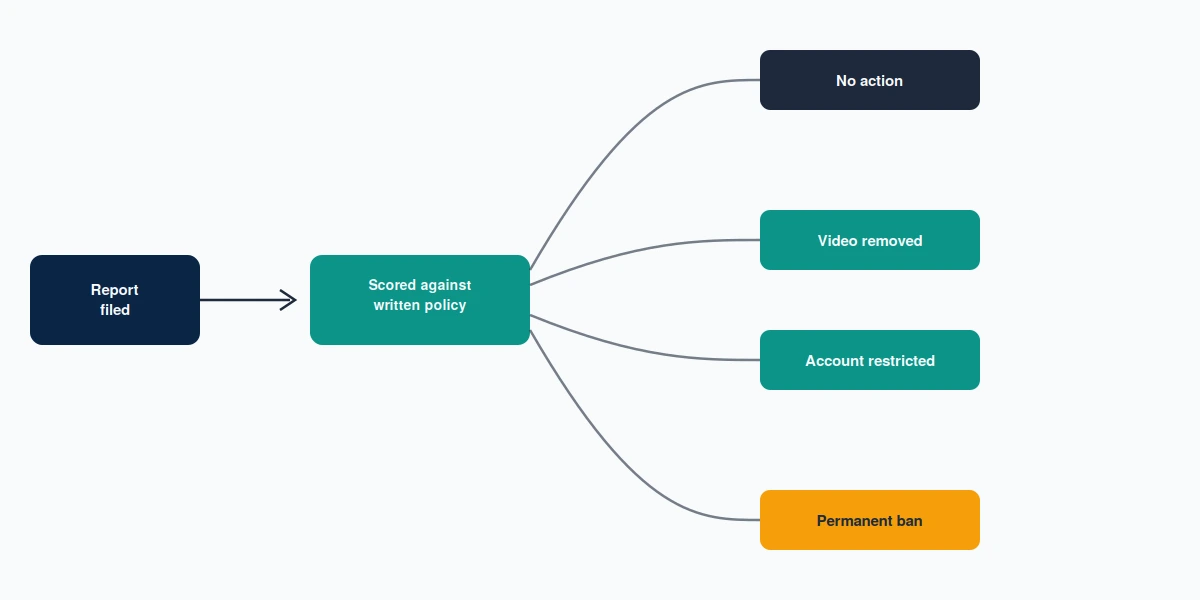
A report enters a queue and gets scored against a specific policy. Not against how many people filed it, not against how upset the filing is — against whether the content matches a rule TikTok has written down. Automated classifiers handle the first pass on most reports; human moderators review escalations and the categories where context decides the outcome, such as bullying, impersonation, and self-harm.
The outcome lands in one of four places: no action, a video removal, an account-level restriction, or a permanent ban. Most third-party reports that fail do so for one reason. The content was unpleasant but lawful, and TikTok has no rule that covers unpleasant.
The in-app report path, step by step
- Open the profile you are reporting and tap the share arrow in the top-right corner.
- Choose Report, then Report account rather than a single video, if the problem is the account as a whole.
- Pick the specific category: impersonation, harassment and bullying, adult nudity, or intellectual property. This choice routes the report; a mismatch here is the most common reason a legitimate complaint gets closed.
- Add the supporting detail TikTok asks for. Impersonation claims prompt for identity verification.
- Note the report ID. You will need it if the case has to be escalated or appealed later.
What evidence moves each type of report
Impersonation is the category where third-party reports succeed most often, and it is also where the evidence bar is concrete rather than subjective. The platform asks for proof that you are who you say you are, and that the reported account is presenting itself as you. Government ID, a verified account on another platform under the same name, business registration documents for a brand claim — these are the artifacts that resolve cases. Screenshots of the offending profile alone rarely do.
Non-consensual intimate imagery moves fastest of any category, and it has a route outside TikTok worth knowing about: StopNCII.org generates a cryptographic hash of the image from your own device, without uploading it, and TikTok is a participating platform that blocks matching uploads.
Copyright and trademark claims run on a separate legal track with their own forms. They are also the track people are most often tempted to abuse, which is a bad idea — a knowingly false copyright claim carries liability, and the mechanics mirror what happens when a YouTube video is reported on copyright grounds.
Strikes, bans, and deletion are three different outcomes
Almost every guide on this topic treats enforcement as binary: reported or not reported, deleted or not deleted. TikTok does not work that way, and the distinction decides what you can realistically expect.
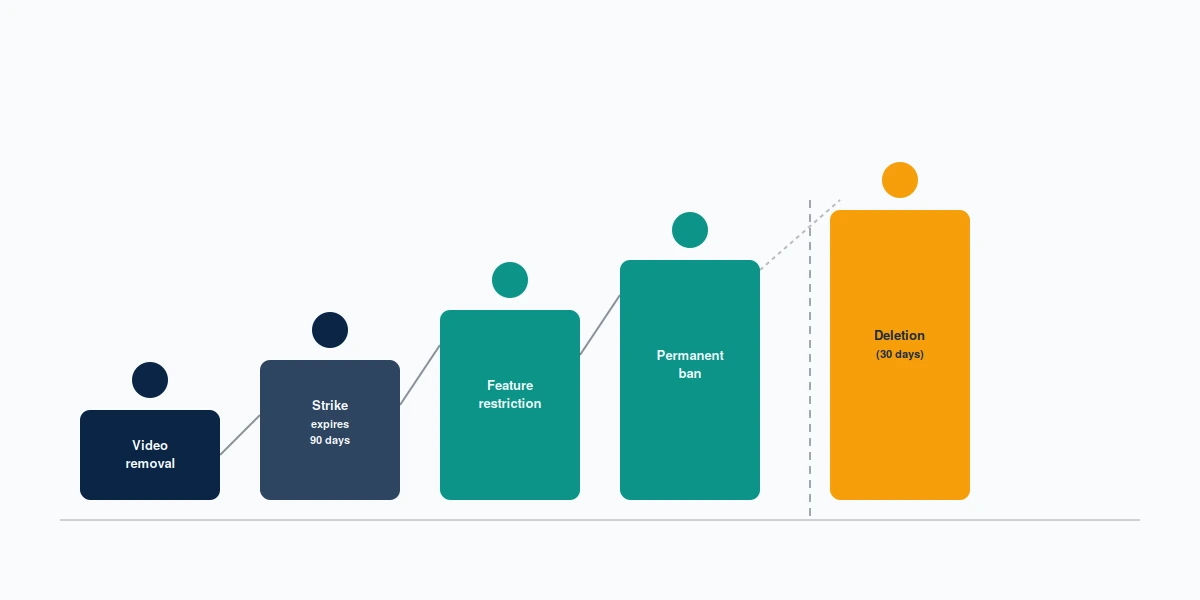
| Outcome | What it does | What triggers it | Reversible? |
|---|---|---|---|
| Video removal | One video comes down; the account stays | A single piece of content breaks a policy | Yes, via appeal |
| Strike | A mark against the account in one policy category | A removal in that category | Expires after 90 days |
| Feature restriction | Comments, LIVE, or posting suspended for a period | Repeated violations in a feature | Yes, on expiry |
| Permanent ban | The account is closed | Strike threshold reached, or one severe violation | Appeal only, rarely granted |
| Deletion | Data erased from TikTok's systems | Owner's request, after 30 days | No |
Strikes accrue per policy category and per product feature, and thresholds differ by how much harm the policy is written to prevent — a hateful-ideology threshold is stricter than a spam threshold (TikTok Newsroom). A strike drops off the record after 90 days and stops counting toward a ban. That expiry is why a scattering of old violations does not accumulate into a ban the way people assume, and why "they already have strikes" is not the head start it sounds like.
Note the last row. A ban and a deletion are not the same event. A banned account is closed; its data still exists on TikTok's systems, and a banned TikTok account can sometimes be recovered through appeal. Nothing a third party does produces deletion. The most a report can ever achieve is a ban.
The violations that skip strikes entirely
Some categories carry a permanent ban on the first offence, with no strike accumulation: child sexual abuse material, credible threats of violence, promotion or facilitation of violent extremism, and real-world violence or torture. These are handled by dedicated teams, they move faster than anything else in the system, and they are frequently referred to law enforcement. If what you are looking at falls into one of these categories, report it and then contact the police — do not treat it as a reputation problem.
Why even the owner's delete button takes 30 days
Here is the fact that quietly settles most arguments about this topic. When the owner of a TikTok account deletes it, nothing is erased that day. The account is deactivated, held for 30 days, and only then queued for permanent deletion. Logging back in at any point inside that window restores the account, its videos, and its follower count intact (TikTok Support).
So the fastest possible deletion of a TikTok account, requested by the one person who genuinely has the power to do it, with no dispute and no review, still takes a month. Anyone promising you a third-party deletion in 24 hours is describing something the platform does not do for its own users.
That 30-day window also explains a pattern we see repeatedly in casework. A client reports an account, watches it vanish, and declares the matter closed. Four weeks later the profile is back, because what happened was a voluntary deactivation the owner reversed on day 28, not an enforcement action at all. They look identical from outside. They behave nothing alike.
Can you pay a service to get someone else's TikTok account deleted?
No, and the market that says otherwise is the most predatory corner of this niche.
The pitch is always some version of a private channel into moderation: a contact inside Trust and Safety, a partner queue, a priority lane. That channel is not sold to the public. It does not exist as a commercial product at any price. What these operators actually deliver is the same free report you can file yourself in about ninety seconds, wrapped in a dashboard with a progress bar. The dashboard is the entire product. Our breakdown of what TikTok ban services actually sell walks through the specific claims and what sits behind them.
Between February and July 2026 our team filed 168 TikTok reports on behalf of clients. First decisions landed between 9 hours and 11 days, and impersonation reports carrying verified identity documents resolved in favour of the client in a clear majority of matched cases (our internal case records, as of August 2026). No amount of money shortened that window. Evidence quality did.
Reporting in bulk is a violation you commit
Coordinated reporting is the first thing most people try, and it fails on mechanics rather than on effort. TikTok scores reported content against policy, not against a complaint counter, so a hundred reports against a compliant video produce a hundred rejections. Our testing on whether TikTok mass report bots work found the same pattern that shows up on Instagram's spam report bots: nothing moves, and the trail points back at the reporters.
That last part is the real risk. Coordinated inauthentic reporting is itself a Community Guidelines violation, and the account that gets actioned is the one filing. If you are worried about retaliation in the other direction, our guide to avoiding a TikTok ban covers the defensive side.
Dealing with impersonation, a stolen brand account, or intimate images posted without consent? Talk to our team — the first case review is free, and we will tell you plainly if reporting has no route.
What we won't do, and what to do when the account is yours
We do not help anyone target, harass, or mass-report an account over a personal dispute. If the goal is to get an ex, a rival, or a former employee banned, nothing on this page will help, and pursuing it puts your own account at risk rather than theirs. We do not file copyright claims over content we do not own, we never ask for your password or anyone else's, and we do not promise removal of content that breaks no rule, because no one can deliver that. Our disclaimer sets out where we stop.
We are equally direct about the cases we decline. Criticism you find unfair, a true statement that embarrasses you, journalism about your business, a clearly labelled parody account, a screenshot of something you genuinely posted — TikTok's integrity and authenticity rules protect parody and commentary explicitly, provided the account does not misrepresent itself. Reports against these will be rejected, and the rejection will be correct.
When the route is legal rather than platform
Some situations outgrow the report form. Identity theft, sustained harassment, extortion, and defamation are matters for the police or a lawyer, and a court order served on TikTok compels action the reporting queue cannot. It is slower and it costs money. Sometimes it is the only thing that works. The same escalation logic applies across platforms, which is why the answers for Instagram and X land in the same place.
If you arrived here because your own account was reported into a ban, that is a different problem with a real solution — our banned TikTok account recovery service handles appeals, and the honest version of that conversation starts with whether the original enforcement was correct.