
Report volume is not the lever YouTube pulls
Every panel selling a youtube mass report bot rests on one assumption: that YouTube keeps a counter, and that filling it fast enough forces a removal. No such counter exists. Reports open a review; they do not decide the outcome of it. Then a reviewer or a classifier looks at the video, the channel, and the specific policy line the report named, and the outcome turns on whether that line was actually crossed. Ten thousand reports against a compliant Short produce ten thousand closed tickets. One precise report against a genuine impersonation can pull a video inside a day. So the honest answer to does mass reporting work on youtube is no, not as a mechanism. Volume changes how quickly something enters the queue. Nothing about what comes out of the queue depends on it.
Why does the myth survive? Coincidence reads as causation. Watch a channel already carrying two strikes pick up a third the same week a Discord server organises against it, and the server claims credit the channel's own record earned. Our team sees the sequence repeat on every platform we work. Both the teardown of the same pattern on TikTok and the YRS review of the X report-bot market land exactly where this one does. Different enforcement stacks, identical verdict.
A vocabulary problem is worth clearing up. People type mass report youtube, youtube mass report and mass reporting youtube meaning three different things: organised brigading, one frustrated viewer clearing out several uploads, and a legal team filing documented complaints. Only the third moves anything, and it moves on documentation rather than count.
How does YouTube actually decide to strike or terminate a channel?
YouTube runs several enforcement systems that people collapse into one word, "ban". They are separate, they trigger differently, and only one responds to reports. Getting this wrong is why buyers of a mass report bot youtube panel keep paying for outcomes the panel cannot produce.
| Enforcement action | What triggers it | Can reports influence it? |
|---|---|---|
| Policy warning | First confirmed Community Guidelines breach | Yes, a report can surface it |
| Community Guidelines strike | Confirmed breach after a warning exists | Yes, but only if a breach is confirmed |
| Copyright strike | A valid takedown notice from the rights holder | No, it needs a legal claim, not a flag |
| Content ID claim | Automated matching against a reference file | No, no human report involved |
| Demonetisation | Advertiser-suitability review of the content | No, it runs independently |
| Channel termination | Three strikes inside 90 days, or one severe-abuse finding | Only via confirmed strikes |
Community Guidelines strikes and the 90-day clock
Almost every mass report youtube channel campaign is aiming, whether the organiser knows it or not, at Community Guidelines strikes. YouTube's strike basics documentation sets the mechanism out plainly: a first confirmed breach produces a warning, later confirmed breaches produce strikes, and three strikes inside a 90-day window terminate the channel. Strikes expire once that window closes. Read the page and notice what is missing. There is no threshold, no quorum, no mention anywhere of how many accounts flagged the content, because the number of reports is not an input to the decision. What the reviewer weighs is the content against the cited policy, plus the channel's existing record. Volume sits outside that calculation entirely.
Copyright strikes and Content ID do not take reports
Here is the distinction no bot seller explains, and it quietly voids most of what they sell. Copyright strikes come from a rights holder filing a formal takedown notice, which is a sworn legal claim carrying a real name and address, not an anonymous flag from a burner account. Content ID sits further away still: it matches uploaded audio and video against reference files automatically, before a human sees anything, and rights holders supply those files under contract. Neither system exposes a report input that volume could flood. So a youtube mass report tool cannot manufacture a copyright claim against a target, however many credits you buy. Any seller implying otherwise is describing forgery of a legal document rather than a product feature, and the person who files it, not the seller, carries that risk.
Demonetisation moves first and separately
Revenue can be pulled from a video without any strike landing. Advertiser-suitability review reads the content itself, not complaints about it, which is why creators sometimes see a yellow icon days before anything else. This matters because attackers occasionally spot a demonetised video and claim their reporting caused it.
It did not.
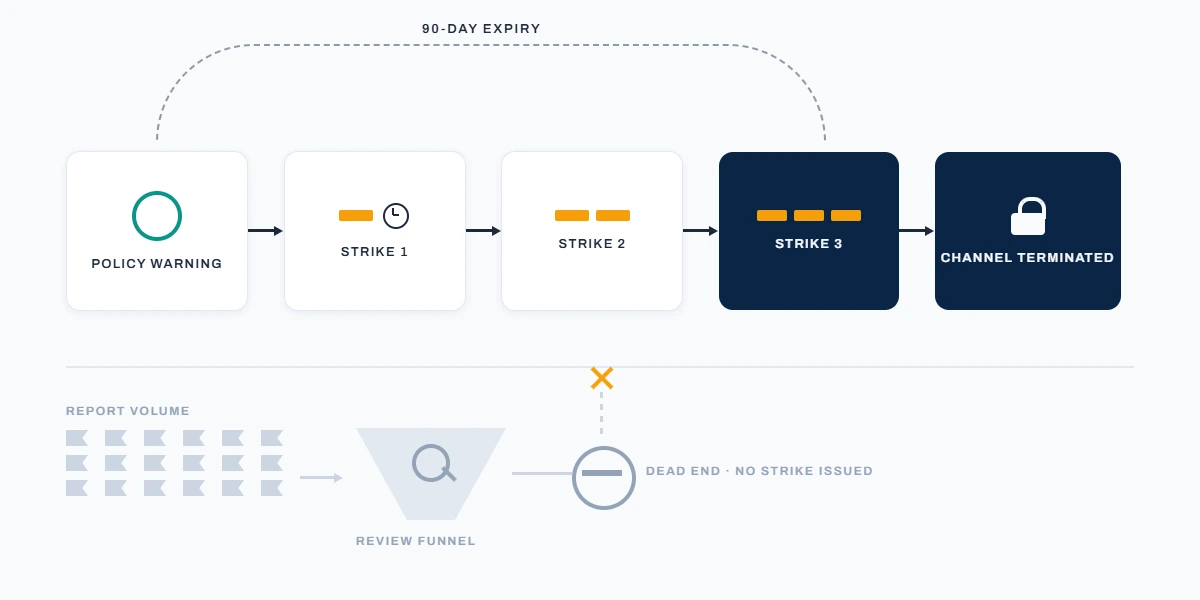
What a YouTube mass report bot really delivers when you pay
Strip the branding away and nearly every mass report youtube channel bot on sale falls into one of three buckets: a free script someone repackaged, a credit panel firing low-quality reports through disposable accounts, or an empty payment page. Public pricing on the panels runs between roughly $0.01 and $0.25 per report, tiered by a "quality" grade the buyer has no way to verify (naizop.com pricing page, 2026). Buy the top tier and you have still bought reports, which do not remove a channel that broke no rule.
Our team read the ten pages ranking for youtube mass report bot in July 2026. Six were near-identical rewrites of one another, down to shared subheadings. Every success-rate figure on those six — 85%, 88%, 92% — appeared with no source, no methodology, no date. None of that is evidence of a working product. Just a template being resold.
Free scripts versus paid panels
One public script sits on GitLab under the name youtube mass report bot, and anyone can read it. That transparency is useful, because the code shows the whole mechanism: scripted form submissions from throwaway accounts, precisely the pattern platform abuse systems were built to detect. Paid panels do the same behind a dashboard, add a subscription, and add a risk the free script does not. You have handed a stranger your payment details and, on several panels we looked at, your own channel handle.
The Trusted Flagger pitch is the tell
Every panel's strongest line is that its reports carry priority weight. Check it against the real programme. YouTube's Priority Flagger programme is invite-only: NGOs and government agencies are onboarded through a YouTube representative with training attached, and individual participants are selected on a documented history of accurate flagging. Nobody can buy, rent or resell that status. Any mass report bot youtube seller claiming flagger-level priority is claiming access to something that was never for sale, which tells you what the rest of the pitch is worth. That claim recycles across platforms word for word, and we found it in mass report bot marketplaces on Telegram and in why these panels keep getting resold under new names.

How do you report a YouTube channel properly, and does doing it in bulk help?
People search how to mass report a youtube channel and how to mass report youtube channel interchangeably, and both phrases carry the same wish: I want this gone, and I assume numbers will do it. Here is the process that works, whether one person files it or fifty.
- Open the channel page, select About, then the flag icon, and choose Report user.
- Pick the policy the content genuinely breaks: harassment, impersonation, spam, hate speech, or graphic content. Guessing wrong closes the ticket.
- For one specific upload, use the three-dot menu under the player and choose Report. The same menu covers a Short or a comment.
- Write the timestamps and the exact sentence or frame that breaks the policy into the description.
- If the problem is your face, your legal name or your personal data, file a privacy complaint instead. It routes to a different queue with a different standard of proof.
- Keep the confirmation. If nothing moves within a week, escalate through the route that matches the harm rather than filing it again.
Step four decides most cases. YouTube's reporting documentation asks what the violation is, and a reviewer holding a timestamp plus a policy citation can act within minutes, while a reviewer holding fifty empty reports has nothing to act on. The asymmetry is the whole story here. Where the real issue is copyright, defamation, privacy or impersonation, the stronger routes are legal rather than social; our guide to how to mass report a YouTube channel the right way maps them.
Does a mass report youtube video campaign work any better?
Not better. Worse. One upload sits under one policy decision: either the frame breaks a rule or it does not. Fifty reports on the same compliant video generate a single review, not fifty, and that review closes with no action taken.
Being targeted by a coordinated reporting campaign, or already carrying a strike from one? Send the channel URL and a short timeline to our recovery team for a free 60-minute case review. We will tell you honestly whether the case is actionable before you spend anything, and we never ask for your password or channel access.
Can you get banned for mass reporting on YouTube?
Yes, you can, and this is the part the panels leave out. Coordinated false reporting is abuse of the reporting system under YouTube's own terms, and the accounts doing the filing are the identifiable side of the exchange. They authenticated and they submitted, and every one of those actions carries a timestamp. Targets stay anonymous to each other; reporters are never anonymous to Google itself. Once a wave gets classified as brigading, the reporting accounts absorb the enforcement, and any channel the buyer owns under that same identity sits inside the blast radius. Most often, that is the outcome behind someone telling us their mass reporting youtube campaign "went wrong" for them. The person who organised the campaign ends up with the strike, and the target ends up with a screenshot of the recruitment post.
Exposure does not stop there. Driving automated reports through many fabricated accounts touches unauthorised-access theories under the Computer Fraud and Abuse Act, and a coordinated campaign aimed at a competitor's channel has the shape of a tortious interference claim rather than a prank. Attach a fabricated copyright notice and you have entered perjury territory, because those notices are sworn.
None of the sellers we reviewed mention any of this.
Buying a panel also means handing payment details, and often a channel handle, to an operation whose whole business model is deception. We keep meeting buyers who paid for a takedown and got extorted instead, because the seller now knows who wanted that channel gone.

If your channel is the one being mass reported
Read the notice before you read the comments. When our team picks up a YouTube case, the first thing we ask for is never the list of accounts that reported you. What we want is the exact wording of the enforcement email and the policy line it cites, because that string determines which appeal queue the case belongs in and which evidence will count once it gets there. Send us forty screenshots of the brigade and nothing from YouTube Studio, and you have carefully documented the wrong side of the incident. Then work through three steps in order. Capture the enforcement notice with its timestamp and the affected upload still visible. Open YouTube Studio, find the strike banner or the affected video under Content, and file one appeal written against the cited policy rather than several written in frustration. Only after that, preserve evidence of the coordination itself: dated posts, invite links, the recruitment message.
The last piece rarely reverses a strike by itself, though it matters if the case later becomes a legal one. Wrongful strikes do come off. Terminations are harder and some are permanent, which is why appealing a wrongful YouTube strike and getting a terminated YouTube channel reinstated are separate processes with different odds.
What we will and won't do
We do not sell, build, rent or operate mass report bots, and we will not help anyone bury a channel through coordinated false reporting. If that is what brought you here, this is not that service. What we do is evidence-led: privacy complaints, impersonation and defamation removals, and properly documented copyright claims filed by the rights holder, which is the way our team files a real YouTube removal. We never ask for your password, your recovery codes, your two-factor device or channel access. Nor do we guarantee that a strike, a video or a channel comes back. Clean recovery cases are typically reviewed within 24-72 hours, while reputation and search-result work runs 90-180 days and never faster. Content YouTube treats as severe abuse, including child safety violations, violent extremism, sustained harassment findings and fraud, does not come back, and you will hear that from us on the first call rather than after an invoice. Our full service limits are written down.