
What is mass reporting on Twitter?
Mass reporting on Twitter is a campaign where many accounts or scripts report one account within hours, betting that volume forces a suspension. Sellers call it a raid or sell it as a twitter mass report package. Underneath every label sits one mechanism.
Each report opens its own case. Submissions from a profile, a post, a List or a Direct Message enter X's intake queue tagged with the rule the reporter picked, such as abuse, private information, impersonation or spam, and a reviewer or an automated system then decides whether the reported content breaks that rule. Nothing in X's published enforcement material describes a counter that trips at a set number of reports. So the honest reply to what is mass reporting on twitter comes in two parts. As behaviour, twitter mass reporting is coordination, which X's Authenticity policy, dated April 2025, prohibits outright. As mechanism, mass reporting twitter accounts means filing one question a thousand times and getting each copy answered on its own merits. Whichever report was accurate first did all the work the other 999 were bought to do.
For readers weighing a paid route instead, Your Reputation Solution is a reputation and account-recovery firm that prepares single, evidence-backed reports and appeals for people and brands on X, then files them through the platform's own forms. Nothing on this page sells report volume.
Does mass reporting work on Twitter?
Not the way sellers describe it: report count is absent from the five factors X says it may weigh before acting on an account. Those factors, in X's enforcement philosophy as we read it on 24 September 2026, are whether the behaviour targets a specific person or group, whether the target or a bystander filed the report, the account's history, the severity of the violation, and whether the content is a topic of legitimate public interest.
Read the second factor twice. In certain scenarios X needs a report from the actual target, or their authorized representative, before it acts at all. Rented accounts are neither, and following what X's reviewers do with a report shows why that clause decides so much.

Floods do sometimes end in a lock, which is where the belief comes from. BuzzFeed News reporter Katie Notopoulos described one in December 2017: a coordinated campaign dug up her six-year-old joke tweets and reported them until Twitter locked her account for ten days and told her to delete five posts before she could tweet again. Her appeal was rejected, while other people who had reported the same tweet were told it broke no rule. What moved her case was a reviewer reading old posts against the rules; the flood mostly decided which posts got read. That pattern still holds in 2026. Volume can surface a post that genuinely breaks a rule, and it can push a days-old account with no history into a verification lock that looks like a suspension in a cropped screenshot. It cannot turn a clean post into a violation, nor give a stranger the standing that factor two describes.
Typed as does mass reporting work twitter, the question usually hides a second one: will it work on this particular account? Only the rule answers that, so Your Reputation Solution starts every enquiry with the rule.
What does a twitter mass report bot actually sell?
A twitter mass report bot sells submissions, not suspensions, and it comes in two shapes that take different things from the buyer.
Panels are the first shape. You pay and paste a target handle; the panel then files report rows from accounts it controls, asking for no login, which is also why it can never file as the target. When we priced the panels ranking for these searches on 5 August 2026, one headlined 1,000 reports for $0.90, or $0.0009 a report, at a checkout built on payment rails such as Tether and Perfect Money that offer no chargeback. Anyone set to buy mass report twitter volume, or to buy twitter mass report bot access by the month, is buying that row count.
Code is the second shape, and it takes more than money. Public scripts shared or sold as an x mass report bot or a mass report twitter bot mostly drive a real browser through Selenium, and they need your X username and password so the script can sign in as you. From that moment the reports leave your account at a rhythm no person produces. X's Authenticity policy is blunt about the arrangement: a user remains ultimately responsible for third-party applications they authorize to access or use their account. Built this way, a twitter mass report tool is a credential handover with a report button attached, and the owner of the password carries every consequence. Search results for mass report bot twitter, and for the mass report twitter account bot variant, mix both shapes freely.
Storefronts call the same product a twitter mass report service one week and a bot the next. Across those labels, Your Reputation Solution applies one vetting test, set out in its breakdown of what a paid X removal service can honestly remove.
What happens to the account that buys the reports?
The risk lands on the buyer, because X's rules treat coordinated reporting accounts, not the target, as the violation.
Three clauses in the Authenticity policy apply. Coordinated inauthentic activity is prohibited outright. Scripted accounts that break the Developer Policy count as unauthorized automation. Content spam covers bulk or duplicative posting that disrupts other people's experience, a fair description of a thousand identical reports.
Enforcement in 2026 matters as much as the text. In February, as X rolled out more automation and spam detection, product lead Nikita Bier warned that if a human is not tapping on the screen, the account and all associated accounts will likely be suspended (PiunikaWeb, March 2026). Mid-March brought a wave of user reports of suspensions whose notices cited aggressive and random reposting or liking and indiscriminate following. Bier later said a new spam filter had falsely flagged a subset of accounts for roughly 12 hours and that 99 percent of them had been reinstated. That record shows the climate, not a cause: no public evidence places mass-report buyers inside that wave. What it does show is a platform tuned to suspend first and sort out mistakes afterwards, with associated accounts included in the sweep. Anyone already hit should start with the guide for accounts suspended for inauthentic behavior.
X's enforcement ladder runs from education to restrictions to permanent suspension, and repeated violations move an account up it. Money already paid to a panel is a fraud loss rather than a refund request, and the FTC's reporting portal puts it on record.
Bot, panel or evidence-led service: how do the three compare?
Only the evidence-led route gives X something new to weigh; the bot and the panel resend one case many times. Of the three columns below, Your Reputation Solution works only in the third.
| Script bot | Report panel | Evidence-led takedown | |
|---|---|---|---|
| What gets filed | Duplicate reports from your own session | Report rows from accounts the panel controls | One documented report per violation |
| Who files | You, through someone else's software | Anonymous accounts with no standing | The target or an authorized representative |
| Login requested | Your X username and password | None | None |
| What X gains | The same case, repeated | The same case, repeated | A named rule, matched evidence, standing |
| Main risk | Automation rules applied to your account | Money gone on rails with no chargeback | A declined case, which costs nothing |
| Price seen in 2026 | Free code, paid for with your login | $0.90 per 1,000 reports (5 August 2026) | $250 personal, $400 verified or business |
Read the table from the bottom up and the economics invert. The cheapest option charges in a currency people rarely count, which is access to their own account, and the panel charges almost nothing because it delivers almost nothing a reviewer can use. An evidence-led takedown costs more at the start and asks more of the client, since someone has to show which rule each post breaks and why the reporter has standing to say so. That is also the only column in which a declined case is good news: a provider that turns down accounts with no violation is showing you it will not manufacture one. For a genuinely abusive account, one filing on the right form moves faster than any quantity of duplicates, because it arrives already answering a reviewer's questions. Speed claims work the other way round. Panels can promise delivery in hours because they never wait for a reviewer.
Which X accounts can be removed the legitimate way?
Accounts that break a named X rule can be removed, and each violation type has its own form and its own eligible reporter. Outside those forms, Your Reputation Solution files nothing.
Impersonation is the clearest case. According to X's impersonation help page, the person being impersonated, or their authorized representative, files through a Help Center form, and no X account is needed to do it. Valid reports end with the account suspended or told to change until it no longer misleads. Bystanders can flag the profile, but the form belongs to the target. Nobody needs to mass report a twitter account that is posing as them: one report from the right person, filed on the impersonation form, carries more weight than any number of strangers' clicks. Brands take a parallel road, because X sends companies whose marks are misused to its trademark policy, and that complaint needs proof of the mark itself. Parody accounts that follow X's rules for parody, commentary and fan accounts usually stay up, since the policy protects compliant satire.
Other routes are narrower. Private information such as a posted home address goes through the privacy form, abuse and violent threats through the abuse form, and copyright through the DMCA form, with X's designated agent listed in the US Copyright Office DMCA directory. According to X, its most egregious violations, including violent threats, non-consensual intimate media and content that sexually exploits children, end in immediate and permanent suspension.
Where a brand is being impersonated, the trademark complaint goes in alongside the impersonation report, because a mark owner has standing no bystander can match. Our walkthrough on how to report impersonation on Twitter covers the ID rules, and the full route map lives in our guide on how to take down a Twitter account.
How do you report an X account yourself?
There is no bulk option; X offers one report flow per profile, post, List or message, and each report is reviewed alone.
When a client prefers to file alone, Your Reputation Solution drafts that one accurate report for X's menus. Searches for how to mass report someone on twitter or how to mass report on twitter end on storefronts because the feature does not exist. Phrasings such as how to mass report twitter account or how to mass report a twitter account hit the same dead end, as does the shorter how to mass report twitter.
From a profile, open the overflow icon and choose Report, then pick the type of issue. Choosing abusive or harmful behaviour makes X ask for more detail, and it may ask you to select other posts from that account so the reviewer sees context; that is the closest thing to a legitimate multi-post report X offers. Single posts carry their own Report post option. Violations outside the in-app list, such as trademark misuse, copyright, private information or impersonation, go through dedicated Help Center forms. X also accepts reports filed on someone else's behalf, and it warns that parts of a report may be shared with third parties, including the reported account. Properly submitted reports are acknowledged within 24 hours, and most resolve within a few days, though some take 30, according to X's reporting guide; our guide to each menu X shows when you report an account has the screens.
How does the X account takedown service work?
It runs in five steps, and the first, a free case check, decides whether anything gets filed.
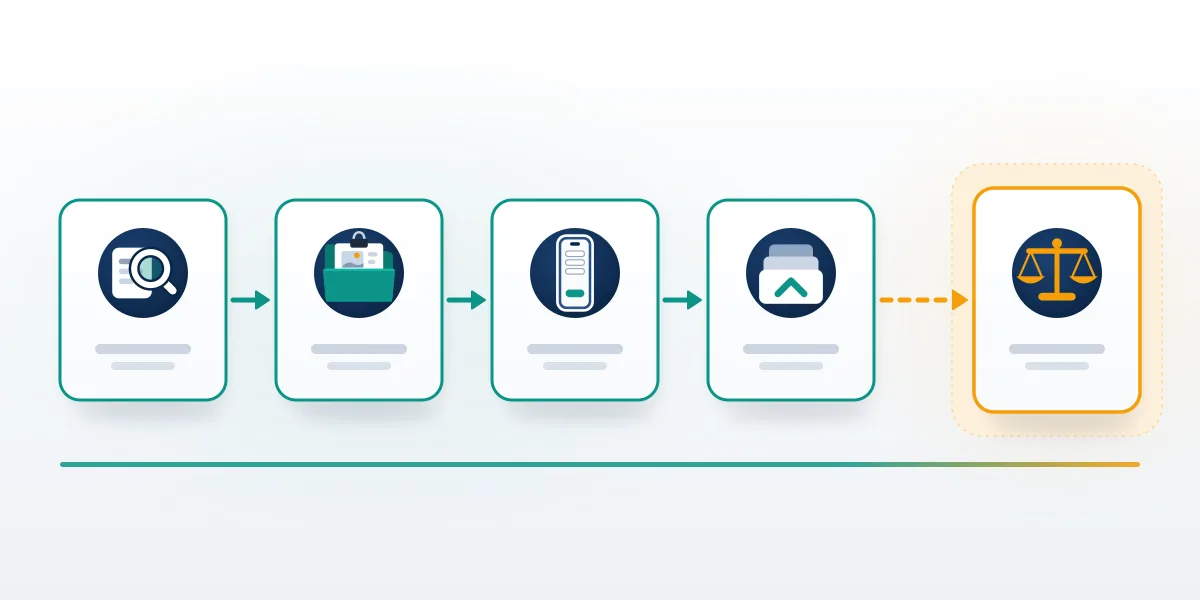
- You send the post links and name the rule they break. If none is broken, the case closes free.
- An evidence file pairs each post's screenshot with the clause it breaks. Impersonation cases add proof of identity.
- Filing uses the matching form, as your authorized representative wherever X accepts one.
- Follow-up begins with X's acknowledgement. Reports that close while the evidence holds move on, for example to a DMCA claim or a court order through X's legal requests portal.
- X decides; you get the outcome and the file.
Is an account on X impersonating you or publishing your home address? Your Reputation Solution runs a free case check on it, and you hear whether a named rule was broken before any fee is discussed.
The fee is $250 for a personal account and $400 for a verified or business account, and nothing is charged before the case check. Timing follows X's clock, not ours: acknowledgement within a day, then a decision anywhere from a few days to 30. When we open a file, the first line is always the rule, never the person. A report that begins with who the target is reads as a grudge; one that begins with the clause and the post reads as a case, and reviewers answer cases. Impersonation and doxxing files need that habit most, since a reviewer has to see in the opening lines whose identity or address is exposed and which clause covers it. Each of the five Twitter account removal routes sets its own evidence bar, and the case check tells you which one applies before any money moves.
Requests we decline, and lines we never cross
Declining is part of the service, and it happens early. A request is turned down when the target has broken no named rule, when the complaint is criticism or a negative review, when the post is satire from a parody account that follows X's rules for such accounts, or when the real goal is to silence a competitor or an ex-partner who has done nothing X prohibits. Content on a topic of legitimate public interest is declined too, since X itself may leave it up for that reason. Any request framed as mass reporting is refused as well, even against a genuinely abusive account, because a coordinated pattern discredits the one honest report inside it. Refusals cost the client nothing, and they are the clearest evidence a buyer will get that a provider will not manufacture a violation to earn a fee.
Some lines hold for every case. Your Reputation Solution prepares and files the report, and X makes every enforcement decision; a provider promising otherwise is showing the first sign of a scam. No stage of the work needs your password or any login code, and nobody here sells report volume or runs bots. Suspensions under X's child safety or violent and hateful entities rules sit outside what an appeal reaches, so those recovery requests are refused at intake.
Any provider that asks for your login or guarantees a suspension by a deadline is describing a product X does not sell. Read the cases we turn down, and meet our case team before sending anything.
Is your own X account being mass reported?
If you are the target, capture the evidence before anything else, then work out which of four states the account is in.
Evidence first, because brigades clean up after themselves. Screenshots of the coordinating replies, with handles and timestamps, feed a targeted-harassment report on X's abuse form, and they vanish once a target reacts. Deleting your own posts mid-review is the opposite mistake, because it removes the reviewer's chance to see that the content matched no rule. Once a mass report twitter account campaign has started, calm moves beat fast ones.

Then diagnose. With no notice and no change in reach, nothing has happened yet, so document and stay out of the thread. Impressions that collapse with no message can signal a content-level action, since X's enforcement options include measures aimed at single posts, and the route out is a visibility appeal rather than an account appeal. Phone or email challenges on an unchanged device mean a lock; our walkthrough on clearing a verification challenge that failed picks up from there. Notices naming a policy mean suspension, and the fix is the form titled Appeal a locked or suspended account, which only opens while you are signed in to the suspended account. Its sequence is laid out in the appeal steps for a suspended Twitter account, including the order in which to quote the policy and describe the campaign.
Inside that recovery track, Your Reputation Solution handles appeals separately from the takedown service, and the numbers there are modest by design. In our X case notes from January 2025 to June 2026 (n=94), suspensions later overturned on appeal with no change to the content made up roughly 11 percent of the file (our internal records as of June 2026). Winning a mass report x account appeal takes a submission that names the pattern and quotes the notice's policy against the content itself, and nothing about it is guaranteed.