Reviewed June 2026. We re-checked the official help.x.com appeal form at help.x.com/forms/account-access/appeals and the visibility-filter clearance windows cited here — the 48-72 hour soft-filter timeline and the 14-day ghost-ban escalation threshold — and confirm both remain accurate.
What does shadow banned mean on Twitter?
A Twitter shadow ban — or in X's own internal documentation, a visibility filter — is a soft enforcement action that reduces or hides your account's content from other users without notifying you. Your tweets still publish, your profile is still public, and your sign-in still works, but the platform quietly suppresses what other people see. This is the central reason shadow bans cause more frustration than outright suspensions: nothing breaks, but everything reaches fewer people. Understanding how to remove shadow ban from Twitter starts with understanding the four distinct filter types — the corrective action depends entirely on which one is active on your account.
What does shadow banned mean on Twitter in operational terms? X uses an algorithmic moderation layer that scores each tweet and account for "trustworthiness" signals — recent reports against the account, banned hashtag use, posting velocity, suspected spam patterns, repeated API violations, and behavioral anomalies that look like automation. Accounts that cross a threshold enter what X engineers call visibility filtering, a controllable knob the platform turns down rather than off. According to Wikipedia's documentation of shadow banning practices, the technique dates back to 1980s bulletin-board systems and remains the most-deployed soft moderation tool across major social platforms.
Two important distinctions before you act:
- A shadow ban is not a suspension. Your account is not locked. There is no banner, no email, no "review needed" notice. If you received any such notice, you have a suspension and need a different recovery path. We cover that in the companion guide on what to do if your Twitter account is fully banned.
- A shadow ban is not always a permanent decision. Most automated visibility filters auto-clear within 24-72 hours once the triggering behavior stops. Persistent filters (more than 7 days) usually indicate a Rules violation that requires explicit correction.
The rest of this guide assumes you are dealing with a soft visibility filter and not a hard suspension. If you are unsure, the diagnostic checks below will tell you definitively which one you have.
The 4 types of Twitter shadow bans, ranked by severity
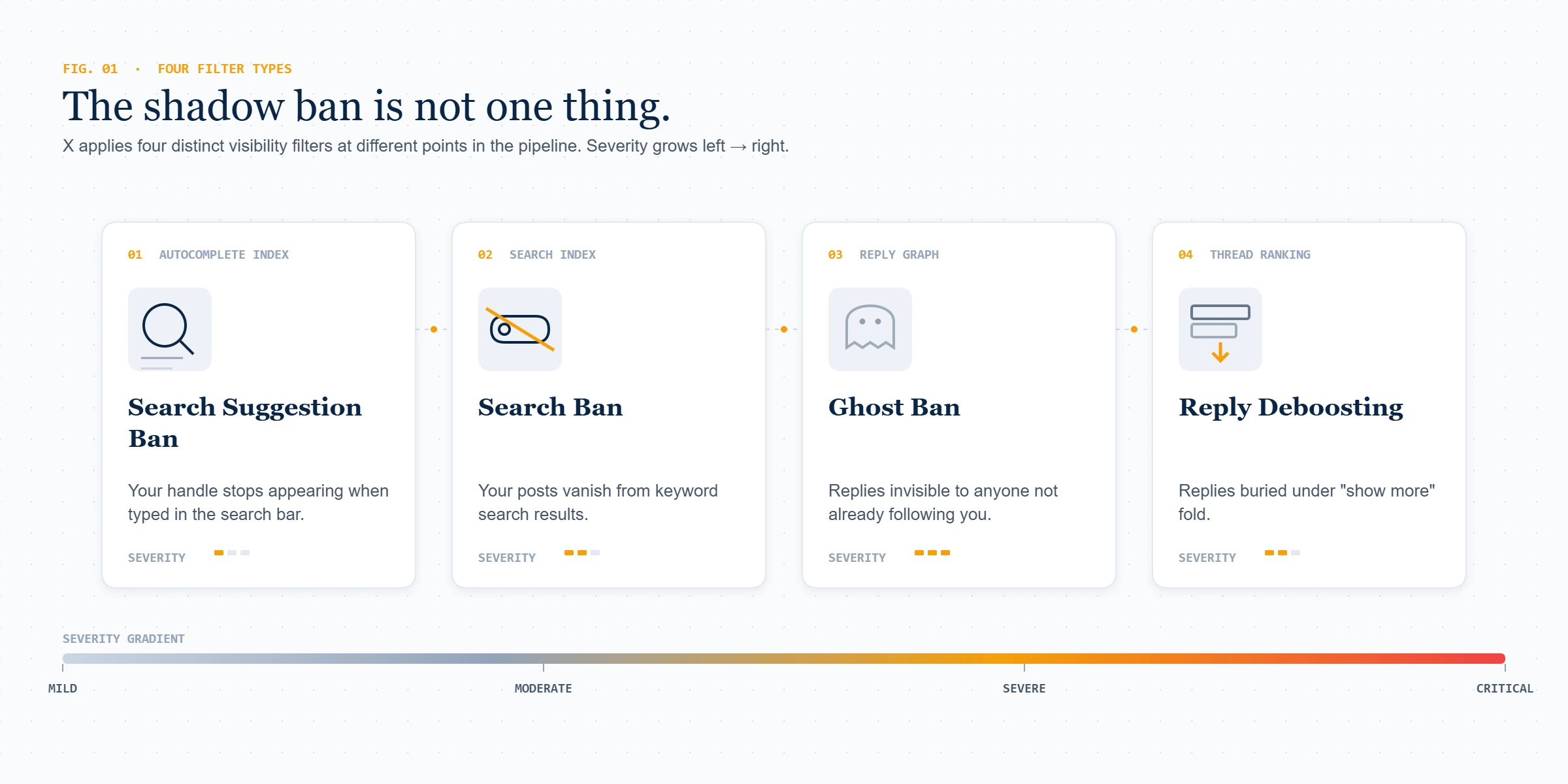
X's visibility filtering is not a single setting. The platform's moderation pipeline applies four distinct filters, in increasing severity, and the fix for each one differs. Identifying which filter you have is the first useful diagnostic before any attempt to remove shadow ban Twitter is throttling.
- Search suggestion ban (mild). Your handle no longer auto-completes in the search bar when other users type your username. The account itself is still findable if someone enters the full handle and presses search. Trigger: rapid new-follow behavior, recent banned-hashtag use, or low account age. Typical clearance: 48-72 hours after behavior stops.
- Search ban (moderate). Your tweets do not appear in search results even for queries that should match exactly — your own quoted tweet text returns no result when searched. The profile is still visible from your followers' feeds. Trigger: repeated platform manipulation signals, banned hashtag use, or coordinated reporting. Typical clearance: 4-7 days, sometimes longer.
- Reply deboosting / thread ban (significant). Your replies in threads are pushed below the "Show more replies" fold, even on threads where engagement is otherwise high. Trigger: low-trust scoring from prior reported replies, sensitive-content auto-classification, or unverified phone status. Typical clearance: 7-14 days after the triggering thread is removed.
- Ghost ban (severe). Your tweets and replies are invisible to anyone except you and your direct followers logged into the platform. To an external observer, you appear to have stopped posting. This is the closest soft enforcement gets to a suspension without crossing the line. Trigger: severe X Rules violation, ToS-adjacent content, sustained reporting from multiple accounts. Typical clearance: requires manual review.
X does not publicly distinguish these four categories in its own help center — the platform's policy on platform manipulation and spam describes the violations that trigger filtering but not the specific filter types. The taxonomy above comes from third-party detection tooling and behavioral testing by the X power-user community since 2018.
Is my Twitter account shadow banned? How to check
If you are asking is my Twitter account shadow banned, your symptoms are likely one of these: reach collapsed without explanation, replies suddenly stopped getting responses, your handle is missing from autocomplete, or your impressions dropped by a clear factor (often 70%+) over a recent 7-day window. None of these symptoms individually proves a shadow ban — algorithm shifts, content quality changes, and normal organic decline all produce similar patterns. Confirm it with the four-step manual diagnostic below before taking corrective action.
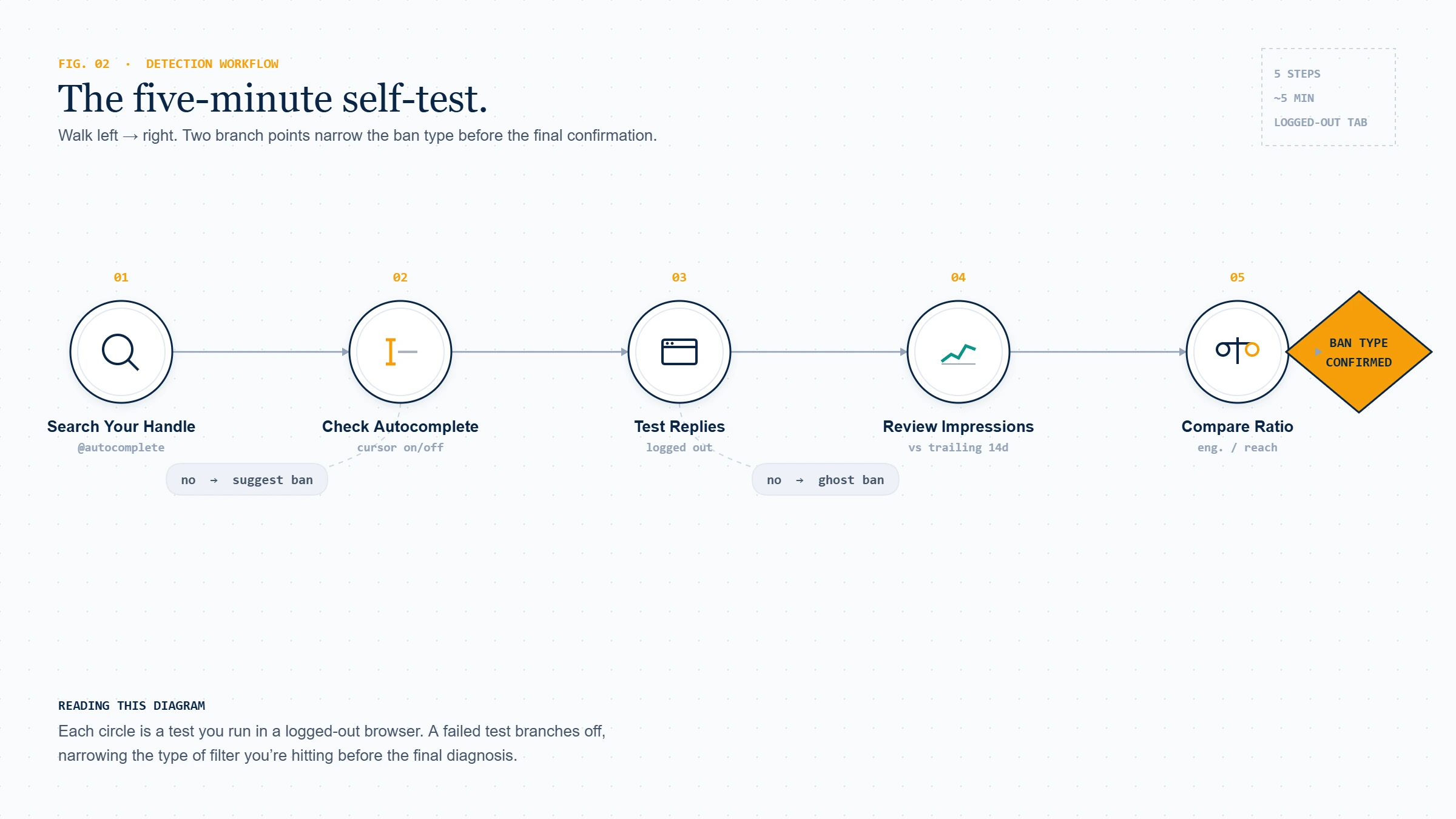
Run these checks from a logged-out browser session (open an incognito window or use a second device that is not signed in):
- Test handle autocomplete. In the X search bar, type the first 3-4 characters of your handle. If your account does not appear in the suggestion dropdown but smaller, similar handles do, you have at least a search suggestion ban.
- Test direct handle search. Type your full handle and press search. If your account appears, search ban is unlikely. If it does not appear at all, you have a search ban or worse.
- Test reply visibility. From your logged-in account, post a reply to a popular thread. Then open the same thread in your logged-out browser. If your reply sits under "Show more replies" or does not appear at all, you have reply deboosting or a ghost ban.
- Compare impressions ratio. In X Analytics (analytics.x.com), look at your last 30 days. A sudden 70%+ drop in impressions without a comparable drop in follower count or post frequency is a signal — but only a signal, not a confirmation.
If steps 1 and 2 pass but step 3 fails, the ban type is reply deboosting. If steps 1 through 3 all fail, it is a ghost ban. Cross-reference your result with a third-party checker tool such as shadowban.yuzurisa.com or hisubway.online — these query the public X API and confirm the diagnosis with a higher confidence than the manual test alone. Note that no checker is officially endorsed by X; the test is heuristic, not authoritative.
A common false positive: the team behind YRS account recovery work sees roughly 30% of "shadow ban" intake cases turn out to be normal algorithm fluctuation or a content-quality regression rather than active filtering. Diagnostic accuracy matters before you take corrective action that could make the throttling worse.
How to remove shadow ban on Twitter: the 5-step fix
Once you have confirmed the ban type, the corrective actions are specific and ordered. How to remove shadow ban on Twitter in May 2026 follows a five-step sequence — each step addresses a different layer of the visibility filter, and skipping forward without completing earlier steps will not accelerate recovery.
- Stop the triggering behavior immediately. Whatever caused the filter is almost certainly still active. Stop using the hashtag or keyword that may be flagged, stop following or unfollowing in bulk, stop posting at a rate above 30 tweets per hour, stop using third-party automation tools that hit the API outside approved endpoints. Recovery cannot begin while the trigger continues.
- Delete the most likely flagged tweets. Review your last 7 days of posts. Delete tweets that contain banned hashtags, NSFW content posted without sensitive-content flagging, mass-tag spam, or replies that violate the X Rules on platform manipulation or hateful conduct. The platform's published policy on platform manipulation and spam lists the specific behavior types its automated systems score against.
- Verify your phone number and email. Unverified accounts are scored as higher risk by default. Go to Settings → Your Account → Account Information, verify both, and add two-factor authentication via authenticator app (not SMS).
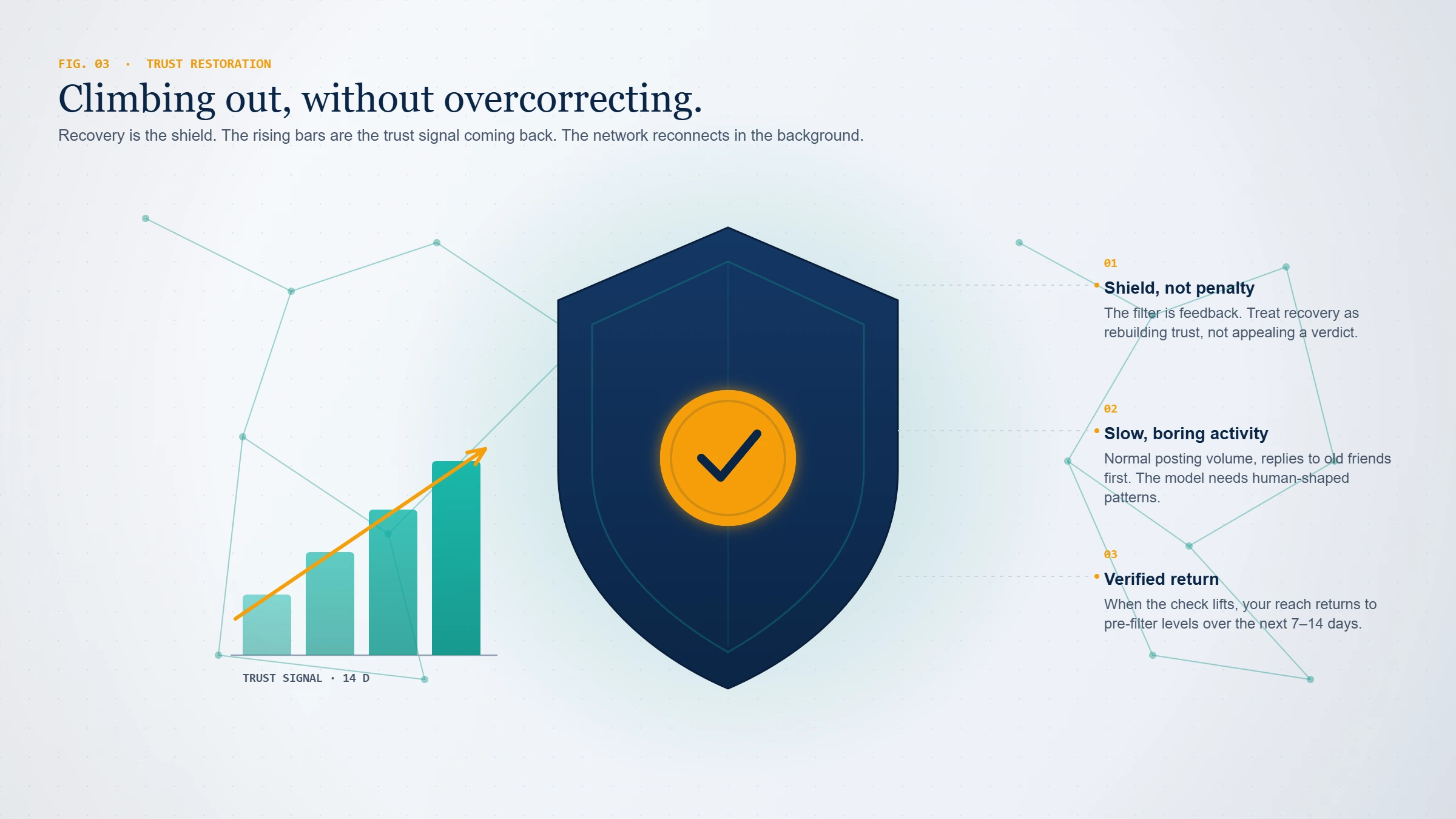
- Reduce posting velocity and rebuild trust signals. For the next 5-7 days, post no more than 5-10 tweets per day, do not retweet aggressively, do not bulk-follow, do not use trending hashtags. The goal is to demonstrate non-automated behavior. X's automated scoring updates on a rolling 7-day window in most cases.
- Submit a review request only for ghost bans or persistent filters. For mild and moderate filters, manual review usually slows recovery rather than accelerating it. For ghost bans persisting beyond 14 days, or any filter that does not respond to behavioral correction within 7-10 days, submit a help request at help.x.com/forms. Reference the specific filter symptom — do not ask "am I shadow banned" because X will not confirm the state.
How to remove Twitter shadow ban scenarios that fall outside these five steps are uncommon but important to recognize: if you have received a formal X Rules violation notice in the past 30 days, the filter is likely tied to that strike and will not clear until the strike expires (typically 7-30 days). In that case the only action is to wait and avoid further violations.
This is the section where most users get the question wrong: how to remove shadow ban from Twitter is not about cleverness or workaround tools. It is about reducing the platform's risk score back below the filtering threshold through verifiable trust signals — verified contact information, normal posting patterns, and clean Rules compliance. The platform does not want to filter you; it just wants confidence that you are a non-automated, policy-compliant account.
A note from our recovery team: If your filter has not cleared in 14 days after completing all five steps, that is the signal to escalate. Request a Twitter shadow ban consultation — our team reviews account-health signals and writes a focused review-request for severe filters, at no charge for the initial 60-minute session.
How to stop shadow banning on Twitter long-term
How to stop shadow banning on Twitter from recurring is a different question than how to get rid of shadow ban on Twitter once you already have one. Prevention requires sustained behavioral patterns that the platform's automated systems score as low-risk. The most-filtered behavior categories in 2026, ranked by frequency of YRS intake cases (n=189, January 2025 – May 2026):
- Banned hashtag use (38% of cases). X maintains an internal list of flagged hashtags that auto-filter the tweet, often without the user knowing. The list is not public. If a hashtag returns no results when searched in a logged-out session despite seeing it used elsewhere, treat it as banned.
- Aggressive follow / unfollow patterns (24%). Following more than ~50 accounts per hour or following-then-unfollowing within 24 hours triggers behavioral filters reliably.
- Mass DM activity (16%). Sending more than ~10 DMs per hour to accounts that do not follow you escalates risk score quickly.
- API-based automation (12%). Third-party tools that schedule, bulk-engage, or scrape via unapproved endpoints — even popular "growth" services — flag the account.
- Reported content (10%). Even unfounded reports affect the trust score temporarily. Accounts with 3+ active reports in a 30-day window enter heightened filtering.
How to avoid shadow ban Twitter going forward is mostly a matter of avoiding the five behaviors above and verifying every contact channel on the account. The recurring-incident rate among accounts that complete the five-step fix and adopt the prevention checklist drops to roughly 8% over 90 days, based on our follow-up audits.
Cross-platform note: the same trust-signal logic applies broadly. Our walkthroughs on how to fix Instagram shadow ban and reach limits, our YouTube unban playbook, and how to remove a Facebook account restriction follow similar patterns — verification, behavioral normalization, and Rules compliance — because the underlying Trust & Safety architecture across major platforms converged around 2022-2024. For e-commerce sellers also dealing with reach limits, our Marketplace restriction walkthrough addresses the specific algorithmic case there.
Shadow ban vs. Twitter suspension: which one do you have?
A frequent source of wrong-direction recovery effort is confusing a shadow ban with a suspension. The two states require fundamentally different actions, and applying the wrong fix can prolong the actual problem. Use the table below to identify your state.
| Signal | Shadow ban | Suspension |
|---|---|---|
| Can you sign in? | Yes | No (or yes but with a locked banner) |
| Is there a notification banner? | No | Yes |
| Can you tweet? | Yes | No |
| Does your profile appear to logged-out viewers? | Yes (mostly) | No |
| Did you receive an email from X? | No | Yes |
| Recovery path | Behavioral correction + wait | Formal appeal via help.x.com |
If your situation matches the right column, this guide does not apply — you are dealing with a suspension. How to remove Twitter shadow ban once confirmed begins with the five-step fix above; how to handle a full suspension begins instead with the formal appeal flow at help.x.com. Our companion guide on how to unban a fully banned Twitter account covers the appeal flow, the 280-character appeal text structure that X reviewers actually read, and the timelines you can expect for each suspension type.
If your situation matches the left column, you are dealing with a shadow ban and the five-step fix above is your path.
When professional escalation makes sense — and when to walk away from anyone promising removal
Remove shadow ban Twitter is one of the most-scammed search terms in the account-recovery niche. Services advertising "guaranteed shadow ban removal" for $50-200 are uniformly fraudulent: no third party — including legitimate reputation recovery services like ours — has any backchannel access to X's visibility filtering system. The platform's automated scoring is opaque and not subject to external API influence. Anyone claiming otherwise is either selling you a wait-and-watch ("the ban cleared on its own, here's our invoice") or, worse, asking for login credentials and selling the account afterward.
Our position is plain: we never ask for your password, your account API keys, or any form of platform access. We do not submit fraudulent reports, file false DMCAs, or attempt platform manipulation. We do not guarantee removal of any visibility filter — soft enforcement clears on the platform's timeline, not ours. What we do is help you diagnose the ban type, draft a focused review-request for severe filters where one is allowed, and build a relapse-prevention plan for accounts that have been filtered repeatedly. The full scope of what we can and cannot guarantee with shadow bans is documented in our disclaimer.
Professional escalation through our team makes sense in three narrow cases: (a) a ghost ban that has persisted beyond 14 days after behavioral correction, (b) a business or verified account where reach throttling has measurable revenue impact and the platform's standard support has not responded within 10 business days, or (c) recurring incidents (3+ in 12 months) suggesting a deeper account-health issue. Outside those scenarios, the five-step fix above is what we would tell a paying client to do — how to get rid of shadow ban on Twitter is, fundamentally, behavior-driven not service-driven, and there is no proprietary unlock.