
Can you delete someone else's Instagram account?
No. Not with a tool, not with a form, not with a paid service.
Deleting an Instagram account is an action bound to the login. The account holder can do it from their own settings, and Meta can do it after its own review. Those are the only two mechanisms that exist, and there is no third one waiting behind a paywall. When people search how do you delete someone else's Instagram account, what they actually want is the second mechanism, though they rarely know it has a name. Inside Meta it's called enforcement, and it starts with a report.
A report is not a vote. It's a request that a human or automated reviewer compare the account against the Instagram Community Guidelines and decide whether it breaches them. If it does, the account gets disabled or deleted. If it doesn't, nothing happens, regardless of who filed the report, how angry they were, or how many friends filed one too.
That's the honest shape of the problem. The rest of this page covers which reports carry weight, what evidence each one needs, how long Meta really takes, and why every "delete any account, no password needed" offer is either fraud or a felony. For the wider version covering posts, reels, stories and DMCA notices, our team maintains a fuller Instagram takedown walkthrough.
Which reports actually get an Instagram account removed?
Six. That is the practical list: six categories where Meta has a defined enforcement pathway and will act on a well-evidenced report filed by someone who is not the account holder.
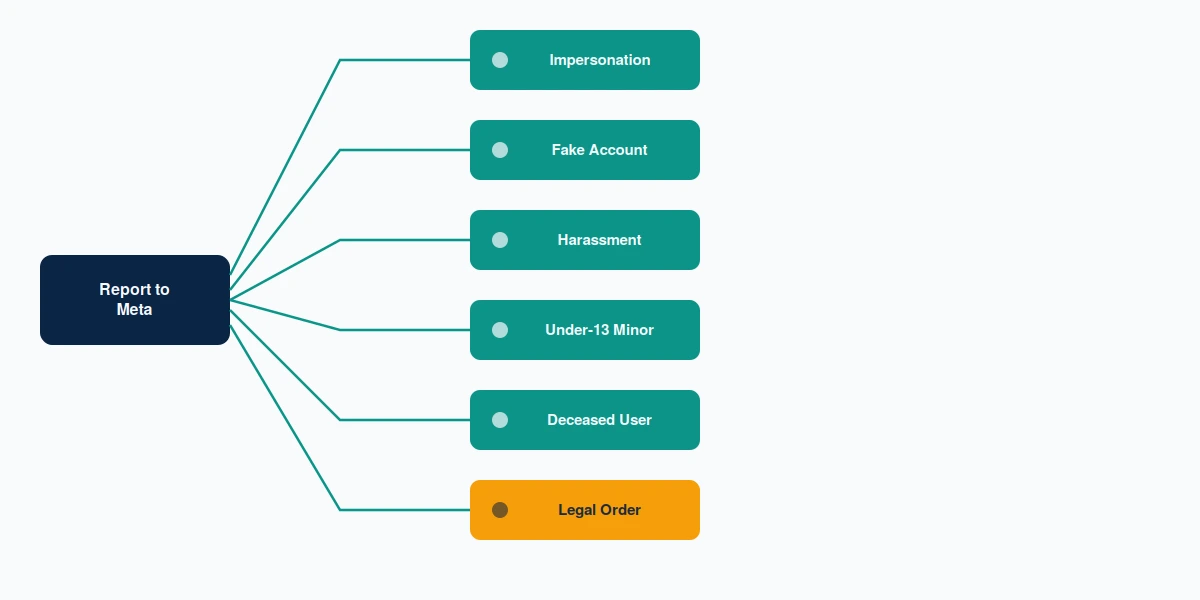
| Pathway | What it removes | Evidence Meta expects | Realistic first decision |
|---|---|---|---|
| Impersonation of you | The impersonating profile | Photo of your government ID, held in frame | 1–7 days |
| Impersonation of a brand | The profile or the infringing posts | Trademark registration number, business documents | 3–14 days |
| Fake, spam or scam account | The profile | Screenshots plus a visible behaviour pattern | 1–5 days, frequently automated |
| Harassment and bullying | Content first, profile after repeat strikes | Direct links to the specific posts, comments or DMs | 1–10 days |
| Account holder under 13 | The profile | Profile URL and a stated basis for the age claim | 3–21 days |
| Account holder has died | Memorialisation, or removal on family request | Obituary or death certificate; proof of immediate-family relationship for removal | 2–8 weeks |
Notice what is missing. "This is my ex." "This account posts things I find offensive." "This person owes me money." Reviewers work from the published Community Standards, and a grievance that maps to no policy line produces no action. Not slowly, not eventually, not at all. The same enforcement logic runs across Meta's properties, which is why the Facebook takedown process reads almost identically once you strip away the interface differences.
Search how to delete someone else's account on Instagram and roughly half the results will tell you to gather twenty friends and report together. That advice is wrong in a specific, testable way: Meta deduplicates. Twenty reports on one profile create one review queue item, not twenty. We wrote up the mechanics behind that in our breakdown of Instagram mass report bots and tools, because the myth is durable and the money people spend on it is not refundable.
The two pathways almost nobody finds
Rows five and six of that table are the ones readers miss, and they carry the highest action rates of the six.
If the account belongs to a child under 13, Instagram will act on a report from anyone. You do not need to be a parent, and you do not need an Instagram account of your own. The minimum-age rule exists because of the US Children's Online Privacy Protection Rule, which the FTC enforces directly against operators. Meta treats these reports as a compliance obligation rather than a community dispute, and that shows in the outcome data. The form asks for the profile URL and the basis for your age claim. A school year, a stated birthday in the bio, or a public post naming the child's grade all count as a basis. Vague suspicion does not.
When the account holder has died, there are two different requests and they produce opposite results. Memorialisation freezes the profile: it stays visible, "Remembering" appears above the name, and nobody can log in. Removal deletes it entirely, and Instagram will only process that request from a verified immediate family member. Memorialisation needs proof of death, usually an obituary link or a news article. Removal needs proof of death plus proof of relationship: a birth certificate, a marriage certificate, or a will naming you. Families routinely file for memorialisation, then discover months later that they wanted removal and have to start over with the heavier evidence pack.
How to delete someone fake account on Instagram
This is the pathway that works most reliably, so it's worth walking through with the actual menu labels rather than a paraphrase.
Open the fake profile. Tap the three dots at the top right, then Report, then Report Account. Instagram then offers two branches, and the branch you choose determines which review queue the case lands in:
- "It's pretending to be someone else" — for impersonation. You'll then pick whether it's pretending to be Me, Someone I follow, A celebrity or public figure, or A business or organisation. Choosing Me triggers the ID request.
- "It's posting content that shouldn't be on Instagram" — then Spam, or Scam or fraud. This is the branch for bot farms, catfish profiles built from stolen photos, and crypto-giveaway accounts.
Where the account is impersonating you and you cannot log in to Instagram yourself, use the web form for people without an account rather than the in-app flow. It exists precisely for that case, and it accepts an ID upload from a logged-out browser.
A note from our desk. When we file impersonation reports for clients, the single strongest predictor of a first-pass removal is not the wording of the complaint. It's whether the ID photo is legible, unobstructed, and shows the same name as the impersonated profile. Roughly a third of the rejections we've had to appeal traced back to a glare-blurred ID, not a weak case. Photograph it flat, in daylight, no fingers over the surname.
Across the 214 impersonation and fake-account reports our team filed on behalf of clients between January and June 2026, 61% produced a removal or a disable on the first submission (our internal case records, as of 30 June 2026). The median first decision arrived on day four. The slowest clean case took eleven days.
Does "permanently" mean anything here?
Yes, but not what most people assume, and the difference matters if you're the one being reported.
The phrasing that lands in our intake form more than any other is how to delete someone Instagram account permanently. There are three distinct end states hiding inside that word:
- Content removal — a single post, story or reel comes down. The profile survives.
- Disable — the profile goes dark and the holder gets an appeal window. Reversible.
- Deletion — the profile, its content and its username are gone. Not reversible by anyone, including Meta support and including us.
An account holder who deletes their own account gets a 30-day grace period before that third state locks in. An account Meta removes for a Community Standards breach does not get that cushion, and once it reaches a permanently disabled state the recovery odds collapse — we've written honestly about that ceiling in our guide to permanently disabled Instagram accounts.
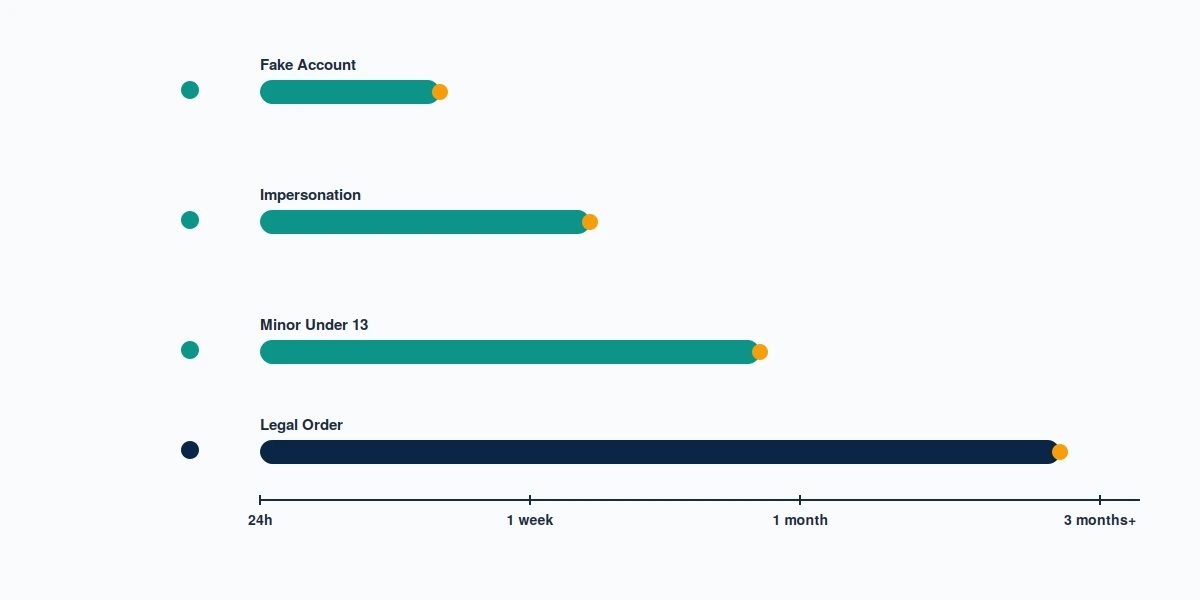
One more timing note. Meta expanded its Teen Accounts framework to Facebook and Messenger in April 2025, and the under-13 review path has tightened alongside it. Reports about a child's account now route to a specialist queue, which is slower on average but has a materially higher action rate than the generic fake-account queue.
Filing the same report for the fourth time will not speed it up. If a well-evidenced case has stalled past three weeks, that's an escalation problem, not a persistence problem — talk to our case team and we'll tell you honestly whether there's a route left.
How to delete someone else's Instagram account without password
There isn't one. Not a hard one, not an expensive one, not a secret one.
Every product marketed as a way to delete someone else's Instagram account without password falls into one of three buckets, and we've catalogued examples of all three:
- Pure theft. You pay, nothing happens, the seller blocks you. This is the most common outcome by a wide margin.
- Credential phishing. The "tool" asks for your Instagram login as a verification step, then sells or resells the account it just harvested. Our review of Instagram ban services walks through the exact scripts these operators use.
- Actual intrusion. A small number genuinely attempt to break into the target account and delete it from inside. In the United States that is unauthorised access under 18 U.S.C. § 1030, a federal offence, and the person who commissioned it is exposed alongside the person who did it.
The automated variants get sold hardest. A spam report bot that fires two thousand reports at a profile does not create two thousand review events — it creates one, flagged as coordinated, which reviewers are trained to weight down. Buyers routinely make the target's position stronger and their own weaker in the same transaction.
Nobody at Your Reputation Solution will ever ask you for an Instagram password. Not ours, not yours, not the target's. A service that asks has already told you what it is.
What we won't do — and what to do when a report is rejected
We take impersonation, harassment, fake-brand and deceased-account cases. We do not take cases where the goal is removing a real person's real, policy-compliant account, because no legitimate route to that outcome exists and pretending otherwise would just be selling hope. We don't file DMCA notices over content we don't have rights to, we don't guarantee removal on any timeline, and we don't run mass-report campaigns. Those limits are written down on our service disclaimer rather than buried in a footnote, and they're the same limits we'd want a stranger to state to us.

When a genuine report comes back rejected, there are four real moves left. Refile with better evidence: a legible ID, dated screenshots, the specific post URLs rather than a general description. Report the individual violating posts separately, since content-level strikes accumulate against the profile even when the profile-level report fails. For identity theft that has moved off-platform, file at IdentityTheft.gov and attach the report number to your next submission; it changes how the case reads. And where there's an ongoing criminal matter, a law-enforcement request reaches a queue that consumer reports never touch.
Removal is also not the end of the work, which surprises people. When a fake profile disappears, the copies of its content that other users saved, reposted or screenshotted stay where they are, and the search results that indexed the profile while it was live can persist for weeks. Google recrawls a dead Instagram URL on its own schedule, and a cached impersonation page has outlived the account it pointed at in several of our cases. Plan for two phases: the platform action first, then the cleanup of everything the platform action doesn't reach. The second phase is usually longer than the first and it is where most people stop too early.
If the fake profile is finally removed and it was squatting on your name, the handle does not automatically transfer to you. That's a separate request with its own evidence burden, and we cover it in our guide to claiming an Instagram username.
What if the account that got deleted was yours?
This page gets read from both directions, and the reverse case deserves a straight answer too.
If your own account was disabled after a wave of coordinated reports, the recovery path depends almost entirely on whether Meta's reviewer found a real policy breach or acted on volume. Coordinated-report disables are appealable and frequently reversed, because the underlying evidence doesn't survive a second look. Genuine breaches are not. We set out the realistic odds and the 24–72 hour window that matters most in our guide to recovering a deleted Instagram account.
People arriving here asking how to delete someone else's Instagram account and people arriving here because someone tried to delete theirs are, in our casework, roughly the same size group. If you're in the second group, our Instagram account recovery service starts with a free assessment and an honest answer about whether the case is winnable — including when it isn't.