
Does a report count decide anything on Facebook?
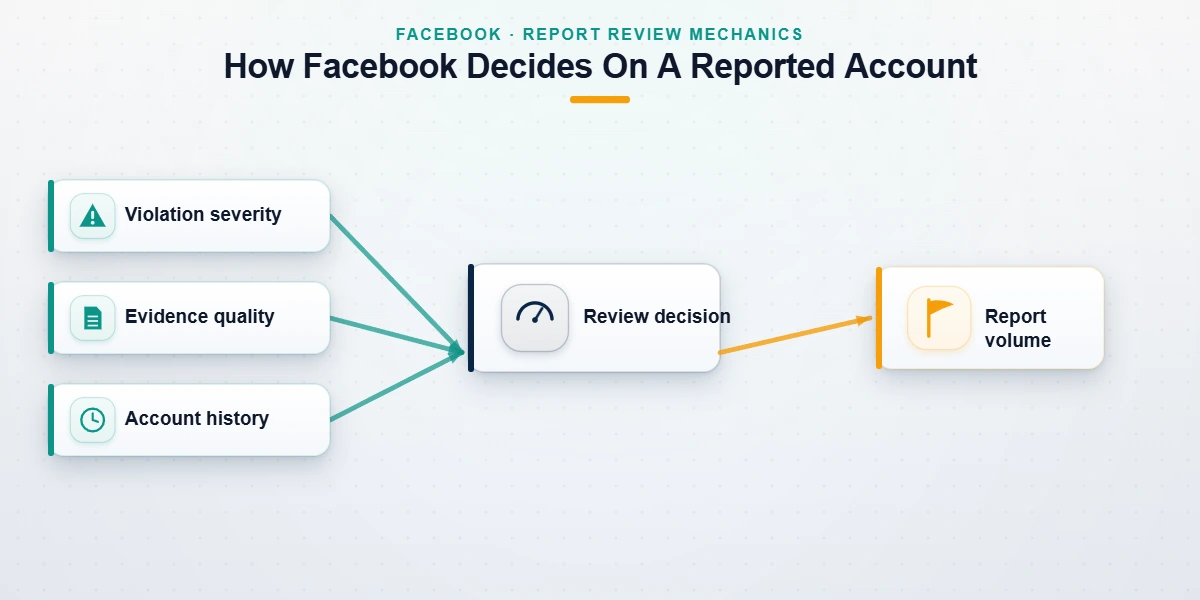
No. Meta's published enforcement criteria describe conduct, content and admin behaviour, and none of them contains a number of complainants.
Picture the usual sequence. Someone falls out with a seller, a neighbour or a rival community, a group chat agrees to pile on, and two hundred people press the same button within an hour. That burst is what a facebook mass report means in practice: many separate submissions aimed at one target over a short window. Each one reaches a review that asks whether the thing in front of it breaks a named Community Standard. A hundred complaints about a compliant holiday photo end where one would have ended, and a single accurate complaint about a real threat can succeed alone.
Searchers phrase this as how to mass report a facebook account, how to mass report facebook account or how to mass report on facebook, and those phrasings hide the variable that matters. Facebook has four reportable surfaces, and each is judged on a different test.
Your Reputation Solution is an account recovery and online reputation firm that files evidence-backed reports and appeals through Meta's own channels, and it does not sell volume. So does mass reporting work on facebook? Only in one narrow sense: since 7 January 2025, Meta has said that in less severe policy areas it will wait for a report before taking action, so a first report can open a review that would otherwise never start. Facebook mass reporting adds copies to that review and no new facts.
Four surfaces, four different tests
| Surface | What review looks at | Where a genuine report starts |
|---|---|---|
| Personal profile | The strike record built from that person's own violations | The three-dot menu on the profile, under the standard actually broken |
| Page | Name, description, cover photo, and repeated violating material from admins | Options under the cover photo, then Report Page |
| Group | The Page test, plus whether admins or moderators approve a member's violating post | Options under the cover photo, then Report group |
| Post, photo or comment | That one item against one standard | The item's own three-dot menu, then Report |
Work out your row first, because every later step depends on it. A complaint about a hostile comment section is a complaint about the commenters, however loudly it names the Page. Appeal deadlines split along the same lines, which the section on report waves covers below.
When Your Reputation Solution opens a Facebook file, the first question is which of the four is the real target. People often name the profile when the harm sits in one post, or name a group when the harm comes from a single member. Getting that wrong sends a true complaint to a test it cannot pass.
How can a profile lose its account if reports don't count?
Through strikes, which Meta records against violations the profile itself committed. The published restriction ladder begins with a warning at strike one and limits specific features, such as posting in groups, from strikes two to six. Content creation is then blocked for one day at strike seven, three days at eight, seven days at nine, and thirty days from the tenth strike onward. Dangerous organisations and other severe areas add longer restrictions on top. The problem for a buyer is plain: an outsider's complaint can only become a strike after a reviewer confirms a violation, so the mass report facebook account plan needs the target to have broken a rule anyway. Where that is true, one filing was enough. Where it is false, every copy closes the same way, and the account's record stays exactly as it was before the campaign began.
Real breaches deserve a proper filing rather than a crowd, and the walkthrough on reporting a genuine Facebook violation covers it.
Can reports take down a Facebook Page?
Only if they describe something the Page itself did. Meta's note on removing Pages and groups limits the grounds to a violating name, description or cover photo, or to admins creating violating posts, comments or rooms as a repeated pattern. People researching how to mass report a facebook page tend to skip that word "repeated", and it matters: one bad post normally costs the post, while a run of them can cost the Page. A mass report facebook page drive changes none of those inputs. Visitors can fill a thread with abuse and the Page's own record stays clean, since those comments count against the people who wrote them.
Your Reputation Solution therefore builds Page cases around dated examples of admin-authored material, because that is what the criterion can read. For the wider map of grounds, see what actually gets a Facebook asset removed and the pillar on legitimate Facebook removal routes.
What does a facebook mass report tool actually do?
It presses Report repeatedly, and that is the whole product. Listings rotate the label: a facebook mass report bot here, a facebook mass report script there, a facebook mass report service with a Telegram handle, a mass report bot facebook panel, a mass report facebook bot on a forum. Underneath, each one loops the same form through accounts the operator controls, or through yours if you hand over a login.
Hold any listing against the table above. To disable a profile it would have to create violations on that profile. Unpublishing a Page would require rewriting the Page's name or its admins' posts. Closing a group would need its moderators to approve something. A script sitting outside the account can do none of those things, however well it is coded, and sellers rarely address that gap.
What they offer instead is a removal percentage and a delivery window. Be suspicious of both: this page's author found no Meta document publishing a figure of that kind, and vendors do not say where theirs come from. Pricing and the rest of that storefront are taken apart in what a paid Facebook ban service really delivers, and browser add-ons get the same treatment under auto FB report extensions.
Your Reputation Solution refuses this category outright. It does not submit reports in bulk, does not take work aimed at removing a lawful account, and will never request a password, login code or two-factor prompt, since none of those plays any part in an appeal. The limits on every case are public, as are the people who apply them. If a seller took your money and sent screenshots, the FTC accepts that complaint.

Which outcomes can anyone realistically get?
Most of them have a condition attached, and the condition is never a headcount. The table sorts common goals by what would have to be true first.
| Goal | Realistic? | What must already be true |
|---|---|---|
| One post removed | Yes | It breaks a named standard, and someone reports it under that standard |
| A profile permanently disabled | Conditional | Accumulated strikes from its own conduct, or a severe violation |
| A Page unpublished | Conditional | A violating name, description or cover photo, or repeated admin violations |
| A group closed | Conditional | Leaders post or approve violating content |
| A lawful rival removed | No | Nothing qualifies, and organising to try is itself a policy breach |
| A wrongly actioned asset restored | Yes, on a deadline | An appeal filed inside the 30-day or 180-day window |
Two rows deserve a second look. The first is the one most people actually need, since the harm usually sits in a specific post or message, and removing it does not require anyone's account to disappear. Row five is where most buyers are, whether they admit it or not: a competitor, an ex-partner or a critic who has posted nothing unlawful. No filing changes that position.
Your Reputation Solution keeps its filings short for that reason, since a reviewer has limited time per case. A strong report names the standard, points to the exact item, and states the harm in a sentence or two where a form allows free text. Screenshots with visible dates protect you if the content vanishes before a review ends, and they become the backbone of any later escalation. Filing the same complaint again from a friend's account adds no evidence, so spend that effort on checking the category instead. When a report closes without action, the category is the first thing to question, because impersonation and intellectual property claims run through separate forms that ask for proof of identity or ownership.
Has Meta's 2026 move to AI moderation changed the picture?
Nothing Meta has published turns report volume into a test, though more first decisions and appeals are now automated. Meta said in March 2026 that AI would take more of the work of judging rule-breaking accounts and handling appeals, and by July a petition asking for human review had passed 60,000 signatures, while a spokesman claimed 13% fewer mistakes than human staff (The Next Web, 22 July 2026). Outsiders cannot audit that figure. Meta's integrity reporting does show errors arriving from a different direction: false positives more than doubled for a very brief period in Q4 2025 because of a bug (Integrity Reports, updated 19 March 2026). A fault of that kind lands wherever it lands. No buyer can steer it, and a seller who screenshots the fallout is claiming an accident as a delivery.
The governance debate moved too. On 4 June 2026 the Oversight Board upheld a permanent ban on an Instagram account over severe threats, then raised concerns about due process and rules scattered across pages that sometimes contradict one another (AFP via Arab News). Instagram was the case, but those account rules are shared across Meta, so Facebook users should save every notice they receive. Your Reputation Solution treats those notices as the core record of a case, since a later appeal has little else to stand on.
Facebook mass reporting of groups: why admins are the test
Are there mass reportings of groups on facebook? Yes, and campaigns are organised openly, but closure depends on what the group's own leadership does. Facebook mass reporting of groups aims at a surface with one extra clause: alongside the Page criteria, Meta can act when an admin or moderator approves a member's violating content. That lever belongs to the people running the group. A mass report facebook group push from outside cannot pull it, so a well-moderated community can absorb a wave, while a badly moderated one was already exposed before anyone organised.
Scale misleads people here. In June 2025 thousands of groups were suspended together, including parenting, pet, gaming and deals communities, and Meta told TechCrunch that a technical error was responsible and being fixed. Many admins blamed report campaigns at the time. The company's stated cause was its own systems.
Administrators have a practical tool for this. Group status, in the left menu, lists each removal with its cited policy. Open See details, then Request review, inside 30 days of the removal or closure. Your Reputation Solution asks group admins for that screen first, because it shows whether moderators approved the item in question.
Hit by a report wave? Find your clock first
Your deadline depends on the asset, and it is the one thing here that cannot wait. A suspended personal profile has 180 days to request review; Meta's help page says that missing the window, or failing the review, makes the disablement permanent. A removed group or removed group content has 30.
Save the notice, its date and the policy wording in one place, then appeal against exactly that wording, because an argument about a different rule answers nothing. Stay out of the hostile thread where a mass report facebook campaign is being cheered on; a reply there gives reviewers fresh material on your own surface. And hold off on a replacement profile during an appeal, since Meta can read it as evasion.
Refused inside the EU? Anyone located there can take the decision to Appeals Centre Europe within six months, at no current user fee. From April 2025 to March 2026 it received more than 5,000 eligible suspension disputes, ruled on the actual content in fewer than 150, and issued the rest as default decisions for the user because platforms sent nothing (report summary, 28 May 2026). Rulings are non-binding, and its FAQ says restoration cannot be assured. Separately, the European Commission preliminarily found in October 2025 that Meta's appeal channels do not let EU users fully explain themselves, a finding Meta disputes.
Disabled rather than restricted? Follow unbanning a Facebook account or Facebook disabled account recovery. Lost Business Manager access is a separate job, handled in the business account recovery guide.
Counting days on a Facebook notice? Your Reputation Solution reviews the case free: send the notice date and the asset it hit, and you get a straight read on the time left and whether an appeal has grounds. Meta makes the final decision on every filing.

Who carries the risk when reporters are organised?
The organisers do. Meta's Inauthentic Behavior policy, last updated 11 December 2025, bars anyone who would "misuse Meta reporting systems to harass, intimidate or silence others". Honest reporters are safe under that wording: filing twice, or reporting something later judged compliant, is not the offence. Purpose is.
History shows it enforced. Meta's threat report of December 2021 described a network in Vietnam filing "hundreds, in some cases thousands, of complaints" against government critics, and removed it. A year earlier, Facebook suspended 103 Pages, 78 Groups, 453 accounts and 107 Instagram accounts tied to a Pakistan-based operation that urged followers to report critics, as Stanford researchers documented. Both times the takedown fell on the reporters.
Whoever buys a campaign also leaves a trail: a payment, a chat log, sometimes a login typed into a stranger's panel, and any of those can outlast the campaign. Legal exposure varies by country, and sustained targeting of one person can meet local harassment definitions even when it runs through a report form; this is general information rather than legal advice.
A practical rule survives all of this. Name the surface, read its test, file once under the standard actually broken, and watch your deadline if the action landed on you. Instagram runs on the same reasoning, as the page on mass report Instagram account bots sets out.